Lessons from Paul Bloom
Cognitive psychologist Paul Bloom researches how people make moral judgments and experience pleasure. He famously argues that empathy is a poor moral guide and that we should rely on rational compassion instead. This collection covers his core ideas on how the mind works, explaining why we value authenticity and actively choose to struggle.
Part 1: The Limits of Empathy
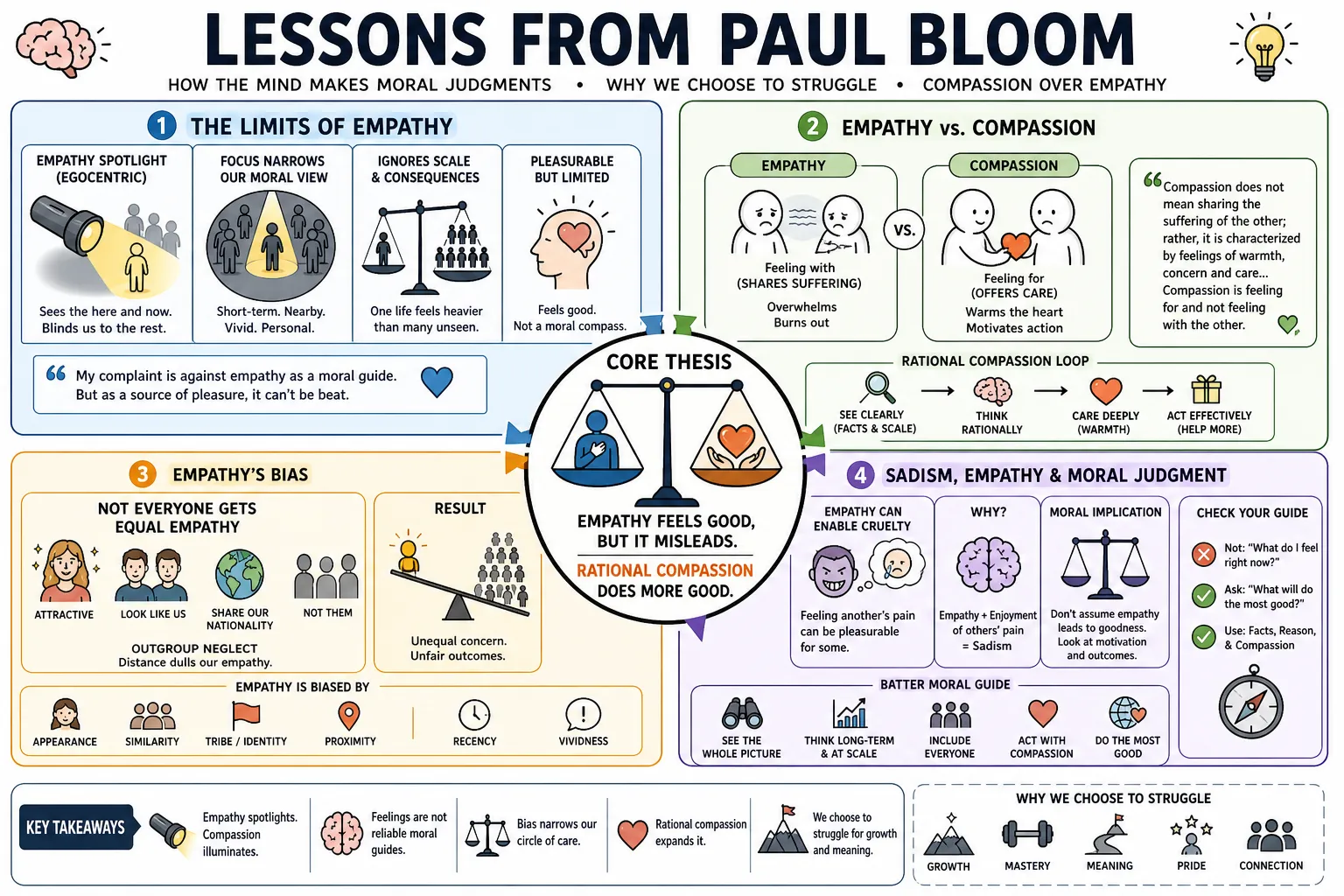
- On Empathy vs. Compassion: "Compassion does not mean sharing the suffering of the other: rather, it is characterized by feelings of warmth, concern and care... Compassion is feeling for and not feeling with the other." — Source: [Against Empathy]
- On the Spotlight Effect: Empathy acts like a spotlight that illuminates specific individuals in the present moment, rendering us blind to the long-term consequences of our actions and the suffering of those outside the beam. — Source: [Against Empathy]
- On Empathy's Bias: "Empathy is biased; we are more prone to feel empathy for attractive people and for those who look like us or share our ethnic or national background." — Source: [Against Empathy]
- On Moral Guidance: "My complaint is against empathy as a moral guide. But as a source of pleasure, it can't be beat." — Source: [Against Empathy]
- On Sadism and Empathy: "If you made a sadist more empathic, it would just lead to a happier sadist." Empathy only produces good outcomes when it connects to preexisting kindness. — Source: [Against Empathy]
- On Averting Our Gaze: "When empathy makes us feel pain, the reaction is often a desire to escape." It motivates us to make the suffering disappear from our sight, rather than actively solving the underlying problem. — Source: [Against Empathy]
- On Numerical Blindness: Empathy is intensely aroused by a single suffering child, but goes numb when confronted with the statistical reality of thousands or millions suffering. — Source: [Against Empathy]
- On Policy Making: Because it is easily manipulated and inherently prejudiced, empathy serves as a poor foundation for social policy, reliably leading to decisions that favor the visible few over the invisible many. — Source: [Against Empathy]
- On Anger and Retribution: Feeling the pain of victims can easily curdle into violent anger and disproportionate demands for retribution against perceived perpetrators. — Source: [Against Empathy]
- On Rational Compassion: We should strive for a cooler, more distanced form of caring that uses reason and cost-benefit analysis to figure out how to do the most practical good. — Source: [Against Empathy]
Part 2: The Origins of Morality
- On Innate Morality: "Certain moral foundations are not acquired through learning. They do not come from the mother's knee." We are born with a basic moral sense. — Source: [Just Babies]
- On the Complexity of Human Nature: "We have a moral sense that enables us to judge others and that guides our compassion and condemnation. We are naturally kind to others. But we possess ugly instincts as well." — Source: [Just Babies]
- On Infant Evaluation: Very young babies demonstrate an ability to evaluate the actions of others, consistently preferring those who help over those who hinder long before they can walk or talk. — Source: [Just Babies]
- On Parochial Altruism: Our innate kindness is largely restricted to our ingroup. We are naturally suspicious of outsiders and selectively generous to family and allies. — Source: [Just Babies]
- On Invisible-Hand Egalitarianism: "The egalitarian lifestyles of hunter-gatherers exist because the individuals care a lot about status. Individuals in these societies end up roughly equal because everyone is struggling to ensure that nobody gets too much power." — Source: [Just Babies]
- On Fairness: Children have a deep-seated instinct for fairness, sometimes preferring that an uneven number of rewards be thrown away entirely rather than distributed unequally. — Source: [Just Babies]
- On the Role of Reason: While we start with biological moral instincts, our moral progress as a species is driven largely by intelligence, logical consistency, and expanded contact with others. — Source: [Just Babies]
- On Kin Selection: Evolution has wired us to care deeply for our relatives because they share our genes, establishing the biological bedrock of our earliest moral impulses. — Source: [Just Babies]
- On Retribution: Even preverbal toddlers show an instinct for punishment, preferring to see bad actors penalized for their anti-social behavior. — Source: [Just Babies]
- On Moral Expansion: "The expansion of our moral circle is a product of our intelligence." We use deliberate reason to override our narrow biological programming. — Source: [Just Babies]
Part 3: The Psychology of Pleasure
- On Human Essentialism: "Pleasure is deep. What matters most is not the world as it appears to our senses. Rather, the enjoyment we get from something derives from what we think that thing is." — Source: [How Pleasure Works]
- On the Origins of Art: "Much of the pleasure that we get from art is rooted in an appreciation of the human history underlying its creation. This is its essence." — Source: [How Pleasure Works]
- On Forgery: "Forgery is just the most dramatic example of the importance of origin. When she later discovered that it was an original by Picasso, she displayed it more prominently, claimed that she saw it differently, and enjoyed it more." — Source: [Descartes' Baby]
- On Imagination: "The pleasures of the imagination are parasitic on the pleasures of real life." — Source: [How Pleasure Works]
- On Uniquely Human Tastes: "Man is the only animal that likes Tabasco sauce." We can learn to enjoy things that signal pain or danger through a uniquely human cognitive trick. — Source: [How Pleasure Works]
- On Authenticity: We value authenticity so highly that an identical physical replica of an object is worth vastly less to us than the original, even if we cannot perceive any sensory differences. — Source: [How Pleasure Works]
- On Food and Belief: The taste of food is measurably altered by our beliefs about its origins, meaning wine genuinely tastes better to our brains when we believe it is expensive. — Source: [How Pleasure Works]
- On Sexual Attraction: Our sexual desires are deeply essentialist, driven heavily by our beliefs about a person's unseen qualities and history rather than just their physical geometry. — Source: [How Pleasure Works]
- On Mate Preferences: "In the largest study ever of human mate preferences, looking at people in 37 cultures, the most important factor for both men and women is kindness." — Source: [How Pleasure Works]
- On Consumer Goods: The joy we extract from everyday objects is inextricably linked to our beliefs about their hidden nature, craftsmanship, and brand history. — Source: [How Pleasure Works]
Part 4: The Pursuit of Meaning and Suffering
- On the Function of Boredom: "Boredom is a cue that needs aren't being met. It's a signal that your environment lacks interest, variety, and newness. To be without boredom would be a curse." — Source: [The Sweet Spot]
- On the Illusion of Constant Bliss: "We are not built to be happy. Evolution doesn't want us to be in constant bliss any more than it wants us to be pain-free. Pain is information about what's wrong." — Source: [The Sweet Spot]
- On the Necessity of Struggle: "A good life involves more than just pleasure. Suffering is essential too. The activities that provide most satisfaction are often the ones that involve greatest sacrifice." — Source: [The Sweet Spot]
- On Life as a Story: We evaluate our lives as narratives. A life without suffering, like a fictional movie without conflict, feels fundamentally empty and devoid of meaning. — Source: [The Sweet Spot]
- On Chosen Suffering: Humans actively seek out hardship because chosen suffering enhances the pleasure that follows and grounds life with a sense of accomplishment. — Source: [The Sweet Spot]
- On the Martyrdom Effect: "Suffering is valuable, but only when it's seen as essential for a positive result." People attach higher moral value to charitable acts that require personal pain. — Source: [The Sweet Spot]
- On Meaning vs. Happiness: Raising children often decreases day-to-day happiness and increases stress, yet parents reliably report that the struggle gives their lives a profound sense of meaning. — Source: [The Sweet Spot]
- On Contrast: "We are temporal creatures, and our suffering and our pleasure and our pain, we like them best in a certain order." Pleasure is heightened when it follows deprivation. — Source: [The Sweet Spot]
- On Flow: The optimal state of human experience occurs when we are pushed to the very edge of our abilities, requiring an intense level of focus and physical or mental struggle. — Source: [The Sweet Spot]
- On Benign Masochism: We enjoy terrifying movies and sad songs because we have the cognitive ability to know we are safe, allowing us to playfully engage with negative emotions. — Source: [The Sweet Spot]
Part 5: Dualism and the Human Mind
- On Innate Dualism: "The premise of this book is that we are dualists who have two ways of looking at the world: in terms of bodies and in terms of souls." — Source: [Descartes' Baby]
- On the Concept of Self: "A direct consequence of this dualism is the idea that bodies and souls are separate. And from this follow certain notions that we hold dear, including the concepts of self, identity and life after death." — Source: [Descartes' Baby]
- On the Persistence of Religion: Our natural tendency to view the mind as separate from the physical body makes beliefs in spirits and an afterlife intuitively appealing to the human brain. — Source: [Descartes' Baby]
- On Objects vs. Agents: From a very young age, human brains process inanimate physical objects fundamentally differently than they process intentional agents like people and animals. — Source: [Descartes' Baby]
- On Perceiving Design: We have a strong cognitive bias to see design and intention in the natural world, which primes us to believe in a conscious creator. — Source: [Descartes' Baby]
- On the Soul: Even secular adults often operate as implicit dualists, speaking of "my brain" or "my body" as if the self is a separate entity inhabiting a physical shell. — Source: [Descartes' Baby]
- On Mind-Body Disconnect: Our intuitive dualism makes it difficult for us to fully accept the scientific reality that our consciousness and personalities are entirely the product of physical brain tissue. — Source: [Descartes' Baby]
- On Empathy's Mechanics: Our ability to understand other minds relies on an intuitive assumption that others possess an internal, unobservable mental state separate from their physical actions. — Source: [Descartes' Baby]
- On Art and Intent: When evaluating a piece of art, our dualistic nature leads us to care less about the physical pigments on the canvas and more about the invisible mental intent of the artist. — Source: [Descartes' Baby]
Part 6: Language, Thought, and Psychology
- On the Scope of Psychology: "If you're looking for a word to refer to the process of coming to know things through exposure to the right sort of information in the environment, I'd recommend 'learning.'" — Source: [Psych]
- On Intuition: "We're tremendous statistical learners. We put together data all the time, and this is the origin of all sorts of beliefs and gut feelings. It guides us in a way that conscious rational thought can't." — Source: [Psych]
- On Dead Theories: "Of all dead psychological theories, catharsis is the deadest." Venting anger does not reduce it; it rehearses and amplifies it. — Source: [Psych]
- On Linguistic Determinism: "Language doesn't just change minds by transferring thoughts from one head to another; it configures how people make sense of the world, including about space, time, and causality." — Source: [Psych]
- On Perception: "We don't see the world as it is, we see it as we are." Our perception is heavily filtered through our specific expectations and prior experiences. — Source: [Psych]
- On the Unconscious: Much of what we do is driven by unconscious processes, but rather than a dark basement of repressed urges, the modern unconscious is viewed as a highly efficient information processor. — Source: [Psych]
- On Memory: Memory is not a video recording; it is a reconstructive process that is highly prone to error, suggestion, and revision every time a memory is recalled. — Source: [Psych]
- On Talk Therapy: "Talk therapy often works, but not always, and usually not quickly. And nobody quite knows why it works." The mechanism of therapeutic change remains somewhat mysterious. — Source: [Psych]
- On Habit: Following William James, psychology shows that habit is essential for survival; if we had to consciously deliberate every minor action, we would be paralyzed by indecision. — Source: [Psych]
Part 7: Human Nature and Rationality
- On Moral Signaling: "We don't give to the poor or abstain from eating meat because we see these acts as good in themselves; rather the propensity to engage in such acts has evolved as a costly signal of our fairness and our kindness." — Source: [Against Empathy]
- On Empathy as Status: In modern discourse, expressing high degrees of empathy is often used as a status signal to demonstrate one's moral superiority rather than a practical tool for solving problems. — Source: [Conversations with Tyler]
- On Doing Bad for Bad's Sake: Sometimes human motivation defies rational self-interest, as people choose to do wrong things simply because they are wrong, exercising a rebellious autonomy. — Source: [NPR Interviews]
- On Love: "Love is a gross exaggeration of the difference between one person and everybody else." — Source: [Just Babies]
- On Childhood Sins: "With the notable exception of lust, my son had committed each of the seven deadly sins by the time he had his fourth birthday." Human nature contains both deep light and profound darkness from the beginning. — Source: [Descartes' Baby]
- On Manipulating People: Despite studying the mechanics of the mind, psychologists have no special superpower to manipulate or instantly read the thoughts of others. — Source: [Conversations with Tyler]
- On Rational Override: We are not slaves to our passions; we possess the cognitive capacity to recognize our own biases and design systems and laws that override them. — Source: [Against Empathy]
- On Effective Altruism: The most ethical approach to charity relies on data and reason to maximize impact, actively resisting the emotional pull of ineffective but heartwarming causes. — Source: [Against Empathy]
- On the Power of Reason: While emotions serve as the engine that motivates action, reason must function as the steering wheel if we want our actions to actually improve the world. — Source: [Against Empathy]
Part 8: Belief, Bias, and the Mind
- On Reinforcement: "If you want to teach something quickly, reinforce it every time. But if you want it to stick once the teaching phase is over, reinforce it occasionally." Variable reward is a powerful driver of behavior. — Source: [Psych]
- On Ingroup Favoritism: Our tendency to favor our own group over others is an evolutionary adaptation that once kept us safe but now drives the tribalism seen in modern politics. — Source: [Just Babies]
- On Purity and Disgust: Disgust evolved to protect us from pathogens, but it has been co-opted by our moral psychology, leading us to condemn behaviors simply because we find them aesthetically repulsive. — Source: [Just Babies]
- On Moral Dumbfounding: People often have strong moral reactions to victimless taboos but cannot articulate a logical reason for their feeling, proving that intuition often precedes reasoning. — Source: [Psych]
- On Essentialist Biases: Our deep-seated belief that things have hidden essences can lead to stereotyping, as we mistakenly assume that all members of a group share a fixed internal nature. — Source: [How Pleasure Works]
- On Artificial Intelligence: As AI becomes more sophisticated, our intuitive dualism will inevitably lead us to assign consciousness, intention, and even moral rights to non-biological systems. — Source: [Making Sense Podcast]
- On Overcoming Biology: The great triumph of humanity is that we are not bound by our evolutionary programming; through culture and science, we can expand our moral circle beyond our kin. — Source: [Just Babies]
- On the Study of the Mind: Psychology is ultimately the project of trying to understand the most complex object in the known universe, the human brain, from the inside out. — Source: [Psych]