Lessons from Paul Orfalea
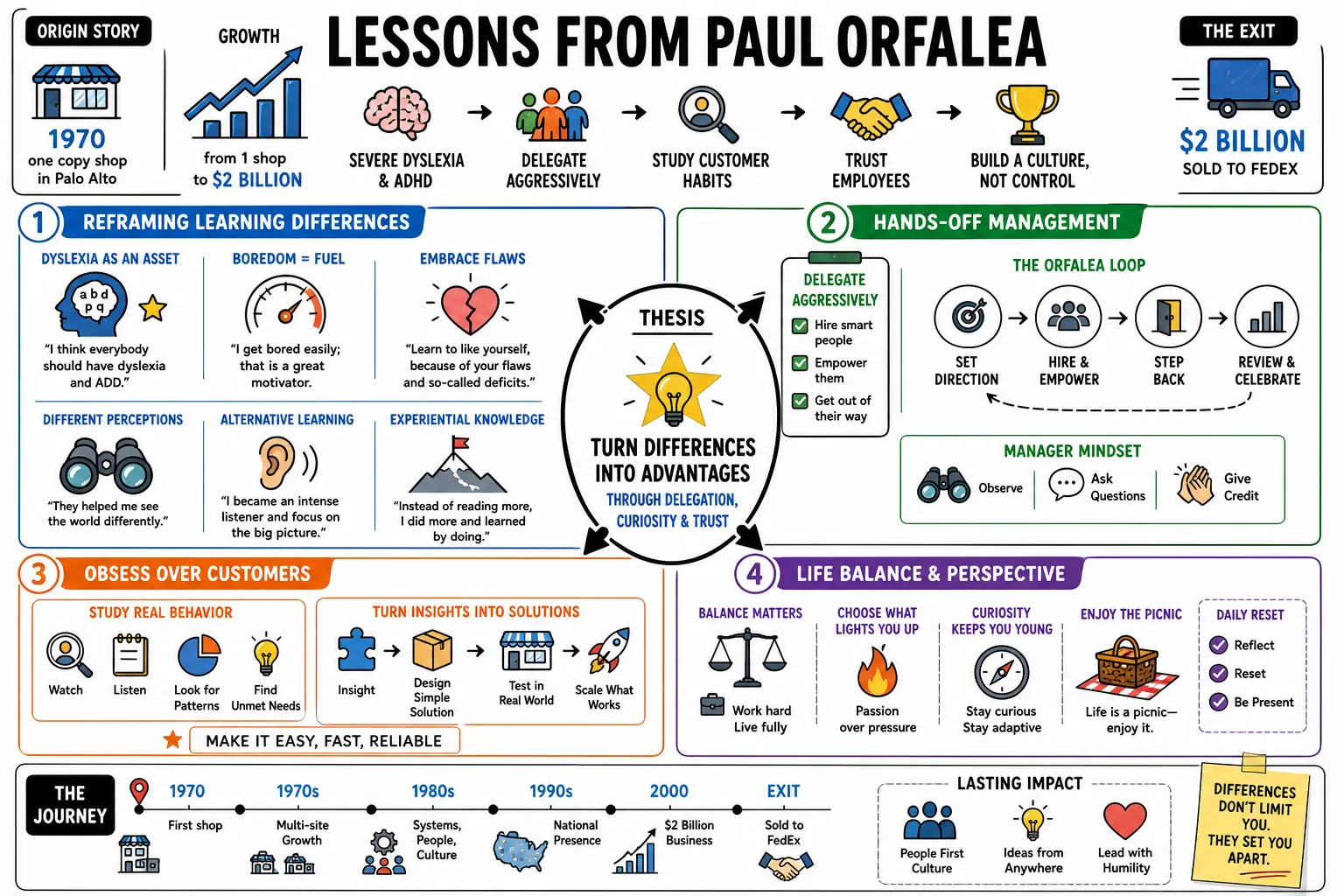
Paul Orfalea started Kinko's as a single copy shop in 1970 and grew it into a $2 billion business before selling to FedEx. He viewed his severe dyslexia and ADHD as distinct advantages that forced him to delegate aggressively, study customer habits, and trust his employees. This profile gathers his advice on unconventional learning, hands-off management, and life balance.
Part 1: Reframing Learning Differences
- On Dyslexia as an Asset: "I think everybody should have dyslexia and ADD." — Source: [AZQuotes]
- On Boredom: "I get bored easily; that is a great motivator." — Source: [AZQuotes]
- On Embracing Flaws: "If you're going to enjoy the picnic that life really is, you'd better learn to like yourself, not despite your flaws and so-called deficits, but because of them." — Source: [Edge Foundation]
- On Different Perceptions: "My learning differences didn't hold me back—they helped me see the world differently. Sometimes, that's all it takes to turn an idea into a revolution." — Source: [Copy This!]
- On Alternative Learning: "Struggling with reading meant I couldn't rely on textbooks; instead, I trained myself to be an intense listener and focus on the big picture." — Source: [University of Michigan]
- On Experiential Knowledge: "Instead of memorizing facts, learn through firsthand experience, relentless curiosity, and active observation." — Source: [LD OnLine]
- On Self-Awareness: "Work with your strengths, not your weaknesses. Go exactly where you are strong." — Source: [LD OnLine]
- On Reframing Disability: "Conditions like ADHD aren't disabilities if you use them to your advantage; they are distinct ways of perceiving business opportunities that others miss." — Source: [Copy This!]
- On Impatience: "Impatience and the need for constant stimulation are what drive a founder to constantly challenge the business and keep it moving forward." — Source: [Edge Foundation]
- On Recognizing Patterns: "Dyslexia forced me to stop focusing on the letters on a page and start focusing on the patterns in human behavior and market needs." — Source: [Smart Business Revolution]
Part 2: The "C" Student Advantage
- On Academic Hierarchy: "The A students work for the B students, the C students run the companies, and the D students dedicate the buildings." — Source: [Invest Like The Best]
- On School vs. Reality: "Traditional academic success is rarely the best indicator of future entrepreneurial achievement." — Source: [The Founder Hour]
- On Not Fitting In: "Being labeled a 'problem child' in school is often just evidence that you are built to challenge the status quo rather than conform to it." — Source: [SBE Foundation]
- On Practical Intelligence: "The real world rewards those who can navigate ambiguity and human relationships, not just those who can pass written exams." — Source: [Noah Kagan Presents]
- On Academic Struggle: "Graduating near the very bottom of my class was a blessing because it meant I had nothing to lose and no conventional corporate path to fall back on." — Source: [Two Billion Dollars in Nickels]
- On Rote Memorization: "Memorizing data for tests does not teach you how to read a room, understand a customer's stress, or build a loyal team." — Source: [Copy This!]
- On Unconventional Paths: "Sometimes failing the conventional route is the only way to be forced onto the path you were actually meant to walk." — Source: [Smart Business Revolution]
- On Measuring Success: "Do not let a school system's narrow metrics dictate your self-worth or your ceiling for success." — Source: [Evan Carmichael]
- On Learning by Doing: "I learned more about business from playing Monopoly and Risk than I ever did from sitting in a classroom." — Source: [Copy This!]
Part 3: The Core of Management
- On The Role of Leaders: "Accountants are in the past, managers are in the present, and leaders are in the future." — Source: [AZQuotes]
- On The Manager's Job: "The goal of management is to remove obstacles." — Source: [Goodreads]
- On Delegation: "I learned to turn a lot of busywork over to other people. That's an important skill. If you don't develop it, you'll be so busy, busy, busy that you can't get a free hour... to sit back and think creatively." — Source: [Invest Like The Best]
- On Humility in Hiring: "My motto has always been that anybody can do it better than me." — Source: [AZQuotes]
- On Managing Stress: "Running a business is learning to go to sleep at night with unresolved issues." — Source: [Mineola Search Partners]
- On Empowering Others: "Because I couldn't easily manage detailed paperwork or operate machines, I was forced to rely on others, which naturally built a culture of trust." — Source: [CAG Speakers]
- On Creating the Environment: "I didn't manage the people; I managed the culture and the environment so that they could manage themselves." — Source: [The Independent]
- On Getting Out of the Way: "A true leader is an expert at getting out of work, stepping back so their team can step up." — Source: [The Founder Hour]
- On Trust vs. Control: "Building a company requires a trusting handshake and prioritizing character over strict top-down control and documentation." — Source: [University of Michigan]
- On Working On the Business: "Your job as a founder is to be 'on' the business, looking ahead, rather than just working 'in' it doing daily operations." — Source: [Noah Kagan Presents]
Part 4: Building Company Culture
- On Prioritizing Employees: "The people in the front lines are my customers. I need to keep them happy. And, the best way to take care of your customers is to take care of your workers." — Source: [AZQuotes]
- On Approachability: "I always introduced myself to the staff simply by saying, 'Hi, I'm Paul—I work here!'" — Source: [Noah Kagan Presents]
- On Autonomy: "We empowered counter workers to do whatever it took to resolve a customer complaint without needing permission from a manager." — Source: [Smart Business Revolution]
- On Titles and Hierarchy: "We called everyone 'coworkers' rather than employees to eliminate rigid hierarchies and foster true teamwork." — Source: [Copy This!]
- On Transparency: "Being open about my own struggles with ADD and my volatile temper helped create a culture where people felt safe being human." — Source: [Deciphr.ai]
- On Limiting Bureaucracy: "In the early days, we had very few rules and no dress code because rules often stifle the creativity needed to solve problems." — Source: [Daily Entrepreneur]
- On Profit Sharing: "If you want people to act like owners and care about the business, you have to give them a stake in its financial success." — Source: [Two Billion Dollars in Nickels]
- On Recognizing Contributions: "Constantly celebrate the small wins of your team, because their daily motivation is the engine of your long-term growth." — Source: [Evan Carmichael]
- On Creating a Second Home: "The workplace should feel like a supportive community, especially since people spend the majority of their waking lives there." — Source: [The Founder Hour]
Part 5: Observational Intelligence
- On Trusting Your Senses: "'Trust your eyes' over what you hear or read; physical observation is the truest data a leader can gather." — Source: [LD OnLine]
- On Management by Wandering: "You learn more by walking around your stores and quietly observing than you ever will from reading a quarterly report." — Source: [Invest Like The Best]
- On Listening: "When reading is difficult, you learn to listen intensely to people's tone, hesitation, and excitement to find the truth." — Source: [University of Michigan]
- On Uncovering Needs: "We didn't invent 24-hour service in a boardroom; we observed the sheer panic of students needing copies at 2 AM and simply responded to what we saw." — Source: [Edge Foundation]
- On Customer Body Language: "Watch how people move through your business. If they look confused or stressed, your process is broken, regardless of what the manual says." — Source: [Copy This!]
- On Not Overthinking: "Sometimes you just need to look at what's directly in front of you instead of relying on complex market research." — Source: [Smart Business Revolution]
- On Absorbing the Big Picture: "Details can be delegated, but the leader must always be scanning the horizon and understanding the broader shifts in customer behavior." — Source: [Two Billion Dollars in Nickels]
- On Remaining Curious: "Constant curiosity about how the world works is the ultimate competitive advantage for an entrepreneur." — Source: [The Founder Hour]
- On Experiencing the Product: "You can't understand your own company if you never stand in line like a regular customer." — Source: [Invest Like The Best]
- On Intuition: "Business plans are fine, but nothing replaces the gut instinct honed by years of watching real people interact with your service." — Source: [Copy This!]
Part 6: Customer-Centric Philosophy
- On Loyalty: "Make your customers comfortable and they will give you their lives." — Source: [Goodreads]
- On True Value: "Kinko's is the soup kitchen for the technologically disadvantaged." — Source: [Goodreads]
- On Selling Relief: "We didn't just sell copies; we sold stress relief to people who were panicked about a deadline." — Source: [Noah Kagan Presents]
- On Handling Complaints: "A complaining customer is doing you a favor by pointing out exactly where your business needs to improve." — Source: [Two Billion Dollars in Nickels]
- On Removing Friction: "Every extra step you force a customer to take is a reason for them to walk out the door and never come back." — Source: [Invest Like The Best]
- On Emotional Connection: "People don't remember the transaction; they remember how you made them feel when they were in a bind." — Source: [Smart Business Revolution]
- On Frontline Importance: "The person at the cash register has more impact on your brand's reputation than the CEO in the corner office." — Source: [The Founder Hour]
- On Evolving with Needs: "If you pay attention to the customer, they will naturally tell you what new services or technologies you need to offer next." — Source: [Edge Foundation]
- On Problem Solving: "Your product is irrelevant if it doesn't solve a highly specific and painful problem for the person buying it." — Source: [Copy This!]
Part 7: Business Strategy and Simplicity
- On Ownership: "Entrepreneurship is not merely about owning a business; it's about owning your life." — Source: [AbeBooks]
- On Keeping it Simple: "Don't overcomplicate things. At the end of the day, the goal is just to ensure you have more money than when you started." — Source: [Daily Entrepreneur]
- On Busyness: "Mistaking a full calendar for actual progress is a trap; busyness is not your friend." — Source: [Slow Brew]
- On Humility in Success: "There's no point in bragging in the good times. Your friends don't need to hear it and your enemies won't believe it anyway." — Source: [Goodreads]
- On Cost Consciousness: "Watch the nickels and dimes carefully. Even stopping to pick up a dropped coin reinforces a culture of valuing every cent." — Source: [Deciphr.ai]
- On Decisiveness: "Don't get paralyzed by analysis. If the numbers make sense and the location is good, make the decision and move on." — Source: [Two Billion Dollars in Nickels]
- On Scaling: "You can't scale a business if you insist on being the bottleneck for every single decision." — Source: [Invest Like The Best]
- On Strategy Games: "Real business strategy is much closer to a game of Risk—requiring adaptability and bold moves—than a perfectly formatted MBA spreadsheet." — Source: [Copy This!]
- On Letting Go: "If someone else can do a task even 80% as well as you can, give it to them so you can focus on the 20% only you can do." — Source: [Noah Kagan Presents]
Part 8: The Three-Legged Stool of Life
- On Personal Priorities: "Happy wife, happy life." — Source: [Goodreads]
- On The Balance of Life: "A good life is a three-legged stool supported by love, work, and play. Lean too heavily on one, and the stool falls over." — Source: [Slow Brew]
- On Defining Success: "True success isn't just a billion-dollar exit; it's having a healthy family and children who actually want to spend time with you." — Source: [The Founder Hour]
- On Sharing Credit: "'Give the glory' to those around you; hoarding credit in business or life only isolates you." — Source: [Two Billion Dollars in Nickels]
- On Taking Time Off: "A leader who never unplugs is a danger to their own company because they lose perspective on what truly matters." — Source: [Invest Like The Best]
- On Wealth: "Money is just a tool to buy you freedom and time; if your money is costing you all your time, you are doing it wrong." — Source: [Noah Kagan Presents]
- On Play: "Never lose your sense of play. It’s what keeps you creative, curious, and resilient when the work gets difficult." — Source: [Evan Carmichael]
- On Legacy: "What matters most at the end of the journey is not the empire you built, but the people you helped and empowered along the way." — Source: [Smart Business Revolution]
- On Keeping Perspective: "When you feel overwhelmed, remember that business is just a game we play; it is not a matter of life and death." — Source: [Copy This!]