Paul Saffo is a technology forecaster and adjunct professor at Stanford University who maps the social impact of technological change. He is best known for formulating the "strong opinions, weakly held" decision-making framework and for detailing how innovations take decades to integrate into daily life. This profile collects his observations on the gap between the invention of a technology and its actual adoption by society.
Part 1: Forecasting Methodology
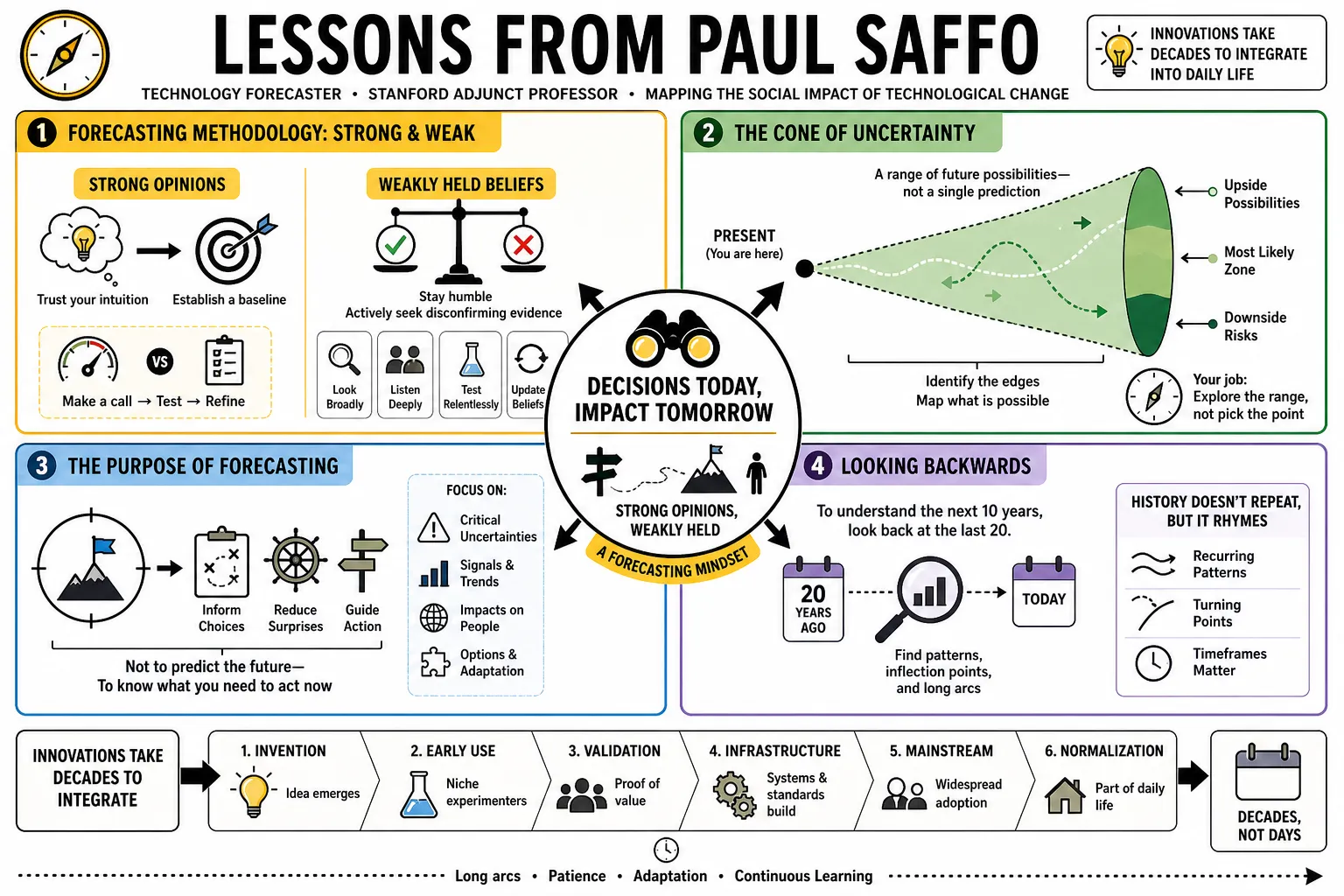
- On Strong Opinions: "Allow your intuition to guide you to a conclusion, no matter how imperfect—this provides a baseline to test against." — Source: [Harvard Business Review.
- On Weakly Held Beliefs: "You must remain intellectually humble and actively look for evidence that proves you wrong." — Source: [Harvard Business Review.
- On The Purpose of Forecasting: "The goal of forecasting is not to predict the future but to tell you what you need to know to take meaningful action in the present." — Source: [Harvard Business Review]
- On The Cone of Uncertainty: "Imagine a cone extending from the present into the future; a forecaster's job is to identify the edges of this cone to map what is possible." — Source: [The Long Now Foundation.
- On Looking Backwards: "To understand the next 10 years, look back at the last 20. History doesn't repeat, but it rhymes." — Source: [Paul Saffo's Archive.
- On Lousy Forecasts: "The fastest way to an effective forecast is often through a sequence of lousy forecasts." — Source: [Paul Saffo's Archive.
- On Illusory Certainty: "The point of forecasting is not to attempt illusory certainty, but to identify the full range of possible outcomes." — Source: [SKMurphy.
- On Creative Doubt: "Engage in creative doubt. Look for information that doesn't fit, or indicators pointing in an entirely different direction." — Source: [Paul Saffo's Archive.
- On When Not to Forecast: "Some things are truly unpredictable; don't force a guess where there is no data." — Source: [Harvard Business Review]
- On Objectivity: "Don't confuse what you want to happen with what is likely to happen." — Source: [Harvard Business Review]
Part 2: The Pace of Technological Change
- On The 30-Year Rule: "It turns out it takes 30 years for a new idea to seep into the culture and become an ordinary fact of life." — Source: [CNET.
- On The First Decade: "In the first decade of a new technology, there is lots of excitement and hype, but very little actually happens in the market." — Source: [WordPress.
- On The Second Decade: "The second decade brings flux and market penetration, creating 'overnight successes' that were actually 20 years in the making." — Source: [WordPress.
- On The Third Decade: "By the third decade, the technology becomes boring, ubiquitous, and completely normalized." — Source: [WordPress.
- On The S-Curve: "New technologies often fail for 20 years before hitting the steep upward slope of the S-curve." — Source: [The Long Now Foundation.
- On False Imminence: "Never mistake a clear view for a short distance. Just because a shift seems obvious doesn't mean it will happen quickly." — Source: [Paul Saffo's Archive.
- On Paving Cow Paths: "We tend to initially use a new technology to do an old task more efficiently. We pave the cow paths." — Source: [Paul Saffo's Archive.
- On The Driver of Change: "Technology does not drive change. It is our collective response to the options and opportunities presented by technology that drives change." — Source: [Paul Saffo's Archive.
- On Non-Linear Change: "We tend to overestimate the short-term impact of a new technology but vastly underestimate its long-term structural implications." — Source: [CTMFile.
- On Uneven Distribution: "The future is already here, it's just unevenly distributed." — Source: [Paul Saffo's Archive.
Part 3: Silicon Valley and Innovation
- On Building on Failure: "Silicon Valley was not built on the spires of earlier successes, but rather on the rubble of earlier failures." — Source: [Anu Partha Blog.
- On The Secret to Success: "Failure is the absolute secret to Silicon Valley's success." — Source: [Anu Partha Blog.
- On The Discovery Process: "Failure is how the industry takes raw, untamed technology and eventually turns it into a compelling medium that changes lives." — Source: [PBS.
- On Recycling Resources: "When a company fails in Silicon Valley, the money doesn't just evaporate; it goes into the pockets of employees who then start or join other companies." — Source: [PBS.
- On Cherishing Failure: "Innovators should cherish failure—preferably other people's—as an essential tool for learning." — Source: [INSEAD.
- On Timing: "Look for fields that have been failing for two decades, as they are often on the cusp of a sudden breakthrough." — Source: [INSEAD.
- On Early Visions: "The rubble of Xerox PARC's failures provided the vision and foundation for the Macintosh and Windows." — Source: [Paul Saffo's Archive.
- On The Right Way to Fail: "Silicon Valley's unique edge isn't just great management, but its cultural ability to fail in the right way and use those failures as fuel." — Source: [Paul Saffo's Archive.
- On Radical New Approaches: "Using technology merely to lower operational costs amounts to standing on a whale fishing for minnows." — Source: [AZQuotes.
Part 4: The Shift to the Creator Economy
- On Economic Eras: "Economies organize around overcoming a specific scarcity. When that scarcity is solved, a new adjacent scarcity is revealed." — Source: [The Long Now Foundation.
- On The Industrial Economy: "The Industrial Economy was defined by a scarcity of stuff and a goal of mass production, symbolized by the time clock." — Source: [Tank Magazine.
- On The Consumer Economy: "The Consumer Economy solved the scarcity of goods but created a scarcity of desire, making the credit card its symbol." — Source: [Tank Magazine]
- On The Creator Economy: "The Creator Economy is driven by a scarcity of meaning and engagement in an age of infinite digital abundance." — Source: [INSEAD]
- On The New Central Actor: "The central actor is no longer the passive consumer, but the creator—a hybrid of producer and consumer." — Source: [Fast Company]
- On Value Creation: "Creators are economic animals who, in the course of their day, generate value through their digital interactions." — Source: [INSEAD]
- On Passive Participation: "Even a simple internet search is an act of creation because it provides data that creates value for the platform." — Source: [INSEAD]
- On The Media Shift: "We are currently experiencing a 25-year-old shift from mass media's one-to-many model to personal media's many-to-many reality." — Source: [Elon University]
- On The Next Abundance: "As the Creator Economy matures, engagement will become abundant, revealing whatever the next fundamental scarcity will be." — Source: [Paul Saffo's Archive]
Part 5: Media and the Sensor Revolution
- On The Media Cycle: "Every media revolution is first hailed as a utopian solution, then demonized as a threat, and finally disappears into daily life." — Source: [Free.fr Archive]
- On Computing's Evolution: "In the 1980s we gave computers brains, in the 1990s we gave them nerves, and now we are giving them senses." — Source: [The Long Now Foundation.
- On Sensors as Media: "Sensors are a weird new kind of media revolution that allows the physical world to communicate directly with the digital world." — Source: [Elon University]
- On Machine Viewers: "We are shifting to a reality where the majority of web viewing and data generation is done by machines rather than humans." — Source: [The Long Now Foundation.
- On From Barcodes to Voices: "The real impact of RFID and sensors is enabling objects to speak and interact with their environment without human intervention." — Source: [The Long Now Foundation.
- On The Path to Robotics: "Once you give computers senses through sensors, and then add wheels, you get robots." — Source: [The Long Now Foundation.
- On Active Environments: "The physical world is becoming digitally active, creating a layer where objects and machines are constantly exchanging information." — Source: [Pew Research Center.
- On The Two-Way Trip: "Unlike the one-way trip of mass media broadcasting, the sensor revolution creates a continuous two-way loop of feedback." — Source: [Free.fr Archive.
- On Invisible Infrastructure: "The ultimate success of the sensor revolution will be when we stop noticing it entirely." — Source: [Paul Saffo's Archive.
Part 6: Information, Cyberspace, and AI
- On Context Over Content: "The future belongs to neither the conduit or content players, but those who control the filtering, searching and sense-making tools." — Source: [QuoteFancy.
- On The Folly Amplifier: "The Web is a compelling new medium being put to all kinds of uses... but it can also be a powerful folly amplifier." — Source: [QuoteFancy.
- On Cyberspace in Pockets: "Before the smartphone, cyberspace was something you went to your desk to visit. Now cyberspace is something you carry in your pocket." — Source: [AZQuotes.
- On Digital Preservation: "The curse of cyberspace is that everything we want to preserve will get lost and everything we want to lose will be preserved." — Source: [AZQuotes.
- On The Third Kind of Knowledge: "The internet requires a third kind of knowledge—the knowledge of what actually matters in a sea of infinite information." — Source: [Edge.org.
- On Naïve Internet Views: "People were touchingly naive at the dawn of the Internet revolution when they said the Internet will route around censorship the way it routes around damage." — Source: [AZQuotes.
- On Corporate AI: "The first multi-trillion-dollar corporation will employ almost no humans, operating entirely through AI and automated systems." — Source: [Imagining the Digital Future.
- On AI Companions: "AI advisors and companions will increasingly vie for people's time, attention and allegiance." — Source: [Imagining the Digital Future.
- On Digital Religion: "New religions and splinter groups will be fueled by personalized dialogues with a deity-avatar." — Source: [Imagining the Digital Future.
- On Establishment Control: "With any revolution, the establishment eventually catches up and figures out how to screw it up." — Source: [AZQuotes.
Part 7: Uncertainty and Risk
- On Mapping Uncertainty: "A forecast is useless if it isn't communicated. Use visuals and stories to effectively map the boundaries of uncertainty." — Source: [The Long Now Foundation.
- On The Limits of Data: "If you wait for perfect information to make a decision, you will be paralyzed. Commit to a hypothesis." — Source: [Harvard Business Review.
- On Intellectual Rag-Picking: "Finding the small indicators that others miss requires a habit of intellectual rag-picking." — Source: [Looking Outside Podcast.
- On Wild Cards: "Unexpected events act as wild cards that can push the edges of the cone of uncertainty even further out." — Source: [WordPress.
- On Employee Risk: "Companies have done a very bad job of explaining to their employees what the intrinsic risks of their evolving industries are." — Source: [AZQuotes.
- On The True Value of Forecasts: "Executives must become sophisticated consumers of forecasts to navigate structural industry risks." — Source: [National Institutes of Health.
- On Intrinsic Uncertainty: "We must accept the intrinsic uncertainty of the present rather than trying to engineer it away." — Source: [Looking Outside Podcast.
- On Recognizing Discontinuities: "Pay attention to the oddities and things that don't fit—they are often the first indicators of a major structural shift." — Source: [The Long Now Foundation.
- On Adapting to Surprises: "By defining the edges of what is possible, decision-makers are far less likely to be blindsided by abrupt changes." — Source: [The Long Now Foundation.
Part 8: Human Nature and Society
- On Commodifying Privacy: "Privacy is becoming steadily less a right and steadily more a commodity, an ever scarcer commodity that we buy and sell at a price." — Source: [Paul Saffo's Archive.
- On Social Solvents: "Digital technology acts as a solvent, rapidly dissolving old social structures before new ones are fully formed." — Source: [Big Think.
- On Becoming Good Ancestors: "Our greatest responsibility is to become good ancestors, and that's what we need to keep in mind as we tackle urgent global crises." — Source: [The Long Now Foundation.
- On The Climate Crisis: "Responding to climate change will become the obsession of the next decade in much the same way terrorism was this decade's obsession." — Source: [AZQuotes.
- On Competing Perspectives: "Finding a solution requires us to listen to the best ideas from the druids, the engineers, and even the astronauts." — Source: [Futurist.com.
- On The Gardener Approach: "To survive the climate crisis, we all need to become a little bit of a philosopher and a lot bit of a gardener, tending humbly to the planet." — Source: [TEDx.
- On Pace Layers: "Society moves at different speeds; fashion and commerce move quickly, while infrastructure, governance, and culture move slowly but provide vital stability." — Source: [The Long Now Foundation.
- On The Limits of Efficiency: "Applying new tools only to old workflows limits our societal potential; we must reimagine the work entirely." — Source: [AZQuotes.
- On The Constant of Human Response: "The tools change constantly, but human nature and our collective response to those tools remains the ultimate constant." — Source: [Paul Saffo's Archive.