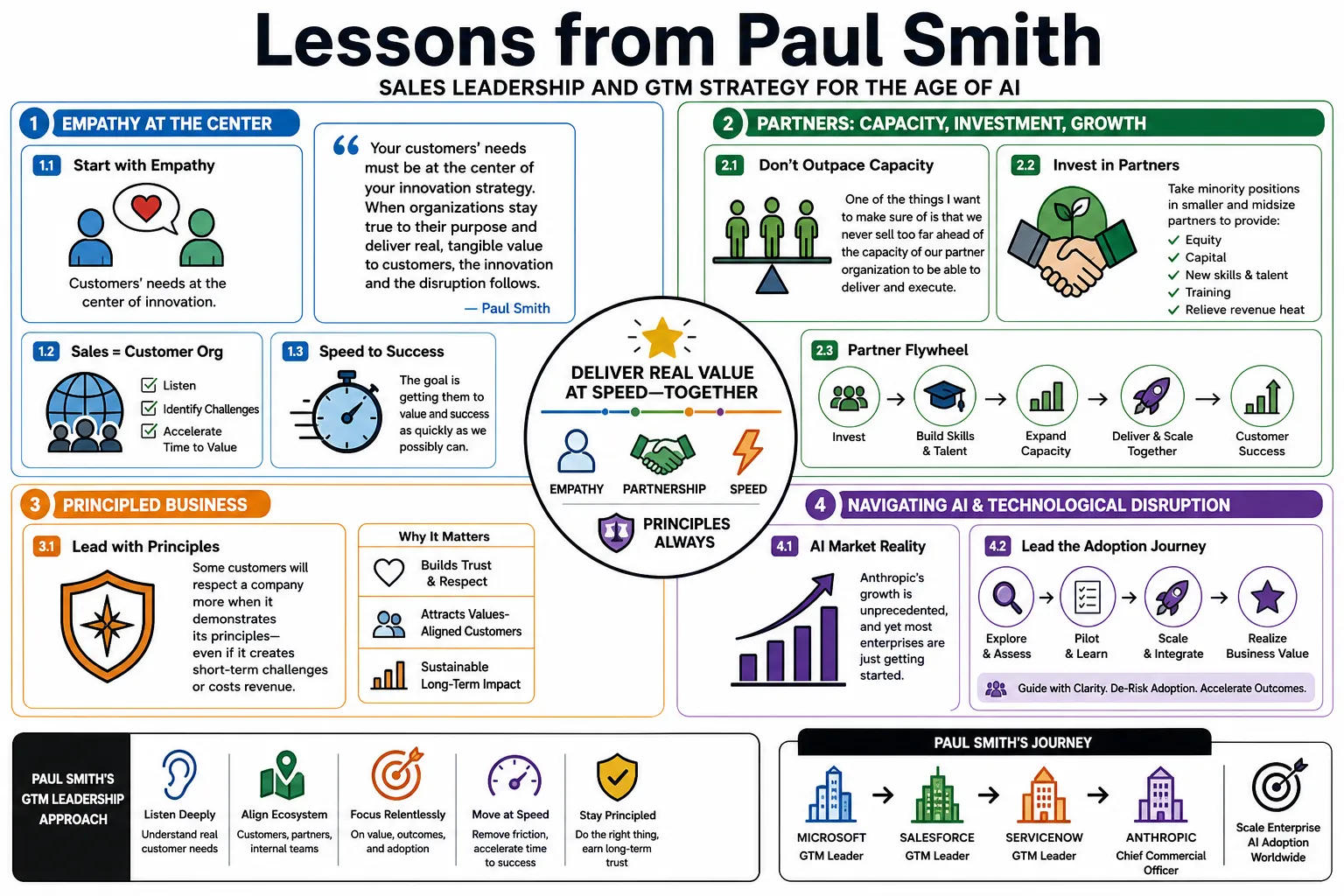
Paul Smith built go-to-market organizations at Microsoft, Salesforce, and ServiceNow before joining Anthropic as Chief Commercial Officer to scale its enterprise business. This profile covers his approach to sales strategy and leadership as corporate AI adoption accelerates.
Part 1: Sales, Go-To-Market, and Customer Value
- On empathy: "Your customers’ needs must be at the center of your innovation strategy. When organizations stay true to their purpose and deliver real, tangible value to customers, the innovation and the disruption follows." — Source: medium.com
- On the role of a sales organization: He views sales not just as a product-pushing function but as a worldwide customer organization dedicated to identifying challenges and accelerating time to value. — Reference: medium.com
- On speed to success: "The goal is getting them to value and success as quickly as we possibly can." — Source: medium.com
- On partner capacity: "One of the things I want to make sure of is that we never sell too far ahead of the capacity of our partner organization to be able to deliver and execute." — Source: crn.com
- On investing in partners: "We will take minority positions in smaller and midsize partners with a specific view towards giving those partners the equity, the capital, to basically bring in new skills and talent, train those skills and talent, take a little bit of the heat off them from a revenue perspective." — Source: crn.com
- On principled business: Some customers will respect a company more when it demonstrates its principles, even if those stances lead to short-term challenges or lost government revenue. — Reference: timesofindia.indiatimes.com
Part 2: Navigating AI and Technological Disruption
- On the AI market: "Anthropic's growth is unprecedented, and yet most enterprises are still in the early stages of AI adoption. The potential ahead is massive" — Source: anthropic.com
- On taking the first step with AI: When adopting new technology, the most important piece of advice is to simply make a start rather than hesitating. — Reference: thedailyupside.com
- On targeted AI implementation: The most successful organizations don't try to tackle everything at once; instead, they target very specific tasks and put AI agents to work automating those particular areas. — Reference: thedailyupside.com
- On data perfection: "My personal belief is big, complex corporations will always have integration challenges. And if you wait until it’s perfect, you will get left behind." — Source: thedailyupside.com
- On the pace of AI innovation: "I think the pace of innovation is going to increase. It is a reasonable assumption that model releases will continue to occur, and if anything, they will occur with greater frequency." — Source: timesofindia.indiatimes.com
- On agentic AI: We are shifting from merely using technology to partnering with it, creating a digital workforce that operates around the clock to autonomously solve complex workflow problems. — Reference: thedailyupside.com
- On measuring AI return on investment: There is genuine value in AI today if you can measure the specific impact of individual projects, such as reducing the ramp time for a sales team from nine months to six months. — Reference: thedailyupside.com
Part 3: Leadership, Execution, and Team Building
- On execution over perfection: "I firmly believe that perfection is often the enemy of progress." — Source: medium.com
- On rapid release cycles: Occasional process errors are a reality of moving quickly in a highly competitive market with incredibly rapid release cycles. — Reference: timesofindia.indiatimes.com
- On disruption: "The term is often applied to individuals or leaders, but personally I think disruption comes with time and proven results, it’s not self-appointed." — Source: medium.com
- On defining a vision: Effective leaders can zoom out to identify patterns and articulate where the organization is going, while simultaneously keeping a meticulous handle on the necessary details. — Reference: medium.com
- On prioritization: A good team will generate an endless supply of good ideas, but a leader must prioritize; once a path is chosen, you have to go all in without looking back. — Reference: medium.com
- On thriving at work: People do their best work when they feel heard and respected, which is why a leader's job is about creating the conditions for them to thrive. — Reference: medium.com
- On front-line experience: Starting a career on the front lines builds a competitive foundation focused on solving the exact problems keeping customers awake at night. — Reference: medium.com
Part 4: Building an AI-Native Operating Model
- On proving value with cycle time: ServiceNow's finance help desk cut its average response time from four days to roughly 98 seconds by assigning a specific workflow to AI agents. — Reference: thedailyupside.com
- On redeploying capacity: The point of automating the finance help desk was not to eliminate its roles; it was to redirect those people toward growth problems elsewhere in the business. — Reference: thedailyupside.com
- On the emerging agent mix: Enterprises should expect agents built by vendors, partners, customers, and third parties to work side by side rather than assuming a single provider will supply every agent. — Reference: thedailyupside.com
- On agent control: Orchestration must show where agents are working, what results they produce, which data they can access, and which permissions they hold. — Reference: thedailyupside.com
- On finding enterprise ROI: Rather than waiting for one sweeping measure of AI value, quantify the impact of individual projects and add those gains together. — Reference: thedailyupside.com
- On redesigning work: The best deployments rebalance the workforce by reducing mundane tasks and increasing high-value, high-productivity work while keeping humans at the center. — Reference: thedailyupside.com
- On simplifying adoption: Starter packages tied to a specific business area make AI easier to adopt than an enterprise-wide transformation presented as the only entry point. — Reference: thedailyupside.com
- On operational foundations: Agentic AI may feel new, but it becomes practical only after years of connecting systems and automating repeatable workflows. — Reference: thedailyupside.com
Part 5: Ecosystems, Delivery Capacity, and Customer Success
- On partner readiness: Bring partners close to the product organization so they can see the roadmap and prepare for a fast-moving innovation cycle. — Reference: thedailyupside.com
- On early customer support: Dedicated customer-success hubs can concentrate expertise around early AI use cases and help customers reach value faster. — Reference: thedailyupside.com
- On the implementation constraint: Commercial demand is not the only limit on growth; the available supply of trained partner talent determines how quickly customers can actually deploy. — Reference: crn.com
- On ecosystem compounding: A growing platform needs a continuous conveyor belt of new partners and skilled talent because successful specialists will often scale, consolidate, or be acquired. — Reference: crn.com
- On cross-training adjacent talent: When demand outstrips supply, look for consultants in neighboring ecosystems whose existing skills can be converted quickly rather than building every capability from zero. — Reference: crn.com
- On focused channel roles: Different partners can be assigned distinct jobs, such as delivery, systems integration, resale, or new-logo acquisition, instead of managing the whole ecosystem as one undifferentiated group. — Reference: crn.com
Part 6: Culture, Judgment, and Commercial Trust
- On durable advantage: A strong platform and a strong team culture reinforce each other; neither technology nor talent alone is enough to sustain an advantage. — Reference: medium.com
- On team ethos: Being hungry and humble while insisting that people win as a team turns culture into an operating system rather than a slogan. — Reference: medium.com
- On understanding without micromanaging: Leaders need a meticulous grasp of the details before solving a problem, but that does not require controlling every move their teams make. — Reference: medium.com
- On composure: Pragmatism, empathy, and control under pressure are commercial leadership strengths because teams take cues from how their leaders work and treat people. — Reference: medium.com
- On growth-minded leadership: Hire leaders who are curious, collaborative, willing to roll up their sleeves, open to trying and failing, and ready to execute. — Reference: medium.com
- On refusing the wrong incentives: Anthropic's decision not to place advertising in Claude reflects a broader principle: avoid business models that would make the product optimize for the wrong outcomes. — Reference: cnbc.com
- On becoming a trusted AI partner: Commercial scale in AI requires helping organizations navigate a fundamental shift in how they create and capture value, not simply giving them access to a model. — Reference: anthropic.com
Part 7: Production-Scale Enterprise AI
- On the shift from pilots to production: Once enterprise AI moves into production, the decisive questions become whether it can operate inside existing security frameworks, satisfy regulatory requirements, and integrate with the systems people already use. — Reference: linkedin.com
- On reliability and control: Model capability may attract experimentation, but reliability and control become non-negotiable when companies entrust AI with consequential work. — Reference: linkedin.com
- On trust as architecture: Enterprise adoption spreads only when trust is built into the platform from the ground up rather than added after deployment. — Reference: linkedin.com
- On market bifurcation: The enterprise AI market will separate around trust and transparency because contracts reflect operational confidence more directly than headlines do. — Reference: linkedin.com
- On capability thresholds: AI capability and adoption do not always improve gradually; crossing a threshold can reorganize an entire category of knowledge work within weeks. — Reference: linkedin.com
- On long-horizon autonomy: A model that can run complex, days-long projects represents a different unit of enterprise work from a tool designed mainly for short, isolated interactions. — Reference: linkedin.com
Part 8: Commercial Discipline and Infrastructure
- On substance over spectacle: Growing revenue and winning customers are more meaningful commercial signals than announcing the largest possible infrastructure commitments. — Reference: cnbc.com
- On demand-led investment: Infrastructure spending should follow strong observed demand rather than becoming a speculative race to buy compute ahead of customers. — Reference: cnbc.com
- On capacity balance: Buy enough compute to preserve the growth curve and protect customer service, but review commitments constantly so capital does not run materially ahead of usage. — Reference: cnbc.com
- On software displacement: There is no universal pattern in which AI simply replaces the existing software stack; some organizations will consolidate tools while others will double down on incumbent applications. — Reference: cnbc.com
- On durable software value: Applications with specialized data models and deeply embedded workflows can remain valuable for a long time even as general-purpose AI absorbs more tasks. — Reference: cnbc.com
Part 9: Marketplace and Deployment Partnerships
- On implementation capacity: Frontier intelligence becomes more useful when it is paired with deep industry expertise and a large, trained practitioner base that can move deployments into production. — Reference: linkedin.com
- On local-market trust: In enterprise AI, the credibility of the partner bringing the technology to market can matter as much as the underlying model, especially in regulated institutions and long-standing business relationships. — Reference: linkedin.com
- On building with the market: Enter a country prepared to build alongside trusted local companies and co-develop agents for concrete functions such as finance, manufacturing, and cybersecurity. — Reference: linkedin.com
- On extending a trusted relationship: A marketplace can turn an enterprise's existing platform commitment into a simpler path for procuring a broader set of compatible partner tools. — Reference: linkedin.com
- On curation as a platform duty: When customers make a strategic platform bet, the platform owner has an obligation to choose ecosystem partners carefully rather than merely aggregate the largest possible catalog. — Reference: linkedin.com