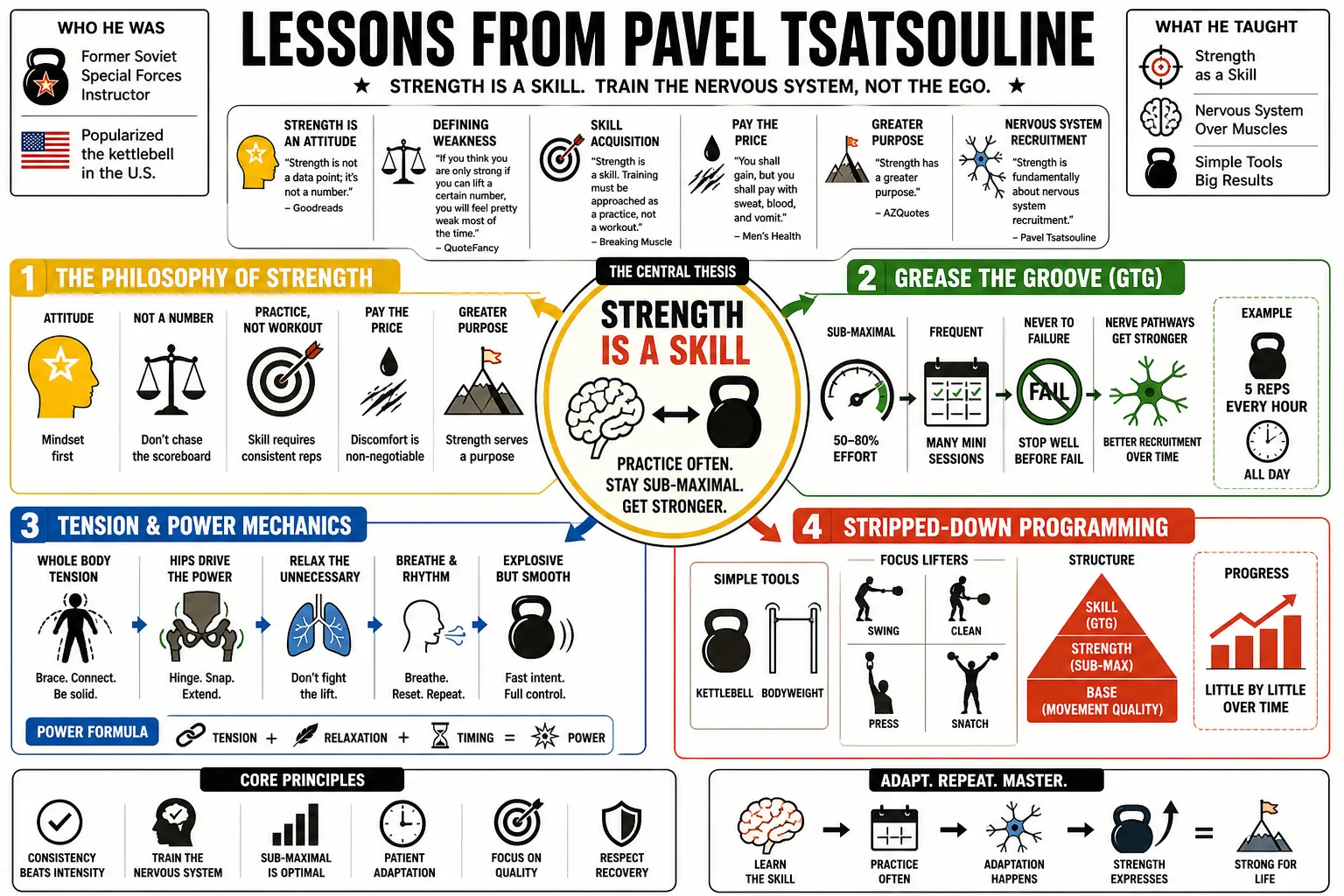
Lessons from Pavel Tsatsouline
Former Soviet Special Forces instructor Pavel Tsatsouline popularized the kettlebell in the United States and reframed strength as a skill rather than an endurance test. His signature "Grease the Groove" method uses frequent, sub-maximal reps to train the nervous system without exhausting the muscles. The insights below cover his mechanics for building power through tension control, stripped-down programming, and patient adaptation.
Part 1: The Philosophy of Strength
- On Strength as an Attitude: "Strength is not a data point; it's not a number. It's an attitude." — Source: Goodreads
- On Defining Weakness: "If you think you are only strong if you can lift a certain number, whatever that number is, you will feel pretty weak most of the time." — Source: QuoteFancy
- On Skill Acquisition: "Strength is a skill. Training must be approached as a practice, not a workout." — Source: Breaking Muscle
- On Paying the Price: "You shall gain, but you shall pay with sweat, blood, and vomit." — Source: Men's Health
- On the True Purpose of Strength: "Strength has a greater purpose." — Source: AZQuotes
- On Central Nervous System Recruitment: "Strength is fundamentally about neurological efficiency. You are already stronger than your muscles currently allow you to demonstrate; you just need to teach your nervous system to recruit more muscle fibers." — Source: Power to the People!
- On Tension: "The ability to generate maximal tension is the absolute source of physical strength, entirely separate from muscle size." — Source: Power to the People!
- On the Illusion of Size: "Building massive muscles without training the nervous system is like putting a large engine in a car without connecting it to the transmission." — Source: The Joe Rogan Experience #1399
- On Practice Over Exhaustion: "You should practice lifting heavy things daily, throughout the day, while totally avoiding muscle fatigue and failure." — Source: Breaking Muscle
- On Focus: "Lift the barbell powerfully-steady, applying a maximal effort along the whole lift." — Source: Goodreads
Part 2: The Kettlebell and Minimalism
- On the Russian Weapon: "The kettlebell is an ancient Russian weapon against weakness." — Source: AZQuotes
- On Mastering the Basics: "Get good with one bell, address your strength imbalances, work up to the snatch and press goals... then we'll talk." — Source: Goodreads
- On the What the Hell Effect: "Consistent kettlebell training often leads to unexpected, wide-ranging improvements in completely unrelated athletic endeavors, like long-distance running or powerlifting deadlifts." — Source: Goodreads
- On Subtractive Design: "People try to overcomplicate a position by adding more where it's unnecessary, but the true artist sculpts, whittles and pares things down to leave something that's absolutely beautiful—not by adding more but by taking away." — Source: Functional Movement
- On Meaningless Variety: "Doing dozens of different exercises just to confuse the muscles is a waste of time. Pick the few movements that yield the highest return and do them perfectly." — Source: Mapdec
- On the Kettlebell Swing: "The swing is the center of the kettlebell universe, teaching the body how to generate explosive power from the hips while maintaining a rigid spine." — Source: Functional Movement
- On the Turkish Get-Up: "The Turkish Get-Up serves as a slow, controlled, and proprioceptively rich movement that builds stability, flexibility, and total-body coordination from the ground up." — Source: Full ASC
- On Training the Posterior Chain: "The kettlebell forces you to rely on your glutes, hamstrings, and back, which are the true engines of human movement." — Source: Mapdec
- On Efficiency versus Labor: "When training, do not use a shovel to dig a canal just to create labor; use the right tool to get the job done efficiently." — Source: Serenity Through Sweat
- On Hard Style: "Training in 'Hard Style' means maximizing power, efficiency, and bodily tension in every single repetition, never just going through the motions." — Source: Sobrief
Part 3: Grease the Groove and Neurological Adaptation
- On High Frequency: "To build a specific strength skill, you must perform the movement frequently throughout the day, spacing sets out by 15 minutes to several hours." — Source: Medium
- On Sub-Maximal Effort: "When practicing a movement throughout the day, never exceed 40–60% of your maximum repetition capacity to keep the nervous system fresh." — Source: Eric Flag
- On Neural Pathways: "The goal of high-frequency training is to grease the neural pathways between your brain and muscles, improving your nervous system's efficiency at firing those specific fibers." — Source: Men's Health
- On Perfect Practice: "Every repetition in a frequent training protocol must be executed with absolute technical perfection to avoid hardwiring bad habits into the nervous system." — Source: Substack
- On Breaking Plateaus: "Treating a lift like a specialized skill practiced in small daily doses is the most reliable way to break through a stubborn strength plateau." — Source: Iron Bull Strength
- On Neuromuscular Profiency: "You get stronger by teaching the body to be better at the movement, not necessarily by breaking down muscle tissue to rebuild it larger." — Source: ChiliTri
- On Seamless Integration: "Strength practice should not require a trip to the gym; you can spread your sets across the day, doing a few pull-ups every time you walk under a bar." — Source: Michael Ashcroft
- On Recovery Between Efforts: "The space between sets is just as important as the sets themselves; allowing full recovery ensures the nervous system is never drained." — Source: Reddit Fitness
- On Specificity: "If you want to get good at push-ups, you have to do push-ups. Do not rely entirely on the bench press to increase your push-up numbers." — Source: Eric Flag
- On Avoiding the Pump: "You should finish a Grease the Groove set feeling more energized than when you started, completely avoiding the muscle pump." — Source: Hevy Coach
Part 4: Avoiding Failure and Fatigue
- On the Danger of Failure: "Training to failure is often counterproductive and burns out the central nervous system long before the muscles truly adapt." — Source: Joe.co.uk
- On the One-More-Rep Mentality: "The obsession with grinding out one more rep is exactly what prevents long-term, stable strength adaptations from taking hold." — Source: Podcast Notes
- On Optimal Rep Ranges: "The most effective number of repetitions for building pure strength is typically one-third to two-thirds of your absolute maximum capacity." — Source: Podcast Notes
- On Tendons and Ligaments: "Focus on doing fewer repetitions more often to build stable adaptations in your tendons and ligaments, which are usually the limiting factors in heavy lifting." — Source: Podscripts
- On Transient Gains: "Quick results like adding massive muscle size in six weeks are often transient and disappear rapidly because the body's deeper structures haven't adapted." — Source: The Joe Rogan Experience #1399
- On Not Forcing Adaptation: "You cannot force the body to adapt through sheer willpower and exhaustion; you must patiently coax it into getting stronger over time." — Source: The Joe Rogan Experience #1399
- On Tension vs. Fatigue: "High levels of fatigue and high levels of tension are mutually exclusive. Since tension builds strength, you must actively eliminate fatigue from the session." — Source: Floris Wolswijk
- On Leaving Reps in the Bank: "Always finish your set knowing you could have done at least two or three more perfect repetitions." — Source: The Tim Ferriss Show
- On Junk Volume: "Doing high-repetition sets that cause exhaustion without increasing your ability to generate force is simply junk volume." — Source: Power to the People!
Part 5: Easy Strength and Submaximal Training
- On the Never Miss Rule: "The most fundamental rule of long-term lifting is to never miss a rep. If it feels heavy or like a grind, it is too heavy for the program's intent." — Source: Dan John University
- On the Park Bench Mentality: "Treat your daily workouts like sitting on a park bench—show up, do your work calmly without psyching yourself up, and go home." — Source: Liftosaur
- On Submaximal Consistency: "By keeping reps low and stopping well before fatigue, you accumulate massive total volume over time without overwhelming your recovery capacity." — Source: Scribd
- On Patterning: "Frequent training allows for the constant neurological patterning of a movement, which is the true driver of strength gains." — Source: Dan John University
- On Fundamental Human Movements: "A complete strength program only needs to cover five basic patterns: push, pull, hinge, squat, and loaded carry." — Source: Lifetime
- On the 40-Day Concept: "If you perform the exact same five lifts for forty workouts at an easy weight, the weight will naturally begin to feel so light you will be forced to add more." — Source: Dan John University
- On Saving Energy: "The more is better mentality drains you. A proper strength protocol allows you to maintain high energy for your actual sport or daily life." — Source: Physio7
- On Daily Practice: "Do not freak out about training the same movement or the same body part for two or more days in a row. It is a standard operating procedure among Russian athletes." — Source: Goodreads
- On Building Gradually: "Start with weights that feel trivially easy. As you build the habit of perfection, the weights will increase without conscious effort." — Source: Muscle & Fitness
Part 6: Flexibility and Tension
- On the Stretch Reflex: "Most limitations in flexibility are not structural; they are neurological reflexes designed by the brain to protect the body from tearing." — Source: Clinique HPH
- On Software Upgrades: "Achieving extreme flexibility is not about physically elongating tissues, but rather providing a software upgrade to the nervous system so it permits a new range of motion." — Source: Thriftbooks
- On Forced Relaxation: "You can overcome the body's natural resistance to stretching by using controlled breathing and forced relaxation techniques to calm the nervous system." — Source: Bookey
- On Waiting Out Tension: "Rather than violently forcing yourself into a deeper stretch, simply hold the position and wait out the tension until the muscles spontaneously let go." — Source: Thriftbooks
- On Contract-Relax Methods: "Contracting a muscle intensely right before attempting to stretch it takes advantage of the neurological refractory period, allowing you to bypass the stretch reflex." — Source: Goodreads
- On Avoiding the Rubber Band Myth: "Treating muscles like rubber bands to be forcibly pulled is biologically incorrect and frequently leads to injury." — Source: Thriftbooks
- On Active Control: "True mobility requires active neurological control over the entire range of motion, not just the ability to passively fall into a split." — Source: Bookey
- On Working With the Body: "The fastest way to achieve advanced flexibility is to work with your body's natural physiological responses rather than fighting against them." — Source: Iron Man Magazine
- On Tension as a Tool: "Muscle tension is not just for lifting; learning how to intentionally flex and relax specific muscles is the master key to unlocking physical mobility." — Source: Thriftbooks
Part 7: Program Design and Progress
- On Step Loading: "Step loading is an adult training progression. It weeds out impatient juveniles unable to stay on task." — Source: Full ASC
- On the Deadlift's Importance: "The deadlift is the absolute cornerstone of building full-body power; a minimalist routine needs little else for the lower body." — Source: Lean Solid Dogs
- On Working Weight Drops: "When performing multiple sets, perform your first set at your working max, and drop the weight by ten percent for the second set to ensure pristine form." — Source: Blogspot
- On Listening to the Body: "Build up the training load gradually using common sense, and listen to your body." — Source: Goodreads
- On Routine Simplicity: "A world-class strength program can consist of just two movements—such as a heavy pull and a heavy press—if executed with absolute dedication." — Source: Reddit
- On Avoiding Boredom: "The desire for workout entertainment and constant variety is the enemy of physical mastery." — Source: Functional Movement
- On Wave Cycling: "Instead of trying to add weight every single session in a linear fashion, progress by riding the natural peaks and valleys of a wave cycle." — Source: Reddit
- On Adaptation Time: "Give your structural connective tissues months to adapt to a load before assuming you are ready to max out." — Source: The Joe Rogan Experience #1399
- On Time Efficiency: "By stripping away isolation exercises and focusing entirely on neurological tension in compound lifts, a highly effective session can take just twenty minutes." — Source: Blogspot
Part 8: Mindset, Resilience, and Practice
- On the Long Game: "Most lifters dramatically overestimate what they can accomplish in a week, while severely underestimating the strength they can build in a year of steady practice." — Source: QLD Kettlebells
- On Practice Over Workouts: "Reframing a workout as a practice shifts the mental focus from enduring pain to acquiring mastery." — Source: Full ASC
- On Irradiation: "Gripping the barbell or kettlebell as hard as possible irradiates tension into the neighboring muscles, instantly making your entire body stronger." — Source: The Tim Ferriss Show
- On Discipline over Motivation: "You do not need to be fired up or motivated to get stronger; you simply need the discipline to execute the repetitions precisely as programmed." — Source: Liftosaur
- On Staying Fresh: "The ultimate indicator of a good strength training session is that you leave the gym feeling better and more capable than when you arrived." — Source: Podcast Notes
- On Artificial Complexity: "The fitness industry thrives on selling complexity; true physical resilience is found in mastering a few monotonous, heavy movements." — Source: Mapdec
- On Treating the Body as a Unit: "Never view the body as a collection of isolated muscles to be exhausted; train it as a single, coordinated mechanism designed to generate force." — Source: Scribd
- On Patience: "Soviet weightlifting methodology dominates because it embraces patient, stable adaptation over the desperate pursuit of rapid, forced progress." — Source: The Joe Rogan Experience #1399
- On Absolute Tension: "If you cannot intentionally tense a muscle to the point of cramping on command, you do not truly own your body's strength potential." — Source: Power to the People!