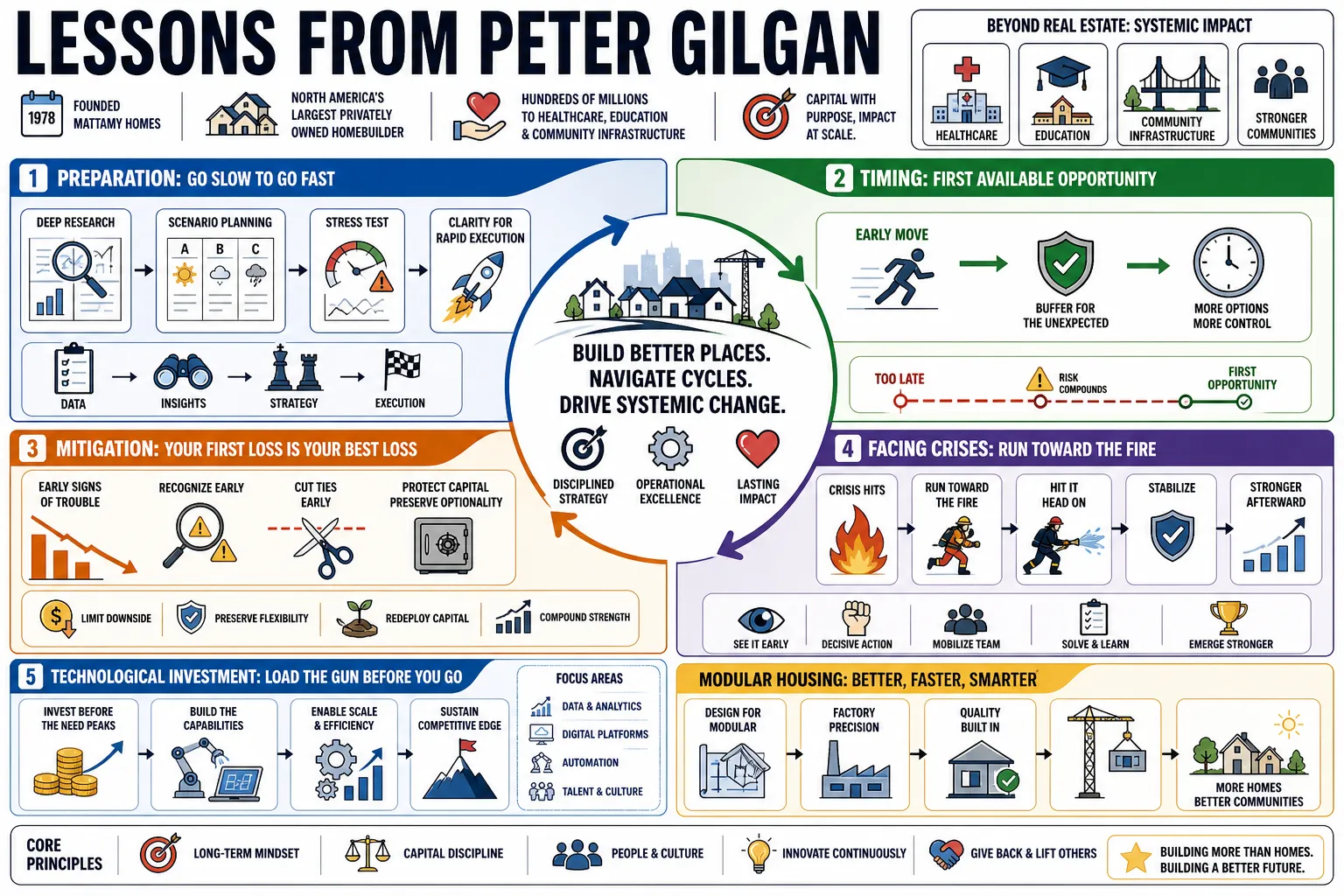
Peter Gilgan founded Mattamy Homes in 1978 and built it into North America's largest privately owned homebuilder by rethinking how suburbs are designed. Beyond real estate, he is one of Canada's most active philanthropists, donating hundreds of millions to healthcare, education, and community infrastructure. This profile explores his strategies for navigating market cycles, his push toward modular housing, and his philosophy on using capital to drive systemic change.
Part 1: The Foundations of Strategy
- On Preparation: "Go slow to go fast." Extensive research and gaming out alternative scenarios provides the clarity needed for rapid execution. — Source: [Scott Mautz]
- On Timing: Execute tasks at the first available opportunity rather than the last possible moment to buffer against the unexpected in complex operations. — Source: [Inc. Magazine]
- On Mitigation: "Your first loss is your best loss." It is better to recognize a failing investment early and cut ties before the damage compounds. — Source: [Inc. Magazine]
- On Facing Crises: "Run toward the fire. Don't run away from the fire. Hit it head on." — Source: [Horatio Alger Association]
- On Technological Investment: "Technology is a massive enabler, and you've got to load the gun before you get going." — Source: [Horatio Alger Association]
- On Private Ownership: Keeping a company private allows for long-term strategic decisions instead of chasing quarterly earnings reports. — Source: [Ivey Business School]
- On Recognizing Sunk Costs: Avoid throwing good money after bad; pivoting early preserves necessary resources for the next venture. — Source: [Scott Mautz]
- On Competitive Pacing: Outmaneuver competitors by moving with absolute conviction once the research phase is entirely complete. — Source: [Inc. Magazine]
- On Capitalizing on Hesitation: A contrarian approach works best when you act aggressively while the rest of the market is paralyzed by uncertainty. — Source: [TVO Today]
- On Daily Efficiency: Posting basic execution mantras in field offices ensures that high-level strategy actually translates to daily frontline behaviors. — Source: [Inc. Magazine]
Part 2: Navigating Market Cycles
- On Economic Downturns: "When others are running for the door, you run for the fire. That’s been my business model since day one." — Source: [WONK Podcast]
- On Recessions: A recession is a clarifying event that forces a business to abandon bad habits, innovate, and improve its core operations. — Source: [Horatio Alger Association]
- On Market Troughs: Use the lowest points in the economic cycle to quietly acquire assets and lay the groundwork for the inevitable recovery. — Source: [Scott Mautz]
- On Real Estate Fundamentals: "If you believe those fundamentals that people need a place to live, then what we’re witnessing is a cycle." — Source: [TVO Today]
- On Speculative Markets: Relying entirely on foreign or speculative pre-sale investment to drive condominium development is an unsustainable model for the country. — Source: [WONK Podcast]
- On Regulatory Friction: Severe bureaucratic delays prevent builders from quickly converting investments back into cash, severely restricting reinvestment speed. — Source: [WONK Podcast]
- On Taxation Predictability: "To retroactively tax a decision that someone made last week or last year or a decade ago... it would have to be really prospective." — Source: [WONK Podcast]
- On Cross-Border Efficiency: Building the exact same home in Florida can be done for half the price compared to Ontario due to structural efficiencies and lower fees. — Source: [WONK Podcast]
- On Long-Term Demand: Even during bleak economic conditions, the sheer physical shortage of housing units makes continued building a safe long-term bet. — Source: [The Logic]
Part 3: Redefining Real Estate
- On the Purpose of Architecture: "You start with an idea, and it develops into something that hopefully is a thing of beauty and endurance and sustainability." — Source: [Horatio Alger Association]
- On Community Infrastructure: True development focuses on designing neighborhoods with amenities that foster social connection rather than merely maximizing lot yield. — Source: [Forbes]
- On Monotonous Suburbs: The shift toward New Urbanism was driven by a desire to break away from the bland, impersonal subdivisions dominating the 1980s. — Source: [Forbes]
- On the WideLot Design: Creating wider, shallower properties allowed builders to tuck garages to the side or rear, preventing cars from dominating the streetscape. — Source: [Wikipedia]
- On Street Engagement: Reinstating the front porch as the focal point of a home encourages residents to actively interact with their neighbors. — Source: [ULI Toronto]
- On Green Practices: "The most advantageous green practices are still largely ignored," but they must be integrated into the earliest stages of master planning. — Source: [Green Building+Architecture]
- On NIMBYism: "Nobody wants intensification beside them. That's just a fact of life... but again, it's saying, 'Okay, what's in the best public good?'" — Source: [WONK Podcast]
- On Systemic Solutions: Solving the housing crisis requires all three levels of government and private industry to work arm-in-arm without ideological friction. — Source: [WONK Podcast]
- On Master Planning: Transitioning from building single structures to constructing entire multi-phase communities ensures tighter control over the neighborhood's long-term feel. — Source: [Forbes]
- On Pedestrian Focus: Suburban design should prioritize walkability, green spaces, and human scale over the sheer convenience of the automobile. — Source: [ULI Toronto]
Part 4: The Future of Modular Housing
- On Technological Maturity: "As technology started catching up to the vision, we started to seriously look at the opportunity in the last couple of years." — Source: [The Logic]
- On Affordability: The ultimate goal of automation is to provide livable, sustainable housing that is genuinely affordable for young families currently priced out. — Source: [Toronto Life]
- On Factory Production: Taking the boring, tedious, and time-consuming labor off the job site and moving it into a controlled factory environment drastically improves efficiency. — Source: [Toronto Life]
- On the Missing Middle: Modular innovation is best applied to mid-rise, six-storey buildings that fill the ignored market segment between single-family homes and massive condo towers. — Source: [Maclean's]
- On Past Mistakes: Early attempts at modular building failed because fixed factories were too dependent on the unpredictable zoning approvals of single municipalities. — Source: [TVO Today]
- On Assembly Speed: Properly executed modular components can reduce the on-site physical construction time to under six months. — Source: [Toronto Life]
- On the Ultimate Benchmark: The guiding north star is shrinking the entire timeline from initial planning to handing over the keys from seven years down to twelve months. — Source: [TVO Today]
- On Regulatory Bypass: Utilizing standardized, highly repeatable building designs enables one-and-done code approvals, neutralizing local bureaucratic delays. — Source: [TVO Today]
- On Artificial Intelligence: Software can now optimize material cuts and robotic assembly lines to a degree of precision that makes mass modular housing economically viable. — Source: [The Logic]
Part 5: Leadership and Talent
- On Leadership Evolution: To scale a massive organization, a founder must learn to "play editor rather than author." — Source: [Inc. Magazine]
- On Micromanagement: Trying to write every detail of the business yourself creates a bottleneck; true leadership is about setting standards and empowering others. — Source: [Scott Mautz]
- On Employee Value: Employees must be treated as more important than customers, because it is impossible to have satisfied customers without inspired staff. — Source: [Scott Mautz]
- On Hiring Priorities: A relentlessly positive attitude and strong character are vastly more valuable to a company's culture than a perfect resume. — Source: [Inc. Magazine]
- On Trainability: Technical skills can always be taught on the job, but a candidate's baseline disposition and outlook cannot be artificially manufactured. — Source: [Inc. Magazine]
- On Family Businesses: "Don’t expect your children to automatically be version 2.0 of the founder." — Source: [Scott Mautz]
- On Inherited Leadership: You cannot force entrepreneurship onto the next generation; handing someone a crown does not mean they actually want to rule. — Source: [Scott Mautz]
- On Organizational Humility: The healthiest corporate cultures are populated by highly intelligent people who do not walk around acting like they are the smartest in the room. — Source: [Horatio Alger Association]
- On Employee Retention: Offering upward mobility and framing roles as lifelong careers, rather than temporary jobs, is the key to holding onto talent for decades. — Source: [Scott Mautz]
Part 6: The Philosophy of Philanthropy
- On Foundational Values: "From a young age, my parents spoke to me and my siblings about community and the responsibility of doing our part." — Source: [Financial Post]
- On Structural Impact: Real philanthropic impact comes from deep partnerships and the core belief that human potential is universal, even when opportunity is not. — Source: [Peter Gilgan Foundation]
- On Catalyst Giving: "With each charitable gift granted, no matter the size, we hope to inspire a 'ripple-effect' of meaningful generosity." — Source: [Peter Gilgan Foundation]
- On Public Donations: Highly publicized giving is not an ego exercise; it is a deliberate tactic to pressure other wealthy individuals to step up and write cheques. — Source: [Financial Post]
- On the ROI of Charity: "You'll never miss the time, money, or resources you donate... the reward that comes back is multiples greater." — Source: [Scott Mautz]
- On Privilege: "I'm in a privileged position to be able to make this gift, and I know it's going to be used to help children today." — Source: [SickKids Foundation]
- On Active Fundraising: Merging personal hobbies, such as distance cycling, with charity creates a compelling narrative that attracts larger corporate sponsorships. — Source: [UHN Foundation]
- On Gratitude: Large-scale giving often begins simply as a mechanism to say "thank you" to the local institutions that sustained a community in its early days. — Source: [Horatio Alger Association]
- On Scholarships: Financial aid provides funding beyond tuition; it gives marginalized youth the psychological validation that society believes they are capable of greatness. — Source: [Horatio Alger Association]
Part 7: Advancing Healthcare
- On Baseline Prosperity: "You have no wealth if you don't have your health, it all starts from there." — Source: [Financial Post]
- On Cancer Funding: "Cancer is a cause that has touched my family and loved ones... Now is the time to invest in Canada's capacity for world-class research." — Source: [PR Newswire]
- On the Pillars of Society: A fully functioning community relies on a three-legged stool of stable shelter, accessible health infrastructure, and youth education. — Source: [Empire Club of Canada]
- On Aging Facilities: Historic capital injections are required because modern medicine cannot be effectively practiced inside decades-old physical hospital infrastructure. — Source: [Trillium Health Partners]
- On Neurology: Targeted philanthropic funding allows specialized institutes to accelerate critical research into complex neurodegenerative diseases like Alzheimer’s. — Source: [UHN Foundation]
- On Psychiatric Care: There is an urgent need to fund intensive day programs and therapeutic environments specifically tailored to adolescent mental health. — Source: [Osler Foundation]
- On Senior Dignity: As demographics shift, upgrading hospital wards to cater specifically to the specialized needs of an aging population becomes a moral imperative. — Source: [Trillium Health Partners]
- On Diagnostic Tech: Private donations can bypass budget constraints to immediately procure advanced diagnostic tools, like 3T MRI machines, for early disease detection. — Source: [Sunnybrook Foundation]
- On Pediatric Care: Continually supporting children's hospitals is both an honor and a deeply humbling reminder of the fragility of health. — Source: [SickKids Foundation]
- On Universal Access: The ultimate objective of medical philanthropy is building systems that allow every demographic to live longer, healthier lives. — Source: [SickKids Foundation]
Part 8: Personal Resilience
- On Negative Motivation: Watching someone endure a lifelong, monotonous job can serve as a powerful psychological deterrent that forces a pursuit of entrepreneurship. — Source: [Horatio Alger Association]
- On Manual Labor: Working grueling physical jobs during youth clarifies the stark reality of ungratifying work and highlights education as the primary escape route. — Source: [Horatio Alger Association]
- On Intellectual Curiosity: The light in the eyes of a child represents pure curiosity; without access to education, that light inevitably extinguishes in adulthood. — Source: [Canadian Club Toronto]
- On Global Duty: True success requires shedding insular thinking and adopting the mindset of a citizen of the world dedicated to broad systemic improvement. — Source: [Canadian Club Toronto]
- On Achievement Awards: The concept of a lifetime achievement award implies finality; builders naturally resist the idea that their productive years are over. — Source: [Canadian Club Toronto]
- On Early Mistakes: Mishaps and chaotic learning curves are the unavoidable tax paid during the early, exuberant days of building a business. — Source: [Canadian Club Toronto]
- On Frugality: Being raised in an environment where a salvaged bicycle was considered a treasure permanently ingrains respect for the value of capital. — Source: [Scott Mautz]
- On Basic Mobility: Providing simple tools like bicycles in developing regions radically transforms a population's ability to access distant schools and clinics. — Source: [World Bicycle Relief]
- On Enduring Legacy: A founder's true legacy is measured by the physical communities and health systems left behind to serve the next generation, rather than personal wealth. — Source: [Canadian Club Toronto]