Peter Rahal co-founded RXBAR in his parents’ basement and built it into a protein bar brand that sold to Kellogg for $600 million in 2017. He is known for popularizing radically transparent, front-of-pack ingredient lists and targeting specific niche communities before expanding to the mass market. This compilation covers his operating principles, his perspective on consumer surplus, and his return to food tech with David Protein.
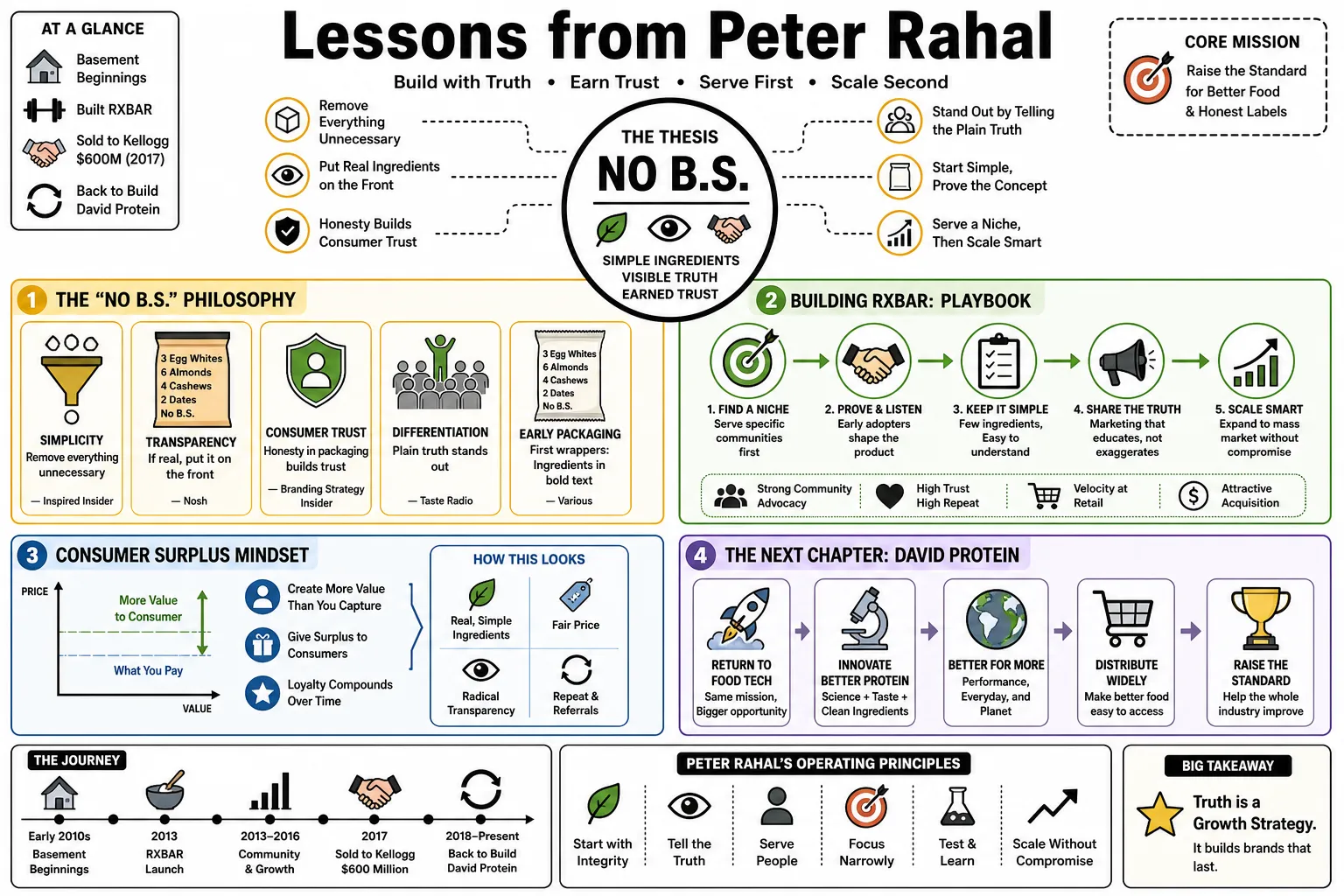
Part 1: The "No B.S." Philosophy
- On Simplicity: "The core idea behind our brand was to remove everything unnecessary and simply tell the customer what they are buying." — Source: Inspired Insider
- On Transparency: "If you use real ingredients, you shouldn't have to hide them on the back of the package. Put them on the front." — Source: Nosh
- On Consumer Trust: "Honesty in packaging was a direct response to a food industry that had spent decades relying on confusing jargon." — Source: Branding Strategy Insider
- On Differentiation: "Sometimes the best way to stand out in a crowded market is to be the only one telling the plain truth." — Source: Taste Radio
- On Early Packaging: Rahal says RXBAR started in his parents' basement, with the team figuring out formulation and packaging from scratch. — Reference: Failure Factor transcript on RXBAR's basement origins
- On Industry Norms: "When everyone else is adding complexity to sound sophisticated, simplicity becomes the ultimate premium feature." — Source: Forbes
- On Building the Core: "We didn't want to create a brand first and a product second. The product itself had to be the brand." — Source: How I Built This
- On Messaging: "Keep the message so clear that a customer walking past it in a grocery aisle understands the value proposition in one second." — Source: Inspired Insider
- On Authenticity: "You can't fake a no B.S. approach. If the product doesn't deliver on the promise of the packaging, the customer will never return." — Source: Taste Radio
Part 2: Consumer Surplus & Product Strategy
- On Creating Value: Rahal was drawn to protein bars because the format was portable, convenient, nutritious, and useful to the CrossFit community. — Reference: Failure Factor transcript on RXBAR's consumer insight
- On The New Venture: "With David Protein, the goal is to offer the protein of a full meal but the calories of a light snack." — Source: Nosh
- On Defensibility: "Marketing hacks fade, but a product that solves a genuine physical or nutritional need builds a permanent moat." — Source: Taste Radio
- On Product Formulation: "We approached David like a technology problem, optimizing the protein-to-calorie ratio until it outclassed everything else on the shelf." — Source: Forbes
- On Functional Food: "We are effectively creating weight management tools that don't look or feel like diet products." — Source: Nosh
- On Market Gaps: Rahal spotted a gap when CrossFit customers avoided conventional bars and wanted a paleo-friendly alternative. — Reference: Failure Factor transcript on the CrossFit market gap
- On Price vs. Value: "Customers are highly rational in the long run. They will stick with the product that mathematically improves their life the most." — Source: How I Built This
- On Science in Food: "You must be technically rigorous. Ignoring the boring science of shelf life and microbiology will eventually destroy your business." — Source: Taste Radio
- On Continuous Iteration: Rahal describes tinkering in the kitchen with scalable ingredients until the RXBAR formula matched the product idea. — Reference: Failure Factor transcript on product formulation
Part 3: Solving Specific Market Problems
- On Niche Targeting: "Don't start by selling to everyone. Find a hyper-specific group with a glaring problem and solve it for them entirely." — Source: Forbes
- On The CrossFit Audience: "We didn't go to Whole Foods first. We went to CrossFit gyms because those athletes desperately needed a clean, paleo-friendly recovery snack." — Source: How I Built This
- On The Side Door Strategy: RXBAR entered through CrossFit and paleo customers first, then used that focused community as the path toward a broader market. — Reference: Failure Factor transcript on RXBAR's initial wedge
- On Deep Understanding: "Many founders fail because they scale before they actually understand the precise mechanics of why their early customers buy." — Source: Taste Radio
- On Customer Loyalty: "When you solve a difficult problem for a niche community, they become your evangelists. You lack a marketing budget, so your customers have to sell for you." — Source: Branding Strategy Insider
- On Ignoring the Mainstream: "In the early days, we actively ignored what the average consumer wanted because the average consumer wasn't our target." — Source: Inspired Insider
- On Identifying Needs: "The best ideas come from personal frustration. We made our first product because we couldn't find a bar we actually wanted to eat." — Source: How I Built This
- On Scaling from a Niche: Rahal's first strategy was to make the best bar for CrossFit, prioritize that distribution, and later address the bigger market. — Reference: Failure Factor transcript on scaling from CrossFit
- On Finding the White Space: "There is always white space in a market if you look closely enough at what the big players are too slow or too arrogant to change." — Source: Forbes
Part 4: The Reality of "The Grind"
- On Overnight Success: "The idea of an overnight success is a complete myth. It takes years of invisible, unglamorous grinding to build something that looks explosive." — Source: Y Combinator
- On The Unsexy Work: "In the beginning, you aren't a CEO. You are acting as the manufacturer, delivery driver, and customer service rep all at once." — Source: How I Built This
- On Resilience: Rahal turned frustration from a bad early job into energy for solving the problem and building his own company. — Reference: Failure Factor transcript on motivation through misery
- On Bootstrapping: "Starting with only $10,000 forced us to be profitable immediately. We lacked the cash to burn on theoretical customer acquisition." — Source: Forbes
- On Basement Beginnings: "We literally started making the bars in my parents' basement. You have to be willing to start in the most embarrassing conditions." — Source: Inspired Insider
- On Avoiding Distractions: "Skip the networking events and the startup panels. Just stay in the kitchen and make the product better." — Source: Taste Radio
- On Self-Awareness: "The grind requires an extreme level of self-awareness. You have to know when you are failing and pivot immediately without ego." — Source: Y Combinator
- On Survival: Before RXBAR, failed startup attempts taught Rahal that alignment, action, and actually making the product mattered more than just talking about the idea. — Reference: Failure Factor transcript on failed pre-RXBAR attempts
- On Action Over Theory: "Stop writing business plans and start selling a flawed version of your product. The market will teach you more in a day than a spreadsheet will in a year." — Source: How I Built This
- On Emotional Endurance: "The mental toll of the grind is heavier than the physical toll. You have to build the emotional endurance to handle constant existential threats." — Source: Taste Radio
Part 5: Harnessing Dyslexia & Unconventional Thinking
- On Early Struggles: "The traditional school system labeled me as disabled, which forced me to develop a completely different way of navigating the world." — Source: Forbes
- On Cognitive Advantages: "Dyslexia makes linear, sequential tasks hard, yet it acts like a superpower for macro-level thinking and recognizing broad patterns." — Source: The Waiter's Pad
- On Being Contrarian: Rahal's dyslexia and school experience helped shape a contrarian, anti-authority mindset that later became useful in company building. — Reference: Failure Factor episode on dyslexia and contrarianism
- On Big Picture Thinking: "I can't always track the granular details, but I can see how the entire ecosystem of a market connects long before others do." — Source: Forbes
- On Adversity as Fuel: "The frustration of my early education became rocket fuel. It gave me a chip on my shoulder and an absolute refusal to fail." — Source: How I Built This
- On Compensating for Weaknesses: "Knowing my limitations forced me to partner with people who were excellent at the sequential, operational tasks I struggled with." — Source: Taste Radio
- On Rejecting the Norm: "If you process information differently than the average person, you will naturally build products that challenge the average assumptions of an industry." — Source: Forbes
- On Finding Your Edge: Rahal frames dyslexia less as a deficit than as part of the pattern recognition and market-gap spotting behind his founder style. — Reference: Failure Factor episode on turning dyslexia into opportunity
- On Radical Candor: "Being forced to communicate differently taught me to speak directly and plainly, which eventually became the voice of my entire brand." — Source: Taste Radio
Part 6: Navigating Growth and Exits
- On Letting Go of Control: Rahal's My First Million episode covers the emotional transition after the RXBAR exit and how he survived the first year after selling. — Reference: My First Million episode on the RXBAR exit aftermath
- On The Post-Exit Void: "The day the wire hits your bank account is exciting, but the next morning you wake up without the singular purpose that drove you for years." — Source: How I Built This
- On U.S. Market Dynamics: "America is easier to dominate than Europe because there is no tall poppy syndrome here. The culture actively wants entrepreneurs to win." — Source: Taste Radio
- On Scaling Operations: "A recipe that works for one hundred bars in a kitchen will completely break when you try to produce one million bars in a factory." — Source: How I Built This
- On Staying as CEO: "Remaining the CEO after the Kellogg acquisition required a massive shift in mindset, moving from scrappy founder to corporate operator." — Source: Nosh
- On Strategic Partnerships: "You don't sell to a conglomerate just for the money. You sell to them for the distribution network that would take you thirty years to build independently." — Source: Forbes
- On Rapid Expansion: Rahal's food-family background helped him think about scalable raw materials and supply chain before RXBAR was big. — Reference: Failure Factor transcript on scalable ingredients and supply chain
- On Knowing When to Sell: "You sell when the resources required to take the brand to its ultimate potential exceed what you can manage in a privately held structure." — Source: Taste Radio
- On the Second Act: Rahal returned with David Protein after RXBAR, discussing why he was building another bar company after a major exit. — Reference: My First Million episode on David Protein
- On Capital Efficiency: "Even after a massive exit, I approach new ventures with the exact same obsession over capital efficiency. Waste is the enemy of execution." — Source: Forbes
Part 7: The "Humble Lion" and Investing
- On Investment Philosophy: "Litani Ventures was built to be a fund for entrepreneurs, run by operators who actually know what it feels like to miss payroll." — Source: AgFunderNews
- On The Ideal Founder: "I look for the Humble Lion, meaning a founder who is intellectually humble enough to learn, but aggressive and competitive enough to win." — Source: Nosh
- On Valued Novelty: "We invest in products that possess valued-novelty. They must be demonstrably different and offer an undeniable, immediate benefit to the consumer." — Source: Taste Radio
- On Coachability: "If a founder is brilliant but refuses to accept feedback, the investment will eventually fail. Coachability is the strongest predictor of scale." — Source: Nosh
- On Operator-Led Capital: "Founders require more than money. They need the battle scars of an investor who has navigated the exact supply chain crisis they face today." — Source: AgFunderNews
- On Spotting Winners: Rahal's partner stories emphasize complementary skills, aligned values, and team design as prerequisites for execution. — Reference: Failure Factor transcript on team design
- On Portfolio Diversity: "While we know food and beverage intimately, true disruption often looks the same across software, retail, and sustainability." — Source: Tracxn
- On Competitive Drive: "You can teach a founder how to optimize a margin, but you cannot teach them the animal instinct required to destroy the competition." — Source: Nosh
- On Supporting the Ecosystem: Rahal's second-act conversation keeps him close to new consumer-product ideas and early company building after RXBAR. — Reference: My First Million episode on post-RXBAR ideas
Part 8: The Irrelevance of Happiness
- On Re-framing Goals: "I realized a long time ago that happiness is irrelevant to building a great company. The goal is impact, not comfort." — Source: Taste Radio
- On Embracing Pain: Rahal describes early company building as low-status, humbling work that required nights, weekends, and willingness to do the unglamorous parts. — Reference: Failure Factor transcript on RXBAR's early grind
- On Perpetual Dissatisfaction: "The drive to build something massive stems from a deep, persistent dissatisfaction with the way things currently are." — Source: How I Built This
- On the Illusion of the Finish Line: "There is no moment where you cross a finish line and finally feel complete. You just move on to a heavier set of weights." — Source: Taste Radio
- On Purpose Over Pleasure: Rahal's return to the bar category is framed around purpose and building again, not just enjoying the outcome of the RXBAR sale. — Reference: My First Million episode on why Rahal is building again
- On Relentless Momentum: "I don't spend much time celebrating wins. By the time a milestone is achieved, my mind is already fixated on the next structural bottleneck." — Source: Forbes
- On the Psychological Cost: "You have to accept that building an empire requires sacrificing the normal, balanced life that most people consider essential for happiness." — Source: Taste Radio
- On Finding Peace in Chaos: "The closest thing to happiness in this game is the deep satisfaction of solving an impossibly hard problem." — Source: How I Built This
- On Managing Expectations: Rahal's story treats entrepreneurship as hard, repetitive execution rather than a romantic idea about starting a company. — Reference: Failure Factor transcript on the reality of startup work
- On The Ultimate Driver: "What gets me out of bed isn't the pursuit of joy. It is the absolute refusal to let potential remain unrealized." — Source: Forbes