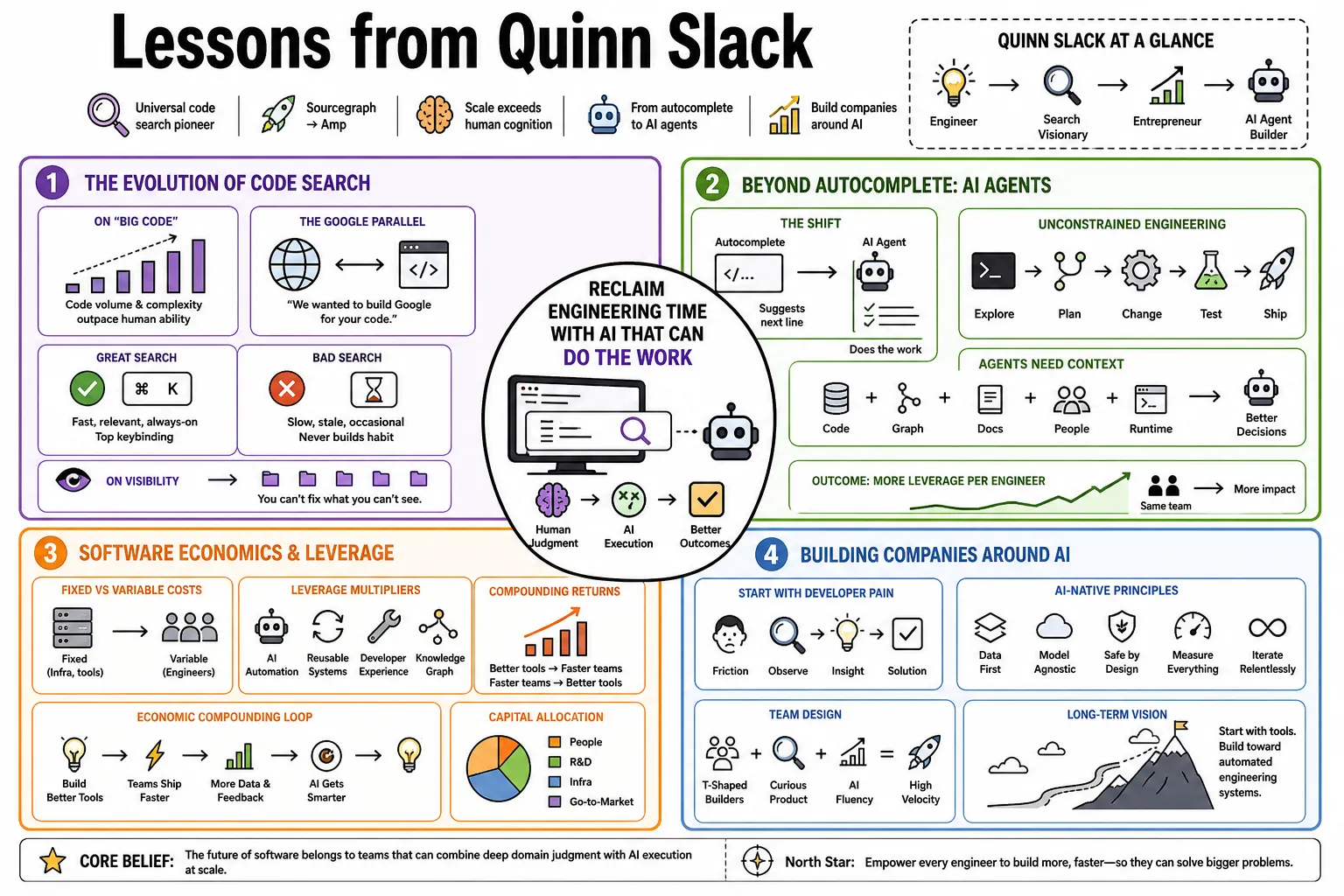
Lessons from Quinn Slack
As the co-founder of Sourcegraph, Quinn Slack brought universal code search to enterprise engineering teams before launching the AI agent company Amp. He argues developer tools need to move past basic autocomplete and start doing unconstrained engineering work. This profile tracks his views on software economics, the cognitive limits of managing massive codebases, and how to build companies around AI.
Part 1: The Evolution of Code Search
- On "Big Code": "The volume and complexity of code are growing faster than human ability to manage it, necessitating tools like universal code search." — Source: EnterpriseReady Podcast
- On the Google parallel: "We wanted to build Google for your code. For developers leaving companies like Google or Facebook, code search is the tool they miss most." — Source: The Craft of Open Source
- On great search: "Great code search is so fast and relevant that you use it constantly while coding. It’s one of your top keybindings." — Source: slack.org
- On bad search: "Bad code search is slow and stale, and you only find it useful a few times per week, which means you never build the muscle memory." — Source: slack.org
- On visibility: "You can't fix what you can't see. Universal code search gives developers the power to instantly see how their code interacts with the entire system." — Source: Sourcegraph Blog
- On enterprise complexity: "The real pain point in large organizations isn't writing the first line of code, it's understanding the million lines that already exist." — Source: EnterpriseReady Podcast
- On the need for insights: "We built Code Insights because engineering leaders needed a way to track trends, like migration progress or vulnerability exposure, across massive codebases over time." — Source: Sourcegraph Blog
- On code as a graph: "Understanding code isn't just about reading text; it's about navigating the interconnected graph of dependencies, references, and definitions." — Source: Sourcegraph 2.0 Announcement
- On early motivations: "I wanted to make coding accessible to more people because a world where everyone codes means more technological progress that benefits more people." — Source: slack.org
Part 2: The Agentic Shift
- On the "nasty, brutish, and short" era: "The current iteration of coding agents is nasty, brutish, and short. It’s like back when there were 15 DVCSes... people are working toward a higher-level platform." — Source: slack.org
- On moving past autocomplete: "We are moving past the 'ghost text' era of simple autocomplete into an era of unconstrained coding agents that can autonomously handle complex, multi-step tasks." — Source: Latent Space Podcast
- On the death of the sidebar: "The sidebar assistant model is becoming obsolete. The future is about agent factories that run in the background." — Source: Raising an Agent Podcast
- On vibe coding: "Vibe coding—where you literally don’t look at the code and you just build stuff by prompting—that’s been a dud. You have to express unambiguously what you want." — Source: slack.org
- On cognitive limits: "Using coding agents well is taking every inch of my 25 years of experience. I can fire up four agents in parallel... and by 11am I am wiped out for the day. There is a limit on human cognition." — Source: Raising an Agent Podcast
- On iterating agents: "The shift is toward AI that doesn't just answer questions, but can iterate, test, and fix its own work until it meets a specific goal." — Source: Open Source Ready Podcast
- On breaking rules for agents: "With Amp, we pushed to main, no code review. We’ve had one synchronous meeting in the entire history of the project. We’re breaking all the rules to build for this new era." — Source: slack.org
- On the baby bird analogy: "Early AI was like a baby bird in the nest, tweeting while you spit food into its mouth. Now, the view is that it's a big bird that can catch its own food." — Source: Raising an Agent Podcast
- On AI written code volume: "90% of code is being written by AI... we’re not going to have a monopoly in models anymore." — Source: slack.org
- On subagents: "We believe that complex hierarchies of subagents and prompt optimizers are not the right direction for the future of coding. Direct, unconstrained agency is." — Source: Latent Space Podcast
Part 3: The Importance of Context in AI
- On the objective function: "AI devs need an objective function, f(code). The best AI dev is the one with the best f(code)." — Source: slack.org
- On what defines the best agent: "The best f(code) comes from having the most comprehensive context... context is the most important part of an AI dev." — Source: slack.org
- On equalizing LLMs: "Assuming equal access to equally capable, cheap, and fast LLMs, everything else about an AI dev is undifferentiated except for its context and objective function." — Source: slack.org
- On deep context: "To evaluate code effectively, an AI needs more than just the file it's in. It needs the entire codebase, documentation, test suites, logs, and even UI screenshots." — Source: Software Engineering Daily
- On the true bottleneck: "The bottleneck for AI isn't the model's inherent intelligence anymore; it's the quality and breadth of the context provided to it." — Source: Software Engineering Daily
- On reducing hallucinations: "By integrating AI assistants directly with the 'Code Graph,' you ground the model in the actual reality of your codebase, dramatically reducing hallucinations." — Source: Sourcegraph Blog
- On enterprise realities: "The real value of AI coding will be realized in the enterprise, where codebases are simply too large for any single human to fully understand without contextual AI assistance." — Source: Open Source Ready Podcast
- On the alien technology: "Current AI is like an alien technology that has landed on Earth. It hasn't been fully integrated into the enterprise yet due to security concerns and behavioral inertia." — Source: Open Source Ready Podcast
- On adoption rates: "Despite the massive hype, only about 5% of professional developers are currently using AI tools effectively to change their core workflows." — Source: Open Source Ready Podcast
Part 4: The Economics and Pricing of AI
- On traditional SaaS pricing: "The high cost of AI inference makes 'all-you-can-eat' subscription models, like traditional SaaS, unsustainable for deep agentic work." — Source: Open Source Ready Podcast
- On perverse incentives: "Subscription-based pricing might make bad agentic products. If you're paying $20/month, the provider is incentivized to make the agent use fewer tokens, which makes it dumber." — Source: Open Source Ready Podcast
- On incentivizing intelligence: "We need an economic model where the agent provider is financially incentivized to make the agent as smart and thorough as possible, not to cut corners on compute." — Source: Open Source Ready Podcast
- On ad-supported AI: "Ads might be necessary to make high-end AI coding agents accessible to everyone for free, because the underlying compute costs are simply too high for traditional freemium models." — Source: Open Source Ready Podcast
- On the speed of change: "Everyone who's buying coding agents for a big company wants it to slow down... But I don't think things are slowing down. I think things are speeding up." — Source: Open Source Ready Podcast
- On the end of moats: "Everything is changing so fast... nobody has a moat anymore. It is easier than ever before to get into a new market or to build a new feature." — Source: slack.org
- On the democratization of development: "A world where everyone can conjure up code means we lower the barrier to entry so much that it resembles how the printing press democratized reading and writing." — Source: AI Native Dev Podcast
- On massive leverage: "AI will enable tiny teams, or even solo individuals, to build and maintain massive software systems that previously required hundreds of engineers." — Source: AI Native Dev Podcast
- On the unbounded demand for software: "AI will not eliminate developer jobs. The world's demand for software is unbounded. Automating tasks simply allows us to build more, faster." — Source: Open Source Ready Podcast
Part 5: Rethinking Developer Workflows
- On shipping velocity: "With Amp, we found ourselves shipping 15 times a day. When the AI writes and tests the code perfectly, the bottleneck becomes human hesitation." — Source: Latent Space Podcast
- On code reviews: "As AI gets better at evaluating code—when its f(code) surpasses the 80th percentile human—traditional human code review and slow CI processes will become obsolete." — Source: slack.org
- On asynchronous coding: "We need to move away from staring at a cursor. You should be able to hand off complex tasks to an agent and review the results asynchronously." — Source: Raising an Agent Podcast
- On the skill of programming: "At a certain point, you have to express unambiguously what you want to a computer. That fundamental requirement remains the core skill of a programmer." — Source: slack.org
- On the joy of coding: "All boredom forever vanished from my life because there was just so much to do and learn on the computer—thankfully, this was before the internet was optimized for wasting attention." — Source: slack.org
- On feedback loops: "A developer’s momentum is entirely dictated by the speed of their feedback loop. If it takes twenty minutes to run CI, you lose the thread." — Source: EnterpriseReady Podcast
- On testing reality: "It doesn't matter how good the code looks if you can't run it in a real environment to see what it actually does. Execution is the ultimate truth." — Source: Software Engineering Daily
- On early career lessons: "Being the first developer at a startup like Bleacher Report teaches you that perfect architecture is useless if the site crashes under load. You build what survives." — Source: The Craft of Open Source
- On managing "Big Code": "Big Code means you can no longer hold the entire system architecture in your head. You must rely on tooling to navigate the unknown." — Source: EnterpriseReady Podcast
- On continuous migration: "Code is never finished. It is in a state of continuous migration. The tools we use must acknowledge and support this constant state of flux." — Source: Sourcegraph Blog
Part 6: Radical Transparency and Company Culture
- On public handbooks: "Making your company handbook public isn't just about transparency; it's a mechanism that forces you to document your culture rather than relying on folklore." — Source: The Craft of Open Source
- On "open process": "We advocate for open process over just open code. Showing how the work is done—the PRs, the issues, the debates—builds more trust than the final repository." — Source: Agent Community Podcast
- On doing the right thing: "Transparency forces a company to do the good thing, simply because their actions, decisions, and mistakes are visible to the public and potential hires." — Source: Agent Community Podcast
- On the "open core" model: "An open core model lowers the barrier to entry. It allows developers to self-host and inspect the tool without needing to send their proprietary code off-network." — Source: Medium
- On remote-first culture: "We went all-remote long before it was forced upon the industry because we realized the best talent isn't geographically constrained to a thirty-mile radius in the Bay Area." — Source: Business Insider
- On location-independent pay: "We pay based on US-market salary data, regardless of where an employee lives. It’s expensive, but it allows us to hire the absolute best people worldwide without penalizing them for their zip code." — Source: Business Insider
- On asynchronous work: "To support a truly global team, you must emphasize asynchronous communication and rigorous documentation over real-time meetings and syncs." — Source: Business Insider
- On social coding: "Development shouldn't happen in a vacuum. We want to make the interaction between developers and AI agents visible, shareable, and collaborative." — Source: Tessl
- On trusting developers: "If you build a product for developers, you have to treat them like intelligent peers. You can't hide your roadmap or obfuscate your pricing." — Source: The Craft of Open Source
Part 7: Challenging Founder Folklore
- On ignoring standard advice: "Founders must ignore traditional advice like 'slow down for compliance' or 'step away from the code.' In the AI era, you have to stay deep in the weeds." — Source: Heavybit Talk
- On staying "radical": "To survive the current technological shift, you have to stay full joker and radical. The safe, enterprise-playbook approach will get you killed." — Source: Heavybit Talk
- On speed as strategy: "If there’s ever been a time to grind, it’s now. In the last 5 years, there was wisdom around 'let’s not burn out.' But everything is changing so fast—now is the time to go, go." — Source: slack.org
- On feedback vs. faith: "There is a deep tension between listening to your users and having the conviction to build a vision that your users can't yet articulate." — Source: slack.org
- On the illusion of safety: "Startups often build faux moats through compliance or enterprise bloat. But when a 10x better AI tool comes along, those moats evaporate overnight." — Source: Heavybit Talk
- On working with AI: "Building AI tools means you have to use them to build the tools. You have to experience the friction firsthand to understand what needs to be fixed." — Source: Latent Space Podcast
- On early-stage focus: "When you are building a new paradigm, you don't need a massive team. You need a few obsessive engineers who are willing to rewrite the core engine daily." — Source: Raising an Agent Podcast
- On the value of Palantir experience: "Working as a forward-deployed engineer teaches you that the real world is incredibly messy, and software only matters if it actually solves the messy problem on the ground." — Source: me.sh Profile
- On starting young: "My early career taught me that you don't need permission to build systems that matter. You just need to sit down and write the code." — Source: Enterprisers Project
Part 8: Building for the Unbounded Future
- On Stanford lessons: "The most valuable part of studying computer science wasn't the syntax, but learning how to systematically decompose incredibly hard problems into solvable components." — Source: Clay Profile
- On continuous learning: "The computer is the ultimate machine for curiosity. As long as you maintain that curiosity, the industry will never outpace you." — Source: slack.org
- On agent orchestration: "In the future, a senior engineer's job will look more like a manager orchestrating a team of highly capable, specialized AI agents." — Source: Raising an Agent Podcast
- On open vs. closed models: "While proprietary models have their place, the open-source community will ultimately commoditize raw intelligence. The differentiation will be in how that intelligence is applied." — Source: Latent Space Podcast
- On the new abstraction layer: "Every decade we build a higher abstraction layer. Assembly to C, C to Python, and now, code to agentic intent. We are moving up the stack." — Source: AI Native Dev Podcast
- On empowering the individual: "The goal of all this tooling isn't to replace the human, but to give the individual developer the leverage of an entire engineering department." — Source: Software Engineering Daily
- On the fallacy of 'AI will replace us': "People who think AI will write all the software don't realize how much software we still want but can't afford to write today." — Source: Open Source Ready Podcast
- On fixing the enterprise: "Enterprise software is notoriously bad because it's hard to refactor massive legacy systems. AI agents will finally give us the capacity to rewrite the world's legacy code." — Source: Sourcegraph Blog
- On the next ten years: "The next decade of software engineering will be entirely unrecognizable compared to the last. The tools, the economics, and the day-to-day workflow are all being rewritten right now." — Source: Heavybit Talk
- On the core mission: "Ultimately, we want a world where anyone with an idea can conjure the software needed to bring it to life, instantly and perfectly." — Source: slack.org