Rahul Moodgal is a veteran business development executive and investor relations professional who has led capital raising for major hedge funds like TCI and Parvus Asset Management. He built a reputation in the financial industry by rejecting high-pressure sales tactics in favor of a slow, relationship-first approach to working with institutional allocators. This profile compiles his frameworks on capital raising, relationship building, and philanthropic work, offering a guide for professionals navigating high-stakes business environments.
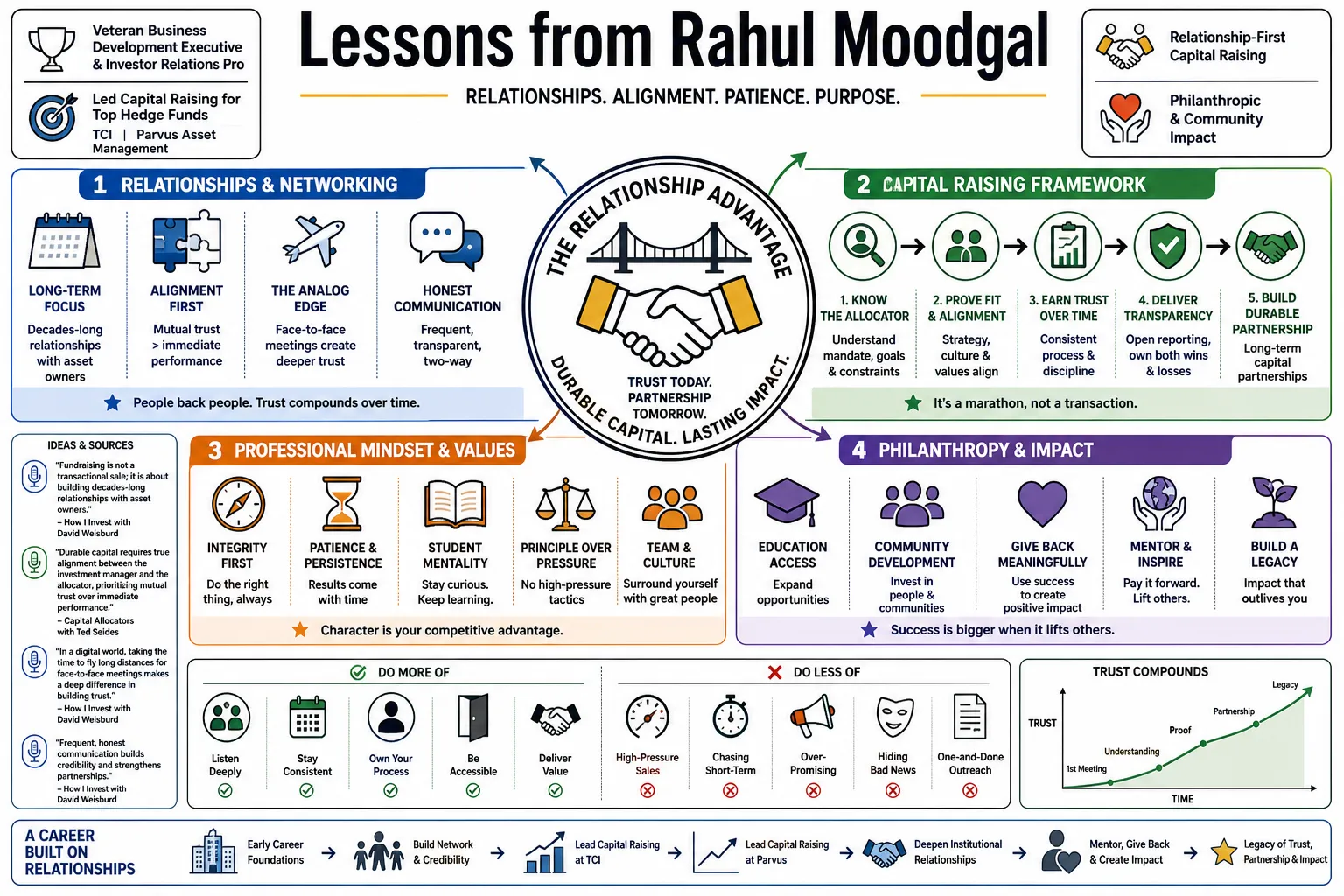
Part 1: Relationships and Networking
- On long-term focus: "Fundraising is not a transactional sale; it is about building decades-long relationships with asset owners." — Source: How I Invest with David Weisburd
- On alignment: "Durable capital requires true alignment between the investment manager and the allocator, prioritizing mutual trust over immediate performance." — Source: Capital Allocators with Ted Seides
- On the analog touch: "In a digital world, taking the time to fly long distances for face-to-face meetings makes a deep difference in building trust." — Source: How I Invest with David Weisburd
- On communication: "Frequent, honest communication—especially during periods of underperformance—solidifies a relationship far more than celebrating the wins." — Source: Capital Allocators with Ted Seides
- On pitching: "Most people pitch performance. The most effective capital raisers pitch the durability of the partnership and the integrity of the process." — Source: How I Invest with David Weisburd
- On human connection: "Investors are ultimately investing in people. The relationship must transcend the numbers." — Source: Careers Unwrapped
- On patience: "It can take years to convert an initial meeting into an allocation. Patience is the ultimate differentiator in capital raising." — Source: Capital Allocators University
- On authenticity: "Being exactly who you are, without a facade, allows institutional investors to gauge your true character." — Source: Careers Unwrapped
- On active listening: "Listening to an allocator's specific needs and constraints is far more valuable than delivering a rehearsed pitch." — Source: How I Invest with David Weisburd
- On shared values: "The strongest relationships are forged when the fund and the investor share fundamental values about business and impact." — Source: Mondrian Alpha
Part 2: The Art of Capital Raising
- On flipping the script: "Flipping traditional fundraising on its head means stopping the 'hard sell' and starting a genuine conversation about mutual fit." — Source: How I Invest with David Weisburd
- On opening with negatives: "Opening a meeting by discussing the fund's weaknesses or past mistakes builds immediate credibility." — Source: How I Invest with David Weisburd
- On capacity discipline: "Raising $20 billion in three and a half years at TCI required immense discipline in managing capacity and expectations." — Source: Capital Allocators with Ted Seides
- On institutional capital: "Endowments, foundations, and sovereign wealth funds operate on multi-decade timelines; your pitch must reflect that same horizon." — Source: How I Invest with David Weisburd
- On product launches: "The success of historical launches, like the $1 billion TCI New Horizon fund, hinged on clear narratives and pre-established trust." — Source: Mondrian Alpha
- On continuous education: "Capital raisers must act as educators, helping allocators truly understand the strategy rather than just selling it." — Source: Capital Allocators University
- On the role of IR: "Investor relations is not a back-office function; it is a critical, strategic pillar of the firm's overall success." — Source: Capital Allocators with Ted Seides
- On scale and focus: "Raising significant capital requires maintaining strict focus on the firm's core competency and not diluting the message." — Source: Accelerating Excellence Podcast
- On rejection: "A 'no' is rarely permanent. It often just means 'not right now,' and maintaining the relationship is key for the future." — Source: Careers Unwrapped
- On long-term vision: "Every capital-raising strategy should be engineered backward from where the firm wants to be in twenty years." — Source: How I Invest with David Weisburd
Part 3: Integrity and Transparency
- On radical honesty: "Transparency isn't a buzzword; it's the mechanism that protects the firm when performance inevitably dips." — Source: How I Invest with David Weisburd
- On hiding bad news: "The quickest way to destroy a multi-year relationship is to delay communicating bad news to an investor." — Source: Capital Allocators with Ted Seides
- On setting expectations: "If you set realistic, sometimes conservative expectations from day one, you build a foundation of trust that survives volatility." — Source: Careers Unwrapped
- On organizational culture: "A culture of integrity must permeate from the portfolio managers down to the back office for investors to truly believe in it." — Source: Capital Allocators with Ted Seides
- On reporting: "Investor letters and reports should be as transparent about the losers as they are boastful about the winners." — Source: How I Invest with David Weisburd
- On admitting mistakes: "Investors respect a manager who can point to a bad trade and articulate exactly what went wrong and why." — Source: Accelerating Excellence Podcast
- On due diligence: "Welcome deep due diligence from allocators; it is the best way to prove that the firm has nothing to hide." — Source: Mondrian Alpha
- On consistent messaging: "The story you tell in year one must be logically consistent with the story you tell in year five, regardless of market conditions." — Source: Capital Allocators University
- On character over track record: "A pristine track record means little if an allocator doubts the character of the people managing the money." — Source: How I Invest with David Weisburd
Part 4: Avoiding the "ESL" Trap
- On the ESL framework: "The three things that consistently destroy investment firms and careers are Ego, Speed, and use." — Source: Accelerating Excellence Podcast
- On ego: "When portfolio managers start believing their own hype, they stop listening to the market and to their investors." — Source: Capital Allocators with Ted Seides
- On speed: "Trying to grow AUM too quickly often leads to accepting misaligned capital that will flee at the first sign of trouble." — Source: How I Invest with David Weisburd
- On use (financial): "Excessive financial use might boost returns in the short term, but it introduces fatal fragility into a strategy." — Source: Accelerating Excellence Podcast
- On use (reputational): "Borrowing against your reputation by making promises you can't keep is a form of use that will eventually margin-call your career." — Source: Capital Allocators with Ted Seides
- On humility: "The antidote to ego is maintaining a deep humility about how difficult markets are to predict." — Source: Careers Unwrapped
- On sustainable growth: "Building a firm slowly with the right partners is far more durable than rapidly accumulating hot money." — Source: How I Invest with David Weisburd
- On self-awareness: "Recognizing when ego is driving a business decision rather than logic is a critical skill for senior leadership." — Source: Accelerating Excellence Podcast
- On risk management: "Avoiding the ESL trap is the qualitative side of risk management that doesn't show up in a spreadsheet." — Source: Capital Allocators University
Part 5: Patience and "The Analog Approach"
- On handwritten notes: "A handwritten note stands out precisely because it takes time and effort in an era of instant emails." — Source: How I Invest with David Weisburd
- On physical presence: "There is no substitute for sitting across a table from someone, breaking bread, and understanding their worldview." — Source: Careers Unwrapped
- On time as an asset: "Using time generously with clients signals that you value them beyond their immediate checkbook." — Source: Capital Allocators with Ted Seides
- On the slow build: "The most lucrative relationships are often the ones that took three to five years to materialize." — Source: How I Invest with David Weisburd
- On remembering details: "Analog relationship building means remembering the names of an allocator's children and asking about them years later." — Source: Careers Unwrapped
- On cutting through noise: "In an industry obsessed with speed and digital scale, the analog approach is the ultimate way to cut through the noise." — Source: Capital Allocators with Ted Seides
- On delayed gratification: "Capital raising requires massive delayed gratification; you plant seeds today that you won't harvest for half a decade." — Source: How I Invest with David Weisburd
- On deliberate friction: "Introducing slight friction—like requiring an in-person meeting before sharing certain documents—can actually increase perceived value." — Source: Capital Allocators University
- On legacy: "The analog approach builds a legacy of trust that outlasts any single fund or market cycle." — Source: Mondrian Alpha
Part 6: Learning from Mistakes and Resilience
- On failure: "You have to make mistakes, feel the pain of them, and then actively learn from them to progress in this industry." — Source: Careers Unwrapped
- On career pivots: "Resilience is often demonstrated by the ability to pivot completely when a chosen path proves to be a dead end." — Source: Careers Unwrapped
- On surviving drawdowns: "A fund's true character, and the quality of its IR team, is only revealed during severe drawdowns." — Source: Capital Allocators with Ted Seides
- On post-mortems: "Conducting honest post-mortems on failed pitches is just as important as analyzing losing trades." — Source: How I Invest with David Weisburd
- On adapting: "The capital raising environment constantly evolves; what worked in 2008 will not work today, requiring continuous adaptation." — Source: Capital Allocators with Ted Seides
- On taking ownership: "When something goes wrong, taking total ownership rather than blaming the market earns long-term respect." — Source: Accelerating Excellence Podcast
- On academic failures: "My diverse academic background included missteps that taught me more about my true capabilities than the easy wins." — Source: Careers Unwrapped
- On stress testing: "A career, much like a portfolio, needs to be stress-tested by adversity to ensure it is strong." — Source: How I Invest with David Weisburd
- On continuous improvement: "The day you stop learning from your mistakes is the day your career begins to plateau." — Source: Capital Allocators University
Part 7: Diverse Background and Education
- On unconventional paths: "An unconventional career path—spanning academia, music therapy, and bartending—provides a unique lens through which to view finance." — Source: Careers Unwrapped
- On broad study: "Studying across 19 different universities globally built a framework for understanding diverse cultures and institutional structures." — Source: iConnections
- On psychology in finance: "Training in counseling and music therapy provides invaluable tools for reading the room and understanding allocator psychology." — Source: Careers Unwrapped
- On breaking the mold: "The industry benefits immensely from people who don't fit the traditional mold of a finance graduate." — Source: Capital Allocators with Ted Seides
- On connecting dots: "A diverse background allows you to connect dots between seemingly unrelated concepts, a important skill in business development." — Source: How I Invest with David Weisburd
- On global perspective: "Living and studying in the UK, USA, Russia, and Japan strips away parochial thinking." — Source: iConnections
- On teaching: "Founding platforms like Capital Allocators University stems from a lifelong academic desire to teach and elevate the industry." — Source: Capital Allocators University
- On continuous curiosity: "Intellectual curiosity should not be confined to finance; reading widely makes you a better investor and a more interesting partner." — Source: Careers Unwrapped
- On empathy: "Working in roles like counseling builds deep empathy, which is surprisingly effective in the hard-nosed world of capital raising." — Source: Careers Unwrapped
Part 8: Philanthropy and Giving Back
- On the portfolio career: "A truly successful career is a 'portfolio career' that balances commercial achievements with active, hands-on philanthropy." — Source: Accelerating Excellence Podcast
- On youth development: "Supporting organizations like the British Exploring Society is about giving young people the resilience to face an unpredictable world." — Source: British Exploring Society
- On therapeutic care: "The Rahul Moodgal Prize at The Mulberry Bush highlights the essential, often overlooked, value of therapeutic work with traumatized children." — Source: The Mulberry Bush
- On personal legacy: "Raising £90,000 for St George's Hospital in memory of my father was a deeply personal demonstration of using networks for good." — Source: St George's Hospital Charity
- On hygiene poverty: "Involvement with The Hygiene Bank addresses fundamental human dignity, which is a prerequisite for any societal progress." — Source: The Hygiene Bank
- On STEM education: "Serving as Board Chair for Scientific Adventures for Girls is about breaking down systemic barriers for the next generation of women." — Source: Mondrian Alpha
- On meaningful giving: "Setting a prize amount at exactly £251 ensures the contribution carries specific, personal meaning rather than just being a round number." — Source: The Mulberry Bush
- On active board roles: "Philanthropy is more than writing checks; it requires the same strategic oversight and active board participation as a hedge fund." — Source: Capital Allocators with Ted Seides
- On accessible play: "Supporting The Triangle Playground ensures that urban youth have safe, community-driven spaces to simply be children." — Source: Mondrian Alpha
- On ultimate purpose: "The capital we raise in finance ultimately serves a purpose only if it enables us to give back and improve the communities around us." — Source: How I Invest with David Weisburd