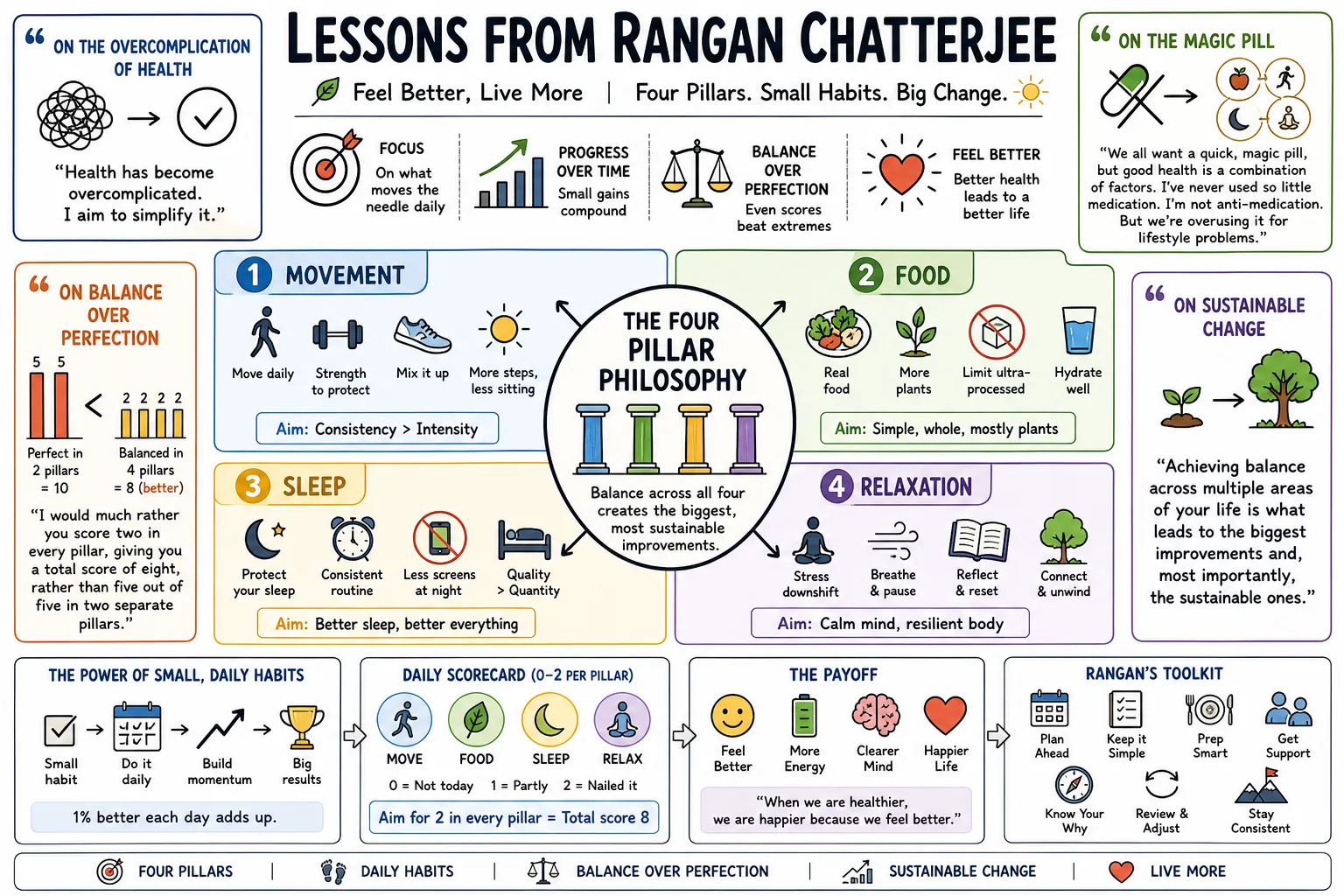
Lessons from Rangan Chatterjee
Dr. Rangan Chatterjee is a British physician, author, and host of the Feel Better, Live More podcast. He advocates for treating chronic issues with daily habits around food, movement, sleep, and relaxation rather than defaulting strictly to medication. This profile gathers his advice on using small, consistent lifestyle changes to treat disease and improve daily life.
Part 1: The Four Pillar Philosophy
- On the Overcomplication of Health: "Health has become overcomplicated. I aim to simplify it." — Source: [Dr. Rangan Chatterjee's Website]
- On the Magic Pill: "We all want a quick, magic pill, but good health is a combination of factors. I've never used so little medication. I'm not anti-medication. But we're overusing it for lifestyle problems." — Source: [Dr. Rangan Chatterjee's Website]
- On Balance Over Perfection: "I would much rather you score two in every pillar, giving you a total score of eight, rather than five out of five in two separate pillars." — Source: [The 4 Pillar Plan]
- On Sustainable Change: "Achieving balance across multiple areas of your life is what leads to the biggest improvements and, most importantly, the sustainable ones." — Source: [The 4 Pillar Plan]
- On Feeling Better: "When we are healthier, we are happier because when we feel better, we live more." — Source: [Feel Better, Live More Podcast]
- On Root Causes: "I could certainly give them a drug to suppress their symptoms, but I was failing to get to the actual root cause of their problems." — Source: [The 4 Pillar Plan]
- On Lifestyle as Treatment: "We are all familiar with the idea that lifestyle can be the cause of disease. What is less commonly known is that a change in lifestyle can also be the treatment." — Source: [The 4 Pillar Plan]
- On the Threshold Effect: "Many chronic issues stem from the accumulation of small stressors across the four pillars of health until the body's threshold is finally breached." — Source: [The 4 Pillar Plan]
- On Prevention: "A change in your daily habits can prevent you from getting sick in the first place, serving as the ultimate preventative medicine." — Source: [Feel Better, Live More Podcast]
Part 2: Food and Nutrition
- On Emotional Eating: "We used to eat to fill a hole in our stomachs, now we eat to fill a hole in our hearts." — Source: [Dr. Rangan Chatterjee's Website]
- On Sugar Normalization: "De-normalize sugar. It is hidden everywhere, and even small changes can successfully retrain your taste buds over time." — Source: [The 4 Pillar Plan]
- On Bliss Point Foods: "The modern food industry engineers foods with specific combinations of sugar, fat, and salt that are devastatingly tasty and lead to inescapable cycles of overconsumption." — Source: [Dr. Rangan Chatterjee's Website]
- On Eating the Rainbow: "Getting five different vegetables into your diet every single day will accelerate the process of optimizing your microbiome." — Source: [The 4 Pillar Plan]
- On the Speed of Gut Adaptation: "Your gut microbiome can begin to change and adapt within just two to three days of making deliberate dietary shifts." — Source: [Dr. Rangan Chatterjee's Website]
- On Nutrition and Mental Health: "Nutrition is just as vital to the fields of psychiatry and mental health as it is to cardiology and gastroenterology." — Source: [Dr. Rangan Chatterjee's Website]
- On Diagnostic Questions: "'What are you eating?' is the very first diagnostic question to ask when addressing issues of fatigue or low mood." — Source: [Feel Better, Live More Podcast]
- On the Low-Fat Fallacy: "The historical low-fat messaging led the public to replace satiating healthy fats with refined carbohydrates and sugars, inadvertently driving modern chronic disease." — Source: [The 4 Pillar Plan]
- On Ingredient Simplicity: "Focus your diet on high-quality, single-ingredient foods to keep blood sugar stable and prevent extreme energy crashes throughout the day." — Source: [Feel Better, Live More Podcast]
Part 3: Movement and Exercise
- On Daily Activity: "Humans are designed to move frequently throughout the day, rather than sitting in a chair for ten hours and then punishing themselves for forty-five minutes in a gym." — Source: [The 4 Pillar Plan]
- On Micro-Workouts: "You do not need a gym membership to stay fit; five minutes of deliberate movement in your kitchen or living room can be highly effective." — Source: [Feel Better in 5]
- On Walking: "Increasing your daily step count is one of the most accessible and effective interventions for improving both physical health and mental clarity." — Source: [The 4 Pillar Plan]
- On Strength Training: "Maintaining muscle mass as you age is a fundamental requirement for longevity and metabolic health, rather than a cosmetic goal." — Source: [Feel Better, Live More Podcast]
- On Movement as Medicine: "Physical activity acts as an anti-inflammatory and an antidepressant, often performing as well as pharmacological interventions for mild mood disorders." — Source: [Feel Better, Live More Podcast]
- On Sedentary Lifestyles: "Prolonged sitting sends physiological signals to your body that you are in a state of hibernation, shutting down essential metabolic processes." — Source: [The 4 Pillar Plan]
- On Functional Fitness: "True fitness is about having the physical capability to carry your groceries, play with your children on the floor, and live without physical limitation." — Source: [Dr. Rangan Chatterjee's Website]
- On Morning Movement: "Starting the day with a few minutes of stretching or light exercise sets a positive behavioral tone that cascades into better choices later in the day." — Source: [Feel Better in 5]
- On Redefining Exercise: "We need to stop viewing exercise as a chore to burn calories and start viewing it as a daily requirement for normal biological function." — Source: [Feel Better, Live More Podcast]
Part 4: Sleep and Restoration
- On the Value of Sleep: "Sleep is an undervalued component of our health. If you can improve the quality of your sleep, you dramatically improve the quality of your waking life." — Source: [Dr. Rangan Chatterjee's Website]
- On the Foundation of Health: "Good sleep is the foundational pillar of human health. Without it, no amount of perfect diet or exercise will function properly." — Source: [The 4 Pillar Plan]
- On the Sleep Epidemic: "We are currently living through an unacknowledged sleep deprivation epidemic that is driving the rise of modern chronic illnesses." — Source: [Dr. Rangan Chatterjee's Website]
- On Switching Off: "The inability to transition out of an anxious, busy state and switch off the mind is the single most common reason modern patients struggle with insomnia." — Source: [The 4 Pillar Plan]
- On Bedtime Routines: "Wind-down routines apply equally to adults, who require physical and environmental signals to tell their biology that it is time to rest." — Source: [Dr. Rangan Chatterjee's Website]
- On the Digital Sunset: "Turn off phones and laptops at least 90 minutes before bed to protect your brain's natural melatonin production from the disruption of blue light." — Source: [The 4 Pillar Plan]
- On Morning Light: "Paradoxically, a good night of sleep begins in the morning. Early exposure to natural sunlight is essential for setting your circadian rhythm." — Source: [Dr. Rangan Chatterjee's Website]
- On Consistency: "Waking up at roughly the same time every day, including weekends, keeps your internal body clock in harmony and prevents biological jet lag." — Source: [The 4 Pillar Plan]
- On Caffeine Curfews: "Because caffeine has a long half-life in the body, implementing a strict cutoff time by midday is necessary for achieving deep, restorative sleep." — Source: [Feel Better, Live More Podcast]
Part 5: Relaxation and Stress Management
- On Taking Time: "Every day, for at least fifteen minutes, be selfish, and enjoy some time for you." — Source: [The 4 Pillar Plan]
- On Reframing Stress: "There is plenty of fantastic evidence that shows we can gain huge benefits from altering the way we view our daily stresses." — Source: [The 4 Pillar Plan]
- On Micro-Stress Doses: "Our modern environment bombards us with invisible micro-stress doses that accumulate and keep our nervous system in a constant state of alarm." — Source: [Dr. Rangan Chatterjee's Website]
- On the Breath: "Deep, slow breathing is the most accessible tool humans possess to consciously switch off the sympathetic nervous system and engage the parasympathetic rest state." — Source: [Feel Better, Live More Podcast]
- On Screen-Free Time: "Implementing designated periods of digital detoxification allows the brain to recover from the constant dopamine spikes of modern technology." — Source: [The 4 Pillar Plan]
- On Nature: "Spending time in green spaces is a biological necessity that rapidly lowers cortisol levels and reduces blood pressure." — Source: [Feel Better, Live More Podcast]
- On Commotion: "Managing the mental commotion and sensory input of your environment is equally important for relaxation as taking physical rest." — Source: [The 4 Pillar Plan]
- On Stillness: "We have lost the art of doing nothing, treating every idle moment as an opportunity to consume content rather than allowing our minds to wander." — Source: [Dr. Rangan Chatterjee's Website]
- On Gratitude: "A daily practice of writing down simple things you are grateful for rewires the brain to scan the environment for positives rather than threats." — Source: [Feel Better in 5]
Part 6: Mental Health and Core Happiness
- On Mental Prisons: "The greatest prison you'll ever live in is the prison you create inside your mind." — Source: [Happy Mind, Happy Life]
- On Practicing Happiness: "If you practice happiness a little bit, you'll become a little bit happier. If you practice a lot, you'll become transformed." — Source: [Happy Mind, Happy Life]
- On Happiness and Health: "What if health wasn't just about your body, but also about how happy you feel every day? ... Happiness isn't simply the reward for a healthy life; it's a major driver of good health." — Source: [Happy Mind, Happy Life]
- On Junk Happiness: "Society trains us to pursue junk happiness through fleeting dopamine hits from purchases or validation, which ultimately leaves us emptier than before." — Source: [Happy Mind, Happy Life]
- On Core Happiness: "True resilience is built upon core happiness, which is structurally supported by the three pillars of contentment, control, and alignment with your values." — Source: [Happy Mind, Happy Life]
- On Happiness as a Practice: "Happiness is not an outcome, but a practice. It is the foundation that shapes how we meet each moment." — Source: [Happy Mind, Happy Life]
- On Identity Change: "You can change who you are at any time. You are not destined to be the person you were yesterday." — Source: [Dr. Rangan Chatterjee's Website]
- On Social Connection: "Loneliness acts as a physical stressor on the body. Nurturing meaningful relationships is a biological requirement for human health." — Source: [Feel Better, Live More Podcast]
- On Alignment: "When your daily actions fail to align with your deeply held personal values, the resulting friction creates chronic psychological stress." — Source: [Happy Mind, Happy Life]
- On Emotional Processing: "Suppressing negative emotions requires immense biological energy, whereas acknowledging them allows the body to release physiological tension." — Source: [Feel Better, Live More Podcast]
Part 7: The Roots of Disease and Lifestyle Medicine
- On the Limits of the 15-Minute Consultation: "The traditional medical model, built around rushed appointments, is structurally incapable of treating complex, lifestyle-driven chronic diseases." — Source: [Dr. Rangan Chatterjee's Website]
- On the Illusion of Genetics: "While genetics load the gun, it is your daily environment and lifestyle choices that actually pull the trigger for most modern illnesses." — Source: [Feel Better, Live More Podcast]
- On Empowering Patients: "The goal of a doctor should be to empower patients with the knowledge to manage their own health, rather than fostering dependence on care." — Source: [Dr. Rangan Chatterjee's Website]
- On Inflammation: "Chronic, low-grade inflammation is the common biological denominator linking depression, heart disease, type 2 diabetes, and cognitive decline." — Source: [Feel Better, Live More Podcast]
- On the Gut-Brain Axis: "The communication highway between the microbiome and the brain means that treating digestive issues often simultaneously resolves anxiety and brain fog." — Source: [The 4 Pillar Plan]
- On Medical Training: "Doctors are highly trained in acute care and pharmacology, but historically receive almost zero education on nutrition, sleep, or stress management." — Source: [Feel Better, Live More Podcast]
- On the Epidemic of Fatigue: "Feeling tired all the time is one of the most common complaints in general practice, and it is rarely solved by a blood test or a prescription." — Source: [Dr. Rangan Chatterjee's Website]
- On Individual Biochemistry: "There is no single perfect diet or routine. Lifestyle medicine relies on recognizing the unique biochemical individuality of every patient." — Source: [Feel Better, Live More Podcast]
- On Healing Environments: "Creating a home and work environment that naturally defaults to healthy choices is far more effective than relying on sheer willpower." — Source: [Dr. Rangan Chatterjee's Website]
- On the Future of Medicine: "Progressive medicine must shift its focus from managing symptoms of decline to actively optimizing the functional health span of patients." — Source: [The 4 Pillar Plan]
Part 8: Daily Habits and Mindset
- On Daily Reflection: "Ask yourself daily: What have I done today to make someone else happy? What has someone else done today to make me happy? What have I learned today?" — Source: [The 4 Pillar Plan]
- On Frictionless Habits: "If you want to build a new healthy habit, you must remove the friction by attaching the new behavior to an anchor habit you already perform daily." — Source: [Feel Better in 5]
- On the 5-Minute Rule: "You can profoundly shift your physical and mental state by committing to just five minutes of a positive practice, bypassing the brain's resistance to large tasks." — Source: [Feel Better in 5]
- On the Power of Saying No: "Learning to decline non-essential commitments is an act of preventative healthcare that preserves your energy for your core priorities." — Source: [Happy Mind, Happy Life]
- On Compassion: "True health requires replacing self-criticism with self-compassion, recognizing that harsh internal dialogue acts as an inflammatory stressor." — Source: [Feel Better, Live More Podcast]
- On the Information Diet: "The news and media you consume daily shape your nervous system as literally as the food you eat shapes your biology." — Source: [Dr. Rangan Chatterjee's Website]
- On Consistency over Intensity: "A gentle, consistent daily walk will always outperform a high-intensity gym routine that you abandon after three weeks." — Source: [Feel Better in 5]
- On Joyful Movement: "If you hate a particular exercise, do not do it. Find a physical activity that brings you joy, or you will never sustain it." — Source: [Feel Better, Live More Podcast]
- On Perfectionism: "The pursuit of the perfect health routine is the enemy of actual health, as stress over doing things perfectly often negates the benefits of the behavior itself." — Source: [Dr. Rangan Chatterjee's Website]
- On the Long Game: "Health is not a 30-day challenge or a destination to reach, but rather the lifelong practice of tuning into your body's changing signals." — Source: [Feel Better, Live More Podcast]