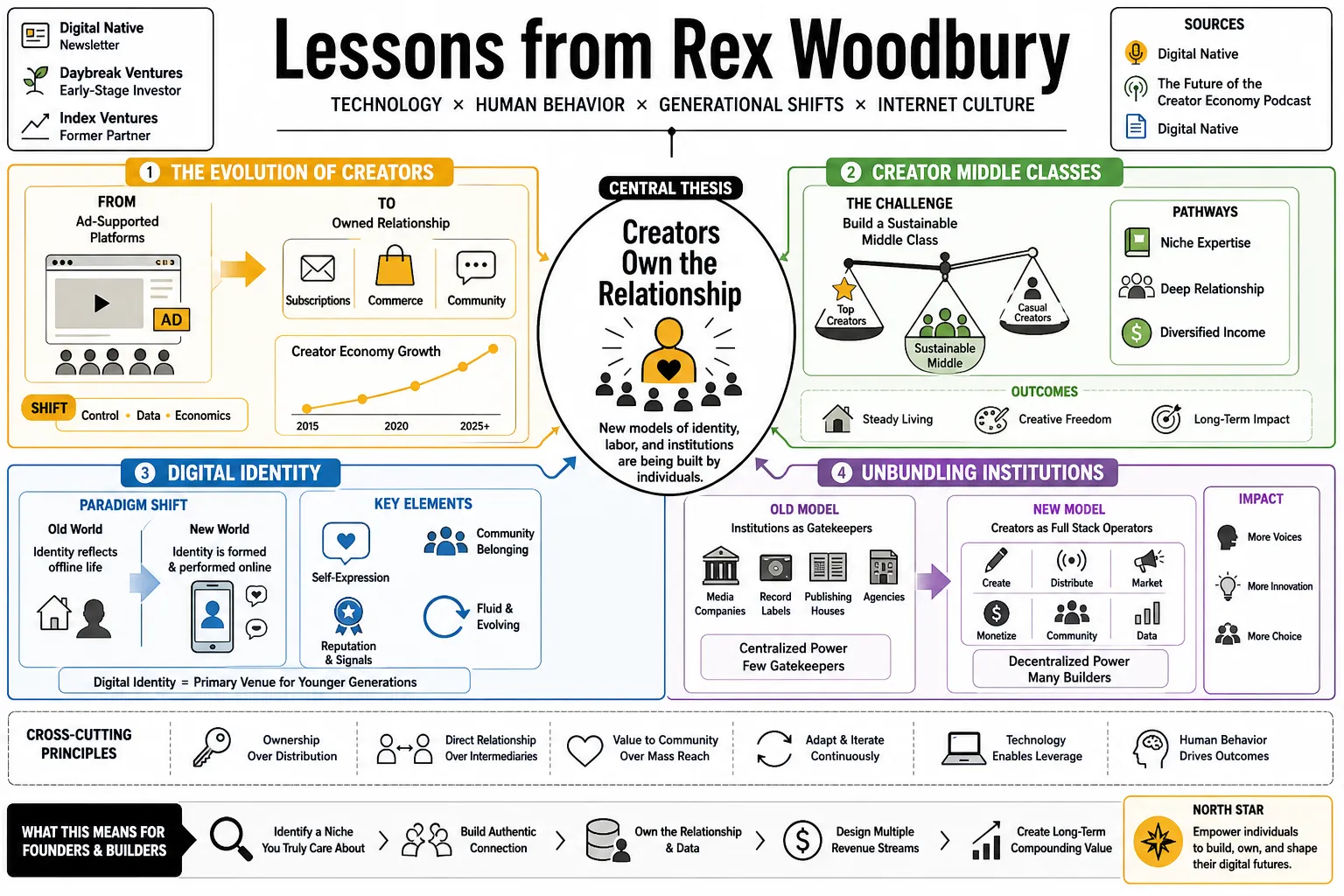
Lessons from Rex Woodbury
Rex Woodbury tracks the intersection of technology and human behavior through his Digital Native newsletter and early-stage investments at Daybreak Ventures. Drawing on his current fund and his prior work at Index Ventures, this profile gathers his observations on the generational shifts shaping consumer startups and internet culture.
Part 1: The Creator Economy and Digital Labor
- On The Evolution of Creators: "We are moving from a world where creators rely on ad-supported models to one where they own the direct relationship with their audience through subscriptions and commerce." — Source: Digital Native
- On creator income: Woodbury frames the creator economy around three linked jobs: making work, finding an audience, and getting paid. The strongest opportunities are tools that help creators move through that whole stack, not just publish more content. — Reference: Digital Native essay on the evolution of the creator economy
- On Digital Identity: "For younger generations, digital identity is no longer a reflection of offline life; it is the primary venue where identity is formed and performed." — Source: Digital Native
- On unbundling institutions: Woodbury's creator thesis starts with distribution: influence used to be filtered through labels, editors, and studio executives, while online networks let individuals build communities directly. — Reference: Digital Native essay on creator distribution and gatekeepers
- On monetization friction: Woodbury sees creator commerce as an infrastructure problem: creators need easier ways to turn trusted taste into storefronts, brands need better acquisition, and consumers need less clunky discovery-to-checkout paths. — Reference: Digital Native essay on the future of creator commerce
- On creator ownership: Woodbury's broader point is that internet platforms shift more cultural and commercial power to individuals; the durable opportunity is giving creators tools to own more of the relationship with their audience. — Reference: CreatorIQ interview with Rex Woodbury on creator power and communities
- On Curation as Creation: "In a world of infinite content, curation becomes a highly valuable form of creation. Tastemakers are the new broadcasters." — Source: Digital Native
- On the business of influence: Woodbury's influence thesis favors depth over celebrity scale: smaller creators can feel more authentic, build higher engagement, and carry recommendations that audiences actually trust. — Reference: CreatorIQ interview with Rex Woodbury on micro- and nano-influencers
- On creator operations: Woodbury's business-in-a-box lens applies beyond content tools: self-directed workers need software for admin, discovery, payments, and operations so a creative or small business can actually run. — Reference: Digital Native essay on business-in-a-box infrastructure
- On Audience Portability: "Creators are realizing the danger of platform dependency and are actively moving toward tools that allow them to port their audiences across the internet." — Source: Digital Native
Part 2: Gen Z and Shifting Consumer Behavior
- On Generational Shifts: "Gen Z is the first generation to grow up entirely immersed in the mobile internet, fundamentally altering their expectations for speed, authenticity, and interface design." — Source: Digital Native
- On discovery habits: Woodbury treats social platforms as discovery engines for culture and commerce, which means consumer startups have to learn how people browse, share, and buy inside social feeds. — Reference: Digital Native essay on social channels and modern commerce
- On Authenticity: "The aesthetic of the internet has moved to something raw, unfiltered, and casually authentic as a direct reaction against the pressure of early social media." — Source: Digital Native
- On social commerce: Woodbury's commerce thesis is that online shopping is moving from pure search toward discovery: trusted creators and social contexts can recreate some of the browsing and curation that older retail formats provided. — Reference: Digital Native essay on creator commerce and discovery-driven shopping
- On niche communities: Woodbury's community thesis is that the internet rewards specificity: even narrow interests can gather large, active groups when distribution is no longer limited by geography or mass-media taste. — Reference: Digital Native essay on internet communities and niche scale
- On Brand Loyalty: "Gen Z buyers buy into a brand's ethos, sustainability practices, and the community it fosters." — Source: Digital Native
- On meme culture: Woodbury treats memes as compressed cultural infrastructure: they reflect culture, magnify it, and help create it, which makes them useful signals for how internet-native behavior spreads. — Reference: Digital Native essay on memes as atomic units of culture
- On Financial Literacy: "We are seeing a democratization of financial education, driven largely by creators who are demystifying investing and wealth-building for younger audiences." — Source: Digital Native
- On the metaverse: Woodbury frames the metaverse less as a single headset category and more as a shift toward persistent digital spaces where work, identity, community, and status can become more immersive. — Reference: Digital Native essay on creator throughlines and metaverse examples
- On Entertainment: "The distinction between gaming and socializing has dissolved. Games like Roblox and Fortnite are primary social networks for the next generation." — Source: Digital Native
Part 3: Venture Capital and Early-Stage Investing
- On High Conviction: "Early-stage investing requires a willingness to be misunderstood. You have to back founders when their ideas still look like toys or fringe behaviors." — Source: Daybreak Ventures
- On thesis-driven investing: Woodbury argues that a venture firm can be thesis-informed without becoming thesis-blind: the thesis helps prepare the investor, but founders closest to the problem are often pulling the market forward. — Reference: Digital Native essay on early-stage investing craft
- On consumer startups: Woodbury sees consumer investing as difficult but cyclically mispriced: when a category falls out of favor, new platforms like AI can create openings for products that feel personal, habitual, and socially native. — Reference: Digital Native essay on AI and consumer technology
- On founder-market fit: Woodbury uses founder-market fit as an evidence filter: teams with direct experience in the category can see product gaps, user behavior, and go-to-market details that outsiders miss. — Reference: Digital Native essay on creator commerce and founder-market fit
- On First Checks: "Writing the first check is about partnering with a founder at the messy stage, helping them turn a raw insight into a scalable organization." — Source: Daybreak Ventures
- On Market Timing: "Many great consumer ideas fail simply because they are too early. The underlying infrastructure or consumer habits must be ready to support the product." — Source: Digital Native
- On growth metrics: Woodbury's early-stage lens starts with product sequencing and user pain: before scale tactics matter, a founder has to know which specific product wedge solves the clearest problem for the user. — Reference: Digital Native essay on early-stage investing questions
- On category intersections: Woodbury often looks for opportunities where categories overlap; in creator markets, for example, he argues that the strongest company ideas may sit at the intersection of commerce, gaming, social, and prosumer software. — Reference: Digital Native essay on creator-economy category intersections
- On Portfolio Construction: "Venture capital is a power-law game. You have to construct a portfolio with the belief that a single generational company will return the entire fund." — Source: Digital Native
- On Building in Public: "Transparency in venture capital is a competitive advantage. Sharing how we think helps us attract founders who align with our worldview." — Source: Daybreak Ventures
Part 4: Internet Culture and Community
- On Digital Third Places: "As physical community spaces decline, digital platforms are stepping in to serve as the third place between home and work where people socialize." — Source: Digital Native
- On fandom: Woodbury treats fandom as economic infrastructure: internet creators can build direct relationships with communities, then use new tools to formalize and monetize that trust. — Reference: Digital Native essay on the evolution of influencers
- On Nostalgia: "Internet culture moves so fast that nostalgia cycles have compressed. We now see trends from just a few years ago being repackaged and recycled." — Source: Digital Native
- On status games: Woodbury's throughline is that online platforms reshape status: the 2010s rewarded public performance through likes, retweets, and follower counts, while the 2020s push more status into communities and digital identity. — Reference: Digital Native essay on status, community, and digital identity
- On loneliness: Woodbury connects new social products to a loneliness problem, arguing that AI companions and creator-like chat interfaces are emerging because many people already seek intimacy and support online. — Reference: Digital Native essay on AI chatbots and loneliness
- On Algorithmic Feeds: "The shift from social graphs to interest graphs means content is now distributed based on merit and algorithmic matching rather than who you know." — Source: Digital Native
- On niche internet fame: Woodbury argues that online communities can be both narrow and enormous: with billions of people online, even highly specific interests can create meaningful audiences and local status. — Reference: Digital Native essay on internet communities and niche scale
- On Participatory Culture: "Audiences no longer want to just consume; they want to remix, respond, and participate in the creation of the media they consume." — Source: Digital Native
- On cultural fragmentation: Woodbury's cultural argument is that mainstream culture has weakened as internet culture became faster, messier, and more fragmented into subcultures with their own references and norms. — Reference: Digital Native essay on the decline of mainstream culture
- On Digital Identity Flexibility: "People maintain multiple personas online. They are one person on LinkedIn, another on Twitter, and someone entirely different on a pseudonymous forum." — Source: Digital Native
Part 5: E-commerce and Next-Generation Marketplaces
- On B2B marketplaces: Woodbury sees B2B commerce as a large, under-digitized market where marketplaces can move opaque phone, fax, and trade-show workflows into better online discovery and transaction systems. — Reference: Digital Native essay on the $100 trillion B2B marketplace opportunity
- On Vertical Marketplaces: "Broad horizontal platforms are being unbundled by vertical-specific marketplaces that offer tailored features and better community trust." — Source: Digital Native
- On marketplace trust: Woodbury's Faire case study shows that B2B marketplaces win by reducing relationship risk: better discovery, data-driven recommendations, referrals, payment terms, and returns make counterparties more willing to transact online. — Reference: Digital Native essay on B2B marketplace mechanics
- On managed marketplaces: Woodbury notes that some marketplaces create value by curating supply or adding workflow software, which makes the platform more than a neutral listing board. — Reference: Digital Native essay discussing managed NFT marketplaces
- On Resale and Circular Economy: "Sustainability is driving a massive boom in the resale market. Used goods are no longer stigmatized; they are celebrated for being unique and eco-friendly." — Source: Digital Native
- On fintech integration: Woodbury's Faire analysis shows how embedded payments, payment terms, and marketplace incentives can make B2B commerce easier while reducing the temptation for buyers and sellers to take transactions offline. — Reference: Digital Native essay on B2B marketplace infrastructure
- On supply-constrained markets: Woodbury treats resale as a software problem with stubborn supply friction: demand for secondhand products is strong, but cataloging inventory and managing transactions remain hard for sellers. — Reference: Digital Native essay on retail and resale software
- On Experiential Commerce: "Retail is moving from a transactional utility to an experiential destination. If a purchase can be automated, it will be; what remains must be engaging." — Source: Digital Native
- On global commerce: Woodbury frames modern commerce as a software-and-supply-chain problem, where brands depend on complex global movement of goods as much as on the storefront customers see. — Reference: Digital Native essay on launching a brand in 2024
Part 6: Health, Wellness, and Social Impact
- On Mental Health Tech: "We are finally seeing the stigma around mental health dissolve, paving the way for platforms that offer accessible digital-first therapy and coaching." — Source: Digital Native
- On Consumerizing Healthcare: "Patients want to be treated like consumers. They demand transparency, convenience, and modern interfaces in their healthcare experiences." — Source: Daybreak Ventures
- On LGBTQ+ Mentorship: "The internet provides a unique opportunity to connect marginalized youth with mentors who share their experiences, fundamentally changing life trajectories." — Source: Stanford GSB Alumni Insights
- On The Worthy App: "Building Worthy taught me that technology works best when it scales empathy and provides actionable support to those who need it most." — Source: Stanford GSB Alumni Insights
- On Preventative Care: "The healthcare system is shifting from reactive treatment to proactive wellness, driven by wearables, data tracking, and personalized medicine." — Source: Digital Native
- On healthcare timing: Woodbury's healthcare thesis is that large regulated markets can still become startup opportunities when consumer expectations, founder quality, and technology shifts collide. — Reference: Digital Native essay on the why now for healthcare
- On Loneliness Epidemic: "Startups addressing loneliness are building vital public health infrastructure." — Source: Digital Native
- On Sustainability: "Climate tech must move beyond enterprise compliance and integrate into everyday consumer decisions, making the sustainable choice the default choice." — Source: Daybreak Ventures
- On purpose-driven brands: Woodbury links Gen Z consumer behavior to values-driven companies, pointing to brands built around sustainability, social impact, and identity as evidence that purchasing can carry cultural meaning. — Reference: Digital Native essay on Gen Z characteristics
Part 7: The Future of Software and Work
- On AI in the Workplace: "Artificial intelligence will not replace workers; it will replace workers who do not use AI, acting as a copilot that amplifies human creativity." — Source: Digital Native
- On asynchronous work: Woodbury argues that remote work depends on collaboration tools as much as communication tools, with products like Notion, Figma, Front, Loom, Miro, and Tandem making distributed work more practical. — Reference: Digital Native essay on remote work and collaboration tools
- On the passion economy: Woodbury's creator-commerce thesis is that trusted creators can turn community and curation into real businesses when infrastructure lets them connect audiences, brands, and purchases. — Reference: Digital Native essay on creator commerce
- On No-Code Tools: "No-code platforms are democratizing software creation, allowing anyone with internet access to build complex applications without knowing how to write syntax." — Source: Digital Native
- On continuous learning: Woodbury argues that education has to become lifelong and job-relevant, with technology shifting learning away from one early-life block and toward ongoing reskilling. — Reference: Digital Native essay on startups transforming education
- On Consumerized Enterprise: "The best enterprise software today feels like consumer software. Employees won't tolerate clunky UI when they use seamless apps in their personal lives." — Source: Daybreak Ventures
- On distributed teams: Woodbury treats remote work as a tooling and behavior shift: distributed teams need software that supports collaboration, presence, and coordination rather than relying on the office to create those moments by default. — Reference: Digital Native essay on remote work's inflection point
- On Freelance Infrastructure: "As more workers opt for independence, there is a massive need for platforms that replicate the benefits of traditional employment, like insurance and community." — Source: Digital Native
- On the Chief Synthesizer: "The most valuable skill in the modern economy is the ability to synthesize overwhelming amounts of information and distill it into a clear, actionable narrative." — Source: Digital Native
Part 8: Writing, Storytelling, and Building in Public
- On Consistency in Writing: "Publishing every week forces you to clarify your thinking. The act of writing is how you discover what you actually believe." — Source: Digital Native
- On founder-market fit: Woodbury argues that broad startup opportunities are easier to unlock when founders have unusual depth in the market, because lived expertise helps them see problems outsiders miss. — Reference: Digital Native essay on founder-market fit
- On building an audience: Woodbury treats audience as distribution, but not as a substitute for substance: creator-led companies work when built-in reach is paired with authenticity, a unique product insight, and durability beyond the figurehead. — Reference: Digital Native essay on the evolution of the creator
- On authenticity: Woodbury's writing on internet perfection points toward a consumer shift away from over-polished self-presentation and toward formats that feel more candid, imperfect, and human. — Reference: Digital Native essay on the rejection of internet perfection
- On the Newsletter Boom: "The rise of Substack proves that readers are willing to pay for deep, high-quality, niche analysis that they can't get from legacy media." — Source: Digital Native
- On format innovation: Woodbury sees the definition of creator expanding across media, commerce, and community, which makes format choice part of the product: creators and companies have to adapt how they tell stories to the channels where audiences build trust. — Reference: Digital Native essay on the evolution of the creator
- On Empathy in Business: "Whether you are designing a product or writing an essay, success depends on your ability to deeply empathize with the end user's emotional state." — Source: Stanford GSB Alumni Insights
- On the Long Game: "Content creation and investing are both exercises in delayed gratification. You plant seeds today knowing you might not see the harvest for years." — Source: Daybreak Ventures