Lessons from Ric Elias
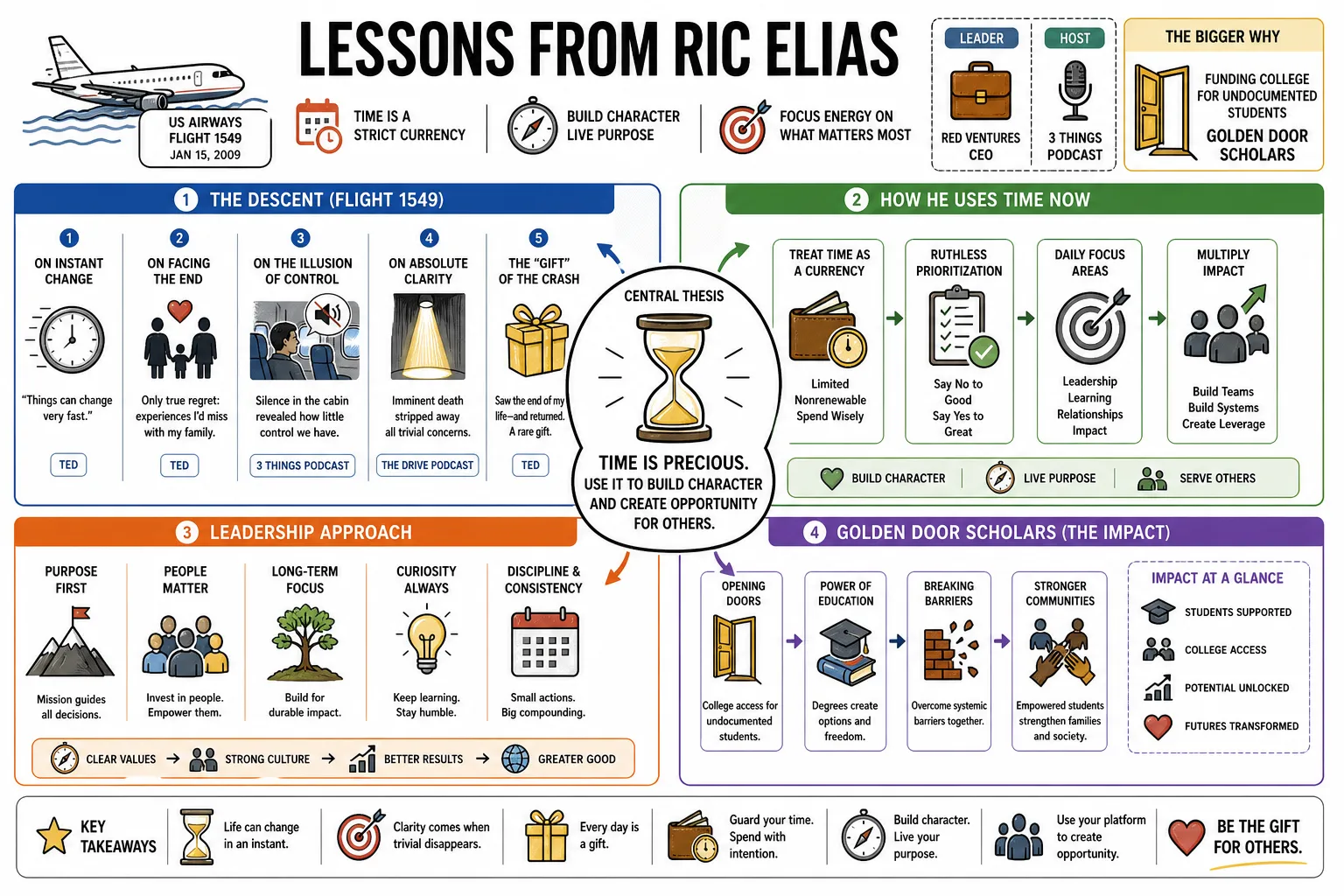
Surviving the 2009 crash of US Airways Flight 1549 clarified exactly how Ric Elias wants to spend his time. The Red Ventures CEO and 3 Things podcast host now treats time as a strict currency, focusing his energy on building character and running a purpose-driven business. This profile covers his approach to meaningful leadership and his work funding college for undocumented students through Golden Door Scholars.
Part 1: The Descent (Flight 1549)
- On instant change: "Things can change very fast. In an instant, everything you know can disappear." — Source: TED
- On facing the end: As the plane went down, he realized his only true regret was the experiences he would miss with his family. — Source: TED
- On the illusion of control: The silence inside the cabin as the engines failed was a stark reminder of how little control we actually have over our fate. — Source: 3 Things Podcast
- On absolute clarity: The prospect of imminent death stripped away all trivial concerns, leaving only the bare essence of what mattered. — Source: The Drive Podcast
- On the "gift" of the crash: He views surviving the crash as a rare gift—the ability to see the end of his life and then return to live differently. — Source: TED
- On emotional weight: He noted that the descent was completely silent, a terrifying contrast to the chaotic noise of normal daily life. — Source: TED
- On shifting focus: Before the crash, his mind was occupied by business deals; during it, his mind was solely on his children. — Source: The Drive Podcast
- On returning to normal: The hardest part of surviving was figuring out how to live in the mundane world after experiencing such a massive perspective shift. — Source: 3 Things Podcast
- On the three lessons: He walked away with three simple realizations: life changes fast, ego is a waste of energy, and being a parent is his ultimate purpose. — Source: TED
Part 2: The Urgency of Time
- On the ultimate currency: Time is the ultimate currency, because it is the only resource that cannot be earned back or replenished. — Source: The Drive Podcast
- On postponement: "I no longer want to postpone anything in life. That urgency, that purpose, has really changed my life." — Source: TED
- On the power of 'no': Saying 'yes' to something trivial is an indirect 'no' to something important. Guarding time requires strict discipline. — Source: The Drive Podcast
- On drinking the good wine: He resolved to stop saving things for a "special occasion," realizing that simply being alive is the occasion. — Source: TED
- On tracking time: He keeps a "no" journal to track the requests he declines, ensuring he actively protects his schedule. — Source: The Drive Podcast
- On wasted hours: "I regretted the time I wasted on things that did not matter with people that do matter." — Source: TED
- On bucket lists: Bucket lists should not be deferred to retirement; the time to act on life goals is the present moment. — Source: 3 Things Podcast
- On living in the present: The crash taught him to pull his attention away from future anxieties and root himself entirely in the current day. — Source: Happiness Plunge
- On compounding experiences: Just like money, time invested in shared experiences with loved ones compounds into lasting joy over decades. — Source: 3 Things Podcast
- On false security: We operate under the assumption of a long life, which lulls us into a complacency he refuses to return to. — Source: The Drive Podcast
Part 3: Redefining Relationships
- On choosing happiness: "I no longer try to be right; I choose to be happy." — Source: TED
- On the cost of ego: Winning an argument with a spouse or friend costs you positive energy and time, neither of which are worth the price of pride. — Source: TED
- On negative energy: He made a conscious decision to eliminate negative energy from his life, recognizing it as a leak in his limited reserve of time. — Source: TED
- On mending fences: The realization that life can end without warning prompted him to immediately repair neglected relationships. — Source: Happiness Plunge
- On connection quality: It is not about the number of people in your life, but the depth and presence you bring to the few who truly matter. — Source: 3 Things Podcast
- On listening: True happiness in relationships comes from listening to understand, rather than listening to formulate a counter-argument. — Source: The Drive Podcast
- On forgiveness: Holding grudges is a form of self-punishment that delays joy and damages the present moment. — Source: 3 Things Podcast
- On shared vulnerability: Connecting with others requires dropping the facade of success and admitting fears and failures. — Source: 3 Things Podcast
- On the definition of wealth: He defines personal wealth primarily by the strength and health of his closest relationships. — Source: The Drive Podcast
Part 4: Intentional Fatherhood
- On his ultimate goal: Above all professional achievements, his singular overriding goal is to be a great father. — Source: TED
- On missing milestones: The sharpest pain he felt during the crash was the anticipation of missing his children grow up. — Source: TED
- On parenting as tug-of-war: He describes parenting as a "game of tug-of-war that you must ultimately lose," as children need to pull away to become independent. — Source: The Drive Podcast
- On achievement culture: He worries about the pressure of modern achievement culture on kids and tries to shield his children from linking their worth to their accomplishments. — Source: The Drive Podcast
- On teaching by doing: He believes children absorb belief systems and values through observing their parents' actions, not just listening to their words. — Source: 3 Things Podcast
- On focused presence: Being physically present with children is meaningless if the mind is still at the office; true fatherhood requires mental arrival. — Source: The Drive Podcast
- On evolving relationships: A parent must continually adapt their approach, moving from a manager of a child's life to a consultant as they reach adulthood. — Source: The Drive Podcast
- On defining success for kids: He wants his children to measure their success by their character and their impact on others, rather than by wealth or status. — Source: 3 Things Podcast
- On the brevity of childhood: The realization that the window of daily influence over his children is incredibly short drives his daily scheduling decisions. — Source: The Drive Podcast
Part 5: The "Well" Life vs. The "Good" Life
- On the distinction: He draws a hard line between a "good" life measured by resume metrics and wealth, and a "well" life measured by purpose and connection. — Source: 3 Things Podcast
- On internal scorecards: A well life requires an internal scorecard based on personal values, ignoring the external scorecard imposed by society. — Source: The Drive Podcast
- On the trap of success: Early in his career, he fell into the trap of believing that professional milestones would deliver lasting personal fulfillment. — Source: 3 Things Podcast
- On character over capability: He prioritizes the development of his character above the refinement of his business capabilities. — Source: 3 Things Podcast
- On quiet satisfaction: The "well" life is often quieter and less visible than the "good" life, requiring a comfort with not being seen. — Source: The Drive Podcast
- On aligning actions: Fulfillment comes when daily actions are tightly aligned with deeply held beliefs, leaving no gap between the two. — Source: 3 Things Podcast
- On rejecting the treadmill: He actively steps off the hedonic treadmill, recognizing that acquiring more will never satisfy the need for meaning. — Source: The Drive Podcast
- On auditing life: He frequently audits his life choices to ensure he is steering toward wellness rather than just accumulating more "good." — Source: 3 Things Podcast
- On the cost of ambition: Unchecked ambition can destroy a well life if it demands the sacrifice of health and family. — Source: The Drive Podcast
- On true wealth: The richest people he knows are those who have mastered contentment, not those with the highest net worth. — Source: 3 Things Podcast
Part 6: Leadership and Purpose
- On the accidental CEO: "There's zero chance I should be sitting here if you saw how I grew up and my journey." — Source: UNC Charlotte Interview
- On the infinite game: At Red Ventures, he believes in "playing the infinite game," prioritizing long-term sustainability over short-term quarterly wins. — Source: 3 Things Podcast
- On employee development: He views the primary role of his company not as generating profit, but as a platform for developing the people who work there. — Source: Red Ventures
- On courage over fear: Scaling a business successfully requires actively letting go of the fear of failure and making courageous decisions. — Source: UNC Charlotte Interview
- On company culture: A strong culture is built by creating a global consciousness among employees about their opportunities and responsibilities. — Source: Inc. Magazine
- On vulnerable leadership: Leaders must show their human side and admit mistakes, as vulnerability builds trust faster than projected perfection. — Source: 3 Things Podcast
- On hiring for character: He prefers to hire for adaptability, curiosity, and character, knowing that specific business skills can be taught on the job. — Source: The Drive Podcast
- On the burden of leadership: True leadership is a heavy responsibility to the families of employees, demanding ethical and long-term decision making. — Source: 3 Things Podcast
- On continuous learning: He approaches his role with the mindset of a student, constantly seeking out mentors and guests to learn from. — Source: 3 Things Podcast
- On defining the mission: A company must have a core reason to exist that goes beyond money, or it will fail to retain its best talent. — Source: Red Ventures
Part 7: Resilience and Growth
- On the value of struggle: Overcoming difficult challenges is not just an obstacle to get past, but the very material required to build a rich life. — Source: The Drive Podcast
- On post-traumatic growth: Surviving the crash did not leave him paralyzed by fear; instead, it served as a catalyst for massive personal expansion. — Source: TED
- On Puerto Rican roots: He frequently credits his upbringing in Puerto Rico for giving him the foundational grit and perspective needed to navigate the corporate world. — Source: UNC Charlotte Interview
- On reframing failure: Failure is merely data collection. The faster you process the data, the faster you can adapt and succeed. — Source: 3 Things Podcast
- On taking risks: The near-death experience taught him that the risk of looking foolish is mathematically zero compared to the risk of dying unfulfilled. — Source: The Drive Podcast
- On mental endurance: Building a multi-billion dollar business required the mental endurance to stay steady during severe market fluctuations. — Source: 3 Things Podcast
- On avoiding comfort: He deliberately seeks out uncomfortable situations and conversations, knowing that comfort is the enemy of growth. — Source: The Drive Podcast
- On gratitude as a tool: He uses intense gratitude not just as a feeling, but as a practical tool to reset his mindset when facing adversity. — Source: 3 Things Podcast
- On second chances: He lives every day acutely aware that he is on a second chance at life, which removes the space for self-pity. — Source: The Drive Podcast
Part 8: Philanthropy and Legacy
- On leaving it better: His guiding principle for both business and philanthropy is a commitment to leaving the woodpile higher than he found it. — Source: The Drive Podcast
- On leading with giving: In his Giving Pledge letter, he stated, "Our goal is simple; lead with giving." — Source: The Giving Pledge
- On the Golden Door Scholars: "This isn't a political issue; it's a human rights issue." He founded the program to give high-performing, undocumented students a chance at college. — Source: PR Newswire
- On ignoring criticism: When warned about the political backlash of supporting undocumented students, he replied, "I don't really care. It doesn't faze me." — Source: Idaho Statesman
- On providing a hand up: He believes philanthropy should not just be writing checks, but providing wrap-around support, mentorship, and real career opportunities. — Source: Golden Door Scholars
- On wealth and luck: "We write this letter with tremendous gratitude, both for the luck that has allowed us to accumulate wealth as well as the opportunity to use that wealth for the greater good." — Source: The Giving Pledge
- On the responsibility of success: Those who have won the economic lottery have a moral obligation to lower the ladder for those trapped at the bottom. — Source: 3 Things Podcast
- On systemic barriers: His philanthropic work focuses heavily on dismantling systemic barriers to economic mobility for underrepresented youth. — Source: WFAE
- On the ultimate legacy: He wants his legacy to be defined not by the companies he built, but by the trajectories of the lives he helped alter. — Source: The Drive Podcast