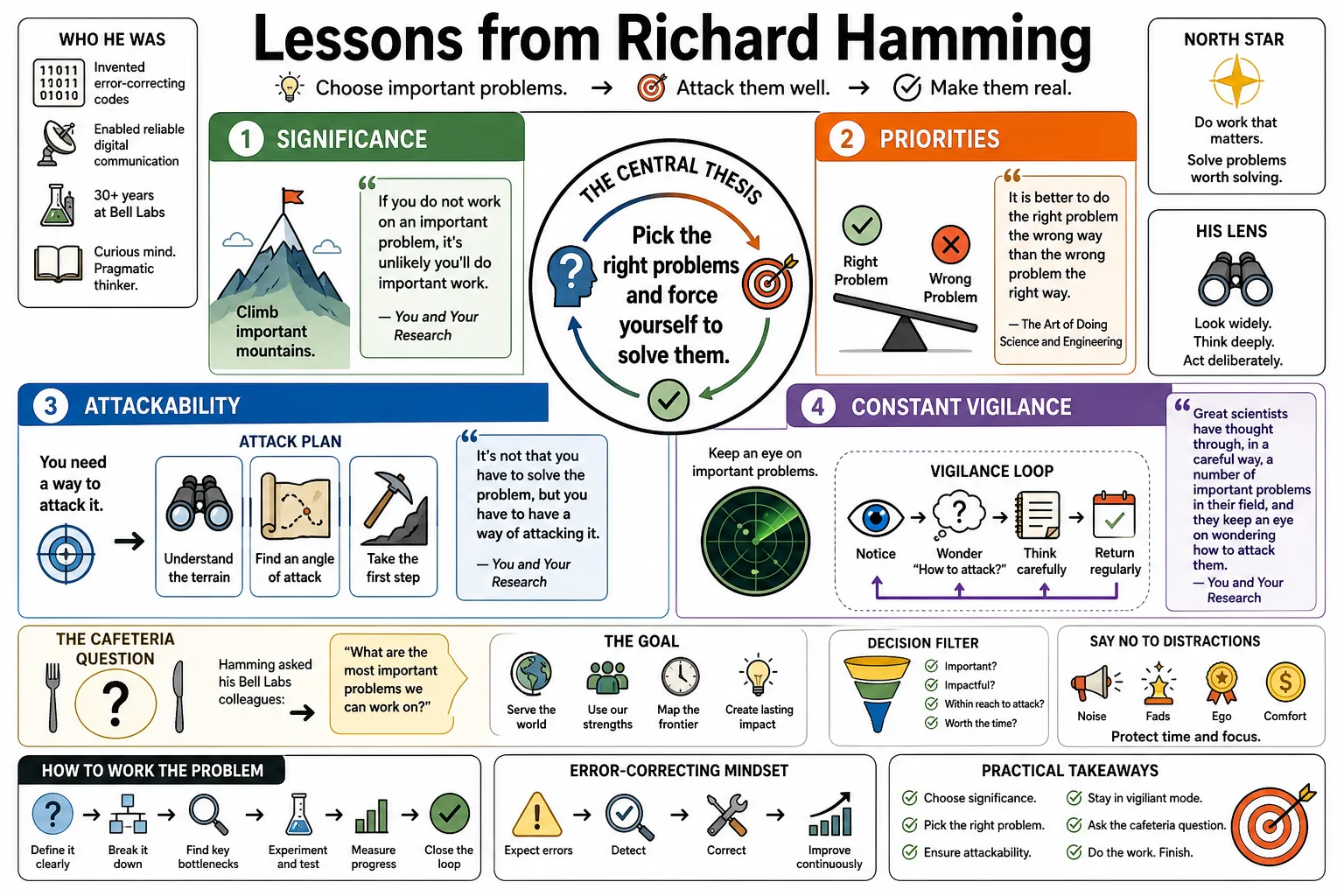
During his three decades at Bell Labs, mathematician Richard Hamming invented the error-correcting codes that make digital communication possible. He later turned his focus toward an uncomfortable question: why do some brilliant people do historically important work while equally smart peers achieve nothing? His conclusions offer an unsentimental guide to choosing the right problems and forcing yourself to actually solve them.
Part 1: Choosing Important Problems
- On Significance: "If you do not work on an important problem, it's unlikely you'll do important work." — You and Your Research
- On Priorities: "It is better to do the right problem the wrong way than the wrong problem the right way." — The Art of Doing Science and Engineering
- On Attackability: "It’s not that you have to solve the problem, but you have to have a way of attacking it." — You and Your Research
- On Constant Vigilance: "Great scientists have thought through, in a careful way, a number of important problems in their field, and they keep an eye on wondering how to attack them." — You and Your Research
- On The Cafeteria Question: Hamming famously asked his Bell Labs colleagues: "What are the important problems of your field? And if they are important, why aren't you working on them?" — You and Your Research
- On Agency: "To the extent you can choose, work on problems you think will be important." — The Art of Doing Science and Engineering
- On Safe Problems: "Most people spend their lives working on 'safe' or 'routine' problems rather than the ones that could actually change their field." — You and Your Research
- On The Fame Trap: "When you are famous it is hard to work on small problems. Early recognition seems to sterilize you." — You and Your Research
- On The Value of Time: "Being busy is not the same as being effective; if you are not tackling core issues, you are merely passing time." — You and Your Research
- On Self-Deception: "Man is not a rational animal, he is a rationalizing animal... often what you believe is what you want to believe, rather than being the result of careful thinking." — The Art of Doing Science and Engineering
Part 2: Courage and Confidence
- On Self-Belief: "Once you get your courage up and believe that you can do important problems, then you can. If you think you can't, almost surely you are not going to." — You and Your Research
- On Ambiguity: "Great scientists tolerate ambiguity very well. They believe the theory enough to go ahead; they doubt it enough to notice the errors and faults." — The Art of Doing Science and Engineering
- On Modesty: "Say to yourself: 'Yes, I would like to do something significant.' You should ignore the social pressure to be modest." — You and Your Research
- On Brains vs. Courage: "Brains are not enough; you need the courage to tackle difficult problems and the persistence to see them through when others doubt you." — You and Your Research
- On Fear of Failure: "If you don't make mistakes, you aren't working on hard enough problems." — The Art of Doing Science and Engineering
- On Experts: "If an expert says something can be done he is probably correct, but if he says it is impossible then consider getting another opinion." — The Art of Doing Science and Engineering
- On Defying Limits: "Perhaps there are thoughts we cannot think. Acknowledging our limits is the first step to pushing past them." — The Art of Doing Science and Engineering
- On Boldness: "Drop modesty and say to yourself, 'Yes, I would like to do first-class work.'" — You and Your Research
- On Doubting Too Much: "If you believe too much you'll never notice the flaws; if you doubt too much you won't get started." — You and Your Research
Part 3: Working Conditions and Constraints
- On The Open Door: "The closed door is symbolic of a closed mind. People who work with their doors open may be interrupted, but they stay in touch with what is important." — You and Your Research
- On Bad Conditions: "What most people think are the best working conditions, are not. Very clearly they are not because people are often most productive when working conditions are bad." — You and Your Research
- On Complaining: "It is a poor workman who blames his tools—the good man gets on with the job, given what he's got, and gets the best answer he can." — You and Your Research
- On Reframing Problems: "Instead of complaining about a lack of resources, use limitations to force more creative and elegant solutions." — You and Your Research
- On Isolation: "I notice that if you have the door to your office closed, you get more work done today and tomorrow... But ten years later somehow you don't quite know what problems are worth working on." — You and Your Research
- On Perfect Environments: "The Institute for Advanced Study in Princeton has ruined more good scientists than any institution has created, because perfect conditions remove the friction needed for breakthroughs." — You and Your Research
- On Great Thoughts Time: "At Bell Labs, I reserved Friday afternoons exclusively for 'Great Thoughts,' refusing to do routine work or small calculations." — The Art of Doing Science and Engineering
- On The Young Turks: "Surround yourself with first-class people who expect you to do great work; their standards will inevitably rub off on you." — You and Your Research
- On The Cost of Comfort: "Smooth sailing rarely produces great captains; true breakthroughs require some level of environmental or intellectual friction." — The Art of Doing Science and Engineering
Part 4: The Subconscious and Immersion
- On Total Immersion: "Keep your subconscious starved so it has to work on your problem." — You and Your Research
- On Emotional Commitment: "Great scientists don't just 'do' science; they live it, bringing a level of emotional commitment that borders on obsession." — You and Your Research
- On Letting Go: "By staying deeply immersed in a problem all day, you force your subconscious to continue working on it while you sleep." — You and Your Research
- On Sudden Insights: "'Sudden' insights in the morning are rarely accidental; they are the output of a subconscious that was given no other input to chew on." — The Art of Doing Science and Engineering
- On Distractions: "If you let your mind wander to trivial things, your subconscious will solve trivial things instead of the hard problems." — You and Your Research
- On Dedicated Focus: "Focus is not just about what you choose to do, but what you actively deny your brain the luxury of thinking about." — The Art of Doing Science and Engineering
- On Physical Toll: "My most productive years were also my most stressful, often resulting in 'incipient ulcers,' because I cared so deeply about the outcome." — You and Your Research
- On Dreaming About Problems: "When you are working on a profound problem, you should be taking it to bed with you every night." — You and Your Research
- On Intuition: "Deep immersion trains your intuition, allowing you to 'feel' the right path before you can mathematically prove it." — The Art of Doing Science and Engineering
Part 5: Communication and Selling Ideas
- On Selling Your Work: "It is not sufficient to do a job, you have to sell it." — You and Your Research
- On The 50 Percent Rule: "Now at least 50% of the time must go for the presentation. It’s a big, big number." — You and Your Research
- On Clear Presentation: "You must learn to sell your ideas, not by propaganda, but by force of clear presentation." — You and Your Research
- On Why Good Ideas Die: "Many a good idea has had to be rediscovered because it was not well presented the first time, years before!" — You and Your Research
- On Audience Needs: "The technical person wants to give a highly limited technical talk... the audience wants a broad general talk and wants much more background than the speaker is willing to give." — You and Your Research
- On Reading Habits: "Write so clearly that a reader casually flipping through a journal is compelled to stop and read your page." — You and Your Research
- On Informal Talks: "You must master the 'elevator pitch' because informal conversations are often where ideas are actually adopted." — You and Your Research
- On Explaining The Why: "You should paint a general picture to say why it’s important, and then slowly give a sketch of what was done." — You and Your Research
- On The World's Attention: "The world is supposed to be waiting, and when you do something great, they should rush out and welcome it. But the fact is everyone is busy with their own work." — You and Your Research
Part 6: Knowledge and Continuous Learning
- On Compound Interest: "Knowledge and productivity are like compound interest. Small, consistent efforts accumulate dramatically." — You and Your Research
- On Doing 10 Percent More: "Working just 10% harder than your peers can lead to exponentially greater output over a 40-year career." — You and Your Research
- On The Prepared Mind: "Luck favors the prepared mind. You prepare yourself for opportunities so that when they arise, you are ready to seize them." — You and Your Research
- On Stumbling Onto Luck: "The particular thing you do is luck, but that you do something is not." — You and Your Research
- On Original Thinking: "If you read all the time what other people have done, you will think the way they thought." — You and Your Research
- On Over-Reading: "I knew a fellow at Bell Labs who read everything in the library, but he has no effect named after him because he read too much." — You and Your Research
- On Reading for Problems: "You need to keep up more to find out what the problems are than to read to find the solutions." — You and Your Research
- On Leading vs. Following: "What you learn from others you can use to follow. What you learn for yourself you can use to lead." — The Art of Doing Science and Engineering
- On Studying Success: "Vicarious learning from the experiences of others saves making errors yourself, but I regard the study of successes as being basically more important than the study of failures." — The Art of Doing Science and Engineering
- On Accumulating Skill: "The more you know, the more you learn; the more you learn, the more you can do; the more you can do, the more the opportunity." — You and Your Research
Part 7: Vision and Systems Thinking
- On Science vs. Engineering: "In science, if you know what you are doing, you should not be doing it. In engineering, if you do not know what you are doing, you should not be doing it." — The Art of Doing Science and Engineering
- On Insight: "The purpose of computation is insight, not numbers." — The Art of Doing Science and Engineering
- On Education vs. Training: "Education is what, when, and why to do things. Training is how to do it." — The Art of Doing Science and Engineering
- On Opening New Fields: "Almost everyone who opens up a new field does not really understand it the way the followers do." — The Art of Doing Science and Engineering
- On Information: "Transmission is how information goes from here to there. Storage is transmission from then to now." — The Art of Doing Science and Engineering
- On Future Preparation: "A solution which does not prepare for the next round with some increased insight is hardly a solution at all." — The Art of Doing Science and Engineering
- On Looking Ahead: "On Friday afternoons, instead of doing routine work, I would ask: 'What is the future of computing?' or 'How will this field change in 20 years?'" — The Art of Doing Science and Engineering
- On True Understanding: "True understanding of a system comes not from memorizing its rules, but from grasping the underlying principles that make those rules necessary." — The Art of Doing Science and Engineering
- On Evaluating Output: "Don't get lost in the data; always remember that the ultimate goal is to uncover the underlying principles of the universe." — You and Your Research
- On Managing Detail: "The best systems thinkers are those who can zoom out to the widest context and then zoom in to execute the minute details without losing the thread." — The Art of Doing Science and Engineering
Part 8: The Cost of Greatness
- On The Struggle: "The true gain is in the struggle and not in the achievement—a life without a struggle on your part to make yourself excellent is hardly a life worth living." — The Art of Doing Science and Engineering
- On The Examined Life: "The unexamined life is not worth living. We 'get better at getting better' by examining how we spend our time, our thought, and what areas we focus on." — The Art of Doing Science and Engineering
- On Getting By: "With one life to lead, you ought to do more than just get by... the life of trying to achieve excellence in some area is in itself a worthy goal for your life." — The Art of Doing Science and Engineering
- On Newton's Effort: "Newton said, 'If others would think as hard as I did, then they would get similar results.'" — You and Your Research
- On Personal Responsibility: "No one else can do your great work for you; if you want to achieve something exceptional, you must take full ownership of the process." — You and Your Research
- On Sacrifice: "Doing first-class work inherently means saying no to many other good, pleasant, and worthwhile things in life." — You and Your Research
- On Aging: "The ability to do great work often diminishes as you acquire more administrative duties; you must fiercely protect your time to think." — You and Your Research
- On Working Hard: "I claim that luck will not cover everything... The prepared mind sooner or later finds something important and does it." — You and Your Research
- On The Ultimate Goal: "The pursuit of excellence is not about the final accolade, but about the transformation of your own character through the effort." — The Art of Doing Science and Engineering