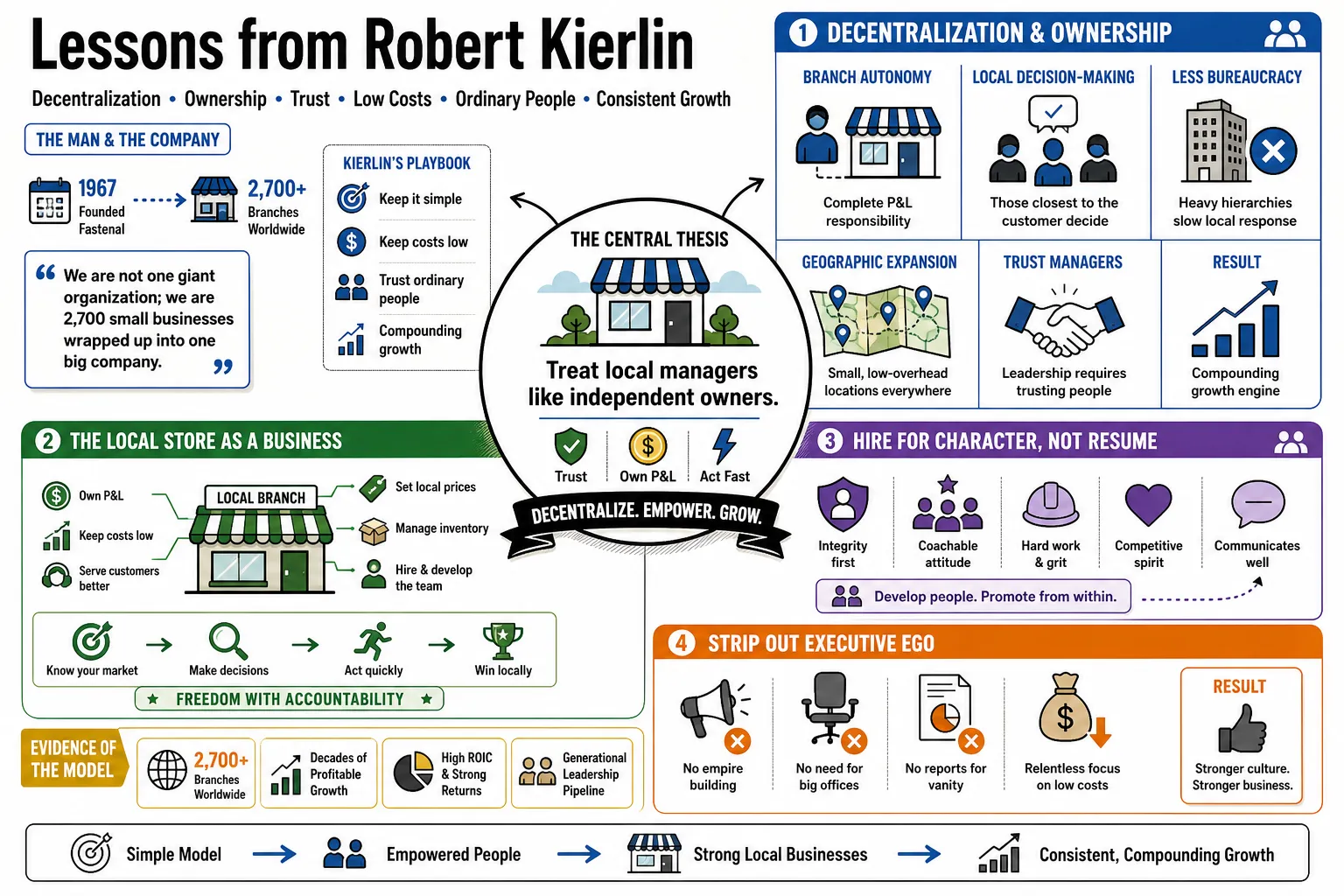
Lessons from Robert Kierlin
Robert Kierlin founded Fastenal in 1967 and built an industrial supply giant by treating local branch managers as independent owners. Obsessed with keeping costs low, he believed ordinary people drive consistent growth when handed total autonomy. This collection outlines his unglamorous approach to decentralized management, hiring for character, and stripping out executive ego.
Part 1: Decentralization and Ownership
- On Organizational Scale: "We are not one giant organization; we are 2,700 small businesses wrapped up into one big company." — Source: [Founders Podcast]
- On Branch Autonomy: Give local managers complete profit and loss responsibility by treating them like independent business owners rather than corporate employees. — Source: [Saber Capital Management]
- On Local Decision-Making: The employees interacting directly with customers are best positioned to make operational choices. — Source: [The Power of Fastenal People]
- On Bureaucracy: Heavy corporate hierarchies interfere with a local store's ability to respond quickly to market demands. — Source: [Deciphr.ai]
- On Geographic Expansion: Opening small and low-overhead locations in remote areas builds a compounding growth engine. — Source: [Bamboo Innovator]
- On Trusting Managers: Leadership requires trusting local branch leaders to direct their own operations without constant headquarters interference. — Source: [Fastenal Shareholder Reports]
- On Systemizing Independence: While branches operate independently, they rely on a highly efficient and centralized logistical backbone. — Source: [Global Fastener News]
- On Avoiding Bottlenecks: Centralized decision-making creates bottlenecks, whereas pushing authority to the edges keeps the business moving fast. — Source: [The Eric Mueller Show]
- On Compounding Growth: Allowing thousands of small branches to solve local problems organically leads to massive and aggregated corporate success. — Source: [Founders Podcast]
Part 2: Cost Control and Frugality
- On Expenditure: "Being careful about your expenditures, whether large or small, requires a total commitment. Either you do a good job of cost control in all aspects of your business, or you start losing it." — Source: [Global Fastener News]
- On Leadership Luxury: Leaders should actively reject corporate luxury to avoid corruption and maintain focus on the business. — Source: [Deciphr.ai]
- On Operational Focus: Frugality acts as a proactive commitment to maintaining low operating costs as a competitive advantage rather than an exercise in being cheap. — Source: [Saber Capital Management]
- On Leading by Example: Driving company minivans and staying in budget motels sends a clear message to employees about the company's financial priorities. — Source: [Minnesota Government Archives]
- On Office Supplies: Reusing basic office supplies sets a tone of diligence and respect for the company's resources. — Source: [Forbes]
- On Core Principles: The internal motto for the company centered on diligence, frugality, and affection. — Source: [Founders Podcast]
- On Executive Compensation: Modest executive salaries and avoiding excessive stock options keep leadership aligned with the realities of the business. — Source: [Bamboo Innovator]
- On Financial Discipline: Extreme frugality ensures that capital remains available for business expansion rather than wasted on overhead. — Source: [Global Fastener News]
- On Hard Work: Business success rarely comes from following trends; it comes from hard work and managing pennies. — Source: [Fastenal.com]
- On the Cost of Ego: Flashy corporate perks act as an expense that inflates egos without adding any value to the customer. — Source: [Deciphr.ai]
Part 3: Hiring for Character
- On Academic Credentials: Traditional degrees matter less than finding individuals with wisdom, savvy, and an entrepreneurial spirit. — Source: [Founders Podcast]
- On Internal Promotion: Commit to filling leadership roles from within, ensuring most executive officers begin their careers in entry-level positions. — Source: [Fastenal Shareholder Reports]
- On Human Potential: "The greatest resource in the world is the human individual, with each individual having enormous potential to do wonderful things." — Source: [The Power of Fastenal People]
- On Hiring Criteria: Look for people who naturally take ownership of problems rather than waiting for instructions. — Source: [Saber Capital Management]
- On Professional Management: Avoid bringing in outside professional managers who do not understand the gritty reality of the store floor. — Source: [Global Fastener News]
- On Untaught Traits: Ambition and work ethic cannot be taught in a classroom, making them the primary traits to look for in a new hire. — Source: [Deciphr.ai]
- On Early Opportunities: Giving young and untested employees significant responsibility early in their careers reveals their true capabilities. — Source: [The Eric Mueller Show]
- On Retaining Talent: When people see that the CEO started on the shop floor, they become more likely to commit to the company long-term. — Source: [Forbes]
- On the Foundation of Success: "Fastenal succeeds because its people succeed." — Source: [The Power of Fastenal People]
Part 4: Challenge Over Control
- On Management Philosophy: "Challenge rather than control." — Source: [Deciphr.ai]
- On Surpassing Expectations: "When you challenge people, they will surprise you with what they are capable of doing." — Source: [Fastenal.com]
- On the Limits of Control: "When you control, you limit what people can do to what you tell them to do." — Source: [Fastenal.com]
- On Autonomy: Giving employees the freedom to solve problems their own way yields better results than dictating the process. — Source: [The Eric Mueller Show]
- On Mistakes: Allowing people to make their own mistakes acts as a necessary part of challenging them to grow. — Source: [Founders Podcast]
- On Setting High Bars: People naturally rise to the level of the expectations set for them. — Source: [Saber Capital Management]
- On Micromanagement: Constant oversight tells employees you do not trust them, which instantly kills their entrepreneurial drive. — Source: [Global Fastener News]
- On Innovation: Innovation happens when employees are challenged with a difficult goal and left alone to figure out the mechanics. — Source: [Bamboo Innovator]
- On Trust: Challenging an employee acts as the ultimate demonstration of trust in their abilities. — Source: [The Power of Fastenal People]
Part 5: Suppressing Ego in Leadership
- On Ego: "Suppress your ego." — Source: [Deciphr.ai]
- On the Spotlight: Effective leaders stay out of the spotlight and ensure their team receives the public credit for successes. — Source: [Reddit Business Communities]
- On Shared Rewards: If the team achieves a goal together, the financial and professional rewards must be distributed among the team. — Source: [Fastenal.com]
- On Listening: "Listen rather than speak." — Source: [Global Fastener News]
- On Team Goals: Success is rarely a solo achievement, meaning suppressing individual pride becomes necessary to promote collective objectives. — Source: [Deciphr.ai]
- On Knowing Less: "Remember how little you know." — Source: [Founders Podcast]
- On Idea Generation: "If 95% of the people in your company do not participate in the creation of ideas, they will spend their time thinking and talking about cars, sports, and office politics." — Source: [Deciphr.ai]
- On Removing Barriers: The job of management is to clear obstacles out of the way so capable people can execute their ideas. — Source: [Saber Capital Management]
- On Quiet Leadership: The best leaders do not need to constantly remind everyone that they are in charge. — Source: [The Power of Fastenal People]
- On Problem Solving: Instead of providing the answer, ask questions that force the employee to arrive at the solution independently. — Source: [Forbes]
Part 6: Equality and Egalitarianism
- On Equal Treatment: "Treat everyone as your equal." — Source: [Deciphr.ai]
- On Corporate Hierarchy: Eliminate hierarchical structures that create artificial separation between management and frontline workers. — Source: [Founders Podcast]
- On Consistent Flexibility: If an engineer is allowed to leave early for a child's sporting event, the same flexibility must be extended to the lathe operators and data entry staff. — Source: [The Power of Fastenal People]
- On Executive Perks: An inflated sense of superiority among executives distracts from the work and breeds resentment on the floor. — Source: [Deciphr.ai]
- On Mutual Respect: Everyone in the building contributes to the bottom line and deserves the same fundamental respect, regardless of their title. — Source: [Fastenal Shareholder Reports]
- On Open Doors: Physical office layouts should reflect an egalitarian culture by avoiding isolated executive suites. — Source: [Saber Capital Management]
- On Human Nature: "See the unique humanness in all persons." — Source: [Global Fastener News]
- On Dignity: Leadership involves understanding the mutual obligations between employees and ensuring everyone is treated with dignity. — Source: [The Power of Fastenal People]
- On Empathy: "Empathy isn't so much an understanding of where someone is coming from as it is an appreciation that we don't know where someone is coming from." — Source: [Fastenal.com]
Part 7: Growth Through Customer Service
- On the Primary Goal: The entire organization must pursue a single common objective, which is growth through customer service. — Source: [Founders Podcast]
- On Alignment: "Organizations succeed to the extent that all of their members pursue a common goal. This is one of those simple ideas that are so difficult to practice." — Source: [The Power of Fastenal People]
- On Customer Proximity: The closer a business gets to its customer, the more indispensable it becomes to their daily operations. — Source: [Bamboo Innovator]
- On Service as a Strategy: Exceptional service operates as the core strategy for taking market share rather than a standalone department. — Source: [Global Fastener News]
- On Inventory Availability: Having the right part on the shelf when the customer walks in remains the purest form of customer service in industrial supply. — Source: [Saber Capital Management]
- On Building Relationships: Industrial sales are driven by long-term reliability and trust rather than flashy marketing campaigns. — Source: [The Eric Mueller Show]
- On Adaptation: Listen to what the local market needs and adapt the branch's inventory to serve that specific customer base. — Source: [Fastenal Shareholder Reports]
- On Speed: In the fastener business, the speed of response often matters more than the price of the part. — Source: [Forbes]
- On Solving Problems: The job is to solve the operational problems that are slowing the customer down rather than simply selling hardware. — Source: [Deciphr.ai]
- On Long-Term Thinking: Prioritize the lifetime value of the customer relationship over the margin on a single transaction. — Source: [The Power of Fastenal People]
Part 8: Continuous Learning and Teaching
- On the Leader's Duty: "If you're not spending 90% of your time teaching, you're not doing your job." — Source: [Founders Podcast]
- On Growth: "Let people learn." — Source: [Global Fastener News]
- On Mentorship: Senior leaders have an absolute obligation to mentor the next generation of branch managers. — Source: [Fastenal.com]
- On Promoting Curiosity: A culture that punishes questions will inevitably stagnate, requiring leaders to encourage active inquiry. — Source: [Deciphr.ai]
- On Humility in Learning: Acknowledging what you do not know is the first prerequisite for acquiring new business skills. — Source: [Saber Capital Management]
- On Experience: Classroom theory offers little value compared to the practical education gained by running a store. — Source: [The Eric Mueller Show]
- On Cross-Training: Exposing employees to different aspects of the business builds a more resilient and empathetic workforce. — Source: [Forbes]
- On Feedback: Honest and direct feedback acts as a form of teaching; withholding it out of politeness hinders an employee's development. — Source: [Bamboo Innovator]
- On the Ultimate Legacy: A leader's true legacy is measured by the competence and success of the people they leave behind to run the company. — Source: [The Power of Fastenal People]