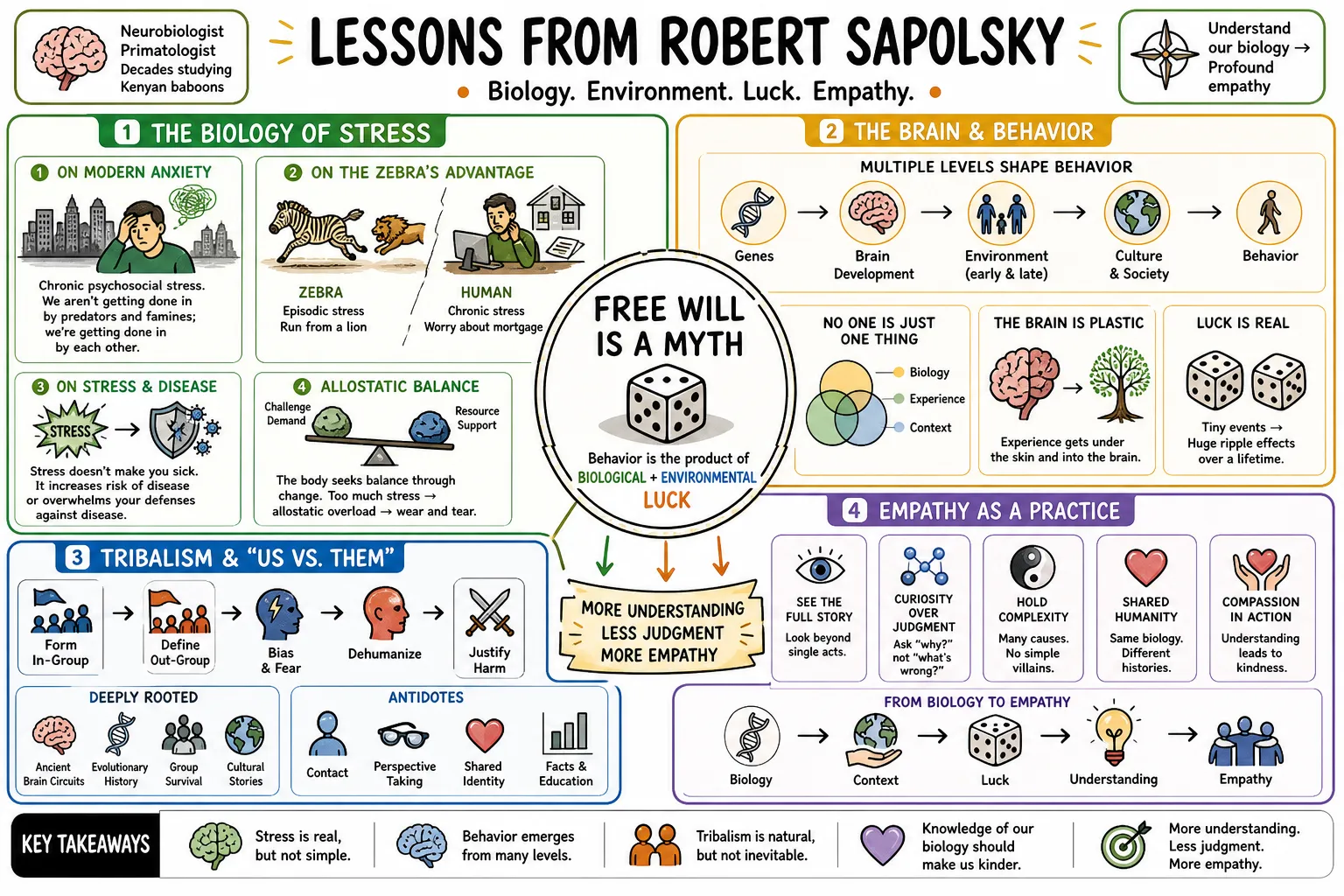
Lessons from Robert Sapolsky
Robert Sapolsky is a neurobiologist and primatologist who spent decades studying Kenyan baboons to understand the biology of stress. He is best known for arguing that free will is a myth and that human behavior is entirely the product of biological and environmental luck. This profile collects his findings on the brain and tribalism, along with his case that understanding our biology should lead to profound empathy.
Part 1: The Biology of Stress
- On modern anxiety: "We are Westernized humans, which is to say we're under chronic psychosocial stress. We aren't getting done in by predators and famines; we're getting done in by each other." — Source: A Primate's Memoir.
- On the zebra's advantage: "For animals like zebras, stress is episodic, like running away from a lion, while for humans, stress is chronic, like worrying about a mortgage." — Source: Why Zebras Don't Get Ulcers.
- On the nature of stress and disease: "It is never really the case that stress makes you sick. Stress increases your risk of getting diseases that make you sick, or if you have such a disease, stress increases the risk of your defenses being overwhelmed by the disease." — Source: Why Zebras Don't Get Ulcers.
- On allostatic balance: "The body not only can sense something stressful, but it also is amazingly accurate at measuring just how far and how fast that stressor is throwing the body out of allostatic balance." — Source: Why Zebras Don't Get Ulcers.
- On outlets for frustration: "Having a physical or psychological outlet for frustration can significantly mitigate the physiological damage caused by stress." — Source: Stanford Lectures on Human Behavioral Biology.
- On predictive information: "Stress is exacerbated when a stressor is unpredictable; knowing a shock is coming allows an organism to relax in the interim rather than remaining in constant vigilance." — Source: Why Zebras Don't Get Ulcers.
- On control: "Feeling a lack of control is one of the most potent triggers for a prolonged, damaging glucocorticoid stress response." — Source: Why Zebras Don't Get Ulcers.
- On social support: "Strong social affiliations are one of the best buffers against the physiological damage of stress, provided the relationships themselves aren't the source of the stress." — Source: Behave.
- On displacement: "We frequently cope with stress by displacing our frustration onto individuals lower in the hierarchy, a biological tendency we share with many other primates." — Source: A Primate's Memoir.
Part 2: Free Will and Determinism
- On the myth of agency: "Not only am I a free will skeptic, I don't believe there is a shred of agency that goes into any of our behavior." — Source: Determined.
- On biological luck: "We are nothing more or less than the cumulative biological and environmental luck, over which we had no control, that has brought us to any moment." — Source: Determined.
- On neurons and choice: "Show me a neuron whose generation of a behavior is independent of the sum of its biological past, and for the purposes of this book, you've demonstrated free will." — Source: Determined.
- On blame and punishment: "It takes a certain kind of audacity and indifference to look at findings like these and still insist that how readily someone does the harder things in life justifies blame, punishment, praise, or reward." — Source: Determined.
- On the criminal justice system: "The criminal justice system is entirely built on the flawed premise of volitional intent; instead, we should view harmful behavior as a biological malfunction needing quarantine and repair." — Source: Determined.
- On the randomness of merit: "Just as we do not blame people for being short, we should not praise them for having the neurobiology that enables strong executive function and discipline." — Source: Determined.
- On the homunculus fallacy: "Believing in free will requires positing a homunculus in the brain that sits outside the laws of chemistry and physics to make independent choices." — Source: Behave.
- On fatalism versus determinism: "Determinism does not mean nothing can change; it simply means that change is the result of external inputs altering biological states, not a magical exertion of will." — Source: Determined.
- On the cruelty of meritocracy: "The belief that individuals are responsible for their successes creates a society that is unusually cruel to those who fail, blaming them for their bad luck." — Source: Huberman Lab Podcast Interview.
- On accepting our lack of free will: "While it is profoundly difficult to live as if we have no free will, we must try to do so in the domains where it matters most, such as judging others." — Source: Determined.
Part 3: Empathy, Aggression, and the Amygdala
- On fear and aggression: "Crucially, the brain region most involved in feeling afraid and anxious is most involved in generating aggression." — Source: Behave.
- On the amygdala's role: "The most important theme is the amygdala's dual role in both aggression and facets of fear and anxiety. Fear and aggression are not inevitably intertwined, but they are close." — Source: Behave.
- On the frontal cortex: "The frontal cortex is the part of the brain that makes you do the harder thing when it's the right thing to do; it is the great inhibitor of impulsive behavior." — Source: Behave.
- On testosterone and aggression: "Testosterone does not invent aggression out of thin air; it exaggerates pre-existing social tendencies and lowers the threshold for aggressive behaviors already established by the environment." — Source: The Trouble with Testosterone.
- On empathy versus compassion: "Feeling someone else's pain is neurologically exhausting and often leads to turning away; taking action to relieve it is more sustainable and effective." — Source: Behave.
- On the limits of empathy: "We are neurologically primed to feel more empathy for people who look like us or share our group identity, making it a poor foundation for a universal moral system." — Source: Behave.
- On delayed maturation: "The human frontal cortex is not fully developed until the mid-twenties, meaning that our most complex moral reasoning is shaped by our late adolescent environment rather than our genes." — Source: Behave.
- On violence as a context-dependent act: "We don't hate violence; we hate the wrong kind of violence. When it is in the right context, like a sports game or a heroic movie, we cheer for it." — Source: Behave.
- On sleep and self-control: "Sleep deprivation impairs the frontal cortex's ability to inhibit the amygdala, making us more reactive, fearful, and impulsive." — Source: Behave.
- On forgiveness: "Ultimately, forgiveness is usually about one thing. This is for me, not for you. Hatred is exhausting; forgiveness, or even just indifference, is freeing." — Source: Behave.
Part 4: Us vs. Them
- On categorization: "There are two kinds of people in the world: those who divide the world into two kinds of people and those who don't. There are more of the first." — Source: Behave.
- On the speed of tribalism: "The brain detects race and categorizes people into Us or Them in less than a tenth of a second, long before conscious thought intervenes." — Source: Behave.
- On the fluidity of Us: "Our categories of Us and Them are incredibly malleable; a shared sports jersey or a common task can override deep-seated racial or ethnic biases in an instant." — Source: Behave.
- On out-group homogeneity: "We view Us as a collection of unique individuals, but we view Them as a monolithic mass, assuming they all think and act the same way." — Source: Behave.
- On disgust and morality: "The insular cortex, which evolved to protect us from toxic food by inducing nausea, has been co-opted to process moral disgust, often leading us to treat out-groups as literal pathogens." — Source: Behave.
- On cultural markers: "What helps define a particular culture? Values, beliefs, attributions, ideologies. All invisible, until they are yoked with arbitrary markers such as dress, ornamentation, or regional accent." — Source: Behave.
- On the origins of xenophobia: "Our evolutionary past in small hunter-gatherer bands primed us to be wary of strangers, but modern society weaponizes this instinct on a massive scale." — Source: Stanford Lectures on Human Behavioral Biology.
- On rationalizing prejudice: "We often feel an automatic, biologically driven aversion to an out-group first, and then our cortex invents a rationalization for why they deserve our dislike." — Source: Behave.
- On mitigating tribalism: "The most effective way to reduce hostile tribalism is through sustained, cooperative contact toward a shared goal, rather than mere proximity." — Source: Behave.
Part 5: Depression and Mental Health
- On the definition of depression: "If I had to define a major depression in a single sentence, I would describe it as a genetic and neurochemical disorder requiring a strong environmental trigger whose characteristic manifestation is an inability to appreciate sunsets." — Source: Why Zebras Don't Get Ulcers.
- On depression as a biological disease: "Depression is as real and biological a disease as adult-onset diabetes, driven by neurochemical imbalances rather than a lack of willpower." — Source: Stanford Lecture on Depression.
- On the pain of depression: "Severe depression is arguably the worst disease you can get, because it attacks the very capacity to feel joy, hope, or meaning." — Source: Stanford Lecture on Depression.
- On learned helplessness: "When organisms are subjected to uncontrollable stress, they eventually stop trying to escape even when an exit is available, a core mechanism in the development of depression." — Source: Why Zebras Don't Get Ulcers.
- On grief versus depression: "Grief is mourning a loss over time; depression is grief that spirals into an endless loop, paralyzing the individual long after the initial trigger." — Source: Why Zebras Don't Get Ulcers.
- On stress and the hippocampus: "Prolonged exposure to high levels of stress hormones can physically shrink the hippocampus, impairing memory and learning." — Source: Why Zebras Don't Get Ulcers.
- On the danger of recovery: "The most dangerous time for a severely depressed person is when they begin to recover from the psychomotor retardation of the illness, as they finally have the energy to act on suicidal ideation." — Source: Stanford Lecture on Depression.
- On neurogenesis: "The adult brain is capable of generating new neurons, a process that is inhibited by chronic stress and stimulated by antidepressants and exercise." — Source: Why Zebras Don't Get Ulcers.
- On the fallacy of snapping out of it: "Telling a depressed person to just snap out of it is as illogical and cruel as telling someone with a broken leg to just walk it off." — Source: Stanford Lecture on Depression.
Part 6: Evolution and Animal Models
- On studying baboons: "The Serengeti is a perfect ecosystem. They live in large troops, so predators don't hassle them much, and they only have to work about three hours a day for their calories. What that means is, they have nine hours of free time every day to devote to making some other baboon miserable." — Source: A Primate's Memoir.
- On recognizing relatives: "These baboons really are our relatives. In fact, this baboon is my cousin." — Source: A Primate's Memoir.
- On genetic determinism: "Genes do not dictate behavior; they dictate how an organism responds to a specific environment. A gene that causes one trait in one environment may cause the opposite in another." — Source: Behave.
- On the nature and nurture debate: "Asking whether a behavior is caused by genes or environment is like asking whether a cake's area is caused by its length or its width; they are completely inseparable." — Source: Stanford Lectures on Human Behavioral Biology.
- On hierarchical stress: "In baboon troops, the highest resting levels of stress hormones are found not in the dominant males, but in the low-ranking individuals who are constantly subjected to unpredictable harassment." — Source: A Primate's Memoir.
- On evolutionary continuity: "Human behaviors are not completely novel; they are built on evolutionary scaffolding shared with other primates, just adapted for our complex social structures." — Source: Stanford Lectures on Human Behavioral Biology.
- On a primate's impulse control: "A typical male baboon is too impulsive and can't possibly do the disciplined thing. Baboons are far less disciplined than chimps and when you map their brain anatomy you notice that they don't have a whole lot of frontal cortical function." — Source: Edge.org Interview.
- On culture in animals: "Primates have distinct cultures; different troops can pass down completely different social norms, such as high or low levels of aggression, to new members." — Source: A Primate's Memoir.
- On the fallacy of purely selfish genes: "Evolution has also heavily selected for cooperation, altruism, and reciprocal behavior, proving that we are not inherently condemned to ruthless selfishness." — Source: Behave.
Part 7: Context and Complexity
- On the messiness of behavior: "It is indeed a mess, a subject involving brain chemistry, hormones, sensory cues, prenatal environment, early experience, genes, both biological and cultural evolution, and ecological pressures, among other things." — Source: Behave.
- On biological context: "It's all about context, and the biology of context is vastly more complicated than the biology of the behavior itself." — Source: Behave.
- On the timeline of actions: "To understand any behavior, you have to look at what happened in the brain one second before, the hormones days before, the environment years before, and the evolutionary history millions of years before." — Source: Behave.
- On prenatal environments: "The environment doesn't start influencing you at birth; factors like your mother's stress levels and nutrition during pregnancy profoundly shape your brain architecture before you are even born." — Source: Determined.
- On childhood trauma: "Severe early life adversity alters the trajectory of brain development, leading to an enlarged amygdala and a stunted frontal cortex, setting the stage for lifelong vulnerability to stress and poor impulse control." — Source: Behave.
- On the illusion of single causes: "There is never a single gene, hormone, or brain region that causes a complex human behavior; everything is multi-causal." — Source: Stanford Lectures on Human Behavioral Biology.
- On language and metaphor: "Humans are unique in our capacity for metaphor, but our brain often struggles to distinguish metaphorical pain or disgust from physical pain or disgust." — Source: Behave.
- On ecological pressures: "The environment our ancestors lived in shaped cultural norms regarding honor, violence, and cooperation that persist today." — Source: Behave.
- On the danger of simple answers: "Beware of anybody who claims they can explain a complex human behavior with a single variable or a simple theory." — Source: Stanford Lectures on Human Behavioral Biology.
- On epigenetics: "Epigenetics shows that our experiences can turn genes on and off, meaning our lived environment physically alters how our DNA operates." — Source: Behave.
Part 8: Science, Compassion, and Mystery
- On the purpose of science: "Science is not meant to cure us of mystery, but to reinvent and reinvigorate it." — Source: Behave.
- On science and compassion: "I love science, and it pains me to think that so many are terrified of the subject or feel that choosing science means you cannot also choose compassion, or the arts, or be awed by nature." — Source: A Primate's Memoir.
- On biological inevitability: "We don't have to choose between being scientific and being compassionate." — Source: Behave.
- On judging others: "Understanding the biology of behavior should make us more forgiving of others and less prone to judging people for outcomes they could not control." — Source: Determined.
- On hypocrisy: "We have to learn our culture's rationalizations and hypocrisies. Thou shalt not kill, unless it's one of them, in which case here's a medal." — Source: A Primate's Memoir.
- On the difficulty of change: "Changing our deeply ingrained, biologically driven prejudices is incredibly difficult, but the fact that the brain is plastic means it is never biologically impossible." — Source: Behave.
- On moral imperatives: "Because we know that people's failures and flaws are a product of biological luck, we have a profound moral imperative to build a society that protects those who drew the short straw." — Source: Determined.
- On finding meaning: "Recognizing that we are biological machines does not strip life of meaning; it allows us to find meaning in relieving the suffering of other machines." — Source: Determined.
- On the human condition: "We are complicated, messy primates doing our best to navigate a world our brains were not entirely evolved to handle, and that alone is grounds for mutual grace." — Source: Why Zebras Don't Get Ulcers.