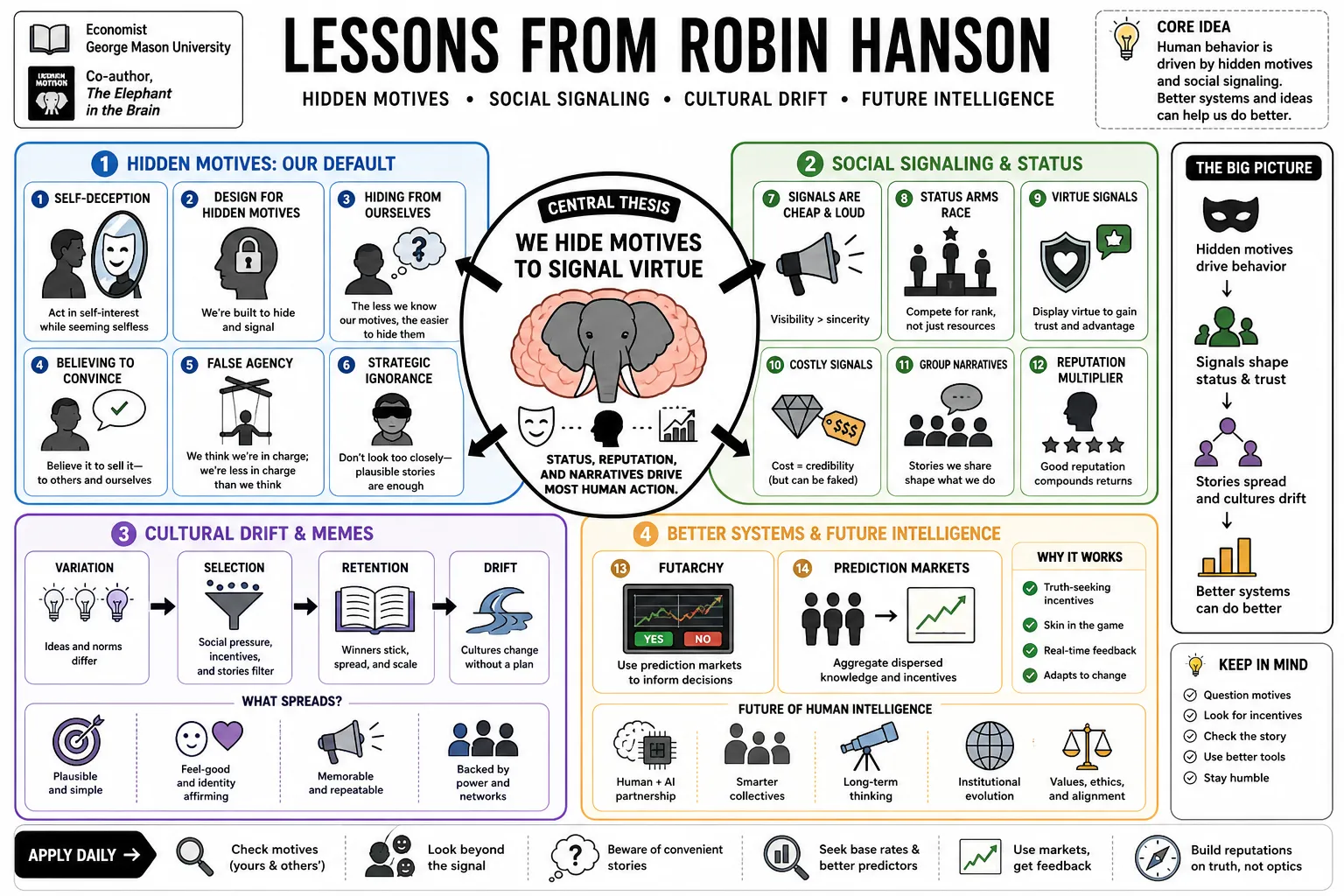
Lessons from Robin Hanson
Robin Hanson is an economist at George Mason University and co-author of The Elephant in the Brain. He is best known for analyzing the hidden, status-seeking motives that drive human behavior and proposing futarchy, a government system based on prediction markets. This compilation collects his ideas on social signaling, cultural drift, and the future of human intelligence.
Part 1: Hidden Motives
- On Self-Deception: "Our brains are built to act in our self-interest while at the same time trying hard not to appear selfish in front of other people." — Source: Goodreads: The Elephant in the Brain by Robin Hanson and Kevin Simler.
- On Design for Hidden Motives: "We, human beings, are a species that's not only capable of acting on hidden motives—we're designed to do it." — Source: 80,000 Hours Podcast: Episode 25 with Robin Hanson.
- On Hiding from Ourselves: "The less we know of our own ugly motives, the easier they are to hide from others." — Source: Goodreads: The Elephant in the Brain by Robin Hanson and Kevin Simler.
- On Believing to Convince: "Often the best way to convince others that we believe something is to actually believe it." — Source: Goodreads: The Elephant in the Brain by Robin Hanson and Kevin Simler.
- On False Agency: "We pretend we're in charge, both to others and even to ourselves, but we're less in charge than we think." — Source: Goodreads: The Elephant in the Brain by Robin Hanson and Kevin Simler.
- On Strategic Ignorance: "You are there to make up a good explanation for what's going on so that you can avoid the accusation that you're violating norms." — Source: 80,000 Hours Podcast: Episode 25 with Robin Hanson.
- On Institutional Reform: "If we can accurately diagnose what's holding back our institutions, we may finally succeed in reforming them, thereby making our lives better." — Source: 80,000 Hours Podcast: Episode 25 with Robin Hanson.
- On Social Judgment: "We are a social species constantly being judged by others on whether we make good friends, allies, or leaders." — Source: Goodreads: The Elephant in the Brain by Robin Hanson and Kevin Simler.
- On The Scope of Signaling: "In a rich society, well over 90 percent of human behavior can be traced back to some form of signaling." — Source: Conversations with Tyler: Episode 1 with Robin Hanson.
- On Altruistic Pretexts: "Our brains evolved to hide our true, ugly motives behind altruistic pretexts to look good while pursuing self-interested goals." — Source: Goodreads: The Elephant in the Brain by Robin Hanson and Kevin Simler.
Part 2: Everyday Institutions
- On Medical Efficacy: "In the aggregate, variations in medical spending usually show no statistically significant medical effect on health." — Source: Cato Unbound: Cut Medicine in Half by Robin Hanson.
- On Cutting Medicine: "Cutting half of medical spending would seem to cost little in health, and yet would free up vast resources for other health and utility gains." — Source: Cato Unbound: Cut Medicine in Half by Robin Hanson.
- On Medicine as a Signal: "We use medical care as a way to show that we care—a social signal of loyalty and altruism toward sick allies—rather than solely for its therapeutic effectiveness." — Source: Cato Unbound: Cut Medicine in Half by Robin Hanson.
- On Educational Credentials: "Education isn't just about learning; it's largely about getting graded, ranked, and credentialed, stamped for the approval of employers." — Source: Derek Sivers: Notes on The Elephant in the Brain.
- On Religious Belonging: "Religion isn't just about private belief in God or the afterlife, but about conspicuous public professions of belief that help bind groups together." — Source: Derek Sivers: Notes on The Elephant in the Brain.
- On Costly Religious Signals: "Religious practices often serve no practical purpose other than to weed out people who are not fully committed to the group." — Source: Derek Sivers: Notes on The Elephant in the Brain.
- On Competitive Altruism: "When people are giving to charity or doing nice things, they act as if they're trying to help. What they're really doing is trying to show that they feel empathy." — Source: Conversations with Tyler: Episode 1 with Robin Hanson.
- On Anonymous Donations: "Because anonymous donations are the exception rather than the rule, the goal is often to appear generous rather than simply to be generous." — Source: Conversations with Tyler: Episode 1 with Robin Hanson.
Part 3: Futarchy and Governance
- On the Core of Futarchy: "Vote on values, but bet on beliefs." — Source: George Mason University: Shall We Vote on Values, But Bet on Beliefs?.
- On Defining National Welfare: "Democratic institutions should define the goals of the organization or nation, such as identifying specific metrics for national welfare." — Source: George Mason University: Shall We Vote on Values, But Bet on Beliefs?.
- On Betting on Policies: "Prediction markets should be used to determine which policies will effectively achieve those pre-defined goals." — Source: George Mason University: Shall We Vote on Values, But Bet on Beliefs?
- On Expert Incentives: "Bureaucracies may lack the incentive to provide their best estimate of the truth due to political pressures or the desire to maintain social status." — Source: George Mason University: Shall We Vote on Values, But Bet on Beliefs?.
- On Market Accuracy: "Prediction markets are superior at aggregating information compared to traditional systems because they provide direct financial incentives for accuracy." — Source: George Mason University: Shall We Vote on Values, But Bet on Beliefs?.
- On Truth-Telling: "Current decision-making processes are often hindered by political agendas and a lack of proper incentives for truth-telling." — Source: George Mason University: Shall We Vote on Values, But Bet on Beliefs?.
- On Implementing Betting Markets: "The policy with the highest expected positive impact on the chosen metric is automatically implemented." — Source: George Mason University: Shall We Vote on Values, But Bet on Beliefs?.
- On the Promise of Prediction Markets: "It's easy to think that prediction markets tell us a lot about the world." — Source: George Mason University: Shall We Vote on Values, But Bet on Beliefs?.
- On Governance Trials: "Implementing prediction markets for high-stakes governance remains a significant challenge that has only recently begun to see experimental trials in decentralized autonomous organizations." — Source: George Mason University: Shall We Vote on Values, But Bet on Beliefs?.
Part 4: The Age of Em
- On the Ambiguity of the Future: "The future is just another place in space-time. Its residents, like us, find their world mundane and morally ambiguous." — Source: Goodreads: The Age of Em by Robin Hanson.
- On Emulations: "An 'em' is a computer model created by scanning a human brain to record its specific cell features and connections." — Source: Goodreads: The Age of Em by Robin Hanson.
- On Future Desperation: "Grand hopes and justifications often masking lives of quiet desperation. Of course, lives of quiet desperation can still be worth living." — Source: Goodreads: The Age of Em by Robin Hanson.
- On Empathy and Inequality: "Humans who attend directly to vivid cases of inequality are capable of great empathy with inequality losers." — Source: Goodreads: The Age of Em by Robin Hanson.
- On Numbing Ourselves: "We humans are also quite capable of avoiding contact and exposure that might produce such compassion, and of numbing ourselves to the plight of losers about whom it would be inconvenient to feel empathy." — Source: Goodreads: The Age of Em by Robin Hanson.
- On the No-Action Baseline: "If we first look carefully at what is likely to happen if we do nothing, such a no-action baseline can help us to analyze what we might do to change those outcomes." — Source: Goodreads: The Age of Em by Robin Hanson.
- On Economic Methodology: "I approach the subject of brain emulations as an economist rather than a philosopher or novelist." — Source: Goodreads: The Age of Em by Robin Hanson.
- On Mundane Worldbuilding: "The world of ems will be mundane and morally ambiguous rather than purely utopian or dystopian." — Source: Goodreads: The Age of Em by Robin Hanson.
- On Machine Speeds: "A society of whole brain emulations will be fundamentally driven by machine speeds and novel economics." — Source: Goodreads: The Age of Em by Robin Hanson.
Part 5: The Great Filter and Grabby Aliens
- On the Great Filter: "There thus exists a great filter between death and expanding lasting life, and humanity faces the ominous question: how far along this filter are we?" — Source: George Mason University: The Great Filter by Robin Hanson.
- On Our Bright Future: "Humanity seems to have a bright future, i.e., a non-trivial chance of expanding to fill the universe with lasting life." — Source: George Mason University: The Great Filter by Robin Hanson.
- On the Silent Universe: "The fact that space near us seems dead now tells us that any given piece of dead matter faces an astronomically low chance of begetting such a future." — Source: George Mason University: The Great Filter by Robin Hanson.
- On Existential Risk: "The central concern is whether this filter lies in our past or in our future, meaning an existential risk awaits us." — Source: George Mason University: The Great Filter by Robin Hanson.
- On Grabby vs. Quiet Aliens: "To a first approximation, there are two kinds of aliens: quiet and loud. Loud (or expansive) aliens expand fast, last long, and make visible changes to their volumes." — Source: Grabby Aliens Research Paper by Robin Hanson et al..
- On Grabbing Resources: "Their behavior also earns them the name 'grabby aliens,' as they reach out and grab all planets or resources around them as quickly as possible." — Source: Grabby Aliens Research Paper by Robin Hanson et al..
- On Expansion Speed: "Grabby civilizations expand from their origin planet at a fraction of the speed of light." — Source: Grabby Aliens Research Paper by Robin Hanson et al..
- On Universal Deadlines: "Because grabby civilizations eventually fill the universe and prevent other civilizations from arising in the space they occupy, they create a deadline." — Source: Grabby Aliens Research Paper by Robin Hanson et al..
- On Human Earliness: "Our early emergence can be explained by the fact that we had to arise before this universal deadline was reached." — Source: Grabby Aliens Research Paper by Robin Hanson et al..
Part 6: Rationality and Bias
- On the Rationality Budget: "You should spend your rationality budget where truth matters most to you. You can't have it all, so you must decide what matters most." — Source: 80,000 Hours Podcast: Episode 25 with Robin Hanson.
- On Tribal Beliefs: "We feel a deep pleasure from realizing that we believe something in common with our friends, and different from most people." — Source: Goodreads: The Elephant in the Brain by Robin Hanson and Kevin Simler.
- On Identity Through Argument: "You are more defined by the topics on which you argue, and the communities in which you argue, than by which side you take on those topics." — Source: Goodreads: The Elephant in the Brain by Robin Hanson and Kevin Simler.
- On Rationalization: "Humans frequently use their reasoning ability to rationalize decisions that were actually made for emotional or social reasons." — Source: Goodreads: The Elephant in the Brain by Robin Hanson and Kevin Simler.
- On Objective Cost: "Because true objectivity is cognitively expensive and difficult to maintain, humans have a limited budget of rationality." — Source: Goodreads: The Elephant in the Brain by Robin Hanson and Kevin Simler.
- On Choosing Battles: "Do not try to be a rationalist in every aspect of life; instead, choose your battles and focus your efforts on areas where accuracy and honesty matter most." — Source: Goodreads: The Elephant in the Brain by Robin Hanson and Kevin Simler.
- On Shared Delusions: "Taking pleasure in disagreeing with others or finding comfort in shared community beliefs is the road to rationality ruin." — Source: Goodreads: The Elephant in the Brain by Robin Hanson and Kevin Simler.
- On Overcoming Bias: "Understanding these hidden motives is a critical step in overcoming bias and reasoning clearly." — Source: Ideas Untrapped: Big Ideas with Robin Hanson.
- On the Pervasiveness of Bias: "Many human behaviors, institutions, and beliefs are not what they appear to be, serving hidden rather than functional motives." — Source: Ideas Untrapped: Big Ideas with Robin Hanson.
Part 7: Cultural Drift
- On Forager vs. Farmer Mindsets: "There is a deep tension between our ancestral forager mindset, which is egalitarian and expressive, and later farmer mindsets, which are hierarchical and disciplined." — Source: Ideas Untrapped: Big Ideas with Robin Hanson.
- On Weak Cultural Selection: "Weak cultural selection pressures have allowed a drift back to forager habits and attitudes, which DNA makes still more natural than farmer ones." — Source: Ideas Untrapped: Big Ideas with Robin Hanson.
- On Cultural Random Walks: "One kind of expected change is random walks, drifting away from adaptive zones. Another is a return to a more natural forager-like culture." — Source: Ideas Untrapped: Big Ideas with Robin Hanson.
- On the Necessity of Discipline: "The shift from foraging to farming required humans to adopt rigid, disciplined, and hierarchical norms that were historically necessary but are not inherently natural." — Source: Ideas Untrapped: Big Ideas with Robin Hanson.
- On Decadence: "A third kind of change we should expect to see from cultural drift is decadence—norms increasingly tolerant of myopia, laziness, and pleasure, and less encouraging of social coordination." — Source: Ideas Untrapped: Big Ideas with Robin Hanson.
- On Forager Freedom: "In the forager state, humans were more like animals in the sense of just doing what felt natural and that typically worked out okay." — Source: Ideas Untrapped: Big Ideas with Robin Hanson.
- On Farmer Constraints: "The farmer mindset was a departure from natural impulses, requiring humans to stay in one place and accept structures like property and domination to survive." — Source: Ideas Untrapped: Big Ideas with Robin Hanson.
- On Modern Conflict: "The cultural conflicts today can be traced to this clash between the suppressed farmer structures and our resurfacing forager instincts." — Source: Ideas Untrapped: Big Ideas with Robin Hanson.
Part 8: Social Status and Prestige
- On the Price of Friendship: "Prestige is your 'price' on the market for friendship and association, just as sexual attractiveness is our 'price' on the mating market." — Source: Goodreads: The Elephant in the Brain by Robin Hanson and Kevin Simler.
- On Weeding Out Freeloaders: "Groups demand costly sacrifices—like time, effort, or adherence to bizarre rules—to prove an individual's loyalty to the community." — Source: Derek Sivers: Notes on The Elephant in the Brain.
- On Acting the Insider: "We pose as a privileged insider, when in fact we're often making the same kind of educated guesses that any informed outsider could make." — Source: Goodreads: The Elephant in the Brain by Robin Hanson and Kevin Simler.
- On Conspicuous Professions: "Conspicuous public professions of belief help bind groups together and confer status on the most devoted members." — Source: Derek Sivers: Notes on The Elephant in the Brain.
- On Social Signaling: "Our brains evolved to navigate a complex social environment where our status and alliances dictated our survival." — Source: 80,000 Hours Podcast: Episode 25 with Robin Hanson.
- On Advertised Generosity: "Charitable acts operate as a costly signal that the donor is empathetic and possesses the resources to help others." — Source: Conversations with Tyler: Episode 1 with Robin Hanson.
- On Avoiding Norm Violations: "We fabricate reasons for our actions largely to convince our peers that we are adhering to group norms and deserve our social standing." — Source: 80,000 Hours Podcast: Episode 25 with Robin Hanson.
- On Educational Stamping: "The modern university system functions largely as a sorting mechanism to signal an individual's intelligence and compliance to future employers." — Source: Goodreads: The Elephant in the Brain by Robin Hanson and Kevin Simler.