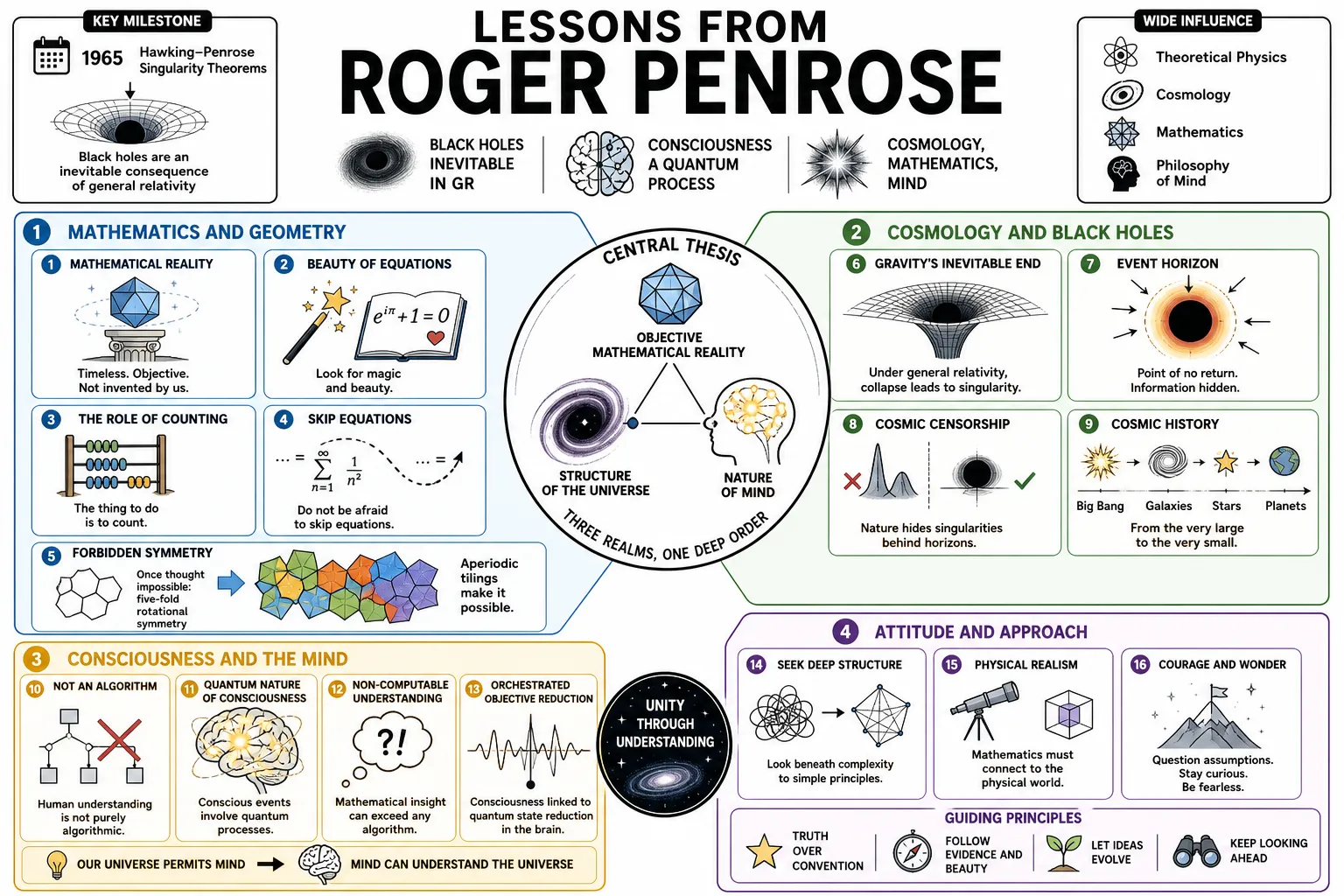
Lessons from Roger Penrose
Mathematical physicist Roger Penrose won the Nobel Prize for proving that black holes are an inevitable consequence of general relativity. He is also known for his controversial argument that human consciousness is a quantum process rather than an algorithmic one. This profile covers his ideas across mathematics, cosmology, and the nature of the mind.
Part 1: Mathematics and Geometry
- On mathematical reality: "Objective mathematical notions must be thought of as timeless entities and are not to be regarded as being conjured into existence at the moment that they are first humanly perceived." — Source: The Road to Reality.
- On the beauty of equations: "No doubt there are some who, when confronted with a line of mathematical symbols... can only see the face of a stern parent or teacher... and no hint of magic or beauty of the subject might be allowed to come through." — Source: The Road to Reality.
- On skipping equations: "Do not be afraid to skip equations (I do this frequently myself)." — Source: The Emperor's New Mind.
- On forbidden symmetry: Aperiodic tilings demonstrate that five-fold rotational symmetry, once considered impossible in crystallography, can exist in non-repeating geometric structures. — Source: Penrose tiling.
- On the three worlds: The physical, mental, and Platonic-mathematical worlds form an interconnected triad where each domain naturally emerges from the other. — Source: Shadows of the Mind.
- On mathematical truth: "Mathematical truth is not determined arbitrarily by the rules of some 'man-made' formal system, but has an absolute nature, and lies beyond any such system of specifiable rules." — Source: Shadows of the Mind.
- On the limits of formal systems: Gödel's incompleteness theorems prove that human mathematicians can perceive the truth of mathematical statements that no algorithmic system can formalize. — Source: The Emperor's New Mind.
Part 2: Black Holes and Singularities
- On black hole formation: The collapse of massive stars inevitably leads to the formation of a singularity, a direct consequence of the general theory of relativity. — Source: Nobel Prize Lecture.
- On cosmic censorship: Nature shields the observable universe from the disruptive effects of singularities by trapping them behind the event horizon of black holes. — Source: Cosmic censorship hypothesis.
- On trapped surfaces: The geometric concept of a trapped surface demonstrates that once light is pulled backward by gravity, a spacetime singularity must form. — Source: Penrose–Hawking singularity theorems.
- On conformal diagrams: Representing the infinite bounds of spacetime using conformal mapping simplifies the mathematical visualization of gravitational collapse. — Source: Penrose diagram.
- On the limits of relativity: Singularities mark the absolute boundaries of spacetime where classical general relativity fails and must give way to quantum gravity. — Source: The Road to Reality.
- On the inevitability of collapse: Slight asymmetries in a collapsing massive body fail to prevent the ultimate formation of a mathematical singularity. — Source: Penrose–Hawking singularity theorems.
- On energy extraction: A spacecraft could theoretically extract usable energy from a rotating black hole by entering and splitting mass inside its ergosphere. — Source: Penrose process.
Part 3: Cosmology and the Universe
- On the improbable Big Bang: "In order to produce a universe resembling the one in which we live, the Creator would have to aim for an absurdly tiny volume of the phase space of possible universes." — Source: The Emperor's New Mind.
- On the odds of the universe: The mathematical probability of our universe beginning in its required low-entropy state by chance is roughly one part in ten to the power of ten to the power of 123. — Source: The Emperor's New Mind.
- On the beginning of time: "The Big Bang is supposed to represent the beginning of all things, so there can be no 'before'. Never fear — Source: this is just a mathematical trick." — Source: [Cycles of Time.
- On cosmic aeons: The history of the universe is a single "aeon" in an infinite sequence of cosmic expansion and rebirth governed by conformal geometry. — Source: Conformal cyclic cosmology.
- On massless decay: In the remote future, all mass will decay into radiation, rendering the physical measurements of time and distance meaningless. — Source: Cycles of Time.
- On conformal equivalence: The infinite, boundless end of one aeon mathematically matches the highly compressed Big Bang of the subsequent aeon. — Source: Conformal cyclic cosmology.
- On observational evidence: Circular temperature anomalies in the cosmic microwave background may be thermal echoes of supermassive black holes evaporating in a previous aeon. — Source: Conformal cyclic cosmology.
- On unconventional theories: The proven reality of quantum mechanics is strange enough that labeling a cosmological model "crazy" is no longer a valid scientific objection. — Source: Physics World.
Part 4: Quantum Mechanics and Twistor Theory
- On the foundations of reality: "The basic theory in twistor theory is not to add extra dimensions." — Source: Twistor theory.
- On quantum gravity: Uniting general relativity and quantum mechanics requires discarding spacetime points in favor of a new foundational geometry. — Source: The Road to Reality.
- On wave function collapse: The collapse of the quantum wave function is an objective physical event triggered by the geometric tension of gravitational self-energy. — Source: Objective-collapse theory.
- On complex numbers in physics: The constant appearance of complex numbers in quantum mechanics suggests they are physical components of the universe rather than mathematical conveniences. — Source: The Road to Reality.
- On the measurement problem: Standard quantum theory remains incomplete because it lacks a physical mechanism explaining how a superposition transitions into a single classical state. — Source: The Emperor's New Mind.
- On the incompleteness of physics: "I argue that the phenomenon of consciousness cannot be accommodated within the framework of present-day physical theory." — Source: The Emperor's New Mind.
- On string theory: Theoretical models relying on unseen spatial dimensions to resolve mathematical inconsistencies risk becoming exercises in faith rather than testable physics. — Source: Fashion, Faith, and Fantasy in the New Physics of the Universe.
Part 5: Consciousness and the Brain
- On understanding: "Intelligence cannot be present without understanding. No computer [can have it]." — Source: Shadows of the Mind.
- On Orchestrated Objective Reduction: Consciousness originates from objective quantum wave function collapse occurring inside the microscopic structures of brain cells. — Source: Orchestrated objective reduction.
- On microtubules: Protein cylinders called microtubules within neurons act as biological channels isolated enough to sustain quantum information processing. — Source: Stuart Hameroff.
- On the biomolecular connection: "There is a connection between the brain's biomolecular processes and the basic structure of the universe." — Source: Orchestrated objective reduction.
- On non-computability: Human conscious experience operates fundamentally outside of algorithms, meaning it cannot be simulated by a Turing machine. — Source: Shadows of the Mind.
- On the feeling of awareness: The qualitative sensation of experiencing the world requires biological access to the uncomputable geometry of quantum gravity. — Source: The Emperor's New Mind.
- On the limitations of neuroscience: Treating consciousness as a byproduct of classical electrical impulses ignores the physical necessity of quantum wave collapse in subjective experience. — Source: Shadows of the Mind.
- On the necessity of quantum theory in biology: "If we try to make general inferences about the theoretical possibility of a reliable computational model of the brain, we ought indeed to come to terms with the mysteries of quantum theory." — Source: Shadows of the Mind.
Part 6: Artificial Intelligence and Computability
- On Strong AI: The assumption that a sufficiently complex digital computer will inevitably become conscious is an illusion akin to the emperor's new clothes. — Source: The Emperor's New Mind.
- On algorithmic limits: Software algorithms execute complex instructions flawlessly but lack the physical capacity to comprehend the meaning of their outputs. — Source: Shadows of the Mind.
- On the Turing test: Passing a behavioral test of intelligence only proves mechanical mimicry, failing to verify the presence of internal subjective experience. — Source: The Emperor's New Mind.
- On the nature of insight: Mathematical discovery relies on intuitive leaps that completely bypass the step-by-step procedures binding classical computers. — Source: The Emperor's New Mind.
- On computational models: Attempting to build human intelligence by scaling up processing power mistakes the simulation of a physical process for the process itself. — Source: Shadows of the Mind.
- On machine understanding: A computer can defeat a grandmaster at chess while experiencing nothing and understanding nothing of the game it plays. — Source: The Emperor's New Mind.
- On the necessity of physics for AI: True artificial consciousness would require a radically new physical architecture built on the principles of quantum gravity rather than binary logic. — Source: The Emperor's New Mind.
Part 7: Time and Entropy
- On the Second Law: "What the Second Law indeed states, roughly speaking, is that things are getting more 'random' all the time." — Source: Cycles of Time.
- On the Sun's gift: "What the Sun does for us is not simply to supply us with energy, but to provide this energy in a low-entropy form, so that we... can keep our entropy down." — Source: Cycles of Time.
- On the hot spot: Biological life is sustained by the thermodynamic gradient created by the Sun acting as an isolated hot spot in a cold sky. — Source: Cycles of Time.
- On gravitational entropy: While gases reach maximum entropy by diffusing outward, a gravitational system reaches maximum entropy by collapsing inward into a black hole. — Source: The Road to Reality.
- On the arrow of time: The forward direction of time is physically tethered to the universe moving from a highly ordered state to one of total disorder. — Source: The Emperor's New Mind.
- On the initial state: The extreme mathematical precision of the Big Bang's low-entropy condition remains one of the deepest unresolved problems in theoretical physics. — Source: The Road to Reality.
- On time without mass: Relativity dictates that time ceases to pass for particles traveling at the speed of light, erasing the concept of a clock in a universe of pure radiation. — Source: Conformal cyclic cosmology.
Part 8: Philosophy and the Nature of Reality
- On the circle of consistency: "The laws of physics produce complex systems, and these complex systems lead to consciousness, which then produces mathematics, which can then encode... the very underlying laws of physics." — Source: The Road to Reality.
- On the unity of worlds: "No doubt there are not really three worlds but one, the true nature of which we do not even glimpse at present." — Source: The Road to Reality.
- On Platonic absolutes: The abstract domains of mathematics, beauty, and morality exist as timeless, objective truths independent of human thought. — Source: The Road to Reality.
- On the mystery of reality: The exactness with which abstract mathematics predicts physical phenomena suggests an inherent, underlying relationship between geometry and the material world. — Source: The Emperor's New Mind.
- On fashion in science: The widespread acceptance of certain physics theories relies as heavily on sociological trends and academic fashion as on empirical data. — Source: Fashion, Faith, and Fantasy in the New Physics of the Universe.
- On faith in physics: Sticking to unprovable string theories with hidden dimensions mirrors religious dogma more than rigorous scientific inquiry. — Source: Fashion, Faith, and Fantasy in the New Physics of the Universe.