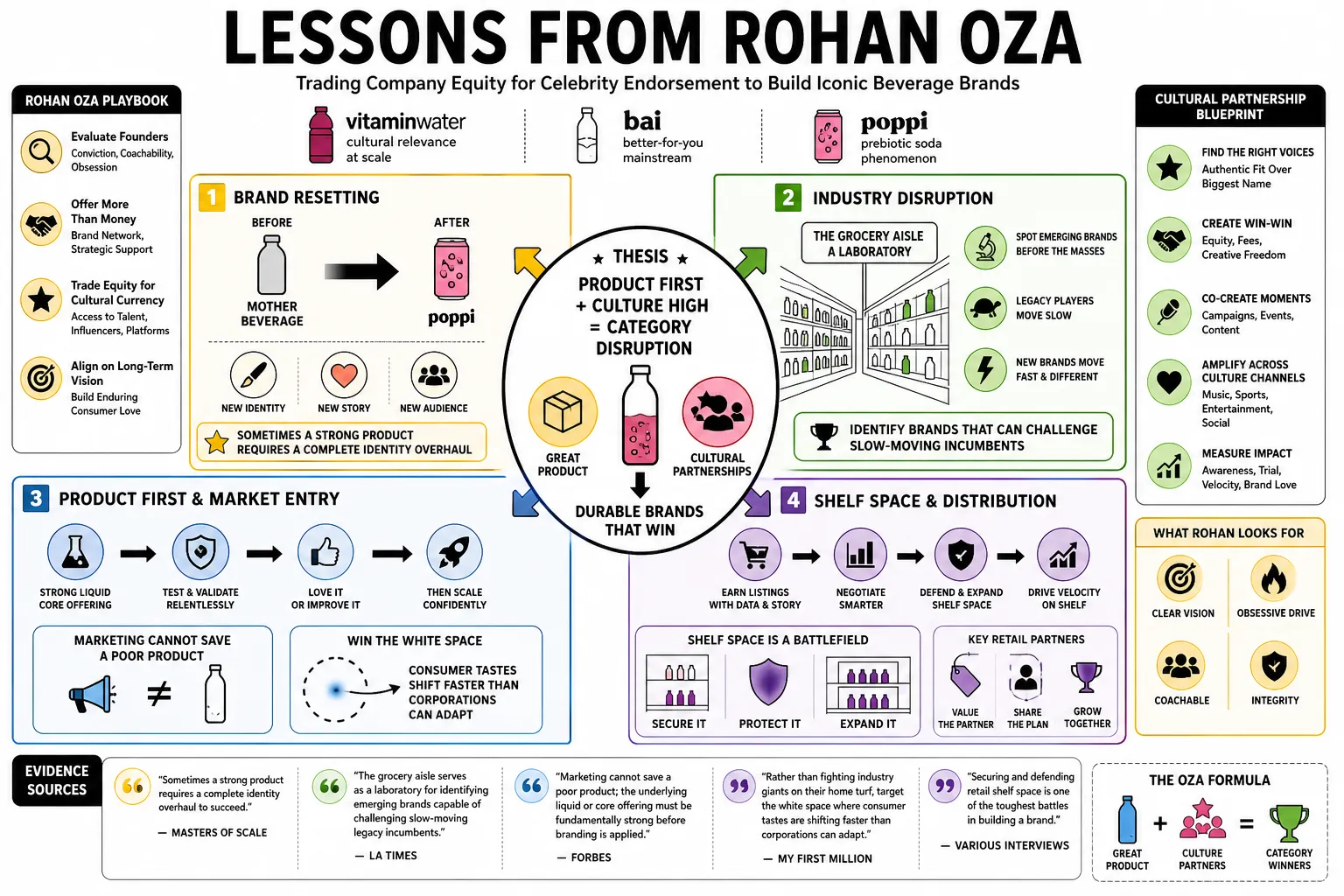
Lessons from Rohan Oza
Investor and marketing executive Rohan Oza established the model of trading company equity for celebrity endorsement. His work at Vitaminwater, Bai, and Poppi showed how emerging consumer brands can use pop culture to challenge legacy beverage companies. This profile covers his approach to evaluating founders and structuring the cultural partnerships that help products scale.
Part 1: Building and Disrupting Brands
- On Brand Resetting: "Sometimes a strong product requires a complete identity overhaul to succeed, as was the case when Mother Beverage became Poppi." — Forbes (Meet Rohan Oza, The Mastermind Behind The $1.9 Billion Poppi Deal)
- On Industry Disruption: "The grocery aisle serves as a laboratory for identifying emerging brands capable of challenging slow-moving legacy incumbents." — Masters of Scale (Rohan Oza: How to Build a Brand That Captures the Moment)
- On Product First: "Marketing cannot save a poor product; the underlying liquid or core offering must be fundamentally strong before branding is applied." — My First Million (Spotting Billion-Dollar Investments with Rohan Oza)
- On Market Entry: Look for consumer categories where tastes are changing before large incumbents can respond, then use the grocery aisle as a laboratory for emerging brands. — Los Angeles Times (How I Made It: Rohan Oza)
- On Shelf Space: For physical products, retail placement is strategic infrastructure; the My First Million episode explicitly frames shelf space as the original algorithm. — Reference: My First Million transcript
- On Boldness: "True disruption requires a willingness to engage in marketing that makes traditional corporate structures uncomfortable." — Business Insider (Meet the Millionaire Marketer Rohan Oza Behind Vitaminwater and Vita Coco)
- On Simplification: Oza links the biggest consumer exits to simple products with clear use cases, rather than brands that make the buying decision harder to understand. — Reference: My First Million transcript
- On Revitalizing Legacy Products: "When tasked with reviving established brands like Sprite, the method is integrating them deeply into contemporary youth culture." — Los Angeles Times (How I Made It: Rohan Oza)
Part 2: Celebrity Equity and Partnerships
- On Celebrity Alignment: "Be your brand. Do not simply hire a famous face; find someone who naturally lives and breathes the product's lifestyle." — Business Insider (Meet the Millionaire Marketer Rohan Oza Behind Vitaminwater and Vita Coco)
- On the Equity Model: "Offering celebrities an ownership stake rather than a flat fee ensures they are financially motivated to drive the brand's long-term success." — Masters of Scale (Rohan Oza: How to Build a Brand That Captures the Moment)
- On Selecting Partners: "Choose cultural figures like 50 Cent or Justin Timberlake who possess a genuine affinity for the category they are entering." — Business Insider (Meet the Millionaire Marketer Rohan Oza Behind Vitaminwater and Vita Coco)
- On Influence: Start by reaching the tastemakers: Oza says one in ten Americans influence the other nine, and the marketer's job is to spot that one. — Reference: My First Million transcript
- On Negotiating Deals: "Ensure that the valuation of the celebrity's equity reflects the actual impact they are expected to bring to the company's growth." — Cheddar (Shark Tank Guest Shark Rohan Oza on Consumer Trends)
- On Mutual Benefit: "The most successful partnerships, such as the Vitaminwater acquisition, create life-changing wealth for both the founders and the celebrity investors." — Business Insider (Meet the Millionaire Marketer Rohan Oza Behind Vitaminwater and Vita Coco)
Part 3: The "Brand Messiah" Philosophy
- On Leadership Styles: "I believe in brand messiahs, not brand managers." — Ross School of Business (Rohan Oza with Dean Scott DeRue)
- On Founder Devotion: "A leader must exhibit a quasi-religious passion for their company, evangelizing the product to anyone who will listen." — Ross School of Business (Rohan Oza with Dean Scott DeRue)
- On Building Teams: "Hire individuals who are emotionally invested in the brand's mission, rather than those looking for a standard corporate role." — Ross School of Business (Rohan Oza with Dean Scott DeRue)
- On Operator Involvement: "Investors should act as extensions of the founding team, matching the brand messiah's passion with hands-on operational support." — Business Insider (Meet the Millionaire Marketer Rohan Oza Behind Vitaminwater and Vita Coco)
- On Corporate Limitations: "Traditional consumer goods companies often struggle to innovate because they employ managers who administer brands rather than messiahs who champion them." — Ross School of Business (Rohan Oza with Dean Scott DeRue)
- On Living the Brand: "If you are not consuming your own product in your daily life, you cannot expect others to do the same." — Masters of Scale (Rohan Oza: How to Build a Brand That Captures the Moment)
Part 4: Pitching and Investing
- On Narrative Clarity: "Keep your stories tight and succinct." — The Statesman (US is the Greatest Country in the World to be an Entrepreneur: Rohan Oza)
- On Purpose: "Make sure the story or the product has a real reason for being." — The Statesman (US is the Greatest Country in the World to be an Entrepreneur: Rohan Oza)
- On Financial Realism: "Inspire the sharks enough that the valuation you are coming with is real." — The Statesman (US is the Greatest Country in the World to be an Entrepreneur: Rohan Oza)
- On Essential Traits: "Passion and confidence are the two most necessary characteristics for anyone delivering a pitch." — The Statesman (US is the Greatest Country in the World to be an Entrepreneur: Rohan Oza)
- On Backing the Jockey: "Investors are ultimately betting on the intelligence and adaptability of the founder as much as the product itself." — Cheddar (Shark Tank Guest Shark Rohan Oza on Consumer Trends)
- On Receiving Feedback: Treat market feedback as strategy input; the Poppi case study shows the brand changing name, packaging, format, channel, and leadership as the opportunity became clearer. — Forbes (Meet Rohan Oza, The Mastermind Behind The $1.9 Billion Poppi Deal)
- On Competitive Deal-Making: "The camaraderie among investors disappears the moment a lucrative deal is on the table; the desire to win is authentic." — Cheddar (Shark Tank Guest Shark Rohan Oza on Consumer Trends)
Part 5: Identifying "Better-for-You" Trends
- On Consumer Shifts: "The most lucrative investments capitalize on the macro consumer movement toward healthier, more functional lifestyles." — Los Angeles Times (How I Made It: Rohan Oza)
- On Evaluating Ingredients: "The Four Ps of consumer trends are plant, protein, premium indulgence, and phat." — Cheddar (Shark Tank Guest Shark Rohan Oza on Consumer Trends)
- On Upgrading Staples: "There is massive opportunity in taking legacy junk food categories and replacing them with cleaner, better-tasting alternatives." — Business Insider (Meet the Millionaire Marketer Rohan Oza Behind Vitaminwater and Vita Coco)
- On Flavor Trade-Offs: "Healthier products will only reach mass scale if they do not force consumers to compromise on taste." — Masters of Scale (Rohan Oza: How to Build a Brand That Captures the Moment)
- On Functional Benefits: "Products like prebiotic sodas succeed by offering tangible health benefits wrapped in familiar, enjoyable formats." — Forbes (Meet Rohan Oza, The Mastermind Behind The $1.9 Billion Poppi Deal)
- On Category Creation: "Sometimes the best strategy is not to beat the competition, but to invent a completely new sub-category that you can dominate." — Los Angeles Times (How I Made It: Rohan Oza)
- On Mainstream Appeal: A better-for-you brand has to graduate from niche promise to mass retail execution, as Poppi did when Walmart accelerated its distribution. — Forbes (Meet Rohan Oza, The Mastermind Behind The $1.9 Billion Poppi Deal)
- On Packaging Cues: "The visual identity of a healthy product must signal premium quality while remaining approachable to the average shopper." — Forbes (Meet Rohan Oza, The Mastermind Behind The $1.9 Billion Poppi Deal)
- On Timing the Market: "Identifying a trend too early can be just as fatal as arriving too late; the product must meet the consumer exactly where their current habits are heading." — Masters of Scale (Rohan Oza: How to Build a Brand That Captures the Moment)
Part 6: Marketing and Cultural Resonance
- On the 10% Rule: Influence the influencers: Oza describes the target as the one in ten Americans who can pull the other nine toward a brand. — Reference: My First Million transcript
- On Grassroots Momentum: "Before spending millions on television ads, build buzz through street-level marketing with bartenders, DJs, and local tastemakers." — Masters of Scale (Rohan Oza: How to Build a Brand That Captures the Moment)
- On Pop Culture Integration: "A brand achieves scale when it stops being seen as a physical item and starts being treated as a prop in popular culture." — Ross School of Business (Rohan Oza with Dean Scott DeRue)
- On Unconventional Tactics: "Standing out requires a willingness to experiment with edgy, non-traditional marketing campaigns that larger corporations would veto." — Los Angeles Times (How I Made It: Rohan Oza)
- On Social Proof: "When tastemakers are seen holding a beverage naturally in paparazzi photos, it generates more credibility than a billboard." — Business Insider (Meet the Millionaire Marketer Rohan Oza Behind Vitaminwater and Vita Coco)
- On Leveraging Media: "Treat every media appearance and cultural event as an opportunity to seamlessly weave the brand into the cultural conversation." — Ross School of Business (Rohan Oza with Dean Scott DeRue)
Part 7: The Entrepreneurial Mindset and Success
- On Creating Value: "One is creating a product that people really want and need." — The Statesman (US is the Greatest Country in the World to be an Entrepreneur: Rohan Oza)
- On Financial Reward: "Two is creating wealth for yourself and your family." — The Statesman (US is the Greatest Country in the World to be an Entrepreneur: Rohan Oza)
- On Shared Prosperity: "Three is sharing that wealth of success with all the employees that help make the company successful." — The Statesman (US is the Greatest Country in the World to be an Entrepreneur: Rohan Oza)
- On the American Dream: "America is the greatest country in the world to be an entrepreneur." — The Statesman (US is the Greatest Country in the World to be an Entrepreneur: Rohan Oza)
Part 8: Career Evolution and Finding Your Path
- On Corporate Constraints: "If you feel too creative and disruptive for a traditional corporate environment, it is likely time to strike out on your own." — Business Insider (Meet the Millionaire Marketer Rohan Oza Behind Vitaminwater and Vita Coco)
- On Non-Linear Paths: "A career can start on a manufacturing floor making M&Ms and end in venture capital; no experience is wasted if you learn from it." — Ross School of Business (Rohan Oza with Dean Scott DeRue)
- On Taking Leaps: "Leaving a comfortable executive position at a giant like Coca-Cola requires faith in your ability to build something from the ground up." — Los Angeles Times (How I Made It: Rohan Oza)
- On Strategic Pivots: "You must be willing to abandon a current path if you realize your unique skills are better suited for a different role in the ecosystem." — Ross School of Business (Rohan Oza with Dean Scott DeRue)
- On Building Portfolios: Build a portfolio around strong founders and brands, accepting that even losing bets can still become well-known while the winners carry the fund. — Reference: My First Million transcript
- On Trusting Intuition: "Data is important, but successfully identifying the next cultural phenomenon often relies on deeply honed gut instinct." — Masters of Scale (Rohan Oza: How to Build a Brand That Captures the Moment)