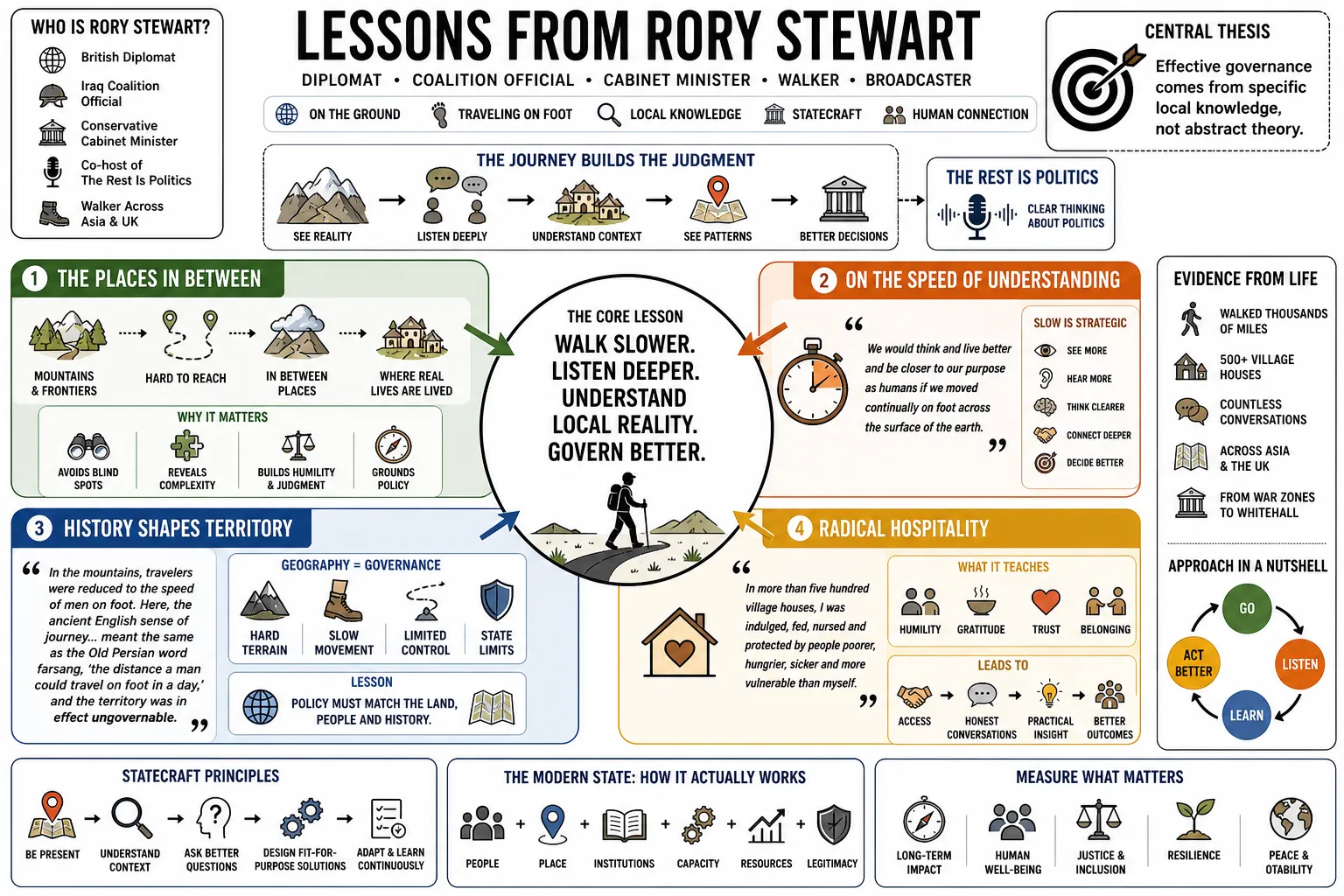
Lessons from Rory Stewart
Rory Stewart served as a British diplomat, Iraq coalition official, and Conservative cabinet minister before reaching a massive audience co-hosting The Rest Is Politics. Known for walking across stretches of Asia and the UK to observe realities on the ground, he argues that effective governance demands specific local knowledge over abstract theory. This collection gathers his thoughts on leadership, foreign policy, and how the modern state actually works.
Part 1: The Places In Between
- On the speed of understanding: "We would think and live better and be closer to our purpose as humans if we moved continually on foot across the surface of the earth." — Source: [The Places In Between]
- On historic geography: "In the mountains, travelers were reduced to the speed of men on foot. Here, the ancient English sense of journey... meant the same as the Old Persian word farsang, 'the distance a man could travel on foot in a day,' and the territory was in effect ungovernable." — Source: [The Places In Between]
- On radical hospitality: "In more than five hundred village houses, I was indulged, fed, nursed and protected by people poorer, hungrier, sicker and more vulnerable than myself." — Source: [Goodreads]
- On traditional greetings: "Peace be with you. How are you? Is your soul healthy? Are you well? Are you well? Are you healthy? Are you fine? Is your household flourishing? Long life to you." — Source: [Goodreads]
- On the kindness of strangers: "I found incredible kindness, dignity and hospitality in both Iraq and Afghanistan—am only alive because of it—the most worthwhile lesson of a twenty month walk to these countries was a deepening appreciation of the kindness of strangers." — Source: [AZ Quotes]
- On physical endurance: "Every step was a battle, and every footfall was chiseled into the frozen ground." — Source: [Bookey]
- On the illusion of state control: Governments in distant capitals often mistake lines drawn on a map for actual administrative control, ignoring the fierce independence of mountain communities. — Source: [The Places In Between]
- On historical memory: The ruins of ancient civilizations scattered across the Afghan landscape serve as a reminder that empires always overestimate their permanence. — Source: [The Places In Between]
- On isolation: The sheer physical difficulty of navigating the Afghan winter isolates communities so completely that neighboring valleys can feel like different centuries. — Source: [The Places In Between]
- On the limits of modernity: Technology and modern transportation have made us forget that for most of human history, geography was the absolute constraint on human ambition. — Source: [The Places In Between]
Part 2: Occupational Hazards
- On interventionism: "For the sake of a tiny sum of money - a couple thousand dollars a month from the hundred billion we had spent on the invasion - we were alienating our key partner and successor." — Source: [Occupational Hazards]
- On local political realities: "I learnt how little you could do in a country where people had a strong idea of what they wanted for themselves and where there was a strong and developed mass politics." — Source: [The Guardian]
- On language as a bridge: Attempting to speak the local dialect, even poorly, signals a willingness to engage on local terms rather than dictating from above. — Source: [Occupational Hazards]
- On administrative hubris: Western officials often arrive in conflict zones with templates for democracy that completely fail to account for deeply entrenched tribal networks. — Source: [Occupational Hazards]
- On compromised alliances: Governing in a post-conflict zone frequently requires negotiating with figures whose methods and morals directly contradict your own values. — Source: [Occupational Hazards]
- On the fragility of infrastructure: You can build a clinic or a school, but without the local political consensus to staff and protect it, it will be looted within weeks. — Source: [Occupational Hazards]
- On the illusion of authority: Sitting in a heavily fortified compound issuing decrees creates a false sense of control over a province that is largely ignoring you. — Source: [Occupational Hazards]
- On the cost of bureaucracy: The machinery of international coalitions often spends more time managing its own internal reporting requirements than engaging with the local population. — Source: [Occupational Hazards]
- On historical repetition: Foreign powers repeatedly enter the Middle East believing their technological superiority will override historical grievances, and they are consistently proven wrong. — Source: [Occupational Hazards]
- On the nature of power: True authority in southern Iraq did not flow from the Coalition Provisional Authority, but from the clerics, tribal leaders, and armed militias who controlled the streets. — Source: [Occupational Hazards]
Part 3: Politics on the Edge
- On the definition of loyalty: "A team player was someone who parroted the party line with fervour, never rebelled, and was never abashed." — Source: [Politics on the Edge]
- On political promises: "The NHS will be stronger, class sizes will be smaller, taxes lower … wages will be higher, fuel bills will be lower." — Source: [Goodreads]
- On the hollow state: Modern government is frequently characterized by a rotating cast of ministers who lack the subject-matter expertise to challenge bad policy. — Source: [Politics on the Edge]
- On lobby fodder: The system demands that elected representatives vote against their own conscience and logic simply to maintain the appearance of party unity. — Source: [Politics on the Edge]
- On practical implementation: Grand political strategies often fall apart because ministers do not pay attention to the tedious, granular details of how a policy will actually be executed on the ground. — Source: [Politics on the Edge]
- On ministerial churn: Moving politicians between departments every few months ensures they never stay long enough to learn the brief, understand the problems, or be held accountable for the outcomes. — Source: [Politics on the Edge]
- On the disconnect from reality: Westminster operates in an atmosphere of intense internal drama that bears almost no relation to the daily lives and concerns of the electorate. — Source: [Politics on the Edge]
- On prison reform: Fixing failing institutions requires basic, unglamorous management—like stopping drugs from coming through the gates—rather than sweeping legislative overhauls. — Source: [Politics on the Edge]
- On the Edwardian fantasy: The British system relies on the outdated assumption that a bright amateur with an Oxford degree can successfully run any government department. — Source: [Rory Stewart Official]
Part 4: The Rest Is Politics
- On political discourse: The primary goal of conversation across the aisle should be to disagree agreeably, exploring differences without resorting to personal destruction. — Source: [The Rest Is Politics]
- On the danger of polarization: When political factions view each other as enemies rather than opponents, the resulting gridlock prevents any meaningful problem-solving. — Source: [The Rest Is Politics]
- On the value of curiosity: A healthy democracy requires participants to remain genuinely curious about why their opponents believe what they do, rather than immediately assuming bad faith. — Source: [The Rest Is Politics]
- On echo chambers: The modern media ecosystem encourages politicians to speak only to their base, hardening divisions and making compromise politically fatal. — Source: [The Rest Is Politics]
- On objective reality: Disagreeing agreeably requires a shared baseline of objective facts; debate becomes impossible when basic reality is contested. — Source: [Alastair Campbell Blog]
- On changing one's mind: It should be viewed as a sign of intellectual strength, not political weakness, to update your views when presented with new evidence. — Source: [The Rest Is Politics]
- On the history of argument: Vigorous, respectful debate is not a modern breakdown of civility but the historical foundation of the parliamentary system. — Source: [The Rest Is Politics]
- On populism: Populist movements thrive by offering simplistic, emotionally satisfying answers to complex, systemic problems that require trade-offs. — Source: [The Rest Is Politics]
- On finding common ground: Even the most opposed political figures usually share a baseline desire to improve the country; the disagreement is over the mechanism, not the motive. — Source: [The Rest Is Politics]
Part 5: Development and Foreign Aid
- On global responsibility: "We have to come out of Brexit, proud global Britain... having some money to do it, some resources to do it – to put Britain on the world stage again – is hugely important." — Source: [The Guardian]
- On the illusion of progress: "Perhaps it is because no one requires more than a charming illusion of action in the developing world. If policy makers know little about Afghanistan, the public knows even less." — Source: [Goodreads]
- On technocratic limits: "What we must resist in general is any idea that there is a purely technocratic solution... to come up with a single mathematical formula, which will be able to resolve the very, very complex trade-offs." — Source: [GOV.UK]
- On direct cash transfers: The most effective and respectful way to lift people out of extreme poverty is often to bypass bureaucracies and give them money directly, allowing them to choose how to improve their own lives. — Source: [GiveDirectly]
- On development jargon: The international aid sector obscures its lack of impact and alienates the public by hiding behind impenetrable acronyms and theoretical frameworks. — Source: [Devex]
- On moral obligation: Committing a fixed percentage of national income to foreign aid is a reflection of a country's character and its recognition of obligations beyond its borders. — Source: [The Guardian]
- On local agency: Development projects fail when they treat local populations as passive recipients of western charity rather than active participants with their own economic priorities. — Source: [GiveDirectly]
- On political resistance: It is incredibly difficult to convince domestic politicians to prioritize foreign aid spending when voters are feeling the effects of local economic austerity. — Source: [Devex]
- On measuring success: The success of an aid program should be judged by the tangible improvement in the daily lives of the poorest individuals, not by the amount of money dispersed or the number of reports generated. — Source: [GiveDirectly]
Part 6: Borders and The Marches
- On the nature of borders: Borders are rarely clean, absolute lines; they are porous, shifting zones of transition where identities blend and overlap. — Source: [The Marches)]
- On walking and observation: You cannot understand a landscape by driving through it; you must walk it to comprehend the scale, the terrain, and the people who inhabit it. — Source: [The Marches)]
- On the Middleland: The borderlands between England and Scotland possess their own distinct culture and history, forming a region that is neither entirely English nor entirely Scottish. — Source: [The Marches)]
- On personal history: "Remember that every life is a special problem, which is not yours but another's; and content yourself with the terrible algebra of your own." — Source: [Goodreads]
- On the scale of knowledge: "If I could skim ten books a day for a year, I would be able to get a sense of most of what David Hume might have read in 1730 -- an age when it still might just have been possible to read everything." — Source: [Goodreads]
- On local identity: People often identify more strongly with their immediate valley, village, or regional landscape than they do with the concept of the nation-state. — Source: [The Marches)]
- On heritage: The physical landscape is a repository of memory, shaped by centuries of agriculture, conflict, and habitation that inform the present. — Source: [The Marches)]
- On paternal influence: Our understanding of geography and history is frequently mediated through the stories, prejudices, and affections passed down by our parents. — Source: [The Marches)]
- On national myths: The stories countries tell about their borders are often simplified narratives designed to project strength and unity, masking a much more complicated reality. — Source: [The Marches)]
- On rural disconnect: Metropolitan centers continually fail to grasp the economic and cultural realities of the rural fringes, leading to deep political alienation. — Source: [The Marches)]
Part 7: Leadership and Philosophy
- On the necessity of doubt: Good leadership requires the capacity to tolerate ambiguity and to resist the pressure to provide immediate, certain answers to complex problems. — Source: [Rory Stewart Official]
- On grounded decision making: Strategy must be built from the ground up, based on empirical observation of what is actually happening, rather than imposing top-down theories. — Source: [Occupational Hazards]
- On the limitations of experts: While technocrats can optimize systems, they often lack the political instinct to understand what a community will actually accept or value. — Source: [Politics on the Edge]
- On taking responsibility: True leadership involves staying in a role long enough to see the consequences of your decisions, rather than moving on before the flaws in your plan are exposed. — Source: [Politics on the Edge]
- On the aesthetic of action: Politicians are frequently seduced by the appearance of doing something—announcing initiatives and passing laws—rather than doing the hard work of making things function. — Source: [Politics on the Edge]
- On historical humility: An awareness of history should make leaders hesitant to embark on grand, transformative projects that ignore the specific context of a society. — Source: [The Places In Between]
- On practical ethics: The moral choice in governance is rarely between a perfect solution and a bad one; it is usually about choosing the least damaging option available in a constrained environment. — Source: [Occupational Hazards]
- On the danger of abstraction: Treating people as data points or demographic categories causes leaders to implement policies that look logical on paper but cause immense harm in practice. — Source: [GiveDirectly]
- On resilience: The ability to endure continuous, grinding friction without losing sight of the core objective is the defining characteristic of effective administration. — Source: [Politics on the Edge]
Part 8: Public Service and Duty
- On the gap in public life: There is an extraordinary and constant tension between the idealistic reasons people enter public service and the cynical mechanics required to survive within it. — Source: [IE University]
- On the politician's role: The duty of a representative is to articulate the unquantifiable values of the public—landscape, community, history—that economists and planners routinely ignore. — Source: [Rory Stewart Official]
- On mutual trust: "It is necessary not just for the public to learn to trust their politicians, but for the politicians to learn to trust the public." — Source: [AZ Quotes]
- On the frustration of government: Those drawn to public service to effect change often find their greatest obstacles are not political opponents, but the institutional inertia of the civil service. — Source: [Politics on the Edge]
- On the necessity of specifics: Broad rhetoric about duty is meaningless unless it is accompanied by a mastery of the specific, boring details required to make the state function. — Source: [Politics on the Edge]
- On ground-level engagement: You cannot reform an institution like a prison or a school without spending significant time walking the corridors and talking directly to the staff and inmates. — Source: [Politics on the Edge]
- On the trap of ambition: The desire for promotion within the party structure inevitably compromises a politician's ability to serve the immediate, practical needs of their constituents. — Source: [Politics on the Edge]
- On international duty: A nation's public service extends beyond its borders; failing to assist in international development diminishes a country's standing and its moral core. — Source: [The Guardian]
- On the ultimate goal: The purpose of political power is not to impose a grand ideological vision, but to incrementally and competently improve the physical and social conditions of everyday life. — Source: [The Rest Is Politics]