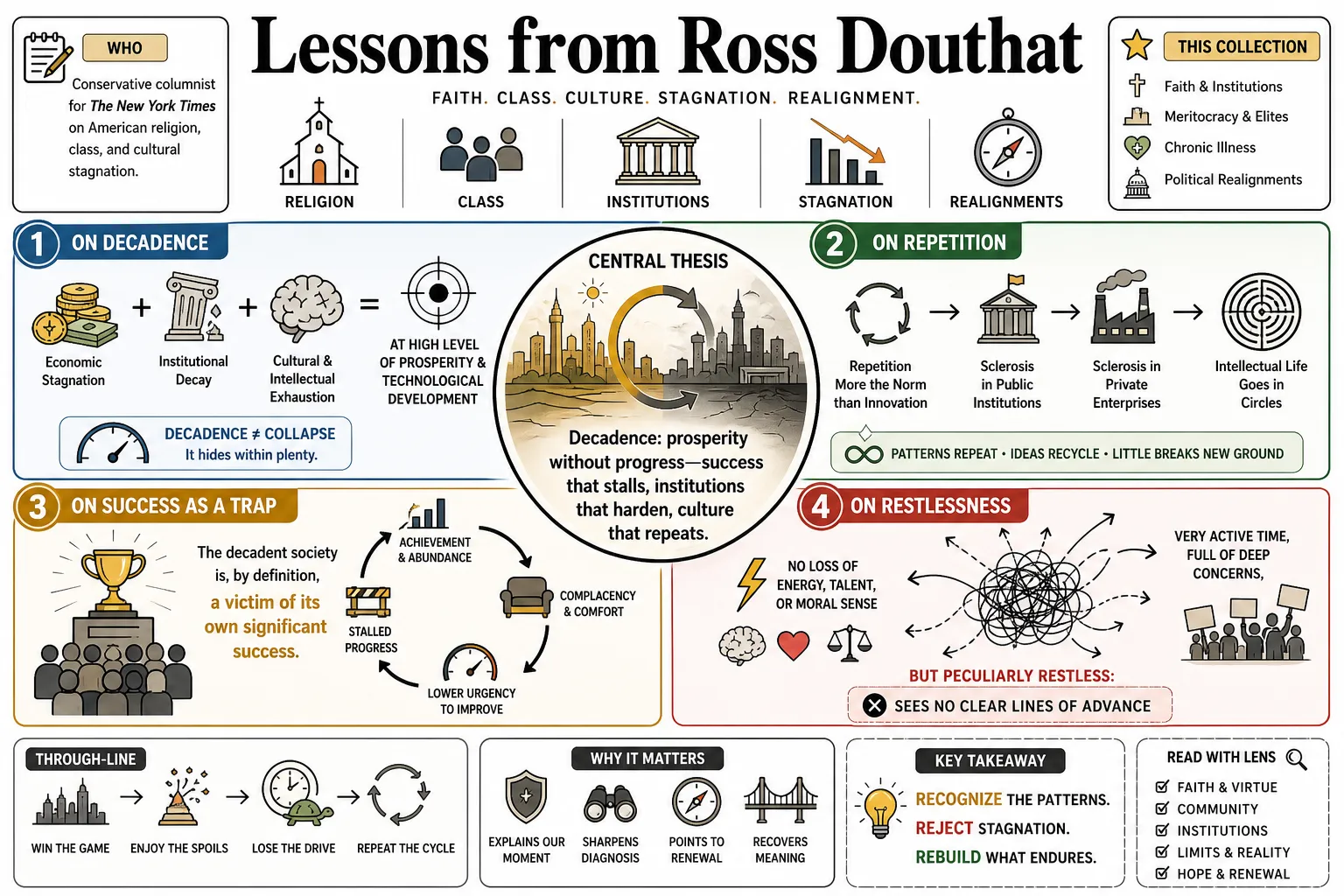
Lessons from Ross Douthat
Ross Douthat is a conservative columnist for The New York Times who writes about American religion, class, and cultural stagnation. He frequently diagnoses modern Western decadence and defends traditional religious institutions. This collection gathers his writing on faith, meritocracy, chronic illness, and current political realignments.
Part 1: The Anatomy of Decadence
- On Decadence: "Decadence refers to economic stagnation, institutional decay, and cultural and intellectual exhaustion at a high level of material prosperity and technological development." — Source: [The Decadent Society]
- On Repetition: "It describes a situation in which repetition is more the norm than innovation; in which sclerosis afflicts public institutions and private enterprises alike; in which intellectual life seems to go in circles." — Source: [The Decadent Society]
- On Success as a Trap: "The decadent society is, by definition, a victim of its own significant success." — Source: [The Decadent Society]
- On Restlessness: Decadence "implies in those who live in such a time no loss of energy or talent or moral sense. On the contrary, it is a very active time, full of deep concerns, but peculiarly restless, for it sees no clear lines of advance." — Source: [The Decadent Society]
- On Cultural Exhaustion: "The forms of art as of life seem exhausted, the stages of development have been run through. Institutions function painfully. Repetition and frustration are the intolerable result. Boredom and fatigue are great historical forces." — Source: [The Decadent Society]
- On Sustaining Stagnation: "Perhaps the task of sustaining decadence is the task that we, the fortunate, the long-lived, the spoiled, should want our leaders to pursue." — Source: [The Decadent Society]
- On the Status Quo: Regarding the adage that unsustainable trends must stop, "I lean toward 'later rather than sooner'" when it comes to the collapse of the decadent order. — Source: [The Decadent Society]
- On Simulation: "If you want to feel like Western society is convulsing, there's an app for that, a convincing simulation waiting." — Source: [The Decadent Society]
- On Technological Disappointment: "The audience realizes that it has been trapped into recognition that just one of the many late-nineteenth-century inventions is more important than the portable electronic devices of the past decade on which they have become so dependent." — Source: [The Decadent Society]
- On Aging Populations: "We are aging, comfortable and stuck," defining a modern Western world defined more by demographic decline than dynamic expansion. — Source: [Harvard Magazine]
Part 2: American Religion and Heresy
- On America's True Spiritual Crisis: "America’s problem isn’t too much religion, or too little of it. It’s bad religion: the slow-motion collapse of traditional Christianity and the rise of a variety of destructive pseudo-Christianities in its place." — Source: [Bad Religion]
- On Therapeutic Religion: "The result is a nation where gurus and therapists have filled the roles once occupied by spouses and friends, and where professional caregivers minister... to the needs of people taught from infancy to look inside themselves for God." — Source: [Bad Religion]
- On Original Sin vs. Self-Esteem: "The Christian teaching that every human soul is unique and precious has been stressed, by the prophets of self-fulfillment and gurus of self-love, at the expense of the equally important teaching that every human soul is fatally corrupted by original sin." — Source: [Bad Religion]
- On Egotism: "Absent the latter emphasis, religion becomes a license for egotism and selfishness." — Source: [Bad Religion]
- On the Nature of Heresy: American spiritual trends often prioritize individual ego and self-fulfillment rather than submitting to historical, orthodox doctrines. — Source: [Bad Religion]
- On the Loss of the Orthodox Center: While America has always fostered religious dissent, modern heresies are more destructive because they are no longer reacting against a strong institutional orthodox center. — Source: [Bad Religion]
- On the Prosperity Gospel: The American obsession with wealth has fused with Christian theology, creating a popular but heretical belief that God exists primarily to grant financial success. — Source: [Bad Religion]
- On Political Religion: When traditional faith recedes, political ideologies, both nationalism on the right and utopianism on the left, rush in to fill the religious void and function as substitute gospels. — Source: [Bad Religion]
- On Christian Paradox: "Indeed, this is perhaps the greatest Christian paradox of all: that the world's most paradoxical religion has cultivated rationalism and scientific rigor more diligently than any of its rivals, making the Christian world safe for philosophy as well as fervor." — Source: [QuoteFancy]
- On the Christian Narrative: Institutional religion provides a necessary framework for navigating existence, which individualistic, DIY spirituality struggles to offer during times of crisis. — Source: [Believe: Why Everyone Should Be Religious]
Part 3: Meritocracy, Privilege, and Elites
- On Elite Incubation: Modern elite universities function as "an incubator for an American ruling class that is smug, stratified, self-congratulatory, and intellectually adrift." — Source: [Privilege: Harvard and the Education of the Ruling Class]
- On the Meritocratic Ideal: "On the evidence we have, the meritocratic ideal ends up being just as undemocratic as the old emphasis on inheritance and tradition." — Source: [Washington Monthly]
- On the Loss of Duty: Modern elites possess "the old aristocracy's vices (privilege, insularity, arrogance) without the sense of duty, self-restraint and noblesse oblige that WASPs at their best displayed." — Source: [Washington Monthly]
- On Reality Privilege: A divide is forming where only the elite can afford a beautiful physical environment, while the masses are pushed toward digital escapism. — Source: [The New York Times]
- On the Digital Divide: "Everyone else, the vast majority of humanity, lacks Reality Privilege. Their online world is, or will be, immeasurably richer and more fulfilling than most of the physical and social environment around them in the quote-unquote real world." — Source: [The New York Times]
- On Privilege Discourse: The modern campus debate about privilege often serves as a way for elites to manage their own guilt without actually relinquishing any power or resources. — Source: [The New York Times]
- On the Illusion of Fairness: The meritocracy tells its winners that they deserve their success entirely through hard work, blinding them to the structural advantages they inherited. — Source: [Privilege: Harvard and the Education of the Ruling Class]
- On Social Stratification: Even as elite institutions diversify in terms of race and gender, they have become increasingly closed off to those from lower socioeconomic classes. — Source: [Privilege: Harvard and the Education of the Ruling Class]
- On Ruling Class Education: The primary lesson learned at elite universities is not intellectual rigor, but how to effortlessly navigate the networks of the ruling class. — Source: [Privilege: Harvard and the Education of the Ruling Class]
- On Meritocratic Arrogance: A system that sorts people purely by intelligence and resume-building inevitably breeds a unique kind of arrogance that looks down on manual labor and rural life. — Source: [The New York Times]
Part 4: The Realignment of the Right
- On the Working-Class Base: The Republican Party can only thrive if it transitions from being the party of the country club to the party of Sam's Club. — Source: [Grand New Party]
- On Obsolete Agendas: The conservative movement has too often remained "stuck addressing themselves to the problems of a bygone era," prioritizing tax cuts over middle-class anxieties. — Source: [Grand New Party]
- On Base Rebellion: "A party elite can rebel against its own base successfully, but only if there's a bigger base waiting to be built." — Source: [Grand New Party]
- On Family Decline: The decline of family formation and stability is the most pressing crisis facing the working class, and economic policy must be tailored to address it. — Source: [Grand New Party]
- On Economic Populism: Working-class voters are open to pro-family government interventions and wage supports, policies that traditional free-market orthodoxy has foolishly rejected. — Source: [Grand New Party]
- On Libertarianism: "No one doubts that pure libertarianism is simple, but that's just why it remains on the ideological fringe, because it boils down the most difficult questions in human affairs to a simple equation, a What Would the Market Do bumper sticker." — Source: [QuoteFancy]
- On Donor Influence: If a political party prioritizes the financial interests of its wealthy donor class over the existential anxieties of its working-class base, it courts political ruin. — Source: [Grand New Party]
- On Reform Conservatism: Conservatism must offer a detailed blueprint for the middle class, combining social conservatism with creative, pro-worker economic statecraft. — Source: [Grand New Party]
- On Political Realism: Cultural issues and material conditions are intertwined; you cannot solve the economic stagnation of the working class without addressing its social decay, and vice versa. — Source: [Grand New Party]
Part 5: Chronic Illness and the Medical Frontier
- On the Slow Path to Healing: "The slowness of my progress was absurd, but I still felt sure that there was progress. And as long as there was progress, there could be an ending, a final victory, health regained." — Source: [The Deep Places]
- On the Limits of Modern Medicine: Experiencing a chronic, unrecognized disease exposes the terrifying gap between the human experience of suffering and the rigidity of institutional medical consensus. — Source: [The Deep Places]
- On the Invisible Epidemic: "If 400,000 cases of Lyme a year yielded 50,000 chronic cases, and if even only a few thousand of those were as severe as mine..." — Source: [The Deep Places]
- On Escaping the Screen: He sought a rural life as a place "that would force me outside, tear me away from the vortex of the internet, the tyranny of the screen, the sedentary pundit's life," only to find nature harbored its own profound dangers. — Source: [The Deep Places]
- On Psychosomatic Diagnoses: Doctors often dismiss unexplained pain as stress or anxiety. "I did feel stressed... But the illness felt like the reason rather than the symptom." — Source: [The Deep Places]
- On the Isolation of Pain: Chronic suffering acts as an invisible wall between the sick person and the healthy world, making ordinary social interactions feel like a simulation. — Source: [The Deep Places]
- On Fringe Treatments: When mainstream medicine offers no cure, desperate patients are forced into the wild west of alternative and experimental treatments, blending science with desperate hope. — Source: [The Deep Places]
- On Suffering and Identity: Prolonged agony strips away professional identity and intellectual pride, reducing a person to their most primal, endurance-focused self. — Source: [The Deep Places]
- On Empathy for the Suffering: Going through a medically contested illness forces a realization that many people dismissed by society as crazy or hysterical are simply suffering from ailments science does not yet understand. — Source: [The Deep Places]
Part 6: Catholicism in Crisis
- On Pope Francis's Agenda: Pope Francis's pontificate represents a deliberate, high-stakes gamble to liberalize the Catholic Church's approach to morality and modern life. — Source: [To Change the Church]
- On the Threat of Schism: By attempting to shift Church doctrine on fundamental issues like marriage and communion, the papacy has sparked an internal conflict that risks permanent fracture. — Source: [To Change the Church]
- On Pastoral vs. Doctrinal Change: The modern liberalizing strategy often avoids explicitly changing doctrine, instead using pastoral accommodations to slowly alter the Church's lived reality. — Source: [To Change the Church]
- On the Francis Personality: A Jesuit observer noted of Francis: "He is well-trained and capable, but is surrounded by this personality cult which is extremely divisive. He has an aura of spirituality which he uses to obtain power." — Source: [Law & Liberty]
- On the Conservative Dilemma: Conservative Catholics find themselves in the agonizing position of defending traditional orthodox teachings while appearing to resist the very authority of the Pope they revere. — Source: [To Change the Church]
- On the Failure of the Liberal Model: Mainline Protestantism demonstrates that liberalizing Christian doctrine to meet modern secular standards usually leads to demographic collapse rather than revival. — Source: [To Change the Church]
- On the Illusion of Compromise: On core theological questions regarding the nature of sin and sacraments, there is rarely a middle ground; attempts at compromise usually just mask a surrender of traditional teaching. — Source: [To Change the Church]
- On Global Catholicism: The battle for the future of the Church is increasingly defined by the tension between a declining, progressive Western Catholicism and a growing, orthodox African and Asian Church. — Source: [To Change the Church]
- On the Long View of History: The Catholic Church has survived immense internal crises before; the current ideological civil war is historically significant but not unprecedented in the span of two millennia. — Source: [To Change the Church]
Part 7: Faith, Reason, and Materialism
- On the Limits of Science: Phenomena such as consciousness, objective morality, and persistent supernatural experiences are black holes that materialist science struggles to explain. — Source: [The New York Times]
- On the Rationality of Religion: Religious belief is not an abdication of reason, but rather a highly coherent framework for understanding the totality of human experience. — Source: [Believe: Why Everyone Should Be Religious]
- On Disenchantment: The promise of a purely rational, secular society has largely failed. Humans remain stubbornly spiritual. — Source: [The New York Times]
- On the New Weirdness: Instead of becoming more rational, the post-Christian world is growing weirder, characterized by rising interest in astrology, the occult, and UFOs. — Source: [The New York Times]
- On the Necessity of Institutions: To survive and transmit values across generations, faith must be embodied in institutions, not just held as a private, solitary sentiment. — Source: [Believe: Why Everyone Should Be Religious]
- On Meeting Doubters: Effective apologetics requires framing the perspective of faith in a way that respects the genuine questions and doubts of non-believers, meeting them on the ground of shared inquiry. — Source: [National Catholic Reporter]
- On Secular Utopianism: Secular ideologies that attempt to build heaven on earth invariably stumble over the flawed, tragic nature of human beings. — Source: [The New York Times]
- On Meaning and AI: In an era of technological disruption and artificial intelligence, religious traditions provide the necessary grounding for understanding what makes humans unique. — Source: [The New York Times]
- On Pascal and Lewis: The intellectual tradition of thinkers like Blaise Pascal and C.S. Lewis demonstrates that faith can be rigorously analytical while remaining deeply mysterious. — Source: [The New York Times]
Part 8: Culture, Technology, and the Future
- On Birth Rates: The most consequential trend of the 21st century is not technological acceleration, but the global collapse of birth rates and the aging of populations. — Source: [The Decadent Society]
- On Cultural Nostalgia: A stagnant culture endlessly recycles the pop culture of its past, producing remakes and sequels rather than genuinely new artistic movements. — Source: [The Decadent Society]
- On Virtual Reality: As the physical world becomes more stagnant and expensive, humanity will increasingly retreat into digital worlds that offer the illusion of progress and adventure. — Source: [The New York Times]
- On Space Exploration: The closing of the physical frontier has contributed deeply to the psychological malaise of the West. — Source: [The Decadent Society]
- On the Internet's Promise: The internet has proved to be an engine of cultural fragmentation and political polarization rather than the utopian town square early technologists envisioned. — Source: [The New York Times]
- On Political Gridlock: Western political systems have become vetocracies, where it is incredibly easy for factions to block action but nearly impossible to build consensus for bold new projects. — Source: [The Decadent Society]
- On Pagan Futures: The decline of Christianity in the West is not leading to a neutral secularism, but rather a return to a stratified, pagan morality that values power and success over the weak and suffering. — Source: [The New York Times]
- On Resilience: Even within a stagnant civilization, small communities, religious orders, and counter-cultural families can preserve the seeds of future renewal. — Source: [The Decadent Society]
- On the Unknown: The future will not be a straight line of either utopian progress or apocalyptic collapse, but a complex, unpredictable muddling through where human agency still matters. — Source: [The New York Times]