Ruchi Sanghvi was the first female engineer at Facebook, where she built the initial version of the News Feed, and later served as VP of Operations during Dropbox's hypergrowth phase. Today, she runs South Park Commons, a community designed to support founders during the earliest, pre-idea stages of starting a company. This collection documents her practical views on scaling products, navigating the emotional toll of founder life, and the mechanics of building resilient engineering cultures.
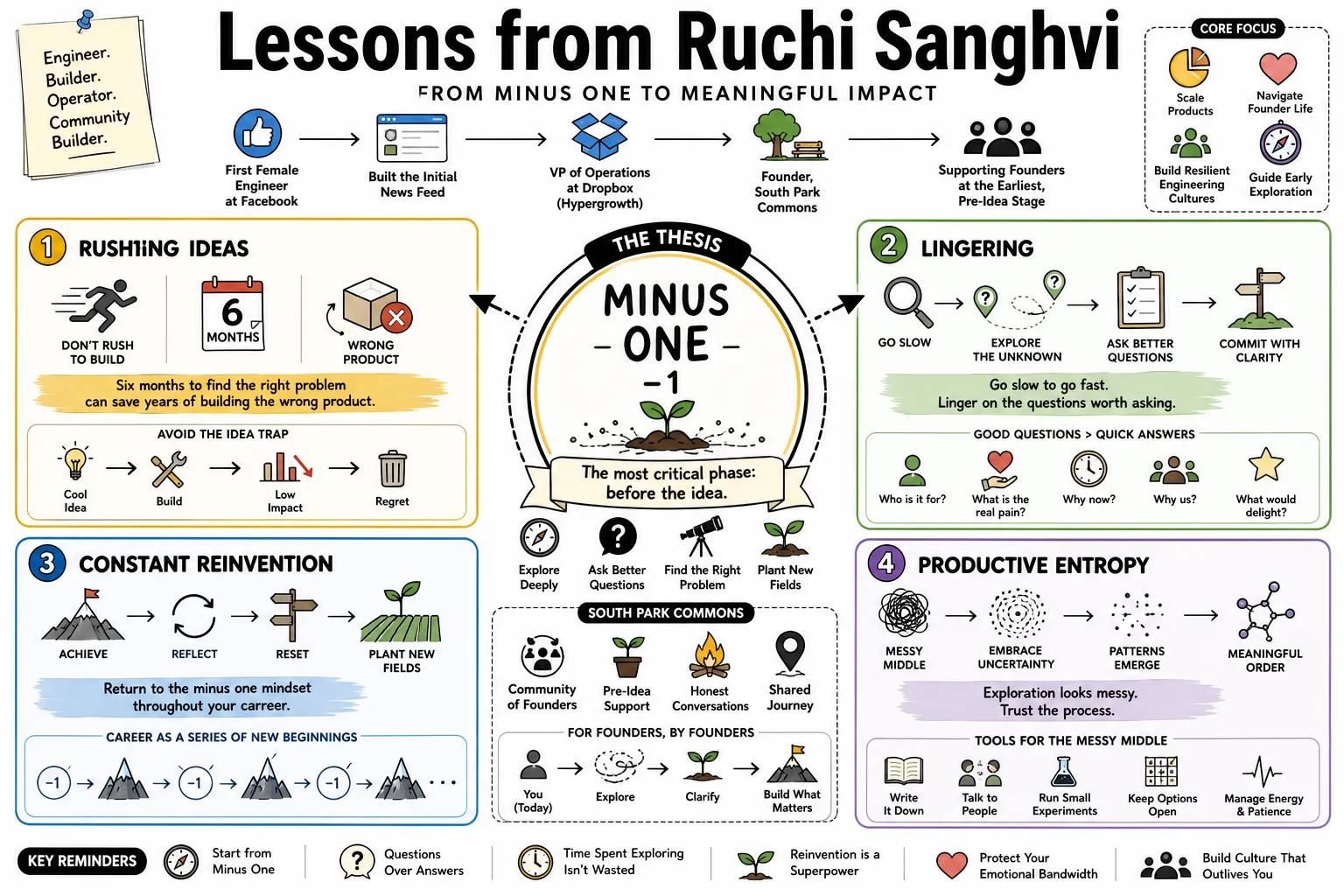
Part 1: The Minus One Phase
- On the "Minus One" Mindset: "The most critical phase of a startup is the time spent before having a clear idea, embracing the messy middle of exploration." — Source: South Park Commons
- On Rushing Ideas: "Taking six months to find the right problem to solve can save years of building the wrong product." — Source: xRaise
- On Lingering: "Go slow to go fast. It is crucial to linger on the questions worth asking before committing to a path." — Source: YourStory
- On Constant Reinvention: "The best founders return to the minus one mindset throughout their careers, constantly reinventing themselves and planting new fields." — Source: South Park Commons
- On Productive Entropy: "In the -1 phase, you need an environment where interruption and interrogation are features, not bugs." — Source: South Park Commons
- On High-Trust Feedback: "High-trust feedback from peers in the earliest stages is often more valuable than early capital." — Source: RaiseFunding
- On Ambition and Isolation: "Ambition doesn't require loneliness. Founding a company is isolating, so you need a high-temperature environment of talent density." — Source: South Park Commons
- On Organic Beginnings: "Meaningful things often begin quietly, messily, and without a clear plan, much like a reading group around a dining table." — Source: South Park Commons
- On Ideation as a Craft: "Ideation is a craft in itself. Give creativity an opportunity and nurture it without the immediate pressure of a demo day." — Source: xRaise
Part 2: Engineering & First Principles
- On First Principles Thinking: "It wasn't about genius or even experience or the number of people. It was about not being afraid to learn and thinking and acting from first principles." — Source: YouTube
- On Ground-Up Arguments: "Build arguments from the ground up rather than relying on silver bullets or past successes, because everything you've learned only matters in context." — Source: xRaise
- On Contextual Knowledge: "Past playbooks are dangerous. What worked at a massive consumer network won't necessarily apply to a B2B collaboration startup." — Source: Economic Times
- On Product Quality: "Only great people can make great products." — Source: YouTube
- On Unlearning: "Sometimes the hardest engineering challenge isn't building new infrastructure, but unlearning the culture and scale of your previous company." — Source: xRaise
- On Ecosystem Building: "Transitioning a product from a single application into a global platform requires enabling third-party developers to build their own visions on top of yours." — Source: Sedna Consulting
- On Meritocracy: "Engineering allows you to focus on raw impact and code rather than background, though it still requires a willingness to be fiercely opinionated." — Source: LiveMint
- On Disagreeing and Committing: "To maintain speed, teams must be okay with their ideas being rolled back or changed without hard feelings; entitlement to code is toxic." — Source: First Round Review
- On Total Ownership: "Don't ask for permission, ask for forgiveness. In a startup, everyone must feel empowered to fix anything they see broken." — Source: South Park Commons
Part 3: Building the Facebook News Feed
- On User Backlash: "We woke to hundreds of outraged users joining groups like 'I hate Facebook' and 'Ruchi's the devil' immediately after the News Feed launch." — Source: The Guardian
- On Paradoxical Engagement: "Amidst all the chaos of the backlash, we noticed something unusual: even though people said they hated it, engagement had doubled." — Source: YouTube
- On Human Psychology in Design: "We weren't psychologists; we built the feed based on the realization that users care most about themselves, followed by their closest first-degree connections." — Source: YouTube
- On Defending Innovation: "The service didn't reveal any information that wasn't already visible on individual profiles—it just aggregated it and made it easier to find." — Source: Wikipedia
- On Crisis Response: "The user revolt forced the team to work 48 hours straight to build and release the first set of granular privacy controls to save the product." — Source: YouTube
- On Privacy and Transparency: "Privacy and security are really important, but it is also important to recognize that the world is becoming a more transparent place through technology." — Source: LiveMint
- On Pace of Policy: "While the world is becoming more transparent, our privacy policies need to keep pace... if they don't, we are just blocking progress." — Source: LiveMint
- On Thick Skin: "Being the face of a controversial launch means you will receive hate mail; you have to separate personal attacks from the product's actual utility." — Source: My Words & Thoughts
- On the Move Fast Mantra: "Facebook's 'move fast and break things' culture was essential for rapid iteration, but later required massive adjustments when dealing with permanent user data elsewhere." — Source: CoxBlue
- On Early Scaling Pressures: "Watching a company grow from 20 employees to over 1,000 requires navigating the intense transition from a startup culture to managing a global utility." — Source: YouTube
Part 4: The Realities of Scaling
- On Being the Fixer: "I managed functions like recruiting or marketing that didn't really have leaders... the goal really was to work myself out of a job." — Source: The Twenty Minute VC
- On Band-Aid Leadership: "A 'Band-Aid' executive steps into functional gaps to move the team forward without setting such a rigid trajectory that a future leader cannot bring their own vision." — Source: Elad Gil
- On the Feeling of Growth: "When companies find product-market fit, everything feels like it is falling apart. You need to hire enough people to keep things going." — Source: SeedToScale
- On Narrowing Roles: "As a company grows, generalists are replaced by specialists. Your role and its scope suddenly becomes narrow... but you are probably having a larger impact in a more focused area." — Source: Elad Gil
- On Letting Go of Structure: "The people who scale well are the people who don't have a problem of letting go of prior structures." — Source: YouTube
- On Lightweight Process: "You must add light-weight processes that are updated every few months to keep product management strong during hyper-growth." — Source: Accel Insights
- On Planning for the Future State: "Leaders must plan for the business they want to be in six months from now; if you only plan for your current size, you will already be behind." — Source: First Round Review
- On Identifying Bottlenecks: "Interviewing 50% of the team upon joining is the fastest way to identify that a company lacks the basic resources to scale its product and recruiting." — Source: Elad Gil
- On Systemizing Integration: "It is just as important to build systems to integrate new hires as it is to hit recruiting targets, to increase productivity and strengthen the culture." — Source: YouTube
- On the Danger of 'Move Fast': "The 'move fast and break things' approach is dangerous for companies that are entrusted with sensitive, permanent user data; reliability must precede speed." — Source: CoxBlue
Part 5: Navigating as a Founder
- On Fighting Psychology: "I’m afraid of failing. And every day is like a roller coaster. And the hardest part is fighting my own psychology." — Source: YouTube
- On Second Company Syndrome: "Building perfect infrastructure to scale to millions of users before you have any is a trap born from unlearning the massive scale of a previous success." — Source: xRaise
- On the Impatience Trap: "Coming from a rocket ship creates unrealistic expectations; consumer social networks grow completely differently than B2B tools." — Source: Economic Times
- On Sprinting a Marathon: "At Cove, we were working 12 to 14 hours every single day not realizing that we were no longer 22 and needed to pace ourselves for a marathon." — Source: YouTube
- On Asking for Help: "It is a mistake to restrict yourself to what you know rather than taking advantage of the broader ecosystem for advice and funding." — Source: Economic Times
- On Sitting in Chaos: "The process requires sitting in the chaos of conflict and being uncomfortable for a long time until true conviction emerges." — Source: YouTube
- On Unshakable Conviction: "Once that conviction is found through rigorous exploration, nothing can sway your direction." — Source: YouTube
- On Passion and Fear: "When evaluating founders, look for deep passion and a distinct lack of fear regarding the unknown." — Source: YouTube
- On Making Space for Learning: "Learning actually takes a lot of work... you need to actively make the time and the space for it to happen." — Source: YouTube
Part 6: Hiring & Talent Density
- On the Unicorn Trap: "Don't look for the perfect person for the job for the next 10 years, the unicorn. The company is changing so quickly that you only know what you need now." — Source: SeedToScale
- On Hiring Better People: "I think of hyperscaling as... you're actually able to continue to hire people who are better than you, perhaps a little bit narrower in scope." — Source: Elad Gil
- On Audacious Goals: "I set this audacious goal of growing the company from 90 people to 270 people in less than seven months... we were determined to hire people that we could learn from." — Source: YouTube
- On Toxic Ego: "The desire to remain the smartest person in the room is a toxic ego trap that prevents a team from successfully scaling." — Source: Elad Gil
- On Zero Tolerance for Mediocrity: "A zero tolerance for mediocrity is essential for the 0 to 1 phase, though leadership must eventually shift focus to the journey of the team to avoid burnout." — Source: YouTube
- On Interviewing for Needs: "Hire for the immediate, critical bottlenecks of the company rather than holding out for a candidate who is perfect across all dimensions." — Source: SeedToScale
- On Reflecting the Customer Base: "Because half of all users are female, companies must recruit women to reflect their customer base and bring collaborative dynamics to the team." — Source: Sedna Consulting
- On Finding Co-Founders: "I went and I looked for 10 other people who are exactly like me—technical, unemployed, and figuring out what they wanted to work on next." — Source: YouTube
- On Curiosity in Leaders: "The most admirable quality in a founder or CEO is an immense, unyielding capacity for learning." — Source: YouTube
- On Building a Team Journey: "As a team scales, a leader must shift focus from just demanding the end result to supporting the psychological journey of the team." — Source: YouTube
Part 7: The Immigrant Experience
- On Being the First Female Engineer: "Being a female, I had to do a lot of behavior adjustments, and in my case, I got more aggressive." — Source: Medium
- On Asking for Opportunity: "I was always raising my hand, asking for opportunities... there were times when people call you stupid, but it's all a part of a steep learning curve." — Source: Medium
- On the Word 'Aggressive': "I don't like being called aggressive. And that reputation has stuck with me... 'aggressive' is generally used positively for men but often as a criticism for women." — Source: Medium
- On Immigrant Hurdles: "The journey from employee to entrepreneur was a complex and taxing one for an immigrant like me." — Source: Wikipedia
- On Visa Anxiety: "Facing a three-month period of unemployment due to visa complications creates an underlying anxiety that shapes your drive to succeed." — Source: YouTube
- On Systemic Reform: "Comprehensive immigration reform is a critical lever for maintaining the knowledge economy and allowing high-skilled workers to build the future." — Source: Council on Foreign Relations
- On Adapting to the Room: "The strategy for minorities in tech often has to be: adapt to get in the room, then work to change the room from the inside." — Source: xRaise
- On Mentorship: "Creating spaces where engineers can explore ideas safely is crucial for breaking down the systemic biases of the industry." — Source: xRaise
- On Self-Advocacy: "If I don't ask for something, I'm not going to get it." — Source: YouTube
Part 8: Personal Philosophy & Resilience
- On Identity and Work: "Work was my identity... I didn't go on holiday for many years because essentially I hated going away." — Source: The Twenty Minute VC
- On Detachment: "When you detach yourself from your company, you end up looking in the mirror going, 'Well who am I and what do I do with my time?'" — Source: The Twenty Minute VC
- On Managing Ego: "After experiencing massive early success, it is absolutely crucial to manage your ego and be honest about your own insecurities." — Source: xRaise
- On Emotional Health: "Being open about mental health and going to therapy is a necessary antidote to the burnout culture of Silicon Valley." — Source: xRaise
- On Defragging: "After intense periods of building, founders need time to 'defrag'—to clear their heads and get back to a generative, creative state." — Source: YouTube
- On Questioning Wisdom: "Sometimes it's worth questioning conventional wisdom and recognizing when the standard advice simply doesn't fit your reality." — Source: YouTube
- On Working with a Spouse: "Collaborating successfully with your spouse requires brutal clarity about strengths, weaknesses, and who takes the lead in specific areas." — Source: xRaise
- On Family Mission Statements: "Applying startup logic to personal life, like drafting a family mission statement, ensures you always operate from first principles at home." — Source: Squarespace
- On The Rollercoaster: "A founder's day often goes from feeling great at breakfast to thinking nothing will work by lunch; resilience is the only way to survive that intensity." — Source: YouTube