Lessons from Ryan Gellert
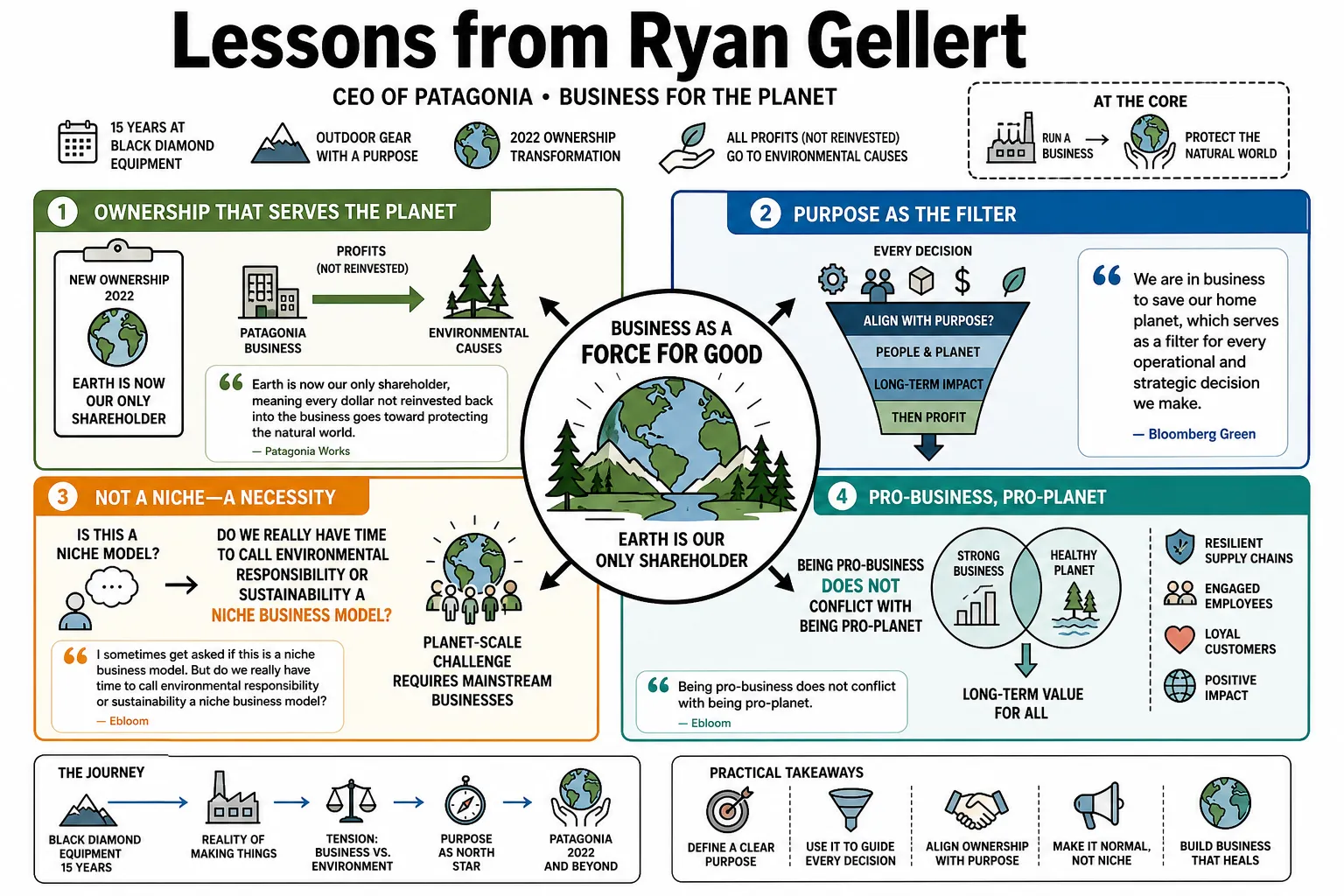
Ryan Gellert is the CEO of Patagonia, the outdoor apparel company that restructured its ownership in 2022 to direct all ongoing profits to environmental causes. Before leading Patagonia, he spent 15 years at Black Diamond Equipment, navigating the tension between manufacturing physical goods and protecting the natural world. This profile examines how Gellert approaches the practical, often messy realities of running a business designed to challenge traditional capitalism.
Part 1: The Business of Saving the Planet
- On the new ownership structure: "Earth is now our only shareholder, meaning every dollar not reinvested back into the business goes toward protecting the natural world." — Source: Patagonia Works
- On the purpose of the business: "We are in business to save our home planet, which serves as a filter for every operational and strategic decision we make." — Source: Bloomberg Green
- On avoiding the niche label: "I sometimes get asked if this is a niche business model. But do we really have time to call environmental responsibility or sustainability a niche business model?" — Source: Ebloom
- On operating a responsible business: "Being pro-business does not have to mean being anti-planet; the two must ultimately reconcile if either is to survive." — Source: Fortune
- On the purpose trust: "The Patagonia Purpose Trust was created specifically to protect our values in perpetuity, ensuring the founder's vision cannot be compromised by future leadership." — Source: Harvard Business School
- On holding companies accountable: "Businesses are implicated in creating the climate and ecological crisis, making their responsibility to fix it an urgent operational mandate." — Source: Patagonia
- On the Holdfast Collective: "All non-voting stock is held by the Holdfast Collective, which allows us to use our profits to directly fund climate solutions and political advocacy." — Source: CityNews
- On rethinking the corporate mandate: "If governments continue to walk back their social and environmental commitments, corporate responsibility becomes doubly urgent." — Source: Patagonia
- On maintaining relevance: "We are unapologetically a for-profit business, because remaining dynamic and profitable is required to prove that our model can actually scale." — Source: Business Insider
- On long-term thinking: "You don't build a great legacy by saying you will; you build it by working to become worthy of it." — Source: Forbes
Part 2: Growth vs. Purpose
- On intentional friction: "We practice intentional restraint regarding our growth, frequently questioning whether expanding a specific category actually serves our mission." — Source: Masters of Scale
- On the paradox of apparel: "Patagonia is a paradox. Our charter mandates responsible practices, yet every product we make takes irreplaceable resources from the planet." — Source: Patagonia
- On prioritizing impact over revenue: Gellert frames Patagonia as a business trying to prove responsible commerce can work at scale, with growth filtered through environmental impact rather than category dominance. — Reference: CNN interview with Ryan Gellert on Black Friday and sustainability
- On resisting traditional metrics: "The tension between generating revenue and preserving the planet keeps us honest and prevents us from defaulting to a growth-at-all-costs mindset." — Source: Forbes
- On scaling carefully: "Managing growth in a mission-driven company requires accepting that not every profitable opportunity is the right opportunity to pursue." — Source: Masters of Scale
- On the pressure to expand: "We have to actively resist the gravitational pull of standard capitalism, which demands endless quarter-over-quarter expansion." — Source: Substack
- On consumer culture: In the CNN interview, Gellert says a healthy planet needs a better model than one built around convincing people to buy things they do not need. — Reference: CNN interview with Ryan Gellert on consumerism
- On living with contradictions: "The tension of our existence is not lost on us. We acknowledge that our operations are counter to our purpose, and we work within that friction." — Source: Patagonia
- On proving a new model: "Profitability is necessary for us not to enrich shareholders, but to demonstrate that prioritizing the earth is a viable business strategy." — Source: Business Insider
- On setting boundaries: "By choosing not to aggressively chase market share, we create the operational space required to invest in deep supply chain overhauls." — Source: CMG Partners
Part 3: Leadership in the Modern Era
- On succeeding a founder: "Stepping into the role after Yvon Chouinard requires leading with humility and understanding that my job is to execute and protect his original vision." — Source: Ebloom
- On taking a stance: "It's a hell of a target-rich environment right now for leaders who are willing to speak up on political and environmental issues." — Source: Axios
- On corporate cowardice: "We need leaders to stop hiding behind industry organizations that lobby against climate action in the name of corporate profits." — Source: Business Chief
- On consistency: "Climate work has to be a 52-week thing, not something executives only pay attention to during a designated week of the year." — Source: NationSwell
- On the role of a modern executive: "Business sector leaders have an obligation to be the catalysts of change, recognizing they cannot rely on governments to act alone." — Source: NationSwell
- On moving past slogans: "Corporate leadership must move beyond sustainability slogans and engage in the uncomfortable work of actually reducing their footprint." — Source: Patagonia
- On accepting failure: "Sometimes doing the right thing means catching failures and accepting that you won't always hit your targets on the first attempt." — Source: Forbes
- On transparency: "If you want to be trusted by your community and your customers, you have to be willing to talk openly about where your business is still falling short." — Source: WBUR Breakfast Club
- On the anti-science movement: "Navigating today's political environment requires a firm refusal to back down when confronted by anti-science rhetoric and coordinated pushback." — Source: Bloomberg Green
- On building a legacy: "Legacy isn't a marketing strategy; it is the sum of the difficult decisions a leadership team makes when nobody is actively watching." — Source: Forbes
Part 4: Confronting the Climate Crisis
- On the reality of progress: "Sometimes it is messy. Sometimes it is painful. But in the end, doing the hard work is the only way to achieve real progress." — Source: Patagonia
- On the urgency of action: "The timeline we are operating on does not allow for companies to wait until they have the perfect sustainability plan before they start acting." — Source: Ebloom
- On systemic change: "We have to look beyond our own direct operations and use our influence to push for broader systemic changes in global supply chains." — Source: The B Team
- On environmental accountability: "You cannot claim to be a sustainable company if you are simultaneously funding politicians or groups that actively dismantle environmental regulations." — Source: Business Chief
- On funding solutions: "The climate crisis requires aggressive capital deployment, which is why we structured our company to funnel dividends directly into environmental work." — Source: CityNews
- On internalizing costs: "We have to stop treating the degradation of the natural world as an acceptable externality on a corporate balance sheet." — Source: Bloomberg Green
- On focusing efforts: In the Leadership Next conversation, Gellert ties Patagonia's climate work to honest footprint mitigation, coalitions, and using the business model where it can actually create leverage. — Reference: Fortune transcript of Leadership Next with Ryan Gellert
- On relentless execution: "The transition to a cleaner economy is going to require years of grinding execution, far beyond the initial burst of press releases." — Source: Fortune
- On the danger of apathy: "The biggest risk right now isn't that companies try and fail; it's that they convince themselves the problem is too large to warrant an aggressive attempt." — Source: WBUR Breakfast Club
Part 5: Redefining Profit
- On shareholder value: "We fundamentally rejected the premise that a company's primary fiduciary duty is to generate maximum financial returns for a small group of owners." — Source: Harvard Business School
- On using profit as a tool: "Profit is not the enemy; it is the engine that allows us to fund climate solutions and prove that a different kind of capitalism is possible." — Source: Business Insider
- On the transition of wealth: "Transferring ownership wasn't about avoiding taxes; it was the only structural way to ensure our profits would fight the environmental crisis forever." — Source: Bloomberg Green
- On rewriting the rules: "We are trying to demonstrate that you can run a highly successful, globally recognized brand without adhering to traditional wealth-accumulation models." — Source: NationSwell
- On financial independence: "Maintaining our status as a privately held company gives us the flexibility to make decisions that public markets would likely punish." — Source: Forbes
- On evaluating success: "Our success is measured not by how much money we retain at the end of the year, but by how much capital we are able to deploy to grassroots activists." — Source: Patagonia Works
- On the purpose of capital: The Leadership Next episode frames Patagonia's ownership structure as a way to redirect company value toward environmental causes and protect values at the core of the brand. — Reference: Leadership Next Apple Podcasts episode on Patagonia's purpose-led structure
- On breaking the mold: "If other businesses look at our financial structure and realize they don't have to follow the standard playbook, we will have succeeded." — Source: CityNews
- On reinvestment: "We still reinvest heavily into the business to ensure our supply chain and products remain cutting edge, but every excess dollar goes to the Earth." — Source: Harvard Business School
Part 6: Advocacy and Speaking Out
- On protecting public lands: "Public lands are the right of every citizen and their collective responsibility to protect against short-term industrial exploitation." — Source: The Inertia
- On the Ambler Road project: "There is no getting around that Ambler Road would permanently disrupt one of the largest, undeveloped parks on the planet, which is why we aggressively oppose it." — Source: Patagonia Works
- On corporate activism: "We do not view advocacy as separate from our business; defending the places where our customers recreate is a core part of our operational strategy." — Source: Fortune
- On political backlash: "If you are taking meaningful stances on the climate crisis, you have to accept that you are going to alienate certain political factions—and you have to be okay with that." — Source: Axios
- On leveraging the brand: "A recognized brand has a megaphone, and it is a moral failure to possess that kind of cultural volume and refuse to use it for the common good." — Source: Masters of Scale
- On grassroot partnerships: "Our role isn't always to lead the fight; often, it's to provide the funding and amplification necessary for local, frontline activists to win their battles." — Source: Patagonia Works
- On defending voting rights: "A healthy environment requires a functioning democracy, which makes protecting access to the ballot box a direct extension of our environmental work." — Source: Axios
- On confronting politicians: "We will not hesitate to publicly call out elected officials who attempt to roll back environmental protections in favor of short-term industrial gains." — Source: The Inertia
- On coalition building: "The outdoor industry has unique leverage when it bands together to advocate for conservation, and we must utilize that collective economic weight." — Source: Bloomberg Green
Part 7: Rethinking Consumption
- On product quality: Gellert describes Patagonia's product responsibility in practical terms: build the best product it knows how to make, emphasize quality, and run a major apparel repair operation. — Reference: Fortune transcript on Patagonia product quality and repair
- On the circular economy: "We are heavily invested in take-back programs and resale because we have to decouple our revenue generation from the constant extraction of virgin materials." — Source: Business Insider
- On discouraging purchases: The CNN interview centers Patagonia's Black Friday stance: use the moment to talk about sustainability, repair, and reducing unnecessary consumption rather than pushing more purchases. — Reference: CNN interview with Ryan Gellert on Black Friday and sustainability
- On supply chain reality: "You cannot claim to care about the environment while ignoring the massive water and carbon footprint of the textile industry." — Source: CMG Partners
- On recycled materials: "Moving our entire product line toward recycled and renewable inputs is non-negotiable if we are to mitigate the inherent harm of manufacturing." — Source: Outside Online
- On the friction of manufacturing: "Every jacket we produce carries an ecological cost; our job is to relentlessly shrink that cost while providing a product that justifies its own existence." — Source: Patagonia
- On repairing gear: "By teaching people how to repair their own clothing, we are actively challenging the throwaway culture that the apparel industry relies upon." — Source: Outside Online
- On transparency in sourcing: "Customers have a right to know exactly where their clothes come from and the human and environmental toll involved in their creation." — Source: WBUR Breakfast Club
- On overconsumption: Gellert links Patagonia's environmental work to a broader critique of overconsumption: a healthier model has to move beyond constantly persuading people to buy more goods. — Reference: CNN interview with Ryan Gellert on consumerism and sustainability
Part 8: The Path Forward
- On long-term optimism: "I remain stubbornly optimistic because I see the sheer volume of young people and frontline workers refusing to accept the status quo." — Source: SXSW
- On the role of business: "The era of the neutral corporation is over; companies will either actively participate in solutions or be correctly identified as part of the problem." — Source: Fortune
- On maintaining focus: "The daily challenge is to keep the company focused on its core mission while navigating an increasingly volatile and unpredictable global market." — Source: Bloomberg Green
- On the legacy of Black Diamond: "My time at Black Diamond taught me the operational realities of the outdoor industry, which provided the grounding needed to help scale Patagonia's advocacy." — Source: Milken Institute
- On the future of the Trust: "The structure we built ensures that even if the leadership changes entirely, the company's financial output will remain locked to environmental defense." — Source: Harvard Business School
- On leading by example: "We don't expect every company to copy our exact model, but we do expect them to look at our success and realize their own excuses are invalid." — Source: CityNews
- On defining the work: "The work isn't about achieving a final, perfect state of sustainability; it is about waking up every day and choosing to do slightly less harm." — Source: Ebloom
- On community impact: "Real impact happens when we decentralize our funding and put resources directly into the hands of the local communities fighting on the ground." — Source: Patagonia Works
- On the ultimate goal: "If we do our jobs right, the company will outlast us all, and the planet will be demonstrably healthier because this business existed." — Source: Forbes