Safra Catz is the CEO of Oracle, having spent over two decades shaping the company's trajectory alongside founder Larry Ellison. Rather than pursuing the visionary spotlight typical of Silicon Valley executives, Catz is known for her disciplined execution, rigorous financial management, and a highly systematic approach to mergers and acquisitions. This profile collects her perspectives on operational efficiency, the shift to cloud computing, and what it takes to drive massive organizational change from the inside.
Part 1: Leadership & Character
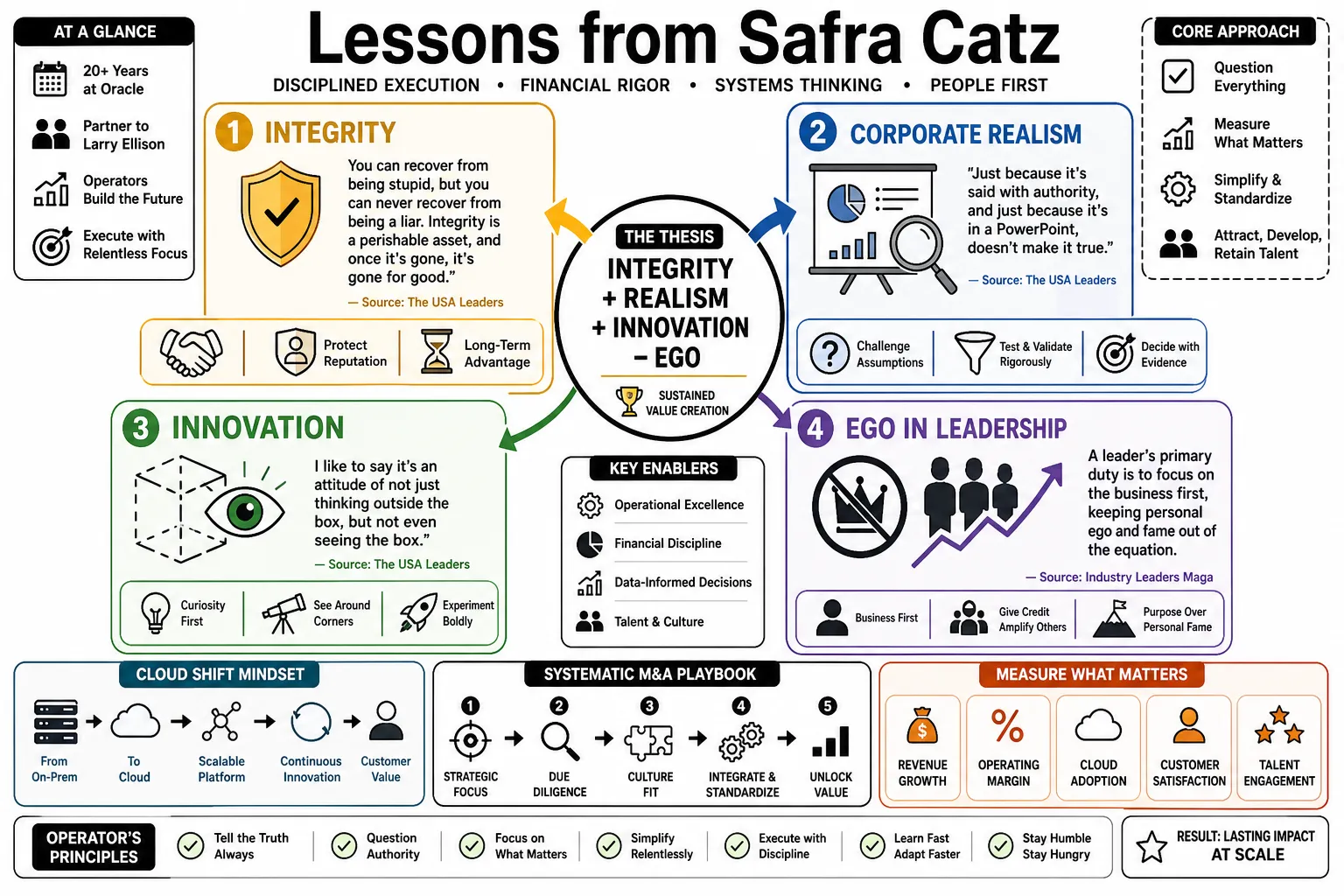
- On Integrity: "You can recover from being stupid, but you can never recover from being a liar. Integrity is a perishable asset, and once it's gone, it's gone for good." — Source: The USA Leaders
- On Corporate Realism: "Just because it's said with authority, and just because it's in a PowerPoint, doesn't make it true." — Source: The USA Leaders
- On Innovation: "I like to say it's an attitude of not just thinking outside the box, but not even seeing the box." — Source: The USA Leaders
- On Ego in Leadership: A leader's primary duty is to focus on the business first, keeping personal ego and fame out of the equation. — Source: Industry Leaders Magazine
- On Personal Priorities: Executives should strictly avoid putting their own career interests or public profile ahead of the company's operational needs. — Source: Industry Leaders Magazine
- On Decision Making: Rely on analytical rigor and concrete data to steer a company rather than blindly following the latest tech industry trends. — Source: Quarterdeck
- On Executive Visibility: True executive influence often comes from internal execution and delivering results, not from seeking the limelight. — Source: Business Insider
- On Quiet Strength: Effective leadership does not require being autocratic or loud; a disciplined, focused approach frequently yields deeper organizational respect. — Source: CEOptions
- On Trust: Building an environment of mutual respect and personal rapport is critical so that executive success is shared rather than resented. — Source: Oracle Investor Relations
- On Enduring the Spotlight: Recognizing the hollow nature of fame allows a leader to remain entirely focused on the mechanics of building a lasting business. — Source: Forbes
Part 2: Acquisitions & Financial Discipline
- On M&A Strategy: "When we do acquisitions, we decide what we want. We decide what fills a hole." — Source: IT Channel Oxygen
- On Walk-Away Leverage: "And if the price is too high, our alternative is the $5bn we spend on R&D every year. We're not well-known for overpaying, because at Oracle we always have an alternative." — Source: IT Channel Oxygen
- On The Role of Finance: "In the finance world, we used to spend all of our time looking backwards, reporting on what happened... Now it's about looking into the future. It's about planning and integration." — Source: Forbes
- On Long-Term Value: "When you're a publicly traded company there's an awful lot of pressure for quarterly earnings. Short-termism is a term that fellow CFOs and I use, and it kind of drives you crazy..." — Source: HubSpot
- On Shareholder Focus: The ultimate purpose of a company is to create long-term shareholder value, requiring executives to manage the noise from various short-term constituencies. — Source: HubSpot
- On Strategic Purpose: Acquisitions should never be isolated financial events; they are calculated moves to enter specific industries or build out the technology stack. — Source: Digital Times
- On Due Diligence: Uncovering every operational risk before signing a deal is non-negotiable and requires a phenomenal level of detail-orientation. — Source: Forbes
- On Post-Merger Integration: A disciplined first 100-day plan is what actually determines whether an acquisition succeeds or fails. — Source: Business Insider
- On Pricing Discipline: Maintaining a strong internal R&D pipeline ensures a company is never forced into overpaying for an asset. — Source: IT Channel Oxygen
- On Financial Evolution: The modern finance department must act as a forward-looking strategic partner rather than just a historical reporting function. — Source: Forbes
Part 3: Technology & Cloud Strategy
- On Technology’s Value: "The truth is that technology is only valuable if it helps you run your organization better." — Source: The USA Leaders
- On Taking Risks: "What we learned during COVID is it's absolutely critical to have a digital connection... Being bold is the way to win. Being timid can wipe you out." — Source: Oracle Investor Relations
- On Cloud Demand: "OCI has emerged as the largest driver of our overall revenue acceleration, growing much, much faster than our cloud competitors." — Source: Cloud Wars
- On Customer Realizations: Customers move to the cloud when they figure out they can get significantly more capability while paying less. — Source: Cloud Wars
- On Mission-Critical Systems: "We know better than anyone what it takes to run the full stack of technology that goes into mission-critical workloads." — Source: Cloud Wars
- On Enterprise Scale: Running the world's most important workloads requires decades of experience, comprehensive security, and unparalleled support. — Source: Cloud Wars
- On Artificial Intelligence: "AI capabilities are unique as they're built-in to help customers drive business outcomes." — Source: Cloud Wars
- On Continuous Upgrades: "New releases used to be scary for customers. Now people are excited. They see it less as a chore and more of a benefit." — Source: Raven Intel
- On Using Internal Tech: "Our own experience adopting Oracle Cloud applications and infrastructure allows us to serve as a unique and knowledgeable advisor to organizations." — Source: Oracle Investor Relations
- On Momentum: Reaching a tipping point in infrastructure demand validates years of aggressive investment in engineering. — Source: Business Chief
Part 4: Operations & Execution
- On Agility: "Changing slowly can be fatal." — Source: Cloud Wars
- On Simplicity: "It's critical to simplify and run the business in such a way that resources are allocated efficiently." — Source: The USA Leaders
- On Silos: "Everyone was looking at optimizing his little piece of the world instead of working together collaboratively to optimize for the whole." — Source: Forbes
- On Economies of Scale: Failing to work collaboratively across departments prevents a large company from benefiting from its own size. — Source: Forbes
- On Internal Operations: Running your own enterprise on the same cloud tools you sell provides the best blueprint for operational efficiency. — Source: Oracle Investor Relations
- On Process Standardization: Aligning acquired companies strictly to corporate policies ensures long-term operational stability. — Source: Business Insider
- On Closing Books: Adopting modern cloud applications internally allows a massive enterprise to close its financial books exponentially faster. — Source: Oracle Investor Relations
- On Discipline: Rigor in daily execution frequently outperforms highly publicized visionary statements. — Source: CEOptions
- On Practical Leverage: True operational leverage comes from removing redundant systems and unifying data models. — Source: Forbes
Part 5: Transformation & Change Management
- On Corporate Transformation: "My experience at Oracle illustrates that new technologies have their greatest impact when they are part of an overall corporate transformation." — Source: Forbes
- On Embracing Change: "Instead of shying away from change and opportunities, they embrace them. They see challenges, and they adjust to them." — Source: Oracle Investor Relations
- On The Hardest Part of Change: The most difficult aspect of any transition is not the underlying technology, but the internal sociology of the workforce. — Source: Forbes
- On Motivation: Organizations must use market challenges as direct motivation to advance rather than as excuses to stall. — Source: Oracle Investor Relations
- On Changing Work Habits: Ensuring employees actually adopt new processes is the only way a digital transformation yields returns. — Source: Forbes
- On Empathy in Change: Understanding the human resistance to new systems is required to successfully transition an established enterprise. — Source: Forbes
- On Internal Blueprints: Practicing what you preach by transforming your own organization validates your advice to the broader market. — Source: Oracle Investor Relations
- On Inevitability: Resistance to digital modernization is a fast track to obsolescence in any industry. — Source: Cloud Wars
- On Shared Goals: A successful transformation requires aligning every department's metrics with the new corporate reality. — Source: Forbes
Part 6: Customer Centricity
- On Customer Choice: "A core focus of our effort is based on the recognition that our customers have varying needs, and one of their most important needs is to have a choice." — Source: The USA Leaders
- On True Success: A technology vendor's success is entirely dependent on delivering measurable business outcomes for the client. — Source: Cloud Wars
- On Co-Creation: Solving complex industry challenges requires moving beyond vendor-client transactions into open, aggressive partnerships. — Source: Cloud Wars
- On Buying Friction: Modern sales engagements demand an accelerated buying experience that removes pain from contract negotiations. — Source: Forbes
- On Client Alignment: Go-to-market strategies must shift from pushing products to ensuring long-term client victories. — Source: Cloud Wars
- On Listening: Serving as an advisor requires actually understanding the varied constraints and pressures your customers face. — Source: The USA Leaders
- On Relationship Evolution: The shift to cloud computing inherently transitions a company from a software seller into an ongoing service provider. — Source: Forbes
- On Value Delivery: Customers no longer buy technology for its own sake; they buy the speed and agility it promises. — Source: Cloud Wars
- On Advising: Experiencing the pain of digital transformation firsthand makes a company a much more credible guide for its customers. — Source: Oracle Investor Relations
Part 7: Diversity & Women in Tech
- On Courage: When it comes to career advancement, the most important quality for women in technology is the courage to simply go for it. — Source: Women Tech Council
- On Creating Paths: If you cannot see a clear path for advancement within your organization, consider blazing a trail of your own. — Source: Time
- On Industry Necessity: "We need everybody, the folks that are most interested and the best. We can't afford half of the population deciding they're not interested." — Source: JPost
- On Talent Deprivation: Companies actively damage their own potential when they fail to foster an environment welcoming to diverse backgrounds. — Source: Forbes
- On Representation: The largest barrier to female leadership remains the raw mathematical lack of women currently sitting in those roles. — Source: Forbes
- On Entrepreneurship: Starting your own business is a highly viable alternative when corporate ladders remain rigid. — Source: Time
- On Inclusion: Ensuring diverse points of view are heard is a business imperative, not just a social one. — Source: Forbes
- On Team Building: Hiring and growing outstanding teams requires looking past traditional molds to find the best inherent talent. — Source: Industry Leaders Magazine
- On Taking Space: Women must be willing to pursue difficult challenges and occupy space in rooms where they are the minority. — Source: Women Tech Council
Part 8: The Oracle Partnership
- On Shared Missions: "Larry [Ellison] and I are publicly committed to Israel and devote personal time to the country... we aren't flexible regarding our mission." — Source: JPost
- On Defining Roles: A highly effective corporate structure often requires one leader to act as the visionary while another serves as the relentless operational enforcer. — Source: Business Insider
- On Continuity: Seamless executive transitions rely on a bedrock of absolute trust built over decades of shared pressure. — Source: Oracle Investor Relations
- On Market Skepticism: Maintaining an unwavering focus on engineering and finance is the best defense against external doubts about corporate resilience. — Source: Forbes
- On Loyalty: Working closely with founders requires a delicate balance of challenging their ideas while protecting the company's operational flanks. — Source: Business Insider
- On Dual Leadership: A complementary approach—pairing technological foresight with strict financial discipline—builds a mature, durable enterprise. — Source: Quarterdeck
- On Executive Chemistry: The most productive leadership teams are formed not just by talent, but by individuals who genuinely respect one another's distinct methods. — Source: Oracle Investor Relations
- On Navigating Transitions: Shifting from on-premise licensing to cloud required both the founder's technology pivot and the CEO's structural reorganization. — Source: Cloud Wars
- On Unconventional Success: Defying standard industry norms regarding succession and executive structure is entirely viable if the underlying business results remain strong. — Source: Forbes