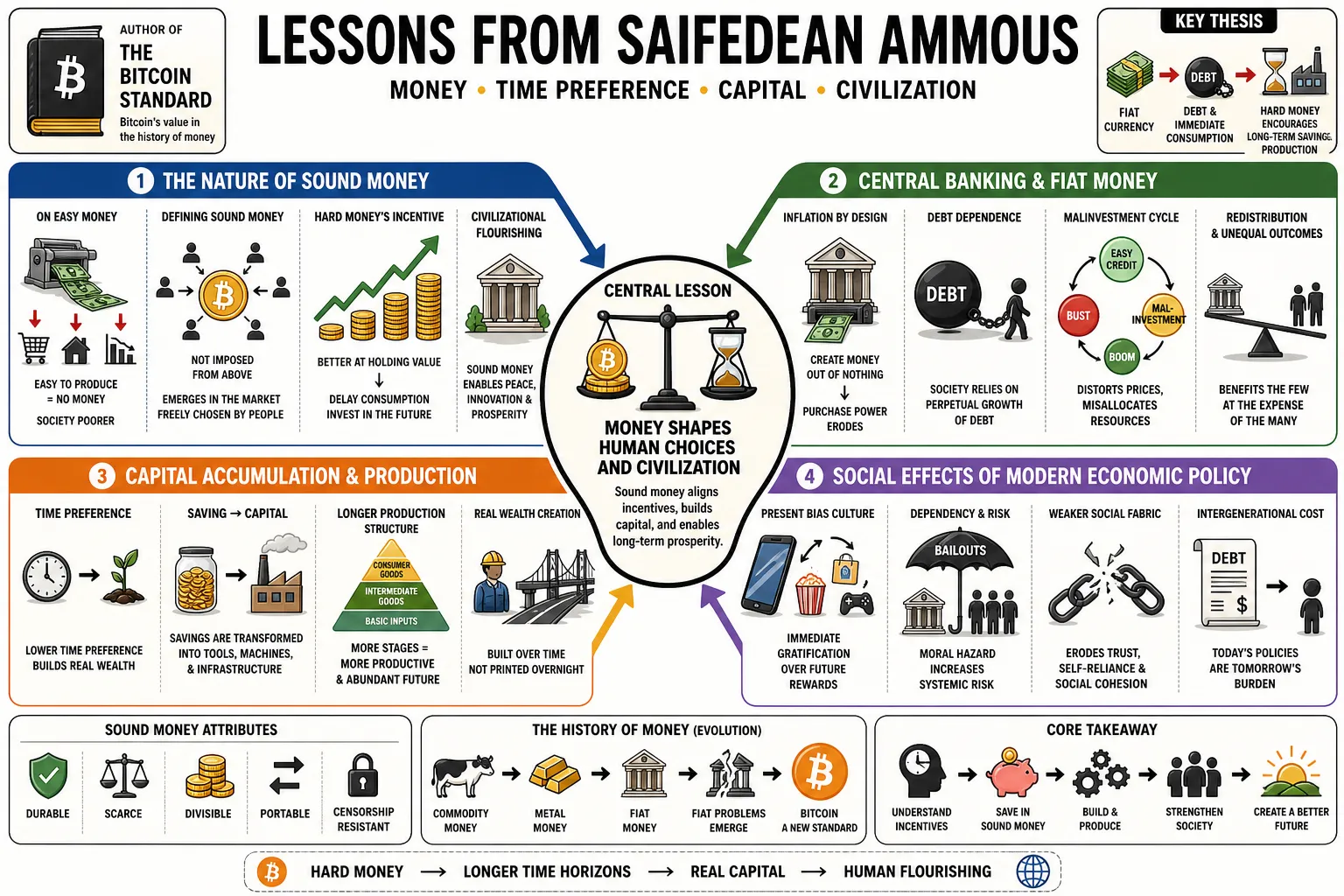
Lessons from Saifedean Ammous
Austrian economist Saifedean Ammous is the author of The Bitcoin Standard, which frames Bitcoin's value within the history of money. He argues that fiat currency drives debt and immediate consumption, while hard money encourages long-term saving. This profile outlines his arguments on central banking, capital accumulation, and the social effects of modern economic policy.
Part 1: The Nature of Sound Money
- On Easy Money: "A money that is easy to produce is no money at all, and easy money does not make a society richer; on the contrary, it makes it poorer by placing all its hard-earned wealth for sale in exchange for something easy to produce." — Source: [Goodreads]
- On Defining Sound Money: "Austrian economists are rarely dogmatic or objectivist in their definition of sound money. They define it not as a specific good or commodity, but as whichever money emerges on the market, freely chosen by the people who transact with it." — Source: [QuoteFancy]
- On Hard Money's Incentive: "The better the money is at holding its value, the more it incentivizes people to delay consumption and instead dedicate resources for production in the future." — Source: [QuoteFancy]
- On Civilizational Flourishing: "Human civilization flourished in times and places where sound money was widely adopted, while unsound money all too frequently coincided with civilizational decline and societal collapse." — Source: [Medium]
- On Money as a Tool: Sound money makes service valuable to others the only avenue open for prosperity to anyone, thus concentrating society's efforts on production and cooperation. — Source: [Medium]
- On Refusing Sound Money: "History shows it is not possible to insulate yourself from the consequences of others holding money that is harder than yours." — Source: [Goodreads]
- On the True Function of Money: Money is not about things and tangible material objects; it is an economic good that humans use to store value across time and space. — Source: [Saifedean.com]
- On the Temptation of Inflation: History has consistently shown that governments, when given the power to control money, will inevitably succumb to the temptation of inflating the money supply. — Source: [QuoteFancy]
- On Economic Goods vs Resources: "What we really value are not resources, but economic goods made from resources. That is what requires time, and that is what is scarce." — Source: [Goodreads]
- On Bulwarks Against Despotism: "Sound money is also an essential element of a free society as it provides for an effective bulwark against despotic government." — Source: [Goodreads]
Part 2: Bitcoin as Digital Gold
- On Bitcoin's Definition: "Bitcoin can be best understood as distributed software that allows for transfer of value using a currency protected from unexpected inflation without relying on trusted third parties." — Source: [Taylor Pearson]
- On Combining Properties: "Bitcoin effectively combines gold's salability across time with fiat's salability across space in one apolitical, immutable, open-source package." — Source: [Goodreads]
- On Lack of Admins: Bitcoin's unique value proposition is its censorship resistance and lack of central administrators, separating it fundamentally from all other cryptocurrencies. — Source: [Lex Fridman Podcast]
- On Decreasing Uncertainty: "By providing a monetary standard built on a hard money that resists debasement, Bitcoin is allowing people worldwide to provide for their future selves more reliably, decreasing their uncertainty about the future." — Source: [Goodreads]
- On Energy Consumption: "If people find that electricity worth paying for, the electricity has not been wasted. Those who expend this electricity are rewarded with the bitcoin currency." — Source: [CoinMENA]
- On Subjective Waste: Economists and politicians cannot objectively label Bitcoin's energy usage as wasteful, because the market, through the actions of its users, determines the value of that energy expenditure. — Source: [Saifedean.com]
- On Proof-of-Work: Bitcoin's energy consumption is a necessary market cost for securing a decentralized, neutral, and apolitical monetary system. — Source: [Bitcoin Magazine]
- On Altcoins: Other cryptocurrencies attempt to replicate Bitcoin but fail because they rely on central teams, making them closer to fiat currency than to sound money. — Source: [The Investor's Podcast]
- On Action vs Argument: "Intellectual arguments are very cheap, but actions are very costly. Engineers, economists, and politicians may have strong opinions about what is a useful or wasteful monetary system, but the only actual answer that matters is the one that humans offer with their actions." — Source: [Saifedean.com]
Part 3: The Fiat System
- On the Meaning of Fiat: "The Latin word fiat means 'let it be done,' and in English, the term has been adopted to mean a formal decree... It is an apt term for the current money standard, as what distinguishes it most is that it substitutes government dictates for the judgment of the market." — Source: [Kriminil Trading]
- On Fiat's Base Layer: "Value on fiat's base layer is not based on a freely traded physical commodity but is instead dictated by authority, which can control its issuance, supply, clearance, and settlement, and even confiscate it at any time it sees fit." — Source: [Kriminil Trading]
- On the Fiat Trap: "I like to call this the easy money trap: anything used as a store of value will have its supply increased, and anything whose supply can be easily increased will destroy the wealth of those who used it as a store of value." — Source: [Medium]
- On Earning Money Twice: "The problem with fiat is that simply maintaining the wealth you already own requires significant active management... You effectively need to earn your money twice with fiat, once when you work for it, and once when you invest it to beat inflation." — Source: [Goodreads]
- On Fiat Strategy: "The correct and successful financial strategy under the fiat standard is to constantly take on as much debt as possible, be meticulous about making all payments on time, and use the debt to buy hard assets that generate future returns." — Source: [Ian Greer]
- On Government Guarantees: "The fundamental engineering feature of the fiat system is that it treats future promises of money as if they were as good as present money because the government guarantees these promises." — Source: [QuoteFancy]
- On Hyperinflation Scenarios: "In each of these hyper inflationary scenarios, as the value of money was destroyed, along with it went any concern for the future. Attention turns instead to the short term quest for survival." — Source: [Goodreads]
- On War Funding: "Under the gold standard, governments fought until they ran out of gold and could no longer tax the population. Governments can fight under the fiat standard until they have appropriated all the value held by their citizens' money." — Source: [Kriminil Trading]
- On the Shift from Reality: Fiat money removes the economic tether to reality, replacing the market's assessment of value with arbitrary political decrees. — Source: [Saifedean.com]
Part 4: Time Preference and Delaying Gratification
- On Defining Time Preference: Time preference refers to the fundamental ratio at which individuals value present consumption compared to future consumption. — Source: [Medium]
- On Capitalism's Core: "Capitalism is what happens when people drop their time preference, defer immediate gratification, and invest in the future." — Source: [Goodreads]
- On Debt and Consumption: "Debt-fueled mass consumption is as much a normal part of capitalism as asphyxiation is a normal part of respiration." — Source: [Medium]
- On the Origin of Civilization: "It is only through the lowering of time preference that individuals begin to appreciate investing in the long run and start prioritizing future outcomes." — Source: [Bookey]
- On Parenthood: The decision to become a parent is one of the ultimate low time-preference acts, as it requires sacrificing significant current resources for a timeline extending beyond one's own lifespan. — Source: [Podcast Notes]
- On Teaching Discipline: A crucial aspect of child-rearing is teaching delayed gratification, instilling the philosophy that we cannot do what we want until we do what we must do first. — Source: [Podcast Notes]
- On Economic Decisions: "The reality is that the most important economic decisions to any individual's well-being are the ones they conduct in their trade-offs with their future self." — Source: [QuoteFancy]
- On Saving Money: When money maintains its value, it naturally lowers the time preference of a society by making saving a rational and rewarding behavior. — Source: [Bitcoin.kn]
- On Fiat's High Time Preference: Inflationary currency forces a high time preference on a population by punishing savers and rewarding those who consume and take on debt immediately. — Source: [Mises Institute Brasil]
- On Capital Accumulation: "Civilization is not about more capital accumulation per se; rather, it is about what capital accumulation allows humans to achieve, the flourishing and freedom to seek higher meaning in life when their base needs are met." — Source: [The Cite Site]
Part 5: Architecture, Food, and Fiat Culture
- On Architectural Degradation: "As with his architecture, art, and family, fiat man's food quality is constantly declining." — Source: [Ian Greer]
- On Cathedral Builders: "The astonishing domes of Europe's churches... were all financed with sound money by patrons with very low time preference." — Source: [The Cite Site]
- On Timeless Art: The only way to impress patrons operating on a gold standard was to build architecture and art that would last long enough to immortalize their names across generations. — Source: [The Cite Site]
- On Fiat Buildings: Modern architecture is often driven by the investment needs of a quickly eroding currency, resulting in cheap, disposable designs rather than durable cultural landmarks. — Source: [Medium]
- On Processed Diets: "Refined sugar and flour can be better understood as drugs, not food." — Source: [Ian Greer]
- On Food Additives: "Things like soy lecithin are literally industrial waste," repurposed for profit in a fiat food system. — Source: [Ian Greer]
- On Nutrition Science: "One can only imagine how different modern nutrition science would be if its purpose was to inform humans of how to be healthy rather than manipulate them into eating poisons for the profit of food corporations." — Source: [Saifedean.com]
- On Subsidized Diets: Fiat monetary systems naturally distort food production by subsidizing highly profitable, nutritionally bankrupt crops at the expense of human health. — Source: [Fiat Food]
- On Systemic Decline: The erosion of money inevitably bleeds into the erosion of physical health and cultural beauty, because the incentive to preserve long-term quality has been removed. — Source: [The Token Dispatch]
Part 6: Keynesian Economics and Macroeconomic Myths
- On Keynesian Consumption: "To non-Keynesians—that is, to economists familiar with the concept of capital—a decline in spending is not just harmless, it is the basic bedrock of civilized society." — Source: [Saifedean.com]
- On National Debt: "One of the most mendacious fantasies that pervades Keynesian economic thought is the idea that the national debt ‘does not matter, since we owe it to ourselves’." — Source: [Medium]
- On Intergenerational Theft: "Only a high-time-preference disciple of Keynes could fail to understand that this 'ourselves' is not one homogeneous blob but is differentiated into several generations—namely, the current ones which consume recklessly at the expense of future ones." — Source: [Medium]
- On Savings vs Inflation: "The inflationary monetary policy, which Keynesians tout as the driver of economic growth[,] discourages people from saving." — Source: [Saifedean.com]
- On the Business Cycle: "Keynesian economics creates the business cycle and then sells Keynesianism as the cure." — Source: [Saifedean.com]
- On Physics Envy: "The physics envy of macroeconomists has, for a century, fueled the most egregious and harmful attempts to ape the methodology of the natural sciences in economics." — Source: [Saifedean.com]
- On Mainstream Textbooks: "The vast majority of textbooks taught in universities today are in the mainstream Keynesian-Samuelsonian economic tradition, which confuses students more than it informs them." — Source: [Saifedean.com]
- On Broken Models: "All of the equations, models, and metrics that are used by prominent economists using the prevailing economic theory (Keynesian economics) are completely broken and nonsensical." — Source: [Medium]
- On Human Action: Economics is not a natural science based on formulas, but rather the study of human action and subjective decision-making. — Source: [Chemaclass]
- On Economic Interventions: Mandating laws against self-interested nature does not change human nature; it only reduces the incentive to behave legally and destroys society's respect for the law. — Source: [Goodreads]
Part 7: Inflation, Debt, and the Cantillon Effect
- On the Cantillon Effect: "According to Cantillon, the beneficiaries from the expansion of the money supply are the first recipients of the new money, who are able to spend it before it has caused prices to rise." — Source: [Goodreads]
- On Rising Prices: "As the money is spent more, the price level rises, until the later recipients suffer a reduction in their real purchasing power." — Source: [Goodreads]
- On Inequality: "This is the best explanation for why inflation hurts the poorest and helps the richest in the modern economy." — Source: [The Cite Site]
- On Wealth Redistribution: Fiat inflation functions as a stealth mechanism to transfer wealth away from wage earners who save in currency, funneling it toward institutions closest to the printing press. — Source: [Binance]
- On Credit Expansion: The ability to print money expands government power inherently at the direct expense of the citizens holding the currency. — Source: [Medium]
- On Escaping the Cantillon Effect: Because Bitcoin's supply is algorithmically fixed and immune to arbitrary expansion, it nullifies the Cantillon Effect inherent in central banking. — Source: [Mises Institute]
- On Savings Destruction: A monetary system that targets steady inflation guarantees the slow confiscation of the purchasing power of the poorest members of society. — Source: [Stewart Noyce]
- On the Incentive to Borrow: Under a fiat system, debt is weaponized into an asset class, forcing everyone to borrow simply to maintain their economic standing. — Source: [Ian Greer]
- On Time and Scarcity: "The economization of time has a peculiar character because of the uniqueness and irreversibility of the temporal order." — Source: [Goodreads]
Part 8: Institutions, Education, and the Future
- On Fiat Science: When academic institutions are shielded from market realities by fiat subsidies, they can become detached from objective truth and serve primarily those who fund them. — Source: [Saifedean.com]
- On the Cost of Tuition: The skyrocketing cost of university education is a direct result of government subsidies and cheap credit distorting the natural market for learning. — Source: [Saifedean.com]
- On Useful Education: True education is measured by the acquisition of practical skills that allow a person to be productive, rather than the accumulation of debt for institutional credentials. — Source: [Podcast Notes]
- On the "Parasitic Class": Academia under the fiat standard is frequently populated by those who promote ideologies designed to expand state power rather than create tangible value. — Source: [Goodreads]
- On the Route to Abundance: "Far from bringing about destitution, the reduction of consumption is the only path to abundance." — Source: [Goodreads]
- On Methodological Individualism: Austrian economics provides a clearer lens for the future by recognizing that all economic phenomena emerge from the actions and choices of individuals. — Source: [Wikipedia]
- On Subjective Value: The value of any good is never inherent or determined by the labor put into it, but is strictly defined by the subjective evaluation of individuals in the market. — Source: [Principles of Economics Lecture 2: Value]
- On Free Markets: A free market for money is the ultimate check on political authority, returning economic control to individuals. — Source: [The Investor's Podcast]
- On the Future of Money: Bitcoin represents the historical return to a hard monetary standard, offering individuals a technological lifeboat out of the collapsing architecture of fiat currency. — Source: [Goodreads]