Lessons from Sam Zemurray
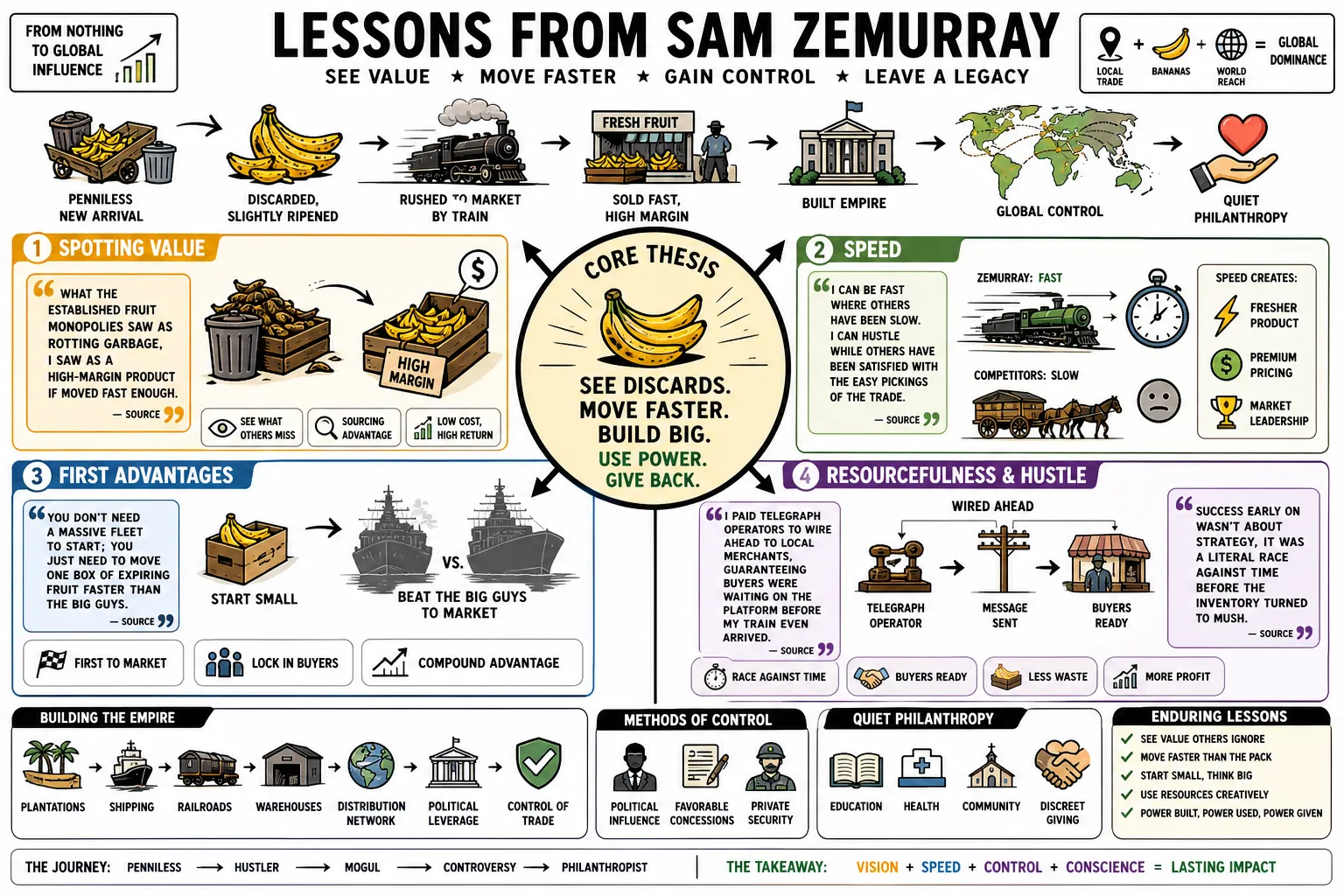
Sam Zemurray arrived in America penniless and built his fortune by rushing discarded, slightly ripened bananas to market on trains. He eventually forced his way into control of the United Fruit Company, dominating the global trade through ground-level operations and political exploitation. This profile examines his ruthless expansion and later attempts to offset it with quiet philanthropy.
Part 1: The Ripes and Early Hustle
- On Spotting Value: "What the established fruit monopolies saw as rotting garbage, I saw as a high-margin product if moved fast enough." — Source: [The Fish That Ate the Whale]
- On Speed: "I can be fast where others have been slow. I can hustle while others have been satisfied with the easy pickings of the trade." — Source: [Kevin Connelly Blog]
- On First Advantages: "You don't need a massive fleet to start; you just need to move one box of expiring fruit faster than the big guys." — Source: [Medium]
- On Resourcefulness: "I paid telegraph operators to wire ahead to local merchants, guaranteeing buyers were waiting on the platform before my train even arrived." — Source: [Colin Keeley]
- On Hustle: "Success early on wasn't about strategy, it was a literal race against time before the inventory turned to mush." — Source: [Oxford Club]
- On Entering Markets: "Look for the discard pile. There is always a secondary market hiding in the waste of a monopoly." — Source: [Blas.com]
- On Early Capital: "Great wealth doesn't start with a boardroom meeting; it starts by running a hustle that nobody else wants to touch." — Source: [The Fish That Ate the Whale]
- On Finding Customers: "Selling is the thing. In the end it does not matter what you're stocking, you just have to find the person who needs it right now." — Source: [Medium]
- On Overcoming Disadvantages: "A thick accent and no money don't matter on the train platform if you have the only inventory in town." — Source: [Big Ben Comedy]
Part 2: Ground Truth and Management
- On Desk Executives: "Those schmucks, what do they know? They're there, we're here!" — Source: [Big Ben Comedy]
- On Understanding the Work: "There is no problem you can't solve if you understand your business from A to Z." — Source: [Deeply Driven Podcast]
- On Gathering Intelligence: "You drink with a man, you learn what he knows. Spend your time in the dives with the banana cowboys, not the country clubs." — Source: [Big Ben Comedy]
- On Remote Management: "A leader who stays in a distant northern office is blind to the realities of the jungle." — Source: [Deeply Driven Podcast]
- On Earning Loyalty: "You don't earn respect from a memo; you earn it by sinking your boots into the same muck as the laborers clearing the brush." — Source: [Deeply Driven Podcast]
- On True Expertise: "The straight details are held by the ship captains and the field hands, never the consultants." — Source: [Oxford Club]
- On Office Culture: "I never saw the point of the executive lifestyle. The actual business happens on the docks." — Source: [Deeply Driven Podcast]
- On Direct Action: "If something gets done, you do it yourself. Delegation is often just an excuse to avoid the dirty work." — Source: [Tulane University]
- On Respecting Labor: "He believed in the transcendent power of physical labor, that a man can free his soul only by exhausting his body." — Source: [Big Ben Comedy]
- On Corporate Hierarchy: "Levels of management exist mostly to hide the truth from the people who actually need to make the decisions." — Source: [The Fish That Ate the Whale]
Part 3: Risk and Ambition
- On Taking Bets: "Go all in, or get out. Young men should bet everything, because great fortunes only come from big plays." — Source: [Big Ben Comedy]
- On Market Timing: "There are times when certain cards sit unclaimed in the common pile, when properties become available that will never be available again." — Source: [Big Ben Comedy]
- On Boldness: "A good businessman feels these moments like a fall in the barometric pressure. A great businessman is dumb enough to act on them even when he cannot afford to." — Source: [Big Ben Comedy]
- On Inaction: "Show me a happy man and I will show you a man who is getting nothing accomplished in this world." — Source: [GoodBooks]
- On Scale: "You can't build an empire by playing it safe with last year's profits. You have to risk everything you have for the next expansion." — Source: [Blas.com]
- On Uncertainty: "Waiting for perfect conditions means you will always be too late. You buy the land when it's still a swamp." — Source: [Kevin Connelly Blog]
- On Fear: "The men who built monopolies were not smarter, they were just willing to walk closer to the edge of ruin than anyone else." — Source: [The Fish That Ate the Whale]
- On Contentment: "Satisfaction is a liability. The moment you are happy with the easy pickings, someone hungrier is already planning to take your market." — Source: [Kevin Connelly Blog]
- On Seizing Power: "When you see leadership driving a company into the ground, you don't write a polite letter, you walk into the room and take the wheel." — Source: [Ryan A. Ferguson]
Part 4: Operations and Execution
- On Cost Cutting: "When profits vanished, I didn't hire experts. I talked to the ship captains and found out slow steaming speeds were rotting the cargo." — Source: [Oxford Club]
- On Supply Chains: "He who controls the logistics controls the market. Growing the fruit is useless if you can't get it to New Orleans before it turns brown." — Source: [Medium]
- On Efficiency: "A delayed train isn't a minor inconvenience; in the fruit business, it is the difference between bankruptcy and a fortune." — Source: [Colin Keeley]
- On Micromanagement: "I mapped the plantations myself because a surveyor doesn't care if the soil is right for the next crop." — Source: [Deeply Driven Podcast]
- On Bypassing Bureaucracy: "When the board asks for a study, they are asking for an excuse to do nothing. Just clear the land and plant." — Source: [Deeply Driven Podcast]
- On Information Flow: "If the news takes three weeks to reach the head office, the company is already dead. You have to shorten the distance between the dirt and the decision." — Source: [The Fish That Ate the Whale]
- On Execution over Theory: "We didn't need a new corporate strategy; we just needed the boats to sail faster and the trains to run on time." — Source: [Oxford Club]
- On Handling Crises: "When the crop fails or a hurricane hits, you don't panic. You immediately assess what's left and figure out how to sell it." — Source: [The Fish That Ate the Whale]
- On Pragmatism: "You don't hold out for the ideal solution when a functional one is sitting right in front of you." — Source: [Blas.com]
- On Focus: "Every hour spent arguing with bankers is an hour lost on the plantations. Keep your focus on the product." — Source: [The Fish That Ate the Whale]
Part 5: Asserting Authority
- On Incompetent Leadership: "You gentlemen have been fucking up this business long enough. I'm going to straighten it out." — Source: [Ryan A. Ferguson]
- On Proxy Fights: "I didn't ask for permission to save my investment. I gathered the proxy votes and fired the board that was destroying my wealth." — Source: [Time Magazine]
- On Confrontation: "When dealing with entrenched aristocrats, blunt force is often the only language they understand." — Source: [Medium]
- On Taking Control: "Never sit quietly while men in suits squander the company you built with your bare hands." — Source: [Colin Keeley]
- On Shareholder Rights: "Owning the stock doesn't mean you just collect a dividend. It means you have the right to kick down the door when management fails." — Source: [The Fish That Ate the Whale]
- On Corporate Arrogance: "The Boston executives treated me like an uneducated immigrant, right up until the moment I owned their company." — Source: [Ryan A. Ferguson]
- On Correcting Course: "Turning around a failing business requires you to immediately fire anyone who defends the old way of doing things." — Source: [Time Magazine]
- On Self-Belief: "I knew I could run United Fruit better than the board because I had actually grown a banana." — Source: [Deeply Driven Podcast]
- On Action vs Words: "He spoke with no accent, except when he swore, which was all the time. His authority came from his presence, not his vocabulary." — Source: [Peter Ubel]
Part 6: Power, Politics, and Interference
- On Government Friction: "When unfavorable tax laws threatened the margins, the cheapest solution was simply to replace the government." — Source: [64 Parishes]
- On Political Corruption: "A mule costs more than a deputy." — Source: [Expat Chronicles]
- On Engineering Coups: "I financed the return of an exiled president and hired mercenaries, because securing a tax-free concession was worth a revolution." — Source: [Library of Congress]
- On Aligning Interests: "If I can perfectly align the interests of my company with the interests of top officials... the United States will secure my needs." — Source: [Jon Birdsong]
- On Ruthless Expansion: "We did not let borders or sovereign governments stand in the way of laying track and planting fruit." — Source: [Business Alabama]
- On Sovereign Influence: "The era of the Banana Republic was built on the reality that a foreign fruit company had more capital and guns than the local military." — Source: [64 Parishes]
- On Bribing Officials: "Paying off a local general wasn't considered a crime; it was just another line item on the balance sheet." — Source: [Expat Chronicles]
- On American Exceptionalism: "Unlike the Europeans, we do not yet know you can't be both powerful and righteous." — Source: [Big Ben Comedy]
- On Mercenary Tactics: "We hired men with machine guns not for war, but as a very aggressive form of corporate security." — Source: [Reddit History]
- On Moral Ambiguity: "If he had questioned the workings of this machine, he would have been a great man, but he was not a great man." — Source: [Jewish Book Council]
Part 7: Wealth, Philanthropy, and Influence
- On Giving Back: "Despite a ruthless reputation in business, he quietly diverted millions into funding clinics, hospitals, and universities." — Source: [Tulane Hullabaloo]
- On Supporting Institutions: "I provided the initial funding to establish Middle American research because understanding the region was both good business and a historical duty." — Source: [Tulane University]
- On Zionism: "He used his immense logistical network and Latin American political connections to quietly funnel arms and secure UN votes for the State of Israel." — Source: [Times of Israel]
- On Operating in the Shadows: "True power doesn't need to put its name on the side of the boat shipping the rifles." — Source: [Jewish Review of Books]
- On Leveraging Networks: "When Chaim Weizmann needed votes for partition, Zemurray made the calls to the Central American presidents he practically owned." — Source: [Jerusalem Post]
- On Anonymity: "Much of his giving was done quietly. He preferred the results of philanthropy over the public praise." — Source: [64 Parishes]
- On Local Community: "He funded New Orleans' first hospital for Black women, recognizing local needs that the establishment ignored." — Source: [Britannica]
- On Legacy: "He donated his mansion to serve as the Tulane president's residence, permanently anchoring his wealth into the academic establishment." — Source: [Library of Congress]
- On Dual Natures: "A man can simultaneously destabilize a foreign nation for profit and build a hospital for the poor at home." — Source: [The Fish That Ate the Whale]
Part 8: Retrospection and Corporate Responsibility
- On Evolving Business: "All we cared about was dividends. Well, we can't do business that way today." — Source: [Goodreads]
- On Mutual Benefit: "We have learned that what's best for the countries we operate in is best for the company." — Source: [Goodreads]
- On Public Relations: "Maybe we can't make the people love us, but we will make ourselves so useful to them that they will want us to stay." — Source: [Goodreads]
- On Changing Times: "The brute force tactics that built the empire in 1911 were the exact tactics that became liabilities by 1950." — Source: [The Fish That Ate the Whale]
- On Exploitation: "Eventually, the bill comes due for decades of treating sovereign nations like private plantations." — Source: [64 Parishes]
- On Adaptation: "A business must mature. You cannot run a global conglomerate with the same street-fighter mentality you used on the train docks." — Source: [The Fish That Ate the Whale]
- On Reputation: "He spent the first half of his life trying to acquire wealth by any means, and the second half trying to prove he was a legitimate statesman." — Source: [Deeply Driven Podcast]
- On the Limits of Control: "You can buy a government, but you cannot permanently buy the submission of the workers who harvest your crops." — Source: [The Fish That Ate the Whale]
- On Final Reflections: "The banana trade made him a king, but it also forced him to confront the human cost of treating the world as a balance sheet." — Source: [The Fish That Ate the Whale]