Lessons from Samuel Insull
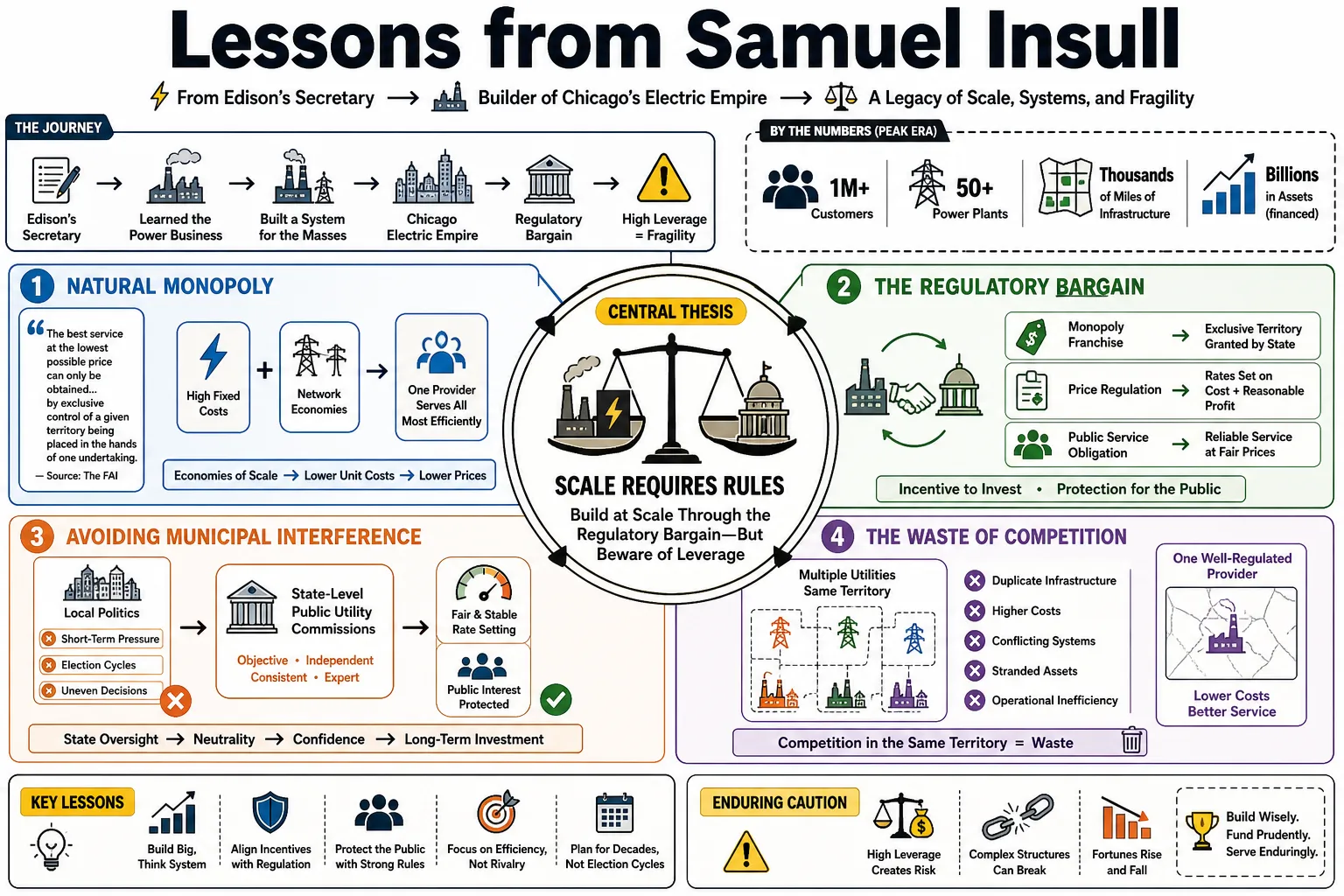
Samuel Insull started as Thomas Edison's personal secretary and went on to build a massive electric utility empire in Chicago. He created the economic model of mass power production and the "regulatory bargain," securing a legal monopoly in exchange for state price regulation. His career shows how to build complex infrastructure and manage public relations at scale, but it also exposes the fragility of highly leveraged corporate structures.
Part 1: Monopoly and Regulation
- On Natural Monopoly: "The best service at the lowest possible price can only be obtained... by exclusive control of a given territory being placed in the hands of one undertaking." — Source: The FAI
- On The Regulatory Bargain: Utilities should operate as monopolies under state regulation that fixes prices based on cost plus reasonable profit. — Source: NARUC
- On Avoiding Municipal Interference: State-level public utility commissions are necessary to prevent localized municipal politics from interfering with objective rate setting. — Source: Yale University
- On The Waste of Competition: Competing electric utility companies in the same territory are wasteful and economically inefficient. — Source: Medium
- On The Obligations of Monopoly: If utilities are granted exclusive operating rights, they have a fundamental obligation to provide reliable, low-cost service to the public. — Source: Yale University
- On Welcoming Regulation: Unlike peers who feared government interference, utilities should actively welcome state regulation to ensure market stability. — Source: The FAI
- On Attracting Capital: A regulated monopoly provides the reliable returns required to attract the vast capital needed for modern infrastructure. — Source: The FAI
- On Franchises: "Exclusive franchises should be coupled with the conditions of public control." — Source: NARUC
- On Fair Rates: Monopolies are justified only when the public is protected from price gouging through state-level rate fixing. — Source: NARUC
- On European Influences: "We had to go to Europe to learn something about the principles underlying the sale of the product." — Source: Medium
Part 2: Load Factor and Efficiency
- On The Power of Equipment: "The junk pile is our most valuable asset." — Source: Institute for Energy Research
- On Load Factor Definition: Profitability in power generation is dictated by the ratio of average demand to peak demand, ensuring assets are used continuously. — Source: EBA Net
- On The Danger of Idle Machinery: If a plant's load factor is extremely low, it is "only a question of time when you will be in the hands of a receiver." — Source: ETS Montreal
- On Time-of-Use Pricing: Implementing varied rates encourages energy consumption during off-peak hours, balancing the load on power plants. — Source: Yale University
- On Load Diversity: Combining different customers—whose peak demands occur at different times of the day—drastically improves total efficiency and lowers costs. — Source: ETS Montreal
- On Mass Production: Centralizing power generation is essential to achieve the economies of scale needed to make electricity a universal necessity. — Source: Institute for Energy Research
- On Instant Consumption: The unique economics of electricity stem from the physical reality that it must be produced and consumed instantly. — Source: Medium
- On High-Utilization Customers: The highest revenue potential lies with customers who provide "the highest load factor—that is, those which had the most uniform demands." — Source: EBA Net
- On The Gospel of Consumption: Encouraging the use of electricity for appliances and streetcars keeps power equipment running and profitable around the clock. — Source: University Press Scholarship
- On Scrapping the Old: Relentlessly replacing outdated technology with larger, more efficient generators is required to maintain a high-utilization business model. — Source: Master Resource
Part 3: Ambition and Leadership
- On Ambition: "Aim for the top. There is plenty of room there." — Source: AZ Quotes
- On The Loneliness of Success: "There are so few at the top it is almost lonely there." — Source: Right Attitudes
- On Taking Action: "The moment of applause was the moment for action." — Source: Deciphr AI
- On Work Ethic: Success in managing complex utility systems requires an immense work ethic and strict organizational talent. — Source: American Business History Center
- On Patience: "The only way I know to accomplish anything is everlastingly to keep working with patient observation." — Source: Today in Science History
- On Confidence: "A slump or calamity that would be disastrous is practically inconceivable." — Source: EBA Net
- On Civic Duty: Corporate leaders have a responsibility to fund and support civic institutions in their operating regions. — Source: Chicagology
- On Leading the Charge: True leadership requires moving ahead of public consensus to build infrastructure the public does not yet realize it needs. — Source: PBS
- On Relentlessness: Building an empire spanning multiple states requires an unwavering commitment to scaling operations constantly. — Source: Wikipedia
- On Transforming Chaos: A leader's job is to take a fragmented landscape of small competitors and turn it into a unified, efficient system. — Source: American Heritage
Part 4: Capital and Corporate Structure
- On Large-Scale Capital: "I cannot bring myself to the belief that the citizens of this country are in fact opposed to large aggregations of capital in corporate form." — Source: Master Resource
- On Private Enterprise: Aggregations of capital "are absolutely necessary to the operation of all great undertakings by private enterprise." — Source: Master Resource
- On Holding Companies: Highly complex holding companies allow operators to control vast utility assets and manage regional grids efficiently. — Source: Chicagology
- On Securing Investment: By standardizing operations across multiple states, holding companies present a more secure profile for raising capital. — Source: O'Shaughnessy Asset Management
- On The Risks of Leverage: Using holding company structures to build empires on thin equity leaves the entire system vulnerable to severe financial panics. — Source: University of Chicago
- On Consolidation: The integration of the power grid requires corporate consolidation to pool resources effectively. — Source: Corefficient
- On Systemic Vulnerability: A pyramided financial structure can amplify local losses into a system-wide collapse during an economic depression. — Source: CAIA Association
- On Regulatory Backlash: The collapse of highly leveraged holding companies inevitably leads to strict federal oversight. — Source: O'Shaughnessy Asset Management
- On Economic Scale: Only large corporations have the financial weight to build the massive power stations required for regional electrification. — Source: Chicagology
Part 5: Customer Relations and Public Opinion
- On Public Support: "It matters not how much capital you may have... if you haven't behind you a sympathetic public opinion, you are bound to fail." — Source: History Is A Weapon
- On Customer Ownership: Promoting customer ownership of utility stocks aligns the financial interests of the public with the success of the company. — Source: Novel Investor
- On Educating the Public: Utilities must run aggressive education campaigns to explain the benefits of the natural monopoly model to consumers. — Source: Foundation for Economic Education
- On Fair Rates as PR: Maintaining fair rates and favorable conditions of service is the baseline requirement for maintaining public trust. — Source: History Is A Weapon
- On Managing Perception: Proactive public relations is a critical tool for securing political support for exclusive franchises. — Source: Royal Society Publishing
- On The Value of Trust: Capital and infrastructure are meaningless if the public believes the utility is acting against its interests. — Source: History Is A Weapon
- On Mass Marketing: Electricity must be marketed not as a luxury, but as an affordable, daily necessity. — Source: PBS
- On Handling the Press: Even in times of prosperity, a utility leader must be acutely aware of how their actions are interpreted by journalists. — Source: Chicagology
- On Sympathetic Opinion: The survival of a regulated monopoly depends entirely on the ongoing sympathy and consent of the governed. — Source: History Is A Weapon
Part 6: Innovation and Infrastructure
- On Interconnection: Connecting independent local grids into a massive, unified network dramatically improves reliability and efficiency. — Source: Institute for Energy Research
- On Lowering Per-Unit Costs: Expanding the user base as widely as possible is the primary mechanism for driving down the per-unit cost of power. — Source: PBS
- On Rural Electrification: The economies of scale achieved in cities must eventually be extended to balance the power demands of rural areas. — Source: Institute for Energy Research
- On Technological Upgrades: Adopting the latest generation of alternating-current technology is essential for transmitting power over long distances. — Source: Wikipedia
- On Central Stations: Building massive, centralized power stations is far more efficient than allowing businesses to generate their own power. — Source: Internet Archive
- On Creating Demand: Utilities must actively encourage the invention and adoption of new electrical appliances to build continuous demand. — Source: University Press Scholarship
- On The Grid as a System: An electrical grid is not just wires and generators, but a carefully balanced economic system of supply and demand. — Source: CleanTechnica
- On Continuous Operation: A modern society requires an electrical infrastructure that can guarantee continuous operation without fail. — Source: Corefficient
- On Expanding Territory: To maintain efficiency, a utility must continually seek to expand its exclusive territory to capture more diverse loads. — Source: Medium
Part 7: Edison and Mentorship
- On The Definition of Genius: "About 99 percent of it is a knowledge of the thing that will not work." — Source: Today in Science History
- On The 1 Percent: "The other 1 percent may be genius." — Source: Today in Science History
- On Working with Edison: Serving as Edison's private secretary provided the foundational understanding of the commercial potential of electricity. — Source: Chicagology
- On Commercializing Invention: While Edison focused on inventing the technology, it required organizational minds to build the business models that commercialized it. — Source: Cook Memorial Public Library
- On Universal Lighting: Fulfilling Edison's vision that only the extravagant will burn tallow candles required pioneering new utility economics. — Source: Quote Investigator
- On Learning from Failure: Observing an inventor's daily struggles teaches that success is built primarily on eliminating what does not work. — Source: Today in Science History
- On Moving Beyond the Mentor: To truly scale electricity, one had to move past Edison's preference for direct current and embrace alternating current. — Source: Green Juice
- On Operational Execution: The translation of a lab experiment into a city-wide grid requires a complete shift from invention to relentless operational execution. — Source: American Business History Center
- On Indispensability: An effective deputy makes themselves indispensable by managing the financial and organizational chaos surrounding a creative genius. — Source: American Business History Center
Part 8: Crisis, Legacy, and Defense
- On Facing Trial: "What I did, when I did it, was honest; now, through changed conditions, what I did may or may not be called honest." — Source: AZ Quotes
- On Political Motivations: "Politics demand, therefore, that I be brought to trial." — Source: AZ Quotes
- On The System on Trial: "What is really being brought to trial is the system I represented." — Source: AZ Quotes
- On Personal Integrity: "You may say I made a mistake, but you will be convinced I was not dishonest." — Source: Chicagology reprint of James Doherty interview with Samuel Insull after his release from jail
- On Underestimating the Panic: "I have erred, but my greatest error was in underestimating the effects of the financial panic on American securities, and particularly on my own." — Source: Institute for Energy Research
- On Seeking Vindication: "I am fighting not only for freedom but for complete vindication." — Source: Institute for Energy Research
- On Changing Sentiments: Public opinion can rapidly shift from viewing an executive as a civic hero to a corporate villain during an economic crisis. — Source: Chicagology
- On The Burden of Collapse: When an empire built on mass investment fails, the founder inevitably bears the public blame for the loss of savings. — Source: PBS
- On Historical Legacy: While his financial structures failed during the Depression, his operational model of centralized, regulated monopoly remains the backbone of the modern grid. — Source: Wikipedia