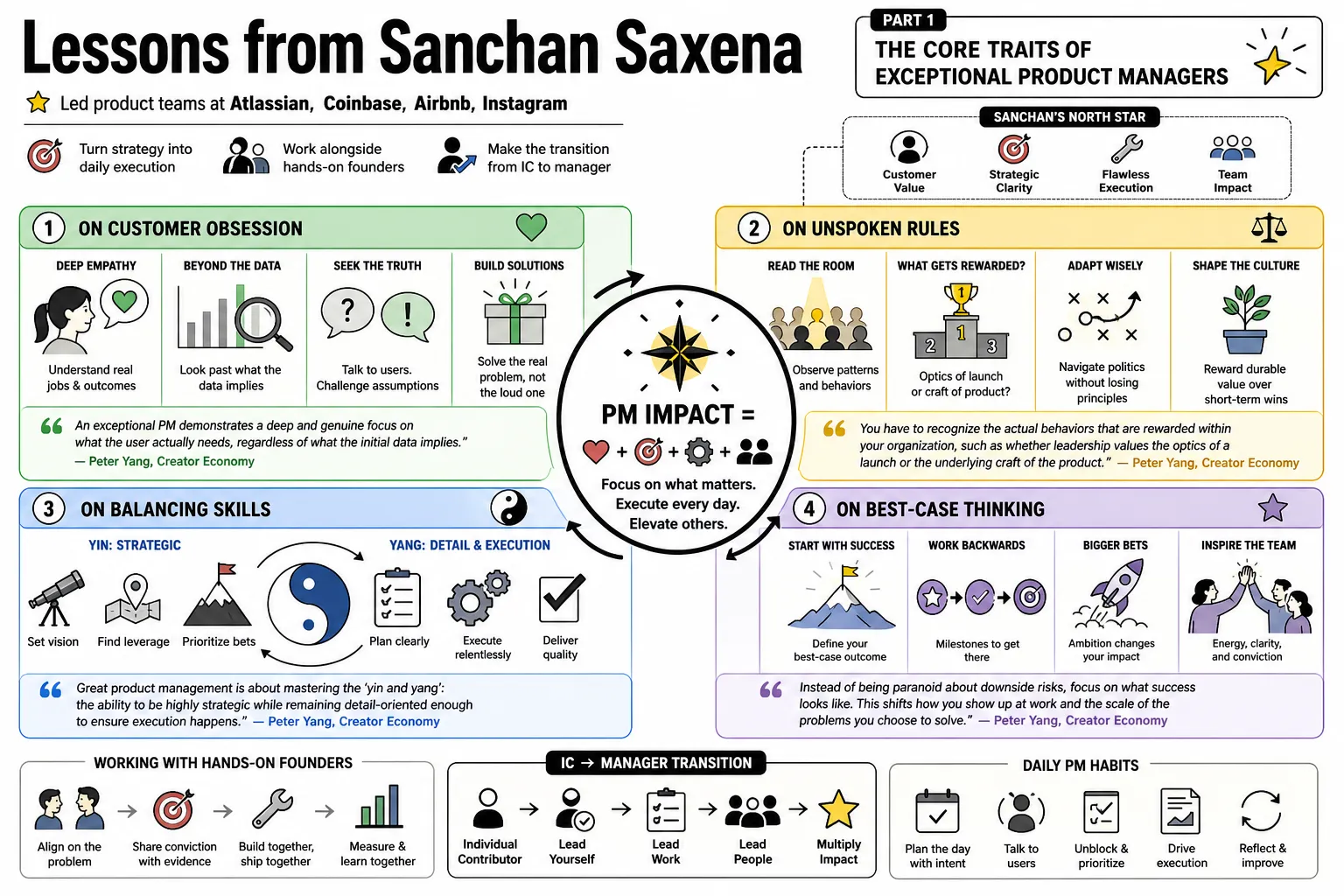
Lessons from Sanchan Saxena
Sanchan Saxena has led product teams at Atlassian, Coinbase, Airbnb, and Instagram. This collection gathers his advice on turning strategy into daily execution, working alongside hands-on founders, and making the transition from individual contributor to manager.
Part 1: The Core Traits of Exceptional Product Managers
- On customer obsession: "An exceptional PM demonstrates a deep and genuine focus on what the user actually needs, regardless of what the initial data implies." — Source: Creator Economy by Peter Yang
- On unspoken rules: "You have to recognize the actual behaviors that are rewarded within your organization, such as whether leadership values the optics of a launch or the underlying craft of the product." — Source: Creator Economy by Peter Yang
- On balancing skills: "Great product management is about mastering the 'yin and yang': the ability to be highly strategic while remaining detail-oriented enough to ensure execution happens." — Source: Creator Economy by Peter Yang
- On best-case thinking: "Instead of being paranoid about downside risks, focus on what success looks like. This shifts how you show up at work and the scale of the problems you choose to solve." — Source: Lenny's Podcast
- On curiosity: "The best product managers are endlessly curious about why things work the way they do, asking questions until they hit the root cause." — Source: Maven Course: The Product Executive
- On ownership: "When a product fails, an exceptional PM takes the blame. When it succeeds, they give all the credit to the team." — Source: Behind the Craft
- On speed: "Speed is a feature. Delivering a good product quickly often beats delivering a perfect product too late." — Source: Creator Economy by Peter Yang
- On problem framing: "Spend more time framing the problem correctly than rushing to build the solution; a well-framed problem makes the solution obvious." — Source: Lenny's Podcast
- On technical fluency: "You do not need to write code, but you must understand the architecture well enough to know why an engineering estimate is one week versus one month." — Source: Maven Course: The Product Executive
- On resilience: "Product management is a marathon of getting told 'no'. You have to build the resilience to keep pushing for the user regardless." — Source: Behind the Craft
Part 2: Managing Stakeholders and Communication
- On communication style: "Communication is the job. Great leaders adjust their communication style based on their audience, whether they are speaking to a CEO or a junior engineer." — Source: Creator Economy by Peter Yang
- On managing up: "Managing up is about making sure your leadership has the exact context they need to make the decisions you need them to make." — Source: Lenny's Podcast
- On alignment: "If you have to force alignment, you haven't explained the 'why' clearly enough." — Source: Maven Course: The Product Executive
- On writing: "Writing clarifies thinking. If you cannot write down your product strategy in a simple one-pager, you probably do not understand it yourself." — Source: Behind the Craft
- On bad news: "Bad news must travel faster than good news. Never let your CEO be surprised by a failure that you already knew about." — Source: Lenny's Podcast
- On saying no: "The art of product management is saying 'no' to good ideas so you have room to say 'yes' to the great ones." — Source: Creator Economy by Peter Yang
- On cross-functional trust: "Trust is built in the trenches. You earn the respect of engineering and design by being with them when things break, rather than appearing only when things launch." — Source: Maven Course: The Product Executive
- On presentations: "When presenting to executives, start with the conclusion. They do not need the mystery novel buildup; they need the bottom line." — Source: Behind the Craft
- On meetings: "If a meeting lacks a clear decision to be made or a specific problem to solve, cancel it and send an email." — Source: Lenny's Podcast
Part 3: The Yin and Yang of Product Leadership
- On zooming in and out: "The most important skill for a product leader is the ability to zoom out to the ten-year vision and immediately zoom in to the pixel-level details of a current sprint." — Source: Creator Economy by Peter Yang
- On strategy and execution: "Strategy without execution is hallucination; execution without strategy is running on a treadmill." — Source: Maven Course: The Product Executive
- On holding duality: "You have to simultaneously believe that your product is changing the world and that your current version is fundamentally broken and needs fixing." — Source: Behind the Craft
- On qualitative vs quantitative data: "Data tells you what is happening, but talking to users tells you why it is happening. You need both to build a complete picture." — Source: Lenny's Podcast
- On short-term vs long-term tradeoffs: "Never sacrifice long-term user trust for a short-term metric bump. The trust is much harder to earn back." — Source: Creator Economy by Peter Yang
- On delegation: "You must delegate the details, but you can never delegate the responsibility for the final quality of the product." — Source: Maven Course: The Product Executive
- On conviction: "You need strong convictions, loosely held. Fight for your vision, but abandon it the moment new evidence proves you wrong." — Source: Behind the Craft
- On intuition: "In the absence of data, you must rely on product intuition. Intuition is the sum of thousands of past mistakes and observations." — Source: Lenny's Podcast
- On balancing voices: "A product leader must balance the voice of the business with the voice of the customer, and usually, the customer needs a louder advocate." — Source: Creator Economy by Peter Yang
Part 4: Lessons from Founder Mode
- On Instagram's simplicity: "Working with Kevin Systrom taught me the power of simplicity; always do the simple thing first before adding complexity." — Source: Creator Economy by Peter Yang
- On Coinbase's decisiveness: "At Coinbase, I learned from Brian Armstrong the rule of 'no decision by committee.' Clear ownership prevents diluted, mediocre outcomes." — Source: Creator Economy by Peter Yang
- On founder involvement: "Founder mode means the founder cares about the details. It is a feature, rather than a bug, when a founder wants to review the pixels." — Source: Lenny's Podcast
- On vision alignment: "When working with a strong founder, your job is to scale their vision and make it operational." — Source: Behind the Craft
- On unconstrained thinking: "Founders do not start with constraints. They start with the ideal state and work backward, which is a mindset every PM should adopt." — Source: Lenny's Podcast
- On the craft of delivery: "Founders like Systrom are obsessed with the craft. They understand that the fit and finish of a product communicate trust to the user." — Source: Creator Economy by Peter Yang
- On avoiding consensus: "Consensus is the enemy of greatness. If everyone agrees on a product decision, it is probably too safe to be impactful." — Source: Behind the Craft
- On top-down mandates: "Sometimes a top-down mandate is necessary to break organizational inertia and force alignment on a new direction." — Source: Creator Economy by Peter Yang
- On speed of execution: "Founders operate on a different clock. They expect things to happen immediately, which forces the organization to cut through red tape." — Source: Lenny's Podcast
- On protecting the core: "The best founders fiercely protect the core user experience from being ruined by monetization or organizational bloat." — Source: Behind the Craft
Part 5: Surviving Crises and Institutional Resilience
- On Brian Chesky's storytelling: "Chesky is a master of narrative. During a crisis, a clear and compelling story is what keeps the company aligned and moving forward." — Source: Lenny's Podcast
- On navigating Covid: "When the pandemic hit Airbnb, it was about stripping the product down to its absolute essentials to survive." — Source: Lenny's Podcast
- On decisive action: "In a crisis, doing nothing is the worst decision. You have to move quickly with imperfect information and course-correct later." — Source: Behind the Craft
- On transparency: "When things are bad, be overly transparent with your team. They can handle the truth, but they cannot handle uncertainty and rumors." — Source: Creator Economy by Peter Yang
- On focusing on constraints: "A crisis imposes brutal constraints, which forces you to kill pet projects and focus only on what truly matters to the customer." — Source: Maven Course: The Product Executive
- On empathy during downturns: "During a crisis, you must over-index on empathy for your users whose lives are disrupted, and for your team who is working through fear." — Source: Lenny's Podcast
- On rebuilding: "When recovering from a shock, do not try to rebuild the old business. Look at how user behavior has fundamentally shifted and build for that." — Source: Behind the Craft
- On organizational resilience: "A crisis reveals the true culture of a company. If you have built a culture of trust, the team will rally; if not, it will fracture." — Source: Creator Economy by Peter Yang
- On the role of leadership: "Leadership in a crisis is about absorbing panic from below and projecting calm clarity back down." — Source: Lenny's Podcast
Part 6: Avoiding the Pitfalls of Metrics and Process
- On metric obsession: "While metrics matter, obsessing over them can kill product quality. You cannot A/B test your way to a cohesive vision." — Source: Creator Economy by Peter Yang
- On the danger of process: "Process should serve the product. The moment the product starts serving the process, you are moving too slowly." — Source: Maven Course: The Product Executive
- On qualitative feedback: "If a metric looks great but users are angry on social media, the metric is measuring the wrong thing. Trust the qualitative feedback." — Source: Lenny's Podcast
- On local maxima: "Optimizing purely for metrics traps you in a local maximum. Sometimes you have to break the metrics temporarily to reach a new peak." — Source: Behind the Craft
- On over-tooling: "Do not hide behind roadmaps, frameworks, and tools. At the end of the day, you just need to talk to users and ship good software." — Source: Creator Economy by Peter Yang
- On vanity metrics: "Beware of metrics that always go up, like cumulative signups. They make you feel good but tell you nothing about the actual health of the business." — Source: Lenny's Podcast
- On the purpose of A/B testing: "A/B testing is a tool for refinement, rather than a substitute for having a strong product opinion in the first place." — Source: Maven Course: The Product Executive
- On organizational debt: "Every new process you introduce is a tax on execution. Review your processes regularly and delete the ones that no longer serve a purpose." — Source: Behind the Craft
- On trusting taste: "Sometimes you have to ship something just because it feels right and looks beautiful, even if you cannot prove it will move a metric." — Source: Creator Economy by Peter Yang
- On setting goals: "Goals should be uncomfortable but achievable. If you hit all your goals easily, you set them too low." — Source: Lenny's Podcast
Part 7: Navigating the Product Executive Transition
- On the mindset shift: "Moving from a manager to an executive means you stop being the person who answers the questions, and become the person who asks the right questions." — Source: Maven Course: The Product Executive
- On scaling yourself: "As an executive, your product is no longer the software; your product is the team that builds the software." — Source: Behind the Craft
- On hiring leaders: "When hiring directors, look for people who are better than you in specific areas. If you are the smartest person in the room, you have hired poorly." — Source: Creator Economy by Peter Yang
- On letting go: "The hardest part of becoming an executive is watching a team make a mistake that you know how to fix, but letting them fail so they learn." — Source: Lenny's Podcast
- On system-level thinking: "Executives do not solve individual product bugs; they solve the organizational bugs that caused the product bugs in the first place." — Source: Maven Course: The Product Executive
- On managing peers: "Your peer group changes when you become an executive. You must build as much trust with the VP of Sales as you do with your engineering counterpart." — Source: Behind the Craft
- On resource allocation: "Executive strategy is largely an exercise in resource allocation. Strategy is what you fund, rather than what you put on a slide." — Source: Creator Economy by Peter Yang
- On setting context: "An executive's primary job is to constantly reinforce the context and the 'why' so that teams can make autonomous decisions." — Source: Lenny's Podcast
- On executive presence: "Executive presence is about calmness under fire. It is the ability to hear a disastrous update and respond with a clear path forward instead of panic." — Source: Maven Course: The Product Executive
Part 8: Career Choices and Defining Success
- On choosing roles: "When choosing a role, do not rely on a spreadsheet of pros and cons. Imagine the best-case outcome of the company succeeding and ask yourself if that is a future you want to be part of." — Source: Lenny's Podcast
- On aligning values: "It is essential to work at companies that reward the values and behaviors you personally care about; otherwise, you will always be fighting the culture." — Source: Creator Economy by Peter Yang
- On career non-linearities: "A career in tech is rarely a straight ladder. Sometimes you have to take a lateral move to learn a new skill that sets you up for a larger jump later." — Source: Behind the Craft
- On leaving a role: "Leave a job when you are no longer learning. Frustration is temporary; stagnation is permanent." — Source: Maven Course: The Product Executive
- On building a network: "Your network is not the people you hand business cards to; it is the people who have seen you do exceptional work in difficult circumstances." — Source: Lenny's Podcast
- On personal growth: "If you look back at yourself a year ago and aren't slightly embarrassed by how little you knew, you aren't growing fast enough." — Source: Creator Economy by Peter Yang
- On taking risks: "Early in your career, optimize for learning and risk. Later in your career, optimize for impact and leverage." — Source: Behind the Craft
- On finding mentors: "You do not need a single mentor. You need a board of advisors: different people you can call for different types of problems." — Source: Maven Course: The Product Executive
- On defining success: "True success in product management is not the title you achieve, but the scale of the positive impact you have had on users' lives." — Source: Lenny's Podcast