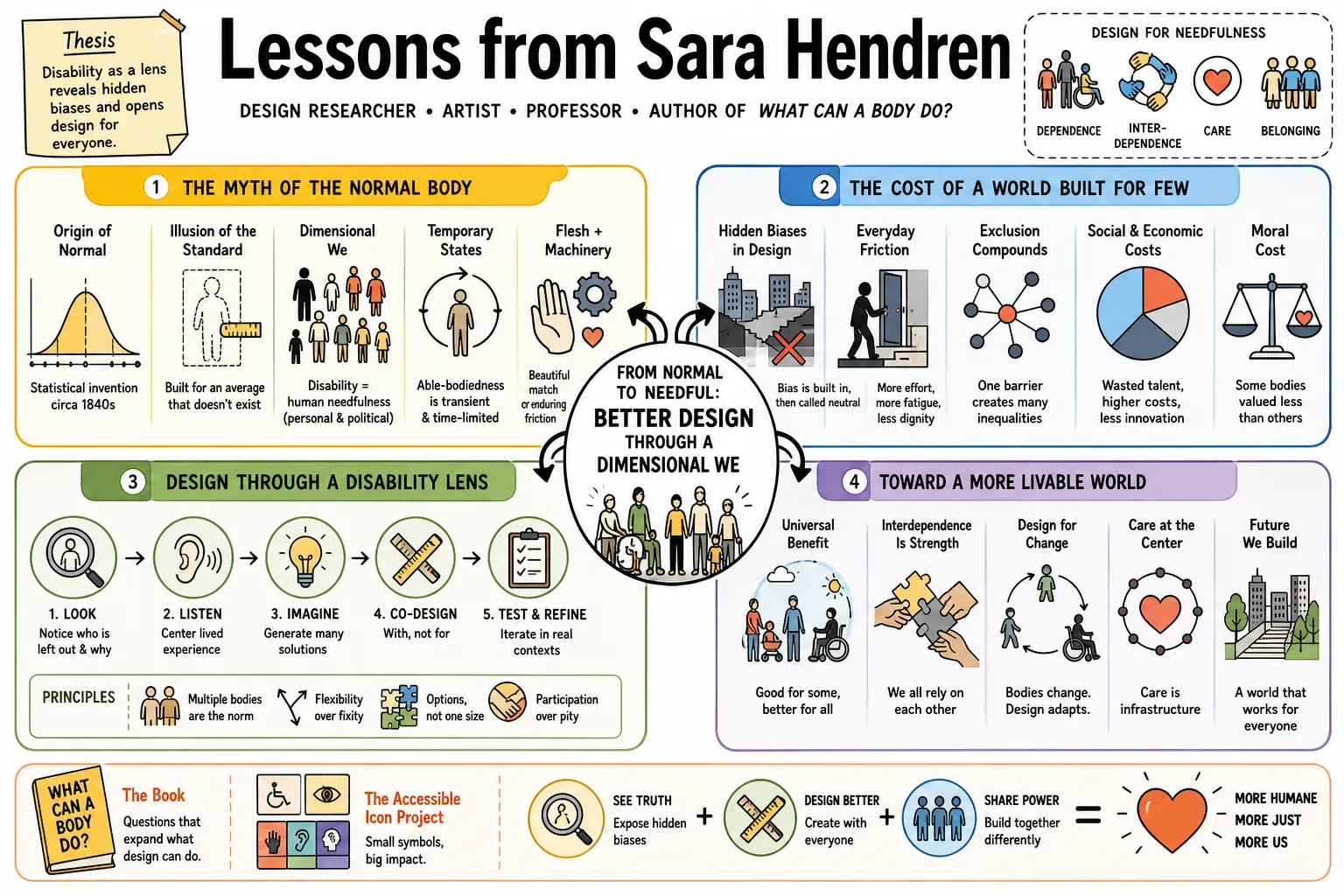
Sara Hendren is a design researcher, artist, and professor who studies the friction between human bodies and the physical world. Through the Accessible Icon Project and her book What Can a Body Do?, she uses disability as a lens to expose the hidden biases of the built environment and rethink how we depend on each other.
Part 1: The Myth of the Normal Body
- On the origin of normal: "The concept of a 'normal' body is a statistical invention dating back to the 1840s rather than an inherent truth of human biology." — Source: [NPR]
- On the illusion of the standard: "Our built world is designed around an average that does not actually exist, ignoring the reality that every body is constantly changing." — Source: [On Being]
- On the dimensional we: "Disability gathers a dimensional we like nothing else, because disability is no more and no less than human needfulness, both personal and political." — Source: [Goodreads]
- On temporary physical states: "Able-bodiedness is merely a transient state that only some people have the privilege to experience for a limited time." — Source: [BikePGH]
- On flesh and machinery: "Bodies are soft flesh in a world of machinery, and that can be a beautiful match or an experience that's full of hurdles." — Source: [On Being]
- On shared physical needs: "Human needfulness is universal; giving and receiving assistance are actions everyone will eventually participate in." — Source: [Disegno Journal]
- On the inevitability of adaptation: "Every single one of our bodies is mysterious, adapting, and always changing, demanding a world that can adapt with it." — Source: [Abler]
- On the reality of difference: "We must stop designing for an imaginary average and start designing for the actual edges of human experience." — Source: [Sara Hendren]
- On viewing physical states: "Disability is not a state of the body to be avoided, but an invitation to understand the human condition more deeply." — Source: [Mass Cultural Council]
- On the limits of inclusion: "Inclusion is necessary but will never be sufficient without a fundamental shift in how we value personhood outside market logic." — Source: [Goodreads]
Part 2: The Misfit and the Built Environment
- On the definition of disability: "Disability is a misfit between the body and the world, rather than a defect located within the person." — Source: [Adit Design]
- On friction as insight: "A misfit is the specific point of friction where the environment fails to meet the needs of a body, revealing hidden design assumptions." — Source: [Hoopla Digital]
- On the built world's rigidity: "Ability and disability are produced in large part by the relative flexibility or rigidity of the built environment." — Source: [Design Lab Pod]
- On hidden assumptions: "The world is built with unstated assumptions about what a body looks like and what it can do, which become visible only when a body fails to match them." — Source: [Human Centered Design]
- On physical wisdom: "The unique adaptations developed by disabled people offer misfit wisdom, an intellectual tradition that benefits the wider culture." — Source: [Disability Visibility Project]
- On designing for the misfit: "We can ask the built world to adapt to our bodies just as much as we are expected to adapt to the world." — Source: [Open Transcripts]
- On the central question: "The capabilities of a body depend on the body itself and equally on the extended shapes of the world around it." — Source: [Sara Hendren]
- On spatial intention: "How a physical space is designed, and who gets to navigate it smoothly, speaks volumes about who it was intentionally designed for." — Source: [BikePGH]
- On public space as common terrain: "Public infrastructure must be reimagined as common terrain that accommodates a wide range of physical speeds and abilities." — Source: [CCC Library]
- On bespoke design: "Standardized design fails at the edges; true dignity often comes from tools tailored to an individual's unique physical requirements." — Source: [Adaptive Design Association]
Part 3: Redefining Independence and Assistance
- On the autonomy myth: "The idea that any human is entirely self-sufficient is a fiction; we all rely on a scaffolding of tools and infrastructure." — Source: [Barnes and Noble]
- On self-determination: "Independence should be defined as self-determination, meaning the dignity of authority and choice, rather than the physical act of doing things alone." — Source: [Goodreads]
- On the dignity of dependence: "Acknowledging the dignity and inevitability of dependence allows us to ask better questions about our lives and generate better designed solutions." — Source: [Olin College]
- On the clinical standard: "The clinical standard often forces patients toward total physical self-sufficiency, ignoring the value of interdependent living." — Source: [Quote Fancy]
- On uncoupling assistance from dependence: "Bundling assistance with a richer idea of independence allows people to demand products and services that support a truly desirable life." — Source: [Penguin Random House]
- On the worship of independence: "The Western worship of independence obscures the biological and political reality that humans are deeply reliant on one another." — Source: [On Being]
- On dependent living: "Recognizing humans as dependent rational animals makes dependent living an honorable and visible part of the social fabric." — Source: [The Baffler]
- On the fear of obligation: "We often treat obligation as a diminishment of life, when it can actually provide a richer, more fulfilling existence." — Source: [On Being]
- On making assistance visible: "Design must move toward making assistance visible and celebrated, avoiding the urge to hide it to preserve the illusion of normalcy." — Source: [CCC Library]
- On the curb-cut effect: "Accommodations designed for disabled individuals, like curb cuts, often become essential scaffolding that benefits the entire population." — Source: [Streetsblog]
Part 4: All Technology is Assistive
- On the nature of tools: "All technology is assistive technology. What is technology doing if not giving us help?" — Source: [Penguin Random House]
- On bridging the gap: "Nearly everything humans make and use, from furniture to city streets, is meant to bridge the gap between body and world." — Source: [Audible]
- On everyday objects: "Your knife and fork and your chopsticks and your glasses are assistive technologies, too." — Source: [Guernica Mag]
- On the redundancy of rehab tech: "Labeling certain tools as assistive technology is redundant, as all tools extend human capability in some way." — Source: [The Mobility Project]
- On normalizing help: "By recognizing all technology as assistive, we understand that all bodies are receiving assistance at all times." — Source: [The Mobility Project]
- On the cyborg self: "People with disabilities are our richest resource of wisdom about how we deeply integrate technology into daily life." — Source: [Guernica Mag]
- On high tech heroism: "The design world is too obsessed with heroic prosthetics that force conformity, neglecting low-tech adaptations that genuinely help." — Source: [Disability Visibility Project]
- On the meaning of prosthetics: "A prosthetic is a bridge that allows a body to perform meaningful, specific tasks, rather than a mere medical device." — Source: [Holland Bloorview]
- On technology and human dignity: "Good technological design respects the user's agency rather than merely attempting to make their body appear standard." — Source: [Bookey]
Part 5: Crip Time and the Insistent Clock
- On the definition of crip time: "Crip time is an acknowledgment of the slowness that comes with aging, illness, or maneuvering with gear." — Source: [On Being]
- On making friends with slowness: "We must learn to make friends with slowness and stop allowing our lives to be entirely subsumed by economic worth and speed." — Source: [On Being]
- On the insistent clock: "The industrial clock uses time strictly to measure productivity, ignoring the natural, fluctuating rhythms of human bodies." — Source: [Disegno Journal]
- On attunement to pacing: "Crip time is a flexible attunement to pacing that accounts for the extra time required for care and basic physical navigation." — Source: [Disegno Journal]
- On time as a misfit: "When a crosswalk timer is too short for a pedestrian, the disability is located in the timing of the clock, completely apart from the person's legs." — Source: [Bryan Sebesta]
- On the resistance of pace: "Operating on crip time serves as a form of political resistance against a world built solely for the fast and the fit." — Source: [Bookey]
- On the value of presence: "A humane world values people for their mere presence and humanity, rather than merely their speed or economic output." — Source: [Open Transcripts]
- On the logic of the market: "We need human values that are alive and operational completely outside the relentless logic of market efficiency." — Source: [Goodreads]
- On temporal friction: "The friction we feel with the clock reveals how deeply standardized our expectations for physical performance have become." — Source: [Disability Visibility Project]
Part 6: Design as Social Imagination
- On design activism: "Design activism uses the language of design to create political debate... The point of these artifacts is contestation, not a tidy fix." — Source: [ResearchGate]
- On the work of social imagination: "Design is the work of social imagination, meaning thinking as if things could be otherwise." — Source: [Sara Hendren]
- On ideas made real: "Designed artifacts are ideas made real in things, embedding our social values directly into the objects we use." — Source: [Adit Design]
- On the Accessible Icon: "The redesigned wheelchair symbol acts as a translational tool to communicate the dynamism and agency of disabled people to the broader public." — Source: [Brian Glenney]
- On unresolved ends: "Activist design creates proposals to provoke and experiment, searching for new political conditions rather than neat solutions." — Source: [ResearchGate]
- On the power of otherwise: "The arts and design allow us to keep claiming that the world as it currently exists might, in fact, be otherwise." — Source: [Northeastern University]
- On the built environment as a choice: "The built world is not a natural occurrence; it is a series of human choices that can be unmade and remade." — Source: [Volume Books]
- On the continuum of activist work: "Releasing the Accessible Icon into the public domain allowed it to function both as an activist intervention and a practical graphic." — Source: [Accessible Icon]
- On design ethics: "How is it that social and political concerns are so easily cut out of technical training? And what would it look like to bring them back in?" — Source: [Olin College]
Part 7: Care, Obligation, and Interdependence
- On the ecology of care: "Being part of a life-long ecology of care connects individuals existentially and materially to the disabled community." — Source: [Disability Visibility Project]
- On care as design: "Good design is a form of care that provides scaffolding without smothering or exploiting the user." — Source: [The Baffler]
- On romanticizing interdependence: "We must avoid the romanticization of interdependence that ignores the heavy, unchosen obligations involved in true care." — Source: [On Being]
- On the reality of dependence: "Acknowledging the plain fact of dependence allows us to build supple, non-brittle systems that actually support vulnerability." — Source: [Streetsblog]
- On loving gestures: "Many of the most successful, universal designs began simply as loving gestures or acts of care for a specific individual." — Source: [The Baffler]
- On the investment in vulnerability: "I don’t need warm-hearted inclusion efforts; I need a widespread investment in vulnerability and assistance as a natural form of human experience." — Source: [Disability Visibility Project]
- On the limits of self-sufficiency: "Striving for total self-sufficiency creates a brittle society unable to cope with the inevitable realities of bodily decline." — Source: [Erin Peavey]
- On unchosen obligations: "Care is rarely a simple consumer choice; it involves deep, unchosen obligations that tie our lives fundamentally to others." — Source: [On Being]
- On the scaffolding of life: "The infrastructure of care is the invisible scaffolding that makes any form of independence possible in the first place." — Source: [On Being]
Part 8: Engineering, Arts, and Humanities
- On Sketch Models: "Sketch models are early ventures into building what is to come, creating an idea that is made concrete but remains rough around the edges." — Source: [Olin College]
- On anemic interdisciplinarity: "Higher education often rests on an idea of well-roundedness that treats the humanities as a superficial addition rather than a rigorous core." — Source: [MIT]
- On the why and should: "Engineering education must shift its focus from how to build technologies to the deeper why and should questions." — Source: [Sketch Model Podcast]
- On the classroom as a formative site: "The technical classroom is a formative site that fundamentally shapes the moral and ethical compass of future engineers." — Source: [Harvard University]
- On prototyping ethics: "Just as hardware is prototyped, engineers must use humanistic inquiry to prototype the social and ethical frameworks of their work." — Source: [Northeastern University]
- On the humanities as rigor: "History, sociology, and art are not merely for culture; they are rigorous, essential tools for analyzing the real-world impact of technology." — Source: [SVA]
- On believing ideas: "Playing the believing game requires the willed capacity to assume an idea is worth considering before immediately critiquing it." — Source: [Infovore]
- On communicating value: "Physical gathering spaces, from libraries to chapels, are designed to encourage specific behaviors and communicate our deepest beliefs about humanity." — Source: [Comment Magazine]
- On the humanist in tech: "To be a humanist in technology is to constantly advocate for the messy, unquantifiable realities of human bodies against the sterile logic of pure efficiency." — Source: [SVA]