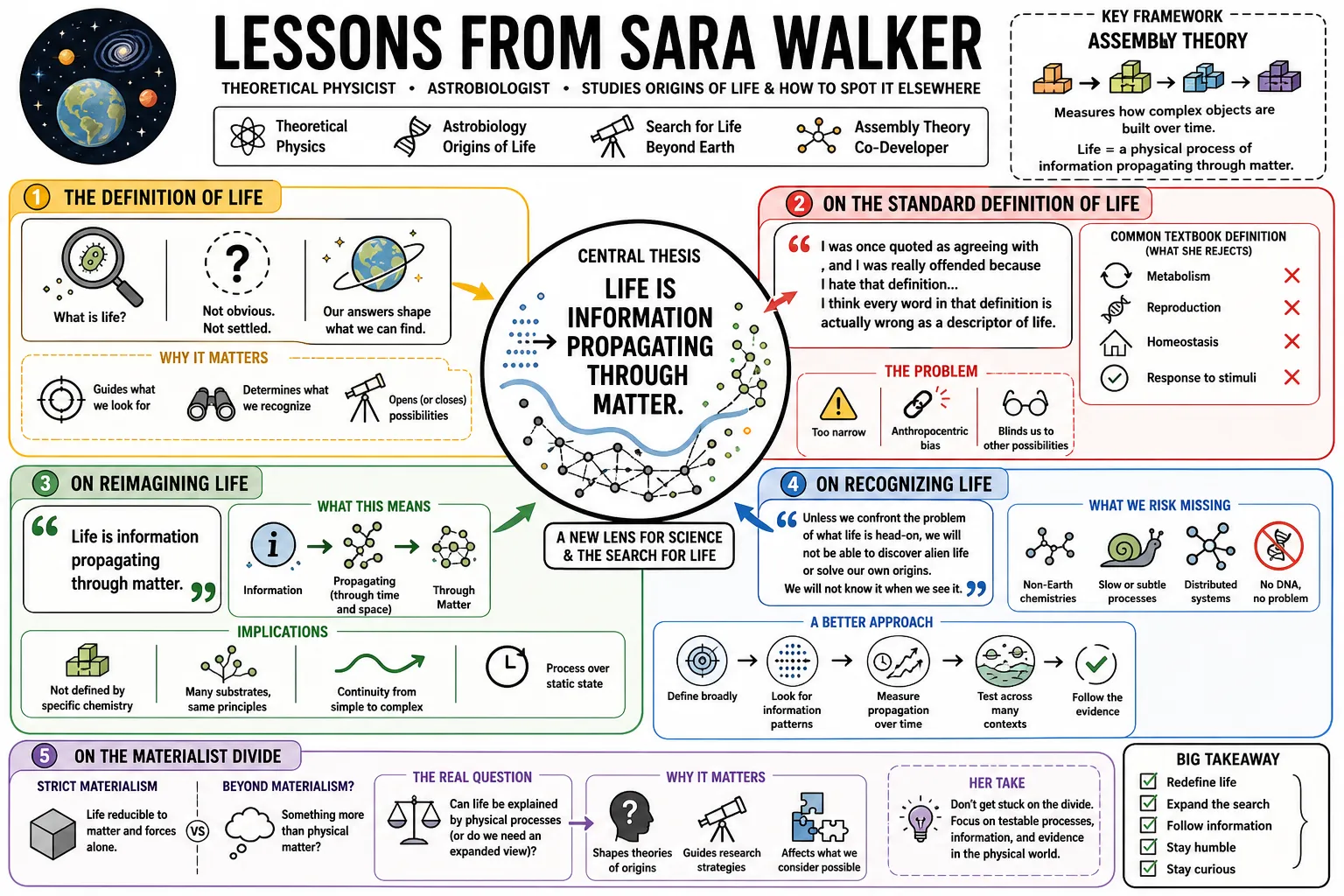
Lessons from Sara Walker
Theoretical physicist and astrobiologist Sara Walker studies the origins of life and how to spot it elsewhere in the universe. She co-developed Assembly Theory, a framework that measures how complex objects are built over time and treats life as a physical process of information propagating through matter. This profile collects her arguments on why standard physics fails to explain the living universe, and why recognizing alien life requires rethinking our basic assumptions.
Part 1: The Definition of Life
- On the Standard Definition of Life: "I was once quoted as agreeing with [that definition], and I was really offended because I hate that definition... I think every word in that definition is actually wrong as a descriptor of life." — Source: [Lex Fridman Podcast]
- On Reimagining Life: "Life is information propagating through matter." — Source: [Consciocentric]
- On Recognizing Life: "Unless we confront the problem of what life is head-on, we will not be able to discover alien life or solve our own origins. We will not know it when we see it." — Source: [American Scientist]
- On the Materialist Divide: "The historical question of life's origin often hinges on whether life can be described entirely in terms of physical matter or if some non-physical feature animates living things." — Source: [Organism.Earth]
- On Defining Physics: "We really don't understand how information operates in the physical world. And if we understood the laws of information, they would really be the laws of life." — Source: [Simplecast]
- On Categorical Errors: "Life is a universal physical process, distinct from a specific arrangement of biological chemistry." — Source: [StarTalk]
- On the Hard Problem of Life: "We have encountered three hard problems now... The hard problem of life: that abstractions (information) matter in determining what can exist." — Source: [Goodreads]
- On the Concept of Life: "'Life does not exist' as a singular, static object; it operates as a mechanism for making specific things possible in a vast universe." — Source: [Sackett.net]
- On Physical Constraints: "Whatever fundamental axioms you assume in your physics define the boundary of what you can subsequently explain about living systems." — Source: [Goodreads]
Part 2: Assembly Theory and the Assembly Index
- On Assembly Theory's Purpose: "Assembly theory treats every complex object as a kind of autobiography. There is a lineage, a history, of formation and processing that has led stepwise to the formation of that complex object." — Source: [Substack]
- On the Assembly Index: "We quantify this in assembly theory as the shortest number of physical steps to build an object from its elementary building blocks, called the assembly index." — Source: [Interalia Magazine]
- On the Rarity of Complexity: "Because the possibility space of the universe is vast, the existence of complex objects is quantifiably rare. This implies that matter carries a history of its own construction." — Source: [Long Now Foundation]
- On the Physics of Construction: "There's sort of a minimal constructed complexity for making the object, or a minimal set of constraints that's necessary, [a] minimal history to produce that particular structure." — Source: [The Nocturnists]
- On Unifying Physics and Biology: "Assembly theory provides a completely new lens for looking at physics, chemistry, and biology as different perspectives of the same underlying reality... it's a major step toward a fundamental theory unifying inert and living matter." — Source: [Santa Fe Institute]
- On Experimental Verification: "You can experimentally measure an object's assembly index by blasting a molecule apart with a laser and counting the different kinds of fragments left behind." — Source: [Blubrry]
- On High-Assembly Objects: "Life is the universe's way of making high-assembly objects. In other words, life turns rare events into everyday occurrences." — Source: [American Scientist]
- On Chance vs. Selection: "Simple structures can form by random chance. Objects with a very high assembly index, like complex molecules or a Lego castle, are statistically impossible to produce randomly." — Source: [Dexa AI]
- On Historical Contingency: "Assembly theory makes a strong claim: all things life can build are historically contingent." — Source: [Calirb]
- On Defining Physical Reality: "We think the physical things are the actual objects you see in the universe as physical structures." — Source: [Blubrry]
Part 3: Information and Causation
- On the Driver of Life: "If you want to understand how information operates in the physical universe, you must study a living thing, because that is where information is most densely concentrated." — Source: [Simplecast]
- On the Necessity of Causation: "A universe without causation is devoid of life." — Source: [Consciocentric]
- On the Power of Theories: "Explanations [and theories] become causal to our future." — Source: [Consciocentric]
- On Maximizing Impact: "If you want to live forever, maximize your causal output." — Source: [Consciocentric]
- On Consciousness vs. Matter: "Consciousness and matter are part of the same causal structure, the key difference being whether we are looking deep in time or looking at what exists only now." — Source: [Consciocentric]
- On Causal Depth: "Living systems are causally deep. Their existence relies on a physical memory of the past that spans billions of years." — Source: Theories of Everything
- On the Physicality of Information: "Information is a physical property that actively structures matter and determines what can exist in the world." — Source: [Preposterous Universe]
- On the Role of the Observer: "By observing what is happening now in the present moment, we can infer what has happened already, even billions of years in the past." — Source: [Time Sensitive]
- On the Nature of the Mind: "That rockets can be made to happen, once minds emerge that can imagine them, is a nontrivial feature of our universe." — Source: [Goodreads]
- On Life as Information: "We are the current manifestation of an ancient lineage of propagating information." — Source: [Consciocentric]
Part 4: Time, Memory, and History
- On the Necessity of Memory: "Everything interesting on this planet requires a memory of the past to exist in the present." — Source: [Consciocentric]
- On the Thickness of the Present: "The present moment contains the four billion years of evolutionary memory required to produce the objects around us." — Source: Theories of Everything
- On Time as a Physical Property: "Thus, in assembly theory, time is essentially the same thing as information, memory, causation and selection. They are all made physical because we assume they are features of the objects described in the theory, not the laws of how these objects behave." — Source: [Medium]
- On Shared History: "If you trace back in time far enough, every living thing on this planet shares a single memory." — Source: [Consciocentric]
- On the Recursion of the Universe: "We live in a recursively structured universe. Most structure has to be built on memory of the past. The information is built up over time." — Source: [Quanta Magazine]
- On Object Perception: "Features of reality that are smaller in time than we are appear to us as material. Objects that are larger in time and require more complex assembly histories appear abstract or informational." — Source: [Goodreads]
- On the Shape of Time: "Life requires us to treat time not merely as a background parameter in equations, but as a structural component of matter itself." — Source: [Interalia Magazine]
- On the Arrow of Complexity: "The passage of time in a living universe is marked by the accumulation of assembly steps. This allows matter to remember and build upon its previous states." — Source: [Nature]
- On Life's Lineage: "We are part of the current moment of a billions-year-old lineage of propagating information that has structured matter on our Earth since the origin of life." — Source: [Consciocentric]
Part 5: Physics of the Living Universe
- On the Dead Universe: "The physics we know and love, as taught in modern physics departments, provides a fundamental description of a dead universe. It's not the universe I live in, and I bet you don't either." — Source: [Consciocentric]
- On the Missing Laws: "Current physical models fail to account for how historical information and the memory of past events shape present physical realities." — Source: [Interalia Magazine]
- On Life Driving Physics: "Life invented the concept of elementary particles and figured out how to measure them." — Source: [Time Sensitive]
- On Local Regularities: "What life does is create local regularities—these are things that can happen..." — Source: [Goodreads]
- On Bridging the Gap: "Physics must treat information and history as fundamental physical properties to accurately describe life." — Source: [Simplecast]
- On New Possibilities: "Things come into existence when and where it is possible to—and what we call life is the mechanism for making specific things possible when the possibility space is too large for the universe to ever explore all of it." — Source: [Goodreads]
- On the Hard Problem of Matter: "The hard problem of matter: that nothing can be observed to exist outside of interactions." — Source: [Goodreads]
- On the Future of Physics: "A complete theory of physics must eventually explain the emergence of observers capable of comprehending the universe." — Source: [Lex Fridman Podcast]
- On Reversing the Hierarchy: "We should view life as the pinnacle physical process that allows the universe to understand itself." — Source: [Nautilus]
Part 6: Astrobiology and Alien Life
- On Recognizing the Alien: "It's possible that we have already encountered extraterrestrial life but we're not able to recognize it because we were relying on our limited notion of what life is to begin with." — Source: Theories of Everything
- On Agnostic Biosignatures: "To find life elsewhere, astrobiologists should look for objective measures of complexity, like the assembly index, rather than specific Earth-based chemical signatures." — Source: [Big Biology]
- On Building Aliens: "Our best bet for making contact with an alien life-form in the near term may be to evolve it, from scratch, in the lab." — Source: [American Scientist]
- On the Origin of Life Problem: "The origin of life is among the greatest open problems in science. How is it that life can emerge from non-living matter?" — Source: [Simplecast]
- On Universal Signatures: "High-assembly molecules serve as universal biosignatures because the laws of probability dictate they cannot form in abundance without a selection mechanism." — Source: [Reddit]
- On Expanding the Search: "Astrobiology must search for general systems where information directs matter, rather than a second instance of Earth biology." — Source: [Templeton Foundation]
- On Martian Microbes: "Finding microbial life on Mars that shares our exact chemistry would mean we have found our distant cousins, rather than a second genesis." — Source: [NASA]
- On the Probability of Life: "The vastness of the universe's possibility space means the exact pathway to life on Earth is highly unlikely to be repeated elsewhere." — Source: [ASU]
- On Discovering Ourselves: "Attempting to define and locate alien life forces us to construct a more rigorous and fundamental definition of what we are." — Source: [American Scientist]
Part 7: The Emergence and Origin of Life
- On the Transition Point: "The origin of life is a measurable threshold where information gains causal control over the chemical systems that house it." — Source: [Preposterous Universe]
- On Historical Necessity: "The emergence of life relies on the universe's ability to retain memory. Without an accumulated history, the transition from inert to living cannot occur." — Source: [Santa Fe Institute]
- On the Limit of Reductionism: "You cannot explain the origin of life by endlessly breaking biological systems down into smaller pieces. You must understand how those pieces assemble over time." — Source: [Big Biology]
- On Chemical Evolution: "Before biological evolution began, a chemical selection process navigated the vast space of possible molecules." — Source: [Nature]
- On the Inevitability of Life: "Life is a mechanism that the universe uses to explore complex possibility spaces that would otherwise remain unreachable." — Source: [Goodreads]
- On the Definition Problem: "The difficulty in solving the origin of life stems directly from a failure to adequately define the physics of what life actually does." — Source: [Lex Fridman Podcast]
- On the Role of Constraints: "The emergence of life is the story of how physical constraints are built up over time, narrowing the field of what happens next to processes that propagate information." — Source: [The Nocturnists]
- On Replicating the Origin: "Understanding the principles of life's origin should allow us to trigger open-ended evolution in completely novel chemical substrates." — Source: [American Scientist]
- On the Physics of Emergence: "The leap from non-living to living matter is a fundamental phase transition in the physical properties of information and causality." — Source: [Mindscape Podcast]
Part 8: Complexity, Evolution, and Technology
- On AI as Life: "AI Is Life. Technology is not artificially replacing life — it is life." — Source: [Noema Magazine]
- On the Nature of Technology: "I tend to think about technology as artifacts that life creates that potentially open up new possibilities." — Source: [Time Sensitive]
- On the Future of AI: "Technology is a solidification of the memory of our past, human ingenuity remains the propellant of our future - as has been the case for millennia. We should not enable the current AI elixir to fool us about what the future looks like, we are far from understanding it." — Source: [Consciocentric]
- On the AI Lineage: "AI is a signature of life because it could only emerge from a 4 billion year evolutionary lineage." — Source: [AI Doers]
- On Complex Objects: "Complex (technological) objects do not just appear spontaneously in the universe... Cells, dogs, trees, computers, you and I all require evolution and selection along a lineage to generate the information necessary to exist." — Source: [Noema Magazine]
- On the Continuation of Life: "Our technologies are not replacing life—they are life's continuation, yet they are still not alive in the way we are." — Source: Theories of Everything
- On Alien Intelligence: "I don't think we're building human-like intelligences. It's something else entirely." — Source: [Time Sensitive]
- On the Biosignature of Computers: "A smartphone is a biosignature because it requires an immense accumulation of historical assembly steps to exist." — Source: [Lex Fridman Podcast]
- On the Limit of Evolution: "Technology allows life to act as a faster mechanism for information to structure the universe." — Source: [StarTalk]
- On the Trajectory of Complexity: "As life evolves and technology advances, the universe changes its causal structure, creating deeper and more complex memory states." — Source: [Long Now Foundation]