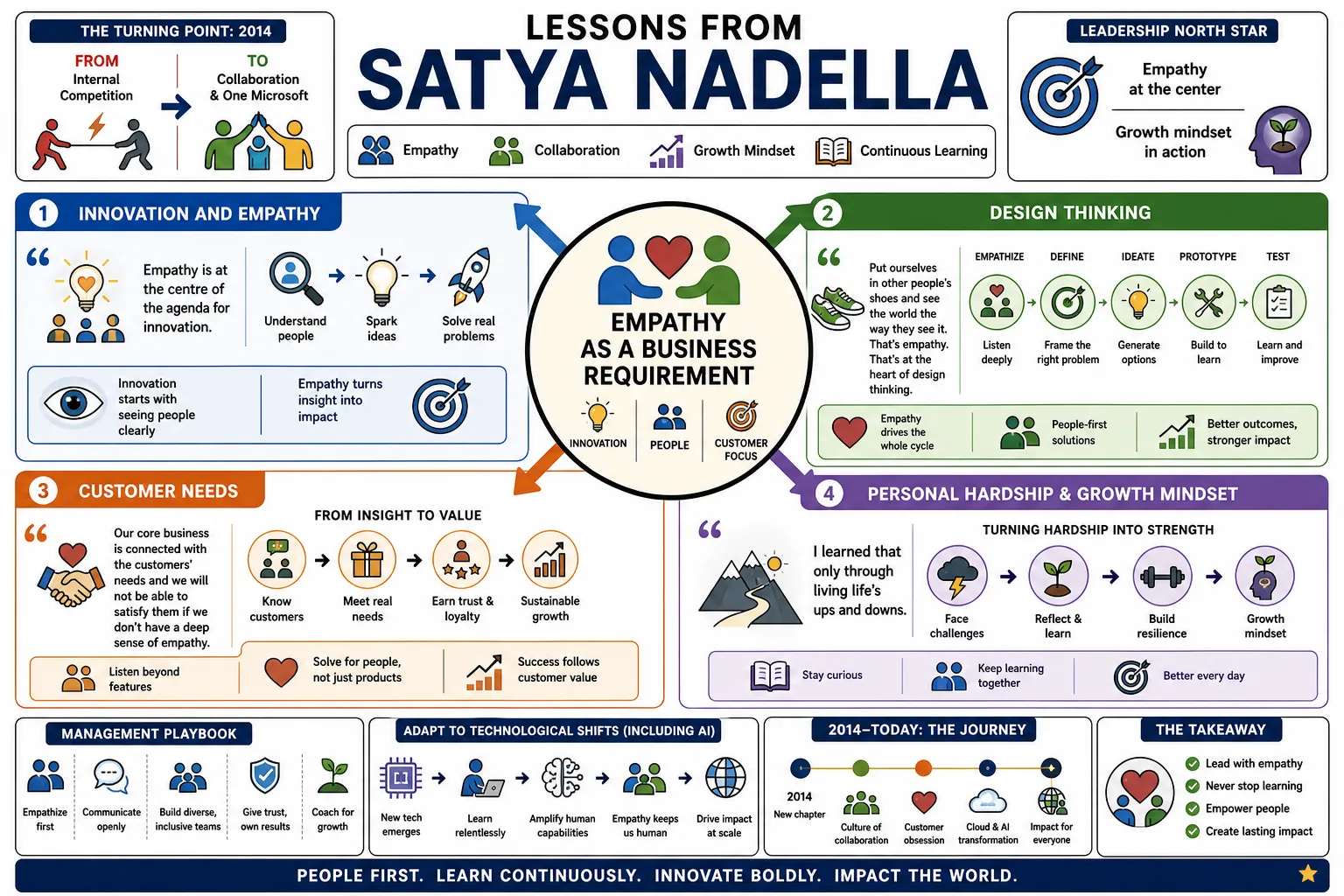
Lessons from Satya Nadella
When Satya Nadella became Microsoft’s CEO in 2014, he scrapped the company's culture of internal competition to focus on collaboration and continuous learning. He built his strategy around the "growth mindset," treating empathy as a hard business requirement rather than just a personal virtue. This collection tracks his views on management, technological shifts, and how humans must adapt to AI.
Part 1: Empathy and Leadership
- On Innovation and Empathy: "The value that I really learned to appreciate deeply and which I talk about a great deal is empathy. I don't think it is simply a 'nice to have' but I believe it is at the centre of the agenda for innovation here at Microsoft." — Source: [Brand Genetics]
- On Design Thinking: "What is the most innate in all of us is that ability to be able to put ourselves in other people's shoes and see the world the way they see it. That's empathy. That's at the heart of design thinking." — Source: [Forbes]
- On Customer Needs: "Our core business is connected with the customers' needs and we will not be able to satisfy them if we don't have a deep sense of empathy." — Source: [Brand Genetics]
- On Personal Hardship: "I learned that only through living life's ups and downs can you develop empathy; that in order not to suffer, or at least not to suffer so much, one must become comfortable with impermanence." — Source: [Goodreads]
- On Business Priority: "Most people think that empathy is something you have only with friends and the family, but in reality, it is also a priority in business." — Source: [Brand Genetics]
- On Team Dynamics: "Without empathy it is not possible to get the best from your team, so for this reason it is the key to everything." — Source: [Brand Genetics]
- On Empathy as a Muscle: "Empathy is a muscle, so it needs to be exercised." — Source: [Brand Genetics]
- On Developing Compassion: "And only then would you be ready to develop that deeper sense of empathy and compassion for everything around you." — Source: [Goodreads]
- On Meeting Unmet Needs: "I think empathy is everything. If you think about even in the business context for us, our job is to meet the unmet, unarticulated needs of customers." — Source: [CBS News]
- On Centering Oneself: "Ideas excite me. Empathy grounds and centers me." — Source: [Microsoft]
Part 2: The Growth Mindset
- On the Learn-It-All: "The learn-it-all will always do better than the know-it-all." — Source: [LiveMint]
- On Continuous Learning: "I fundamentally believe that if you are not learning new things, you stop doing great and useful things." — Source: [Medium]
- On Fixed vs. Growth Mindset: "We have to get from fixed mindset to growth mindset." — Source: [Quotovia]
- On Changing Habits: "Success can cause people to unlearn the habits that made them successful in the first place." — Source: [Medium]
- On Curiosity: "Don't be a know-it-all; be a learn-it-all." — Source: [LiveMint]
- On Self-Measurement: "The way I measure my life is 'Am I better than I was last year?'" — Source: [AZ Quotes]
- On Ambition and Mindset: "Achieving our mission requires us to evolve our culture. It all starts with a growth mindset—a passion to learn and bring our best every day to make a bigger difference in the world." — Source: [Business Chief]
- On the Need for Evolution: "Our ambitions are bold and so must be our desire to change and evolve our culture." — Source: [AZ Quotes]
- On Everyday Learning: "Be passionate and bold. Always keep learning. You stop doing useful things if you don't learn." — Source: [India Times]
- On Insatiable Curiosity: "I love to learn. I get excited about new things. I buy more books than I read. I sign up for more online courses than I can actually finish." — Source: [Mercurius IT]
Part 3: Culture and Organizational Change
- On the Role of the CEO: "The C in CEO stands for culture." — Source: [Ian Khan]
- On Strategy and Culture: "Culture eats strategy for breakfast." — Source: [Goodreads]
- On Internal Competition: "The transition from a culture of proving one's expertise to one of constant curiosity means avoiding rigid, competitive silos." — Source: [LiveMint]
- On Hitting Refresh: "Every person, organization, and even society reaches a point at which they owe it to themselves to hit refresh—to reenergize, renew, reframe, and rethink their purpose." — Source: [Goodreads]
- On Psychological Safety: "A culture of innovation requires psychological safety where employees feel safe enough to experiment and fail without fear of retribution." — Source: [Medium]
- On Team Clarity: "I want to hear them take their intelligence and use it to develop deep shared understanding within teams and define a course of action." — Source: [Goodreads]
- On Building Trust: "Consistency over time is trust." — Source: [Goodreads]
- On Managing Reality: "To be a leader in this company, your job is to find the rose petals in a field of shit." — Source: [Goodreads]
- On Corporate Evolution: "Our industry does not respect tradition – it only respects innovation." — Source: [AZ Quotes]
- On the Necessity of Change: "A leader must see the external opportunities and the internal capability and culture—and all of the connections among them—and respond to them before they become obvious parts of the conventional wisdom." — Source: [ERP Software Blog]
Part 4: Innovation and Technology
- On the Purpose of Technology: "Technology is nothing if it doesn't empower people." — Source: [Quotovia]
- On Creating for Others: "What was true then and what is true now is that we create technology so others can create more technology." — Source: [JD Meier]
- On Customer Empathy: "At the core of our business must be the curiosity and desire to meet a customer's unarticulated and unmet needs with great technology." — Source: [Goodreads]
- On Meeting Customers: "We have to be able to meet customers where they are, not where we are." — Source: [Ian Khan]
- On Cloud Computing: "If God had come to me and said, 'there's mobile and cloud — pick one,' I would've picked cloud." — Source: [Madrona]
- On Symbiosis: "We want not just intelligent machines but intelligible machines; not just artificial intelligence but symbiotic intelligence." — Source: [JD Meier]
- On Cloud and AI Synergy: "AI runs on compute, and compute runs on the cloud." — Source: [Madrona]
- On Innovation over Tradition: "Past success is not a guarantee of future relevance, pushing an organization to remain agile and forward-thinking." — Source: [Ian Khan]
- On People-First Design: "We are not building an AI-first world, we are building a people-first world with AI everywhere." — Source: [Microsoft]
Part 5: Purpose, Mission, and Meaning
- On Microsoft's Mission: "To empower every person and every organization on the planet to achieve more." — Source: [GeekWire]
- On Global Empowerment: "I think our job is to ensure that technology is empowering every person and every organization on the planet to achieve more." — Source: [Quotovia]
- On Meaning at Work: "We spend far too much time at work for it not to have deep meaning." — Source: [Ian Khan]
- On Improving Lives: "I truly believe that each of us must find meaning in our work. The best work happens when you know that it's not just work, but something that will improve other people's lives." — Source: [India Times]
- On Having a Compass: "A company's mission statement is not just a slogan, but a lens through which the organization makes strategic decisions." — Source: [Business Insider]
- On Relevance: "If Microsoft disappeared tomorrow, would anybody miss us?" — Source: [Business Insider]
- On Honest Intent: "So long as you enjoy it, do it mindfully and well, and have an honest purpose behind it, life won't fail you." — Source: [Goodreads]
- On Reimagining Purpose: "Every organization must periodically renew, reframe, and rethink its purpose to remain vital." — Source: [Goodreads]
- On Mastery: "Mastery comes down to being deeply in touch with what gives you purpose." — Source: [Finding Mastery]
Part 6: Navigating Failure and Success
- On Taking Risks: "If you are going to have a risk-taking culture, you can't really look at every failure as a failure, you've got to be able to look at the failure as a learning opportunity." — Source: [AZ Quotes]
- On Daily Renewal: "You renew yourself every day. Sometimes you're successful, sometimes you're not, but it's the average that counts." — Source: [India Times]
- On Career Success: "When I think about my career, my successes are built on learning from failures." — Source: [JD Meier]
- On Uncertainty: "We have to be willing to lean into uncertainty, take risks and move quickly when we make mistakes, recognizing failure happens along the way to mastery." — Source: [Quotovia]
- On the Danger of Success: "Relying too heavily on past achievements can cause a person or company to unlearn the habits that brought them success in the first place." — Source: [Medium]
- On Impermanence: "Living through life's ups and downs teaches us that we must become comfortable with impermanence." — Source: [Goodreads]
- On Respecting Competitors: "It showed me that you must always have respect for your competitor, but don't be in awe." — Source: [Goodreads]
- On Humility: "Curiosity and humility are far more valuable in a rapidly changing world than projecting certainty." — Source: [LiveMint]
- On Building on Mistakes: "True innovation stems from a willingness to iterate, fail, and continuously adjust based on what was learned." — Source: [Medium]
Part 7: The Future of Work and AI
- On the New Production Function: "The key is learning the new production function... It’s kind of like rewiring yourself — unlearning is the hardest part. Learning is easy." — Source: [Business Insider]
- On Broad AI Benefits: "For this not to be a bubble, by definition it requires that the benefits of this are much more evenly spread." — Source: [Pivot to AI]
- On Job Reorganization: "Corporate leaders who view AI as a means to eliminate jobs are looking at the technology wrong; they should be thinking about reorganizing the job to better leverage humanity." — Source: [Fox Business]
- On Power Concentration: "The future of AI cannot be controlled by a small number of companies." — Source: [Computing]
- On Social Permission: "No amount of just narrative is going to do it because where we are now, we have to sort of walk the walk. We now have to do the hard work in earning the social permission." — Source: [Windows Central]
- On Human and Token Capital: "The real opportunity is not in picking the best model but instead in building a learning loop on top of models where human capital and token capital compound." — Source: [Fast Company]
- On Hollowing Out Industries: "There is no societal permission for an AI future that hollows out entire industries." — Source: [The Next Web]
- On Democratizing AI: "You can't hand the world's curiosity to a handful of companies and call it progress." — Source: [The Street]
- On Human Value: "Importantly, human capital does not become less valuable as token capital grows. It only becomes more valuable!" — Source: [VentureBeat]
Part 8: Personal Growth, Listening, and Humanity
- On Active Listening: "Listening was the most important thing I accomplished each day because it would build the foundation of my leadership for years to come." — Source: [Goodreads]
- On Self-Perception: "The view you adopt for yourself profoundly affects the way you lead your life." — Source: [JD Meier]
- On EQ vs IQ: "The energy you create around you is perhaps going to be the most important attribute. In the long run, EQ trumps IQ." — Source: [India Times]
- On Inclusivity in Meetings: "The next time you are in a meeting, ask the quietest person what they think. Invite everyone into the conversation." — Source: [India Times]
- On Rilke and Building: "Inspired by the poet Rilke, he describes the building process as letting the future enter us and changing itself in us before it becomes real." — Source: [Simplecast]
- On Shaping the Future: "Ultimately, technology is in the hands of humanity. It is up to us to imagine the future and shape it using technology." — Source: [Microsoft]
- On Collective Obligation: "As AI evolves, it must do so in alignment with social, cultural, and legal norms, ensuring that the industry delivers a broad public benefit." — Source: [The Source]
- On Democratizing Expertise: "Technology should act as a co-pilot, empowering employees and democratizing expertise across all industries." — Source: [MIT]
- On the Human Element: "At its core, any transformation is about humans and the unique quality we call empathy, which becomes ever more valuable as technology disrupts the status quo." — Source: [Microsoft]