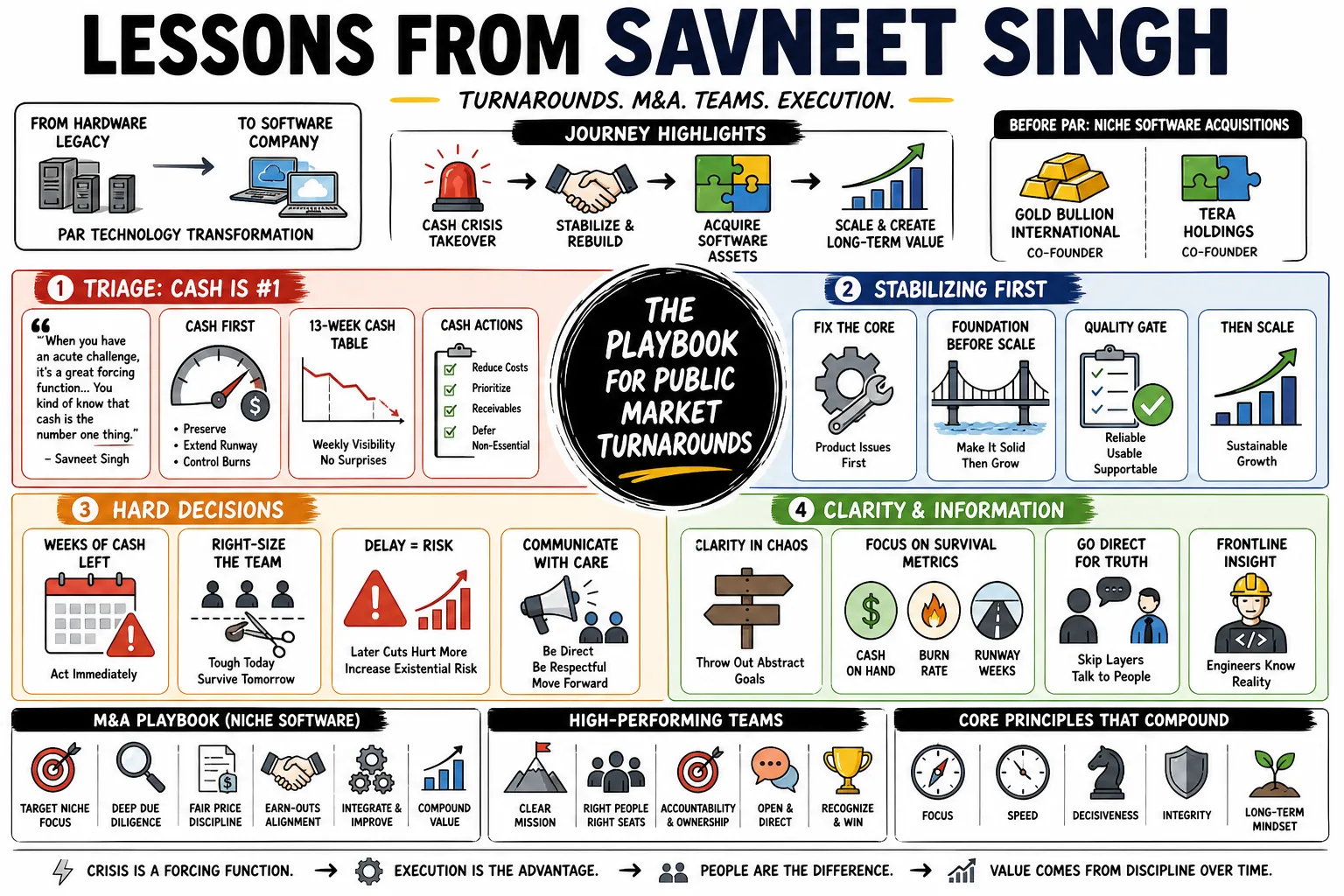
Lessons from Savneet Singh
Savneet Singh took over PAR Technology during a cash crisis and turned the legacy hardware business into a software company. Before that, he focused on niche software acquisitions as a co-founder of Gold Bullion International and Tera Holdings. This profile compiles his practical advice on executing public market turnarounds, structuring M&A deals, and building high-performing teams.
Part 1: The Crisis Playbook
- On Triage: "When you have an acute challenge, it's a great forcing function... You kind of know that cash is the number one thing." — Source: [Fintech Leaders]
- On Stabilizing First: Before attempting to scale, a business must fix its core product issues to ensure the foundation can support growth. — Source: [Founderpath Blog]
- On Hard Decisions: Stepping into a company with weeks of cash left requires immediate workforce reductions; delaying only increases the existential risk. — Source: [SaaStock Presentation]
- On Clarity in Chaos: During a turnaround, abstract goals must be thrown out in favor of basic survival metrics. — Source: [Think Like an Owner]
- On Information Gathering: A leader parachuting into a crisis must rapidly identify the ground truth by bypassing middle management and talking directly to frontline engineers. — Source: [Think Like an Owner]
- On Managing the Board: In a turnaround, the board needs absolute transparency about the depth of the crisis, avoiding sugarcoated projections. — Source: [Think Like an Owner]
- On Vendor Negotiations: When bankruptcy is a real threat, you must be honest with suppliers about cash flow to renegotiate terms effectively. — Source: [SaaStock Presentation]
- On Stopping Bad Projects: The quickest way to extend runway is immediately killing all R&D projects that do not serve current paying customers. — Source: [Think Like an Owner]
- On Communication: "My job as a leader is to be a really active listener, seek out opinions from people throughout the organization, and then have the conviction to make a decision." — Source: [ExCo Leadership]
- On Turning the Corner: Once the cash burn is stopped, you must deliberately transition the company’s mindset from survival back to offense. — Source: [SaaStock Presentation]
Part 2: Cultural Transformation & Urgency
- On Feel-Good Culture: Moving away from abstract corporate wellness values is necessary to establish concrete, performance-driven principles. — Source: [Punchh Blog]
- On Core Values: Culture in a turnaround is built on basic tenets like Speed, Ownership, and Winning. — Source: [Think Like an Owner]
- On Speed as a Habit: Instilling urgency means expecting tasks to be completed in days rather than the weeks it took under previous management. — Source: [Think Like an Owner]
- On Radical Ownership: Decentralizing accountability forces individuals to own the outcome of their unit rather than passing blame to other departments. — Source: [Founderpath Blog]
- On Evaluating Culture: You evaluate if a culture is working by measuring how quickly the team responds to new challenges, avoiding reliance on employee surveys. — Source: [Think Like an Owner]
- On Toxic Positivity: A culture that avoids hard truths and negative feedback will inevitably fail to correct structural business flaws. — Source: [SaaStock Presentation]
- On Setting the Pace: The CEO must personally demonstrate the work ethic and speed they expect from the rest of the executive team. — Source: [Think Like an Owner]
- On Accountability: Accountability is meaningless unless it is tied directly to performance reviews and compensation. — Source: [Think Like an Owner]
- On Culture as Action: Culture is defined by the behaviors you tolerate and reward on a daily basis, rather than words written on a wall. — Source: [Think Like an Owner]
Part 3: Talent, Incentives, and Organization
- On Equity Compensation: Tying employee incentives to company equity aligns the talent base directly with shareholder value creation. — Source: [Think Like an Owner]
- On Decentralized P&Ls: Adopting an Amazon-style structure by giving young General Managers full P&L ownership drives faster decision-making. — Source: [Founderpath Blog]
- On Hiring the Right Stage: The executive who can manage a stable enterprise is rarely the same person who can navigate a distressed turnaround. — Source: [Think Like an Owner]
- On Removing Underperformers: Failing to address underperforming managers quickly demoralizes the high performers who carry the organization. — Source: [Think Like an Owner]
- On Metric-Driven Reviews: Performance reviews must be explicitly linked to company-wide metrics and values to remove subjectivity. — Source: [Think Like an Owner]
- On Organizational Design: One of the most common mistakes is creating overlapping responsibilities, which guarantees that no one is actually accountable. — Source: [Think Like an Owner]
- On Empowering Youth: Giving significant P&L responsibility to hungry, younger managers often yields better results than hiring expensive industry veterans. — Source: [Founderpath Blog]
- On Retention: The best people stay when they are challenged with difficult problems and given the autonomy to solve them. — Source: [Think Like an Owner]
- On Delegating: "I can't do anyone's job at PAR better than they can," meaning the CEO's role is to facilitate experts rather than micromanage. — Source: [ExCo Leadership]
Part 4: Capital Allocation & M&A Strategy
- On Measuring Success: The true measure of SaaS value creation is "ARR per share," rather than top-line revenue growth. — Source: [Founderpath Blog]
- On Valuations: Acquiring companies at median multiples is a safer strategy than chasing peak market valuations for hyped assets. — Source: [Founderpath Blog]
- On Product-Led M&A: Acquisitions must be driven by product strategy and enhancing the customer experience, rather than mere financial synergies. — Source: [Think Like an Owner]
- On Integration: The success of an acquisition is determined by how well the acquired product integrates into your core platform, rather than the deal price. — Source: [Think Like an Owner]
- On Capital Discipline: Capital allocation requires saying no to exciting market trends in order to protect the balance sheet. — Source: [MOI Global Latticework]
- On Dilution: Issuing shares for acquisitions is only justifiable if the resulting cash flows are highly accretive to the existing shareholders. — Source: [Founderpath Blog]
- On Niche Software: Acquiring niche software businesses allows for steady growth through specialized products that large competitors ignore. — Source: [Tera Holdings Background]
- On Avoiding Bidding Wars: Walking away from an acquisition is always better than winning a bidding war that destroys your return on invested capital. — Source: [Think Like an Owner]
- On Building Platforms: True value compounds when an acquisition transforms point solutions into a unified operational platform. — Source: [Retail Tech Innovation Hub]
- On Patience in Capital: The best capital allocators wait for the obvious pitch rather than swinging at every potential deal. — Source: [MOI Global Latticework]
Part 5: Software & The SaaS Business Model
- On Customer Durability: "Some of our customers measure the length of their franchisees in decades... these are really, really durable business that go from family to family." — Source: [Bristlemoon Research]
- On Legacy vs SaaS: Transitioning a public hardware company into a SaaS model requires educating investors on long-term software margins over short-term revenue dips. — Source: [Founderpath Blog]
- On the Value of Platforms: "What Bolla is building with PAR isn't a loyalty programme - it's an intelligence layer that turns data across customers... into real-time action." — Source: [Retail Tech Innovation Hub]
- On Churn: In enterprise software, low churn is often a byproduct of deep integration into a customer's daily operations. — Source: [MOI Global Latticework]
- On Pricing Power: True software businesses earn their pricing power by continually shipping features that save their clients labor and time. — Source: [Founderpath Blog]
- On Point Solutions: Point solutions ultimately fail to scale because enterprise customers eventually demand an integrated tech stack. — Source: [Retail Tech Innovation Hub]
- On Compounding Value: The difference between a tool and a platform is that a platform compounds value as more data flows through it. — Source: [Retail Tech Innovation Hub]
- On Gross Margins: Expanding software gross margins is the clearest indicator that a turnaround is succeeding and the product architecture is stable. — Source: [Founderpath Blog]
- On Hardware as a Trojan Horse: Legacy hardware footprints can be used to introduce higher-margin software solutions to a captive audience. — Source: [Founderpath Blog]
- On R&D Efficiency: Software development must be measured by feature adoption, avoiding metrics based purely on lines of code or engineering hours. — Source: [MOI Global Latticework]
Part 6: Restaurant Tech & Industry Shifts
- On Historical Underinvestment: "For a long time, restaurants looked at technology as a cost center, as really a way to speed up transactions." — Source: [Morningstar]
- On the Pandemic Catalyst: "With the advent of the cloud, the push from COVID-19, they really quickly realized they had to become digital businesses." — Source: [Morningstar]
- On Omnichannel Expectations: Guests now expect restaurants to be available everywhere, shifting the burden onto reliable, integrated backend systems. — Source: [Morningstar]
- On Franchise Dynamics: Selling to franchises requires understanding that you are selling to multigenerational family businesses, rather than corporate headquarters. — Source: [Bristlemoon Research]
- On Labor Shortages: Technology in the restaurant space is moving past taking orders; it is about mitigating chronic labor shortages through automation. — Source: [Restaurant Technology Guys]
- On Data Silos: The biggest pain point for modern operators is having loyalty data isolated from point-of-sale data, preventing unified customer profiles. — Source: [Retail Tech Innovation Hub]
- On Menu Syncing: Integrating menus across delivery apps and in-store kiosks is a complex data problem that solves massive operational headaches. — Source: [QSR Web]
- On Margins in Food Service: Because restaurant margins are notoriously thin, any software they buy must prove immediate, hard ROI. — Source: [Restaurant Technology Guys]
- On the Future of Dining: The successful restaurant of the future will operate more like an e-commerce fulfillment center powered by real-time intelligence. — Source: [Morningstar]
Part 7: Entrepreneurship & Investing
- On Contrarian Bets: "You make money in business by making bets that others won't take. You have to have a bit of a contrarian nature to go against the grain." — Source: [ExCo Leadership]
- On the Cost of Conformity: "Otherwise, you'll just be average," emphasizing that following consensus guarantees mediocre returns. — Source: [ExCo Leadership]
- On Evaluating Investments: "There are bets that are on a market. There are bets on a business. There are bets on the jockey." — Source: [Bristlemoon Research]
- On Spotting Winners: Identifying tomorrow's enterprise software leaders requires finding companies that solve unglamorous, mission-critical problems. — Source: [MOI Global Latticework]
- On Building Gold Bullion International: Bringing an ancient asset class like physical gold into the digital era required convincing institutions that transparency was possible. — Source: [Medium]
- On Holding Companies: The model at Tera Holdings proved that buying and patiently growing niche software is a highly reliable path to compounding capital. — Source: [The Waiter's Pad]
- On Public vs. Private: Executing a turnaround in the public markets adds the pressure of quarterly scrutiny, demanding absolute conviction from the CEO. — Source: [Think Like an Owner]
- On Early Career Lessons: Starting in investment banking at Morgan Stanley provides a baseline understanding of how capital flows and businesses are valued. — Source: [Treville Background]
- On Partnering with Management: Private equity succeeds when it acts as a long-term partner to management teams rather than acting as a financial engineer. — Source: [The Waiter's Pad]
Part 8: Personal Philosophy & Continuous Growth
- On Reinvention: "A cat must lose its taste for mice if it wants to be a lion." — Source: [The CEO Forum Group]
- On Elevation: Leaders must continuously let go of comfortable, low-level tasks to force themselves to operate at a higher strategic tier. — Source: [The CEO Forum Group]
- On the Role of a Teacher: A CEO's primary internal function often resembles that of a teacher, constantly communicating the "why" behind the company's direction. — Source: [Think Like an Owner]
- On Self-Awareness: Acknowledging that you cannot code or build hardware better than your engineers is the first step to effective delegation. — Source: [ExCo Leadership]
- On Managing Pressure: Handling the stress of a near-bankruptcy requires separating the emotional weight of the crisis from the mechanical steps needed to solve it. — Source: [SaaStock Presentation]
- On Community Service: Extending leadership beyond the boardroom into community advocacy, such as working with the Sikh Coalition, grounds an executive. — Source: [Sikh Coalition]
- On Reading and Learning: Continuous learning is the only defense against an industry that makes your current skill set obsolete every few years. — Source: [Think Like an Owner]
- On Making Mistakes: Acknowledging early organizational design mistakes openly builds more trust with the team than attempting to project infallibility. — Source: [Think Like an Owner]
- On the Long Game: Enduring business success is built on decades-long relationships with customers, separating great platforms from temporary trends. — Source: [Bristlemoon Research]