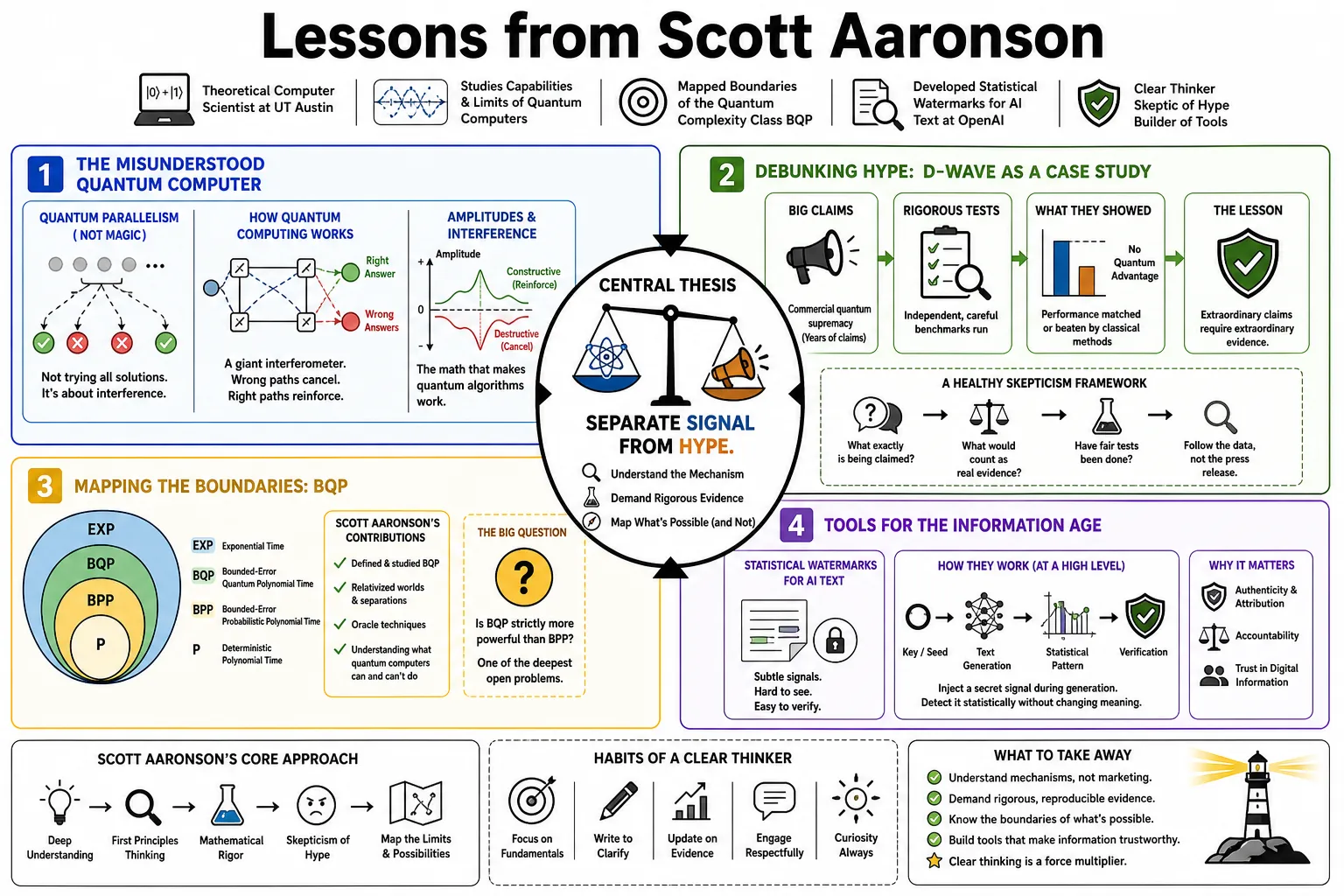
Lessons from Scott Aaronson
Scott Aaronson is a theoretical computer scientist at UT Austin who studies the capabilities and limits of quantum computers. He is best known for mapping the boundaries of the quantum complexity class BQP and for his recent work developing statistical watermarks for AI text at OpenAI. This profile covers his approach to information and computation, along with his habit of debunking scientific hype.
Part 1: The Misunderstood Quantum Computer
- On Quantum Parallelism: "If you take nothing else from this blog: quantum computers won't solve hard problems instantly by just trying all solutions in parallel. They work by exploiting constructive and destructive interference among probability amplitudes." — Source: [Shtetl-Optimized]
- On How Quantum Computing Works: "A quantum computer is like a giant interferometer. You are choreographing a pattern of interference so that for every wrong answer, the paths leading to it cancel each other out, while the paths leading to the right answer reinforce each other." — Source: [TED Talks]
- On D-Wave and Hype: "For years, D-Wave claimed they were selling commercial quantum computers that outperformed classical ones. But when rigorous tests were run, the promised exponential speedup simply wasn't there. Science requires separating hardware engineering from theoretical hype." — Source: [Shtetl-Optimized]
- On Quantum Supremacy: "Quantum supremacy isn't about doing something useful; it's about doing something—anything—that a classical computer simply cannot do in a reasonable amount of time, proving that the exponential state space of quantum mechanics is real." — Source: [Nature]
- On NP-Complete Problems: "It is a persistent media myth that quantum computers will easily solve NP-complete problems like the Traveling Salesperson. We actually have strong theoretical evidence that they cannot." — Source: [Quantum Computing Since Democritus]
- On Shor's Algorithm: "Shor's algorithm doesn't work by trying all factors simultaneously. It works because factoring possesses a highly specific, periodic mathematical structure that a quantum Fourier transform can exploit." — Source: [Shtetl-Optimized]
- On Quantum Mechanics as Information: "If quantum mechanics isn't physics in the usual sense—if it's not about matter, or energy, or waves, or particles—then what is it about? From my perspective, it's about information and probability." — Source: [Quantum Computing Since Democritus]
- On Minus Signs in Probability: "Quantum mechanics is essentially a generalization of probability theory that allows for minus signs, which we call amplitudes. These minus signs are the entire reason quantum computers have an advantage." — Source: [Quanta Magazine]
- On the Burden of Proof: "If you want to argue that quantum computers are physically impossible, you don't get to just assert it. You have to identify the specific physical principle that prevents them from scaling, which usually implies discovering entirely new physics." — Source: [Shtetl-Optimized]
- On Building Quantum Computers: "Building a useful quantum computer is not merely an engineering challenge; it is a battle against the fundamental tendency of the universe to measure and collapse fragile quantum states." — Source: [Lex Fridman Podcast]
Part 2: The Architecture of Complexity
- On Computational Complexity: "By any objective standard, the theory of computational complexity ranks as one of the greatest intellectual achievements of humankind—along with fire, the wheel, and computability theory." — Source: [Quantum Computing Since Democritus]
- On P vs. NP: "If P were equal to NP, the world would be a profoundly different place. There would be no special value in creative leaps, because anyone who could appreciate a symphony would be able to write one." — Source: [MIT News]
- On BQP (Bounded-error Quantum Polynomial time): "BQP is the set of all problems that a quantum computer can solve efficiently. It sits comfortably inside PSPACE, meaning quantum computers do not possess infinite power; they are constrained by bounds of space and time." — Source: [Complexity Zoo]
- On the Polynomial Hierarchy: "We found evidence that quantum computers can solve certain problems that lie outside the entire polynomial hierarchy, showing that quantum resources give us capabilities entirely orthogonal to classical non-determinism." — Source: [ACM Symposium on Theory of Computing (STOC)]
- On Forrelation: "To separate quantum computing from classical, we use a problem called Forrelation—checking the correlation between a boolean function and the Fourier transform of another. It isolates exactly what makes quantum algorithms distinct." — Source: [ECCC]
- On Physical Reality and Complexity: "Computational complexity is not just about computers. It is the ultimate test of physical theories. If a physical theory allows you to solve NP-complete problems in polynomial time, that is strong evidence the theory is flawed." — Source: [Shtetl-Optimized]
- On Cryptography: "Modern cryptography doesn't exist because we have proven that decoding messages is mathematically impossible. It exists because we assume that certain computational tasks, like factoring large primes, are inherently complex." — Source: [Quantum Computing Since Democritus]
- On Time Travel and Computation: "If closed timelike curves existed, you could solve NP-complete problems efficiently just by having a computer send the right answer back in time to itself. This implies that nature likely forbids time travel to protect computational bounds." — Source: [Physical Review Letters]
- On Oracles: "In complexity theory, we use 'oracles' as imaginary black boxes to test the limits of computation. They help us understand not what algorithms can do in our world, but what they could do in any logically possible world." — Source: [SIGACT News]
- On Worst-Case vs. Average-Case: "We care about worst-case complexity because it provides an absolute guarantee. But nature often generates average-case problems, which is why algorithms that fail in theory often work in practice." — Source: [Simons Institute]
Part 3: AI Safety and Watermarking
- On the Need for AI Watermarks: "If large language models are going to generate a significant fraction of human text, we need a way to track it. Watermarking is an elegantly simple statistical method to separate the synthetic from the organic." — Source: [OpenAI AI Safety Workshop]
- On Watermark Mechanics: "We can insert a secret statistical signal into an LLM's word choices during generation. It is entirely imperceptible to human readers but forms a definitive signature when analyzed by a detection tool." — Source: [Shtetl-Optimized]
- On AI Plagiarism: "Without watermarking, educators will face an impossible task distinguishing student essays from machine output. We have a responsibility to provide tools to maintain academic integrity." — Source: [Axios]
- On Watermark Evasion: "No watermark is perfectly robust. A determined adversary can always paraphrase the text enough to destroy the signal, but watermarking raises the cost and effort of automated mass-misinformation." — Source: [Reddit AMA]
- On AI Alignment Strategies: "We shouldn't just rely on theoretical models of alignment. We need practical, engineering-level interventions—like cryptographically signing outputs—that we can deploy today." — Source: [Alignment Forum]
- On Near-Term AI Risks: "While some worry about superintelligent agents ending the world, we must first solve the immediate risks of deepfakes, spear-phishing at scale, and the degradation of public truth." — Source: [80,000 Hours Podcast]
- On Transparency vs. Security: "Releasing the watermark detection key to the public allows anyone to spot AI text, but it also allows adversaries to build systems that automatically strip the watermark. This is the fundamental trade-off." — Source: [Simons Institute Talk]
- On Open Source AI: "Open sourcing powerful language models democratizes access, but it permanently breaks our ability to enforce safety measures like watermarking, because anyone can just recompile the model without the restrictions." — Source: [Shtetl-Optimized]
- On Misinformation at Scale: "The primary danger of LLMs is not that they are smarter than us, but that they reduce the marginal cost of producing convincing bullshit to nearly zero." — Source: [AXRP Podcast]
- On Working at OpenAI: "I went to OpenAI because I realized that AI capabilities were advancing faster than our theoretical understanding of them. If I wanted to help make AI safe, I had to work close to the metal." — Source: [Shtetl-Optimized]
Part 4: Math, Logic, and Truth
- On Gödel's Incompleteness: "It's a shame that, after proving his Completeness Theorem, Gödel never really did anything else of note. Well, alright, I guess a year later he proved the Incompleteness Theorem." — Source: [Quantum Computing Since Democritus]
- On Math vs. Physics: "Math is the study of all logically possible universes. Physics is the study of the specific, slightly weird universe we happen to inhabit." — Source: [Shtetl-Optimized]
- On Axioms: "You don't get to complain about the consequences of your axioms. If you don't like the theorems, you have to go back and change the starting assumptions." — Source: [Quantum Computing Since Democritus]
- On Cantor's Diagonalization: "Cantor didn't just show that infinity has different sizes; he introduced diagonalization, a conceptual weapon that Turing later used to prove that some problems can never be computed." — Source: [Numberphile]
- On Turing Machines: "The Turing machine is not important because it's practical. It's important because it defines the absolute speed limit of mathematical truth." — Source: [Shtetl-Optimized]
- On Mathematical Logic: "One of the best predictors of success in mathematical logic is having an umlaut in your name." — Source: [Quantum Computing Since Democritus]
- On the Busy Beaver Function: "The Busy Beaver function grows faster than any computable function. It forces us to confront the fact that there are specific, finite mathematical questions that we can formally state but never answer." — Source: [Quanta Magazine]
- On Platonism in Math: "Most working mathematicians are Platonists on weekdays, believing theorems exist independently of us, and formalists on weekends, pretending it's all just manipulating symbols when asked by philosophers." — Source: [Shtetl-Optimized]
- On Proof: "A mathematical proof is not just a guarantee of truth; it is a mechanism for transferring certainty from the writer's brain into the reader's brain." — Source: [Quantum Computing Since Democritus]
Part 5: Physics and Information
- On Information as Fundamental: "Information is not a secondary artifact of physical matter. In modern physics, information governs how matter is allowed to behave." — Source: [Shtetl-Optimized]
- On the Holographic Principle: "The holographic principle suggests that the information capacity of a region of space scales with its surface area, not its volume, severely capping how much computation the universe can actually perform." — Source: [Scientific American]
- On Black Hole Firewalls: "If you want to understand black holes and the firewall paradox, you eventually have to stop talking about string theory and start talking about quantum circuits and computational complexity." — Source: [JHEP152)]
- On Wheeler's 'It from Bit': "John Archibald Wheeler proposed that the universe is fundamentally made of binary choices. Quantum computing updates this to 'It from Qubit'." — Source: [Quantum Computing Since Democritus]
- On Many-Worlds Interpretation: "You don't have to believe the Many-Worlds interpretation is literally true to do quantum computing, but you do have to believe it mathematically, because the algorithms rely on those parallel states interfering." — Source: [Sean Carroll's Mindscape]
- On Entropy: "Entropy is just the measure of our ignorance about a physical system. When we say entropy increases, we mean our ability to extract useful computational work from the system is degrading." — Source: [Shtetl-Optimized]
- On Simulation Theory: "If the universe is a simulation, the simulator has chosen to run it on a quantum computer, because simulating quantum mechanics on a classical computer requires exponential overhead." — Source: [Lex Fridman Podcast]
- On the Speed of Light: "The speed of light is not just about how fast a photon moves; it is the universe's ultimate bandwidth limit, preventing information from traveling fast enough to cause logical paradoxes." — Source: [Shtetl-Optimized]
- On Postselection: "If we could perform quantum postselection—forcing the universe to only give us outcomes we want—we could solve practically any problem. The fact that we can't suggests nature strictly forbids time-travel-like computation." — Source: [Proceedings of the Royal Society A]
Part 6: Academia and Scientific Truth
- On Scientific Janitors: "Philosophy is an intellectual clean-up job. They are the janitors who come in after the scientists have made a mess, to try and pick up the pieces and arrange them logically." — Source: [Quantum Computing Since Democritus]
- On Peer Review: "Peer review doesn't guarantee a paper is correct. It mostly guarantees that the paper successfully navigates the sociological expectations of a specific group of referees at a specific time." — Source: [Shtetl-Optimized]
- On Bad Physics Claims: "When someone claims to have a classical algorithm that solves an NP-hard problem instantly, they are usually hiding an exponential cost somewhere in their physics assumptions." — Source: [Shtetl-Optimized]
- On the Role of Experiments: "More often than not, the only reason we need experiments is that we're not smart enough to deduce the consequences of our own mathematical theories." — Source: [Quantum Computing Since Democritus]
- On Interdisciplinary Work: "The best interdisciplinary work doesn't happen when two fields merge into a mush; it happens when one field provides a hard, rigorous tool that suddenly cracks open a problem in the other." — Source: [Shtetl-Optimized]
- On Expository Writing: "Writing clearly about science is not a secondary task. If a complex idea cannot be explained to a bright undergraduate, the researcher probably doesn't understand it properly themselves." — Source: [ACM SIGACT]
- On Teaching: "You've eaten your polynomial-time meatloaf and your BQP brussels sprouts. So now please enjoy a special dessert lecture." — Source: [Quantum Computing Since Democritus]
- On Institutional Bureaucracy: "Scientists spend years acquiring the skills to push the boundaries of human knowledge, only to spend half their careers filling out grant compliance forms." — Source: [Shtetl-Optimized]
- On the Value of 'Doofosity': "We must constantly wage a war against 'doofosity'—the tendency in science journalism to obscure clear mathematical truths behind buzzwords and lazy analogies." — Source: [Shtetl-Optimized]
Part 7: Free Will, Minds, and Penrose
- On Free Will: "I don't know if we have free will. But I know that our current physical models—whether deterministic like classical mechanics, or probabilistic like quantum mechanics—fail to leave a comfortable space for it." — Source: [Shtetl-Optimized]
- On Roger Penrose's Theory of Mind: "Penrose argues that consciousness relies on uncomputable quantum gravity in the brain's microtubules. It's a brilliant, beautiful theory that almost certainly has zero connection to neurological reality." — Source: [Quantum Computing Since Democritus]
- On the Turing Test: "The Turing Test is deeply unfair to computers because it tests their ability to mimic human flaws, human delays, and human neuroses, rather than their sheer capacity to think." — Source: [Shtetl-Optimized]
- On Strong AI: "There is no theoretical limit preventing a classical computer from simulating a human brain. The only constraints are hardware, software, and our understanding of neuroscience." — Source: [Robinson's Podcast]
- On Consciousness and Computation: "If you perfectly upload your brain to a server, and the server behaves exactly like you, does it have an inner life? To insist it doesn't is to believe in a magical biological soul that math cannot capture." — Source: [Shtetl-Optimized]
- On Predictability: "One definition of free will is Knightian uncertainty. If a machine cannot perfectly predict your next move, even with full access to your physical state, then you possess functional free will." — Source: [Free Will and Unpredictability Paper]
- On Quantum Brains: "The brain is warm and wet, which means any quantum superposition in your neurons would collapse in a fraction of a picosecond. Evolution builds robust biological networks, not fragile quantum circuits." — Source: [Quantum Computing Since Democritus]
- On Substrate Independence: "Information processing is substrate-independent. Whether an algorithm is executed by silicon chips, neurons, or water pipes, the mathematical truth it computes remains exactly the same." — Source: [Shtetl-Optimized]
- On the Hard Problem of Consciousness: "We can solve the 'easy problems' of how the brain processes data. But why that processing feels like something from the inside is a question complexity theory cannot touch." — Source: [Lex Fridman Podcast]
Part 8: The Shtetl-Optimized Mindset
- On the Name 'Shtetl-Optimized': "The blog's name reflects my self-identity: someone whose natural vocation is the life of the mind, isolated from the practical physical world, much like a scholar in a traditional Jewish shtetl." — Source: [Shtetl-Optimized]
- On Nerd Culture: "Many people misunderstand nerd culture. It's not about being antisocial; it's about valuing truth and logical consistency above social hierarchy and status." — Source: [Shtetl-Optimized]
- On Speaking Truth: "If a startup raises hundreds of millions of dollars on a fundamental misunderstanding of quantum mechanics, someone in the theoretical community has to actually point it out, even if it's awkward." — Source: [Shtetl-Optimized]
- On Public Debates: "The internet often devolves into tribalism. The only way to survive it as a scientist is to ruthlessly follow the logic, concede when you are wrong, and ignore the mob when you are right." — Source: [Shtetl-Optimized]
- On Apologizing: "When I make a mathematical error on the blog, I try to correct it immediately. Defending a wrong equation to protect your ego is the worst intellectual sin you can commit." — Source: [Shtetl-Optimized]
- On Rationality: "Being rational doesn't mean you lack emotion. It means you use reason to navigate your emotions, and you update your beliefs when reality refuses to conform to them." — Source: [Shtetl-Optimized]
- On Optimism: "I am an optimist, but not because I think the world is necessarily getting better. I'm an optimist because human beings are computationally universal, meaning there is no strict upper bound on what we can figure out." — Source: [Shtetl-Optimized]
- On Intellectual Honesty: "If you want to convince someone they are wrong, you have to pass the Ideological Turing Test: you must be able to state their argument so clearly that they agree you understand their position." — Source: [Shtetl-Optimized]
- On the Purpose of Writing: "I write because I want to bridge the gap between the profound truths hidden in theoretical computer science and the public's right to understand the actual universe they live in." — Source: [ACM Expository Award]