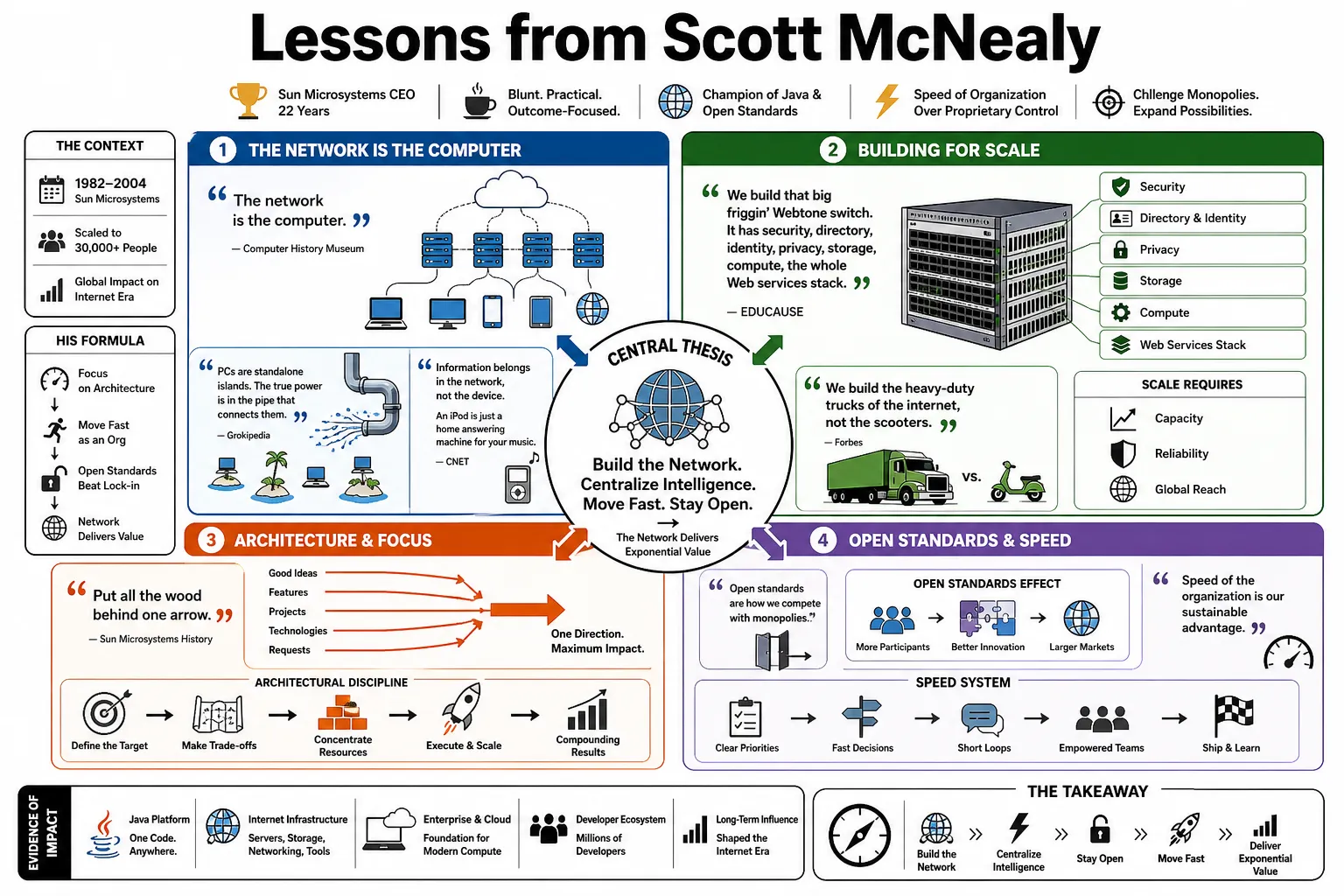
Lessons from Scott McNealy
Scott McNealy led Sun Microsystems for 22 years, championing Java and the then-radical idea that "the network is the computer." He used open standards to challenge software monopolies and prioritize organizational speed over proprietary control. This collection captures his blunt, practical approach to the realities of scaling and managing a massive technology company.
Part 1: The Network and Computing Architecture
- On the Network Vision: "The network is the computer." — Source: Computer History Museum
- On Scalability: "We build that big friggin' Webtone switch. It has security, directory, identity, privacy, storage, compute, the whole Web services stack." — Source: EDUCAUSE
- On Infrastructure: "We build the heavy-duty trucks of the internet, not the scooters." — Source: Forbes
- On Device Intelligence: "Information belongs in the network, not the device. An iPod is just a home answering machine for your music." — Source: CNET
- On Architectural Focus: "Put all the wood behind one arrow." — Source: Sun Microsystems History
- On Centralized Computing: "PCs are standalone islands. The true power is in the pipe that connects them." — Source: Grokipedia
- On the Cloud Precursor: "People call it cloud computing now—why didn't I think of 'cloud' in the 1980s?" — Source: Computer History Museum Oral History
- On Thin Clients: "A thin client is more secure, more manageable, and more reliable than a fat PC on every desk." — Source: ZDNet
- On Network Ubiquity: "Our vision is to stimulate the participation age where everyone and everything is on the network." — Source: Sun Keynote
Part 2: The Microsoft Wars and Competition
- On Proprietary Fences: "In a world without fences, who needs Gates and Windows?" — Source: InfoWorld
- On Market Control: "The only thing I'd rather own than Windows is English. Then I'd be able to charge you an upgrade fee every time I add new letters like N and T." — Source: ZDNet
- On Monopolies: "Bill Gates dropped out of Harvard. I finished. So I learned what a monopoly is." — Source: CNN Money
- On Developer Enticement: "The first hit of heroin is free." — Source: ZDNet
- On Microsoft's Product Names: "Active Directory is actually 'Captive Directory.'" — Source: InfoWorld
- On Product Reliability: "Internet Information Server is the Corvair of Web servers, unsafe at any speed." — Source: Computerworld
- On Windows NT: "Windows NT stands for 'Not There' or 'Nice Try.'" — Source: CNET
- On Choice: "Without choice, there is no competition. Without competition, there is no innovation." — Source: Computer History Museum
- On Central Planning: "Microsoft and IBM represent Soviet-style central planning for technology." — Source: Forbes
Part 3: Open Standards, Java, and the Future of Code
- On Cross-Platform Portability: "Write Once, Run Anywhere." — Source: Oracle Java History
- On Java's Origin: "Java was intended for a TV set-top box clicker that never shipped." — Source: JavaOne Retrospective
- On Integrity of Standards: "Almost Ethernet is useless. Almost Java is an unbelievable mess." — Source: ZDNet
- On Strategic Sharing: "Sharing has been our corporate strategy since February 24, 1984." — Source: InfoWorld
- On the Digital Divide: "Java is a tool for eliminating the digital divide." — Source: Sun Microsystems CSR Report
- On Open Interfaces: "Interfaces should be open, even if implementation is proprietary." — Source: Mixergy Interview
- On the Economic Limit: "If the marginal cost of distribution is near zero, the price of software will tend toward zero." — Source: InfoWorld
- On Tactical Regret: "I wish we had gotten to open source Java a little sooner." — Source: InfoWorld
- On Software Trust: "I had faith in James Gosling; I let the engineers build what they believed in." — Source: YCrash Interview
Part 4: Speed, Execution, and Management Philosophy
- On Decisiveness: "Agree and commit, disagree and commit, or get out of the way." — Source: Wikipedia - Sun Microsystems
- On the CEO Role: "Being a CEO is like being a piñata. You wake up and wait for the 2x4 to swing in." — Source: Computer History Museum Oral History
- On Decision Quality: "The best decision is the right decision. The next best decision is the wrong decision. The worst decision is no decision." — Source: Stanford GSB
- On B2B Sales: "Sales is a contact sport. You can't zoom your way to B2B success." — Source: Tech Sales Insights Podcast
- On Persistence: "No deal is ever lost; it's only postponed." — Source: Grit Podcast
- On Talent Dilution: "A+ people hire A+ people. B-players hire C-players to feel superior. That's the Bozo Explosion." — Source: Mixergy
- On Leadership Responsibility: "The worst part about being CEO is you never get to fix anything, because they only bring you the unfixables." — Source: Computer History Museum
- On Executive Planning: "A CEO's job is to have a depth chart for every executive—who moves up, sideways, or out." — Source: Tech Sales Insights
- On Product Adoption: "Eat your own dog food. I forced non-technical staff to use Java terminals to ensure they worked." — Source: Forbes
- On Market Speed: "Technology has the shelf life of a banana." — Source: ZDNet
Part 5: Privacy, Data, and the Surveillance State
- On Digital Privacy: "You already have zero privacy anyway. Get over it." — Source: Wired
- On Public Anxiety: "Privacy concerns are a red herring." — Source: FTC Archive
- On Surveillance Types: "I am a raging libertarian concerned about government surveillance; commercial tracking is a choice." — Source: Business Insider
- On Safety vs. Privacy: "If I could embed a locator chip in my child right now, I would. Some call that Big Brother; I call it fatherhood." — Source: Computer History Museum
- On Choice and Data: "You can opt out of Google or Uber, but you cannot opt out of the government." — Source: Lex Fridman Podcast Context
- On the Reality of the Network: "The 'network is the computer' vision means every action leaves a digital trail." — Source: Tech Sales Insights
- On Transparency: "You don't need transparency when the network tracks every transaction." — Source: BusinessWeek
- On the Obsolescence of Privacy: "Privacy is an obsolete concept in the face of technological progress." — Source: Ruhr University Bochum Archive
- On Jini and Networking: "If you're on a network, you're shared. That's the definition." — Source: CNET
Part 6: Education and the Participation Age
- On the Education Gap: "Curriki's mission is to eliminate the Education Divide." — Source: Medium
- On Knowledge Networks: "The Network is the Teacher." — Source: Curriki Mission
- On Active Learning: "We are moving to the participation age. You get on the Net and you do stuff—you don't just view stuff." — Source: EDUCAUSE 2005 Keynote
- On the Student Demographic: "The student profile used to be age 5 to 22; now it's expanded to age 105." — Source: EDUCAUSE
- On Motivations: "Humans are coin-operated, but they also like a little psychic income." — Source: CNET
- On Textbook Monopolies: "We need to break the monopoly of expensive, static textbooks with dynamic open-source materials." — Source: Curriki Blog
- On Generational Shifting: "Today's kids are digital natives and we are digital immigrants." — Source: Emerald Insight
- On Open Source Minds: "Educational content is software for the mind and should be free." — Source: Bookey
- On Choice in Education: "Without choice, you have no innovation in the classroom." — Source: AZ Quotes
Part 7: Entrepreneurship, Startups, and Venture Capital
- On Bubble Valuations: "At 10 times revenues... What were you thinking?" — Source: BusinessWeek
- On Early Opportunity: "I thought, 'This is like stealing! I'm in!' when I saw the first workstation margins." — Source: Computer History Museum Oral History
- On Strategic Risk: "Have a controversial strategy. If everyone thinks it's right, everyone else would be doing it." — Source: Computer History Museum
- On Corporate Loyalty: "I was a knucklehead for hanging onto my stock through the crash out of loyalty." — Source: Grit Podcast
- On Collaboration: "I never was the brightest kid in the room, but I loved being around bright people." — Source: Stanford GSB
- On Missed Markets: "We had Route D running on Sun OS... we never went after it. Cisco happened." — Source: Computer History Museum
- On Manufacturing Roots: "Real life is taking raw materials, adding labor, and shipping a product for a profit." — Source: Encyclopedia.com
- On Product Cycles: "I brought the automotive concept of 'model years' to the software world." — Source: Hagerty
- On Managing Talent: "Get the best people and train them well." — Source: Bookey
- On Post-Sun Ventures: "Wayin was about the realization that the 'network is the computer' vision had manifested in social data." — Source: Forbes
Part 8: Personal Philosophy, Sports, and Legacy
- On Vision: "I'm not a visionary, I'm a janitor." — Source: Wikipedia
- On Parenting Discipline: "You’re going to play golf and/or hockey or not at all." — Source: Maverick McNealy Profile - PGA Tour
- On Privilege: "You’ve got a platinum spoon in your mouth... so you have to outwork and outclass everyone." — Source: Wikipedia
- On Hockey Lessons: "Hockey teaches physical strength, physical courage, and teamwork. People run you into the boards if you're a jerk." — Source: YouTube - Maverick McNealy Interview
- On Golf Lessons: "Golf is the gentleman’s sport where you can’t blame anybody but yourself." — Source: YouTube - McNealy Sports Philosophy
- On Self-Motivation: "We never forced practice; if they didn't want to hit balls, they had to sit in the car while we had ice cream." — Source: Golf Digest
- On Personal Wealth: "I’m the richest caddie in the world, and I’m working for free." — Source: Wikipedia - Maverick McNealy
- On His Upbringing: "I had an MBA at the dinner table listening to my father discuss American Motors." — Source: Computer History Museum Oral History
- On Moving Forward: "Don't dwell on past mistakes like the wind or a bad rake job. Just look forward." — Source: Grit Podcast
- On Education Choices: "I don't think an MBA is a very applicable discipline... the real advantage was meeting bright people." — Source: Computer History Museum Oral History