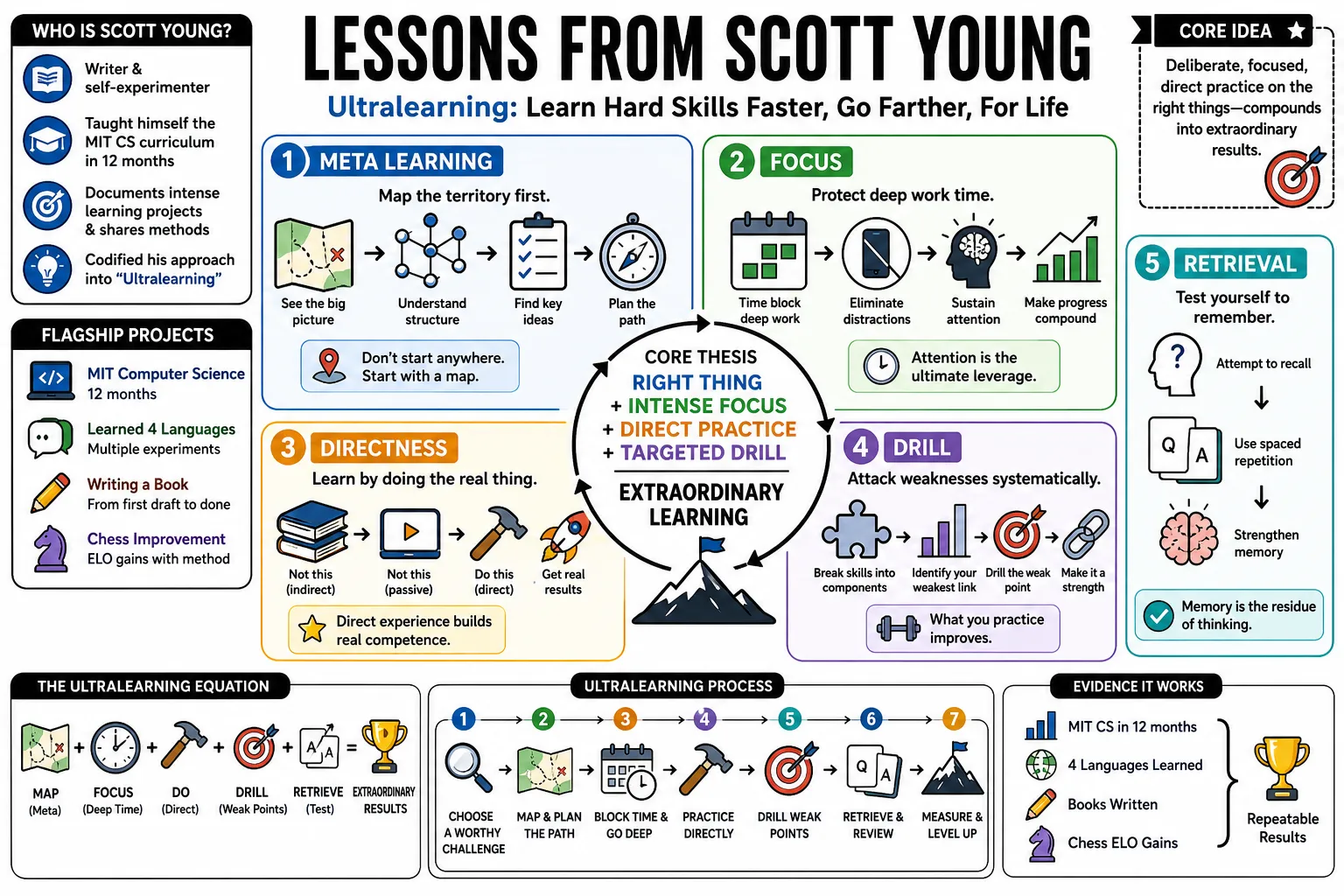
Scott Young is a writer and self-experimenter best known for documenting intense self-directed learning projects, including teaching himself the four-year MIT computer science curriculum in 12 months. He codified his approach into the concept of "Ultralearning," a framework for acquiring hard skills quickly through aggressive focus and direct practice. This profile extracts his most practical insights on how to bypass the illusion of competence, break through skill plateaus, and build reliable systems for lifelong education.
Part 1: The Foundations of Ultralearning
- On Metalearning: "Map the territory before you start walking; identifying how a subject is structured prevents wasted effort later." — Source: [Ultralearning]
- On Focus: "Dedicate concentrated blocks of time to your project and ruthlessly eliminate the distractions that fracture your attention." — Source: [Ultralearning]
- On Directness: "Learn by doing the actual thing you want to master, rather than relying on indirect proxies like reading about it." — Source: [Ultralearning]
- On Drill: "Break down complex skills into their component parts and repeatedly attack your weakest point until it becomes a strength." — Source: [Ultralearning]
- On Retrieval: "Testing yourself to recall information from memory is vastly superior to passively reviewing material." — Source: [Ultralearning]
- On Feedback: "Seek immediate, corrective feedback, even if it stings; it is the most reliable compass for improvement." — Source: [Ultralearning]
- On Retention: "Employ spaced repetition and strategic review to pace yourself and prevent the inevitable decay of knowledge." — Source: [Ultralearning]
- On Intuition: "Build deep understanding not through rote memorization, but by exploring concepts playfully and examining numerous examples." — Source: [Ultralearning]
- On Experimentation: "Once the foundation is laid, venture past the established methods to discover the style that uniquely suits you." — Source: [Ultralearning]
- On the Ultralearning Ethos: "Take absolute responsibility for your own education: decide what you want, how to get there, and execute your own plan." — Source: [Ultralearning]
Part 2: The MIT Challenge and Intense Constraints
- On the Value of Constraints: "Imposing an artificial, extreme deadline forces you to optimize your learning methods out of pure necessity." — Source: [The MIT Challenge]
- On Active vs. Passive Consumption: "It is far easier to passively watch a lecture than to solve a problem, which is exactly why you must choose the latter." — Source: [The MIT Challenge]
- On Self-Correction: "Using grading rubrics and solutions manuals on your own exams highlights the exact gaps in your understanding immediately." — Source: [The MIT Challenge]
- On the Real Value of College: "You can acquire the complete intellectual knowledge of a degree program without the institution, but the social network remains the university's true moat." — Source: [The MIT Challenge]
- On Effortful Practice: "If a learning method feels comfortable and effortless, it is likely highly inefficient." — Source: [The MIT Challenge]
- On the Drill-Down Method: "When you hit a wall in a complex concept, step back and isolate the exact sub-skill where your comprehension fails." — Source: [The MIT Challenge]
- On Goal Postmortems: "After completing a massive project, examine whether the implicit assumptions (like the trade-off of your social life for knowledge) were actually accurate." — Source: [Scott H. Young Blog]
- On Institutional Pacing: "The four-year timeline of a degree is built for the average student taking multiple subjects; focused, singular attention can drastically compress this timeline." — Source: [The MIT Challenge]
- On Pushing Limits: "The satisfaction of the MIT Challenge did not come from the diploma, but from proving to myself that my intellectual limits were further out than I thought." — Source: [The MIT Challenge]
Part 3: The Mechanics of Skill Acquisition
- On the 'See' Component: "Our brains learn most efficiently by observing; finding high-quality examples to imitate is the first step to mastery." — Source: [Get Better at Anything]
- On the 'Do' Component: "The brain is an effort-saving machine; you must actively force it into challenging tasks to trigger adaptation." — Source: [Get Better at Anything]
- On the 'Feedback' Component: "Progress requires constant adjustment; frequent, small corrections are infinitely better than rare, massive evaluations." — Source: [Get Better at Anything]
- On Imitation Before Innovation: "Clone the proven methods of experts first; only once you understand why the rules exist should you attempt to break them." — Source: [Get Better at Anything]
- On Variable Practice: "To ensure your skills transfer to the real world, randomize your practice scenarios rather than repeating the exact same drill." — Source: [Get Better at Anything]
- On Problem-Solving: "Complex problems are like mazes; success comes from mapping the constraints and moving purposefully, not blindly running into walls." — Source: [Get Better at Anything]
- On Mental Models: "Stop viewing intelligence as a muscle to be flexed; view it as a library of mental models and feedback loops to be refined." — Source: [Get Better at Anything]
- On Cognitive Load: "Trying to learn too many new elements at once overwhelms working memory; isolate the novel parts and practice them individually." — Source: [Get Better at Anything]
- On the Transfer Problem: "Skills rarely transfer automatically between domains; you must explicitly practice applying knowledge in the context where you intend to use it." — Source: [Get Better at Anything]
- On Decoding Expertise: "Experts often cannot articulate how they do what they do; your job as a learner is to deconstruct their actions, rather than passively absorb their advice." — Source: [Get Better at Anything]
Part 4: Language Learning and The Year Without English
- On Total Immersion: "Removing the crutch of your native language forces your brain to adapt to the new language as a biological necessity." — Source: [The Year Without English]
- On the Pain of Fluency: "The first few weeks of speaking a new language exclusively are mentally exhausting, but this intense friction is what causes rapid growth." — Source: [The Year Without English]
- On Preparing for Immersion: "Jumping into full immersion for a difficult language without foundational vocabulary is a recipe for frustration, not fluency." — Source: [The Year Without English]
- On Method Over Talent: "Language acquisition isn't a magical gift; it is the inevitable result of applying a high-volume, high-immersion system." — Source: [The Year Without English]
- On Embracing Mistakes: "Accept the embarrassment of sounding foolish; the fear of making mistakes is the biggest bottleneck to language learning." — Source: [The Year Without English]
- On Skill Decay: "Rapid acquisition often leads to rapid forgetting; if you do not build a maintenance plan, the language will evaporate as quickly as it arrived." — Source: [The Year Without English]
- On Environmental Design: "If you want to learn a language, change your environment so that speaking it becomes easier than avoiding it." — Source: [The Year Without English]
- On Vocabulary vs. Grammar: "In the early stages of immersion, raw vocabulary and a willingness to be misunderstood trump perfect grammar every time." — Source: [The Year Without English]
- On the Joy of the Climb: "Mountains look better from the base than the summit. If you do not actually enjoy the daily struggle of learning, do not undertake the project." — Source: [The Year Without English]
Part 5: Rethinking Productivity and Focus
- On True Capacity: "Productivity is not about cranking widgets faster; it is about increasing your capacity to accomplish what actually matters to you." — Source: [Scott H. Young Blog]
- On Prioritization: "An infinite to-do list will always remain infinite; true productivity is the painful process of choosing what you will intentionally ignore." — Source: [Scott H. Young Blog]
- On Invisible Productivity: "The most sustainable productivity does not feel like a hustle; it relies on quiet, low-effort systems that work reliably in the background." — Source: [Scott H. Young Blog]
- On Open-Ended Tasks: "Tasks without a clear completion state are a breeding ground for procrastination and eventual burnout." — Source: [Scott H. Young Blog]
- On Engineering vs. Willpower: "When a habit fails, do not blame your lack of discipline; examine your system to find the friction point that caused the breakdown." — Source: [Scott H. Young Blog]
- On Fixed-Schedule Work: "Imposing strict start and stop times prevents work from bleeding into your life, forcing deeper focus during work hours." — Source: [Scott H. Young Blog]
- On Planning Failures: "Maintain a weekly list and a daily list. If you never finish your daily list, you are failing at planning, rather than failing at working." — Source: [Scott H. Young Blog]
- On Adaptability: "Rigid routines break under pressure; let your habits change shape to fit the daily context, because adaptability breeds consistency." — Source: [Scott H. Young Blog]
- On the Hustle Delusion: "Feeling busy and stressed is often a sign of poor systemic design, rather than an indicator of important work." — Source: [Scott H. Young Blog]
Part 6: Escaping the Illusion of Competence
- On Passive Recognition: "Just because you recognize a concept when you read it does not mean you can recall or apply it when the book is closed." — Source: [Scott H. Young Blog]
- On the Fluency Illusion: "Highlighting text and re-reading notes makes the material feel familiar, creating a dangerous false confidence in your actual understanding." — Source: [Scott H. Young Blog]
- On Testing as Practice: "Exams serve a dual purpose: the act of retrieving information actually cements it into your memory rather than simply assessing it." — Source: [Scott H. Young Blog]
- On Desirable Difficulty: "The harder it is to retrieve a piece of information from memory, the stronger the neural connection becomes once you finally succeed." — Source: [Get Better at Anything]
- On the Feynman Technique: "If you cannot explain a concept simply to a beginner, you do not actually understand it yourself." — Source: [Ultralearning]
- On the Danger of Tutorials: "Following a step-by-step coding tutorial teaches you how to follow instructions, rather than how to write software." — Source: [Ultralearning]
- On Creating Artifacts: "The only proof of learning is production; until you have built, written, or created something without assistance, assume you do not know it." — Source: [Scott H. Young Blog]
- On Seeking Discomfort: "If your study session feels incredibly smooth and easy, you are likely suffering from the illusion of competence." — Source: [Ultralearning]
- On Overlearning: "To ensure a skill holds up under pressure, you must practice it slightly beyond the point of basic mastery." — Source: [Ultralearning]
Part 7: The Myth of Talent and Struggle
- On Natural Ability: "What looks like innate talent is almost always the invisible accumulation of highly structured, deliberate practice over many years." — Source: [Get Better at Anything]
- On True Satisfaction: "Your deepest moments of satisfaction come from overcoming self-imposed limits, rather than choosing the path of least resistance." — Source: [Ultralearning]
- On the Necessity of Struggle: "Doing the hard thing up front makes everything else easier in the long run; avoiding the struggle just delays the baseline required for mastery." — Source: [The Learning Leader Show]
- On Systems Over Magic: "There is no secret alchemy to becoming world-class; it is simply the relentless application of a functional learning system." — Source: [Superhuman Academy]
- On Embracing Pain: "The trick to ambitious goals is not finding a way to make them painless; the trick is not minding that it hurts." — Source: [Scott H. Young Blog]
- On Early Frustration: "The beginning of any complex project is supposed to feel overwhelming; this is a feature of the territory, not a flaw in your intelligence." — Source: [Ultralearning]
- On Plateaus: "When progress stalls, it isn't a sign you have reached your genetic limit; it is a signal that your current method of practice has stopped working." — Source: [Get Better at Anything]
- On Redefining Failure: "In an ultralearning project, a failed experiment is just high-quality feedback; the only real failure is persisting with a broken method." — Source: [Ultralearning]
- On Intellectual Confidence: "Confidence does not come from knowing everything; it comes from knowing that with the right process, you can figure out anything." — Source: [The MIT Challenge]
Part 8: Consistency, Habits, and Lifelong Learning
- On Curiosity: "The more you learn, the more you realize how much is left; genuine mastery breeds a profound, insatiable curiosity." — Source: [Ultralearning]
- On the Long Game: "While intensive sprints are useful for initial acquisition, lifelong mastery is built on the quiet, compounding interest of daily habits." — Source: [Scott H. Young Blog]
- On Blending Motives: "The most successful learners combine a highly practical reason for acquiring a skill with an intrinsic, playful curiosity about the subject." — Source: [Ultralearning]
- On Project-Based Learning: "Organizing your learning around a specific, tangible project provides the necessary context and urgency that abstract studying lacks." — Source: [Ultralearning]
- On Environmental Triggers: "Willpower is a finite resource; instead of fighting yourself, design your physical environment to trigger the behavior you want." — Source: [Scott H. Young Blog]
- On the Danger of Waiting: "Knowledge does not keep perfectly in the brain; if you do not integrate what you learn into your daily life, it will slowly decay." — Source: [Scott H. Young Blog]
- On Learner Identity: "Ultimately, the goal is to become the type of person who is unafraid of their own ignorance, rather than simply acquiring a specific skill." — Source: [Ultralearning]
- On Context Switching: "Constantly shifting between tasks destroys the deep focus required for meaningful learning; defend your attention fiercely." — Source: [Scott H. Young Blog]
- On the Value of Books: "Reading is the most effective activity available; it allows you to download decades of an expert's life into a few hours of your time." — Source: [Scott H. Young Blog]
- On the Ultimate Metric: "The true measure of your education is not the credentials you hold, but your behavioral capacity to interact effectively with a complex world." — Source: [Get Better at Anything]