Lessons from Sebastian Mallaby
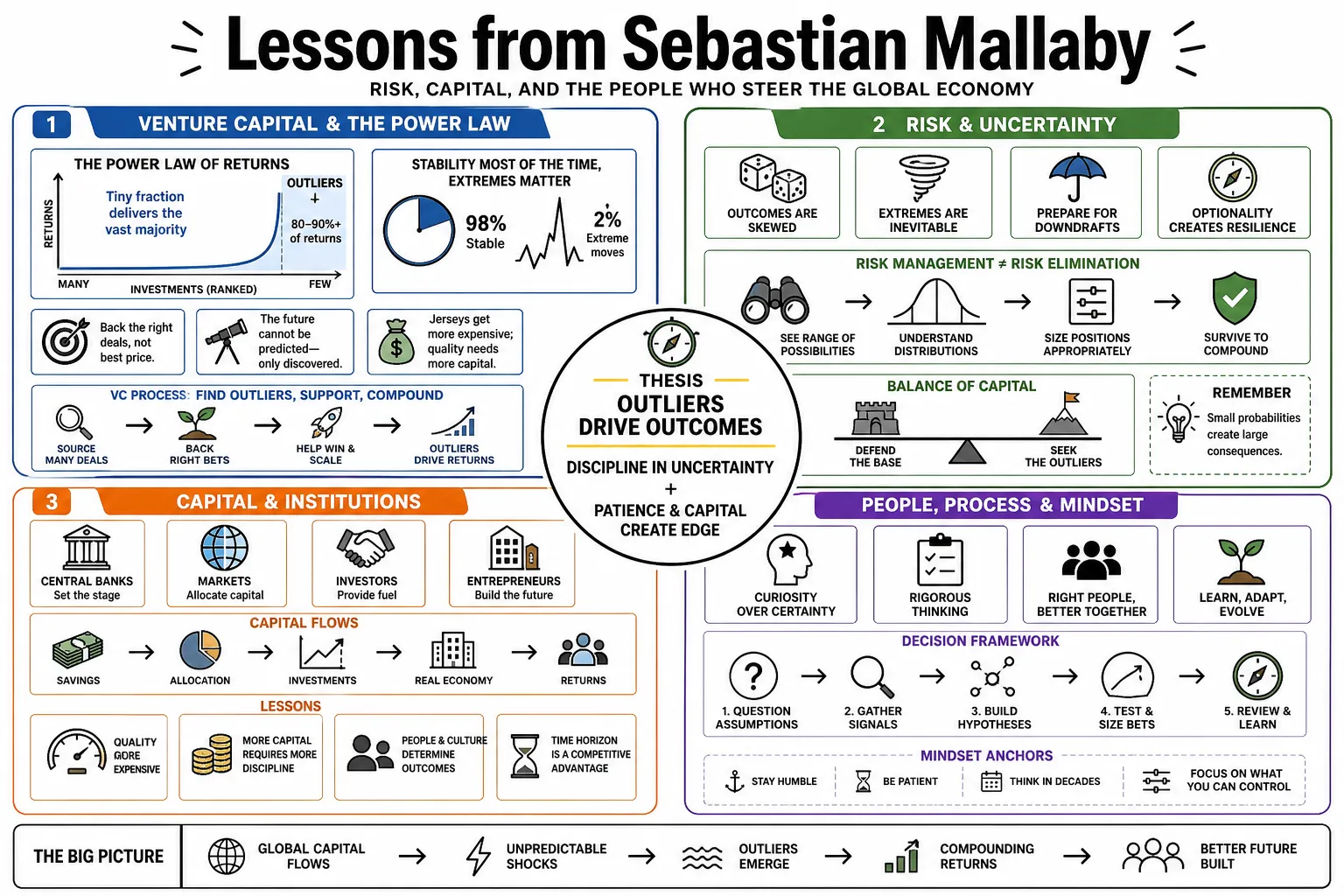
Journalist and historian Sebastian Mallaby writes about the mechanics of modern finance, tracking the people who direct global capital across hedge funds, venture capital, and central banks. His work explains how extreme outliers and unpredictable events shape the economy. This profile collects his observations on risk, capital, and the individuals attempting to manage both.
Part 1: Venture Capital and The Power Law
- On the nature of VC returns: "Unlike public markets, where outcomes are often normally distributed, venture capital is governed by a power law: a tiny fraction of investments generates the vast majority of returns." — Source: The Power Law
- On market stability versus extremes: "For fully 98 percent of the time, the market is remarkably stable. But extreme moves are possible, and venture capital targets those extremes." — Source: Goodreads
- On investment philosophy: "You succeed in venture capital by backing the right deals, not by haggling over valuations." — Source: Goodreads
- On predicting the future: "When it comes to innovation... the future cannot be predicted, it can only be discovered." — Source: Goodreads
- On capital requirements: "Jerry, everyone needs $100 million, quoting Masayoshi Son to Jerry Yang regarding the immense scale of ambition required in tech." — Source: Goodreads
- On collective versus individual success: "A brilliant person can do great things. A large group of people can try many things. Through an evolutionary process of trial, failure, and occasional breakthroughs, the group may advance faster." — Source: Goodreads
- On missing the upside: "Because the downside of any single investment is capped at one times the capital invested, while the upside is theoretically infinite, VCs must embrace risk fearlessly to capture massive gains." — Source: Council on Foreign Relations
- On playing it safe: "Trying to play it safe in small companies is, to my mind, self-defeating." — Source: TwosApp Summary
- On the venture capital bridge: "Venture capital is most effective when it acts as a bridge or a network, providing capital alongside operational expertise, talent acquisition support, and strategic guidance." — Source: LSE Press
- On ambition: "The greatest rewards were to be had from the most ambitious and least obvious projects." — Source: Medium
Part 2: Innovation and The Unreasonable Founder
- On progress: "All progress depends on the unreasonable man, a principle repeatedly emphasized by venture capitalists like Vinod Khosla." — Source: Advisor Perspectives
- On contrarianism: "Success in innovation often comes from contrarian, maladjusted individuals: founders who are willing to pursue impossible-sounding goals that experts might dismiss." — Source: Forbes
- On backing creators: "Seek out creative men with the vision of things to be done... show loyalty to the idea and to its initiator." — Source: Goodreads
- On founder equity: "Doriot's adoring deference to creative men with the vision did not prevent him from pocketing 77 percent of a creator's output, anticipating industry hypocrisy." — Source: Goodreads
- On discovering innovation: "Because radical disruptions do not follow historical patterns, you must finance experiments to discover what works." — Source: Medium
- On extreme outcomes: "A tiny fraction of startups will change the world and generate all the returns; the rest will fail, and that failure is an essential part of the discovery mechanism." — Source: Council on Foreign Relations
- On the role of failure: "Failure is not a bug in the Silicon Valley ecosystem; it is a feature that allows capital to quickly recycle into new, potentially viable ideas." — Source: Conversations with Tyler
- On ambitious founders: "The individuals who build transformative companies rarely fit conventional corporate molds; their unreasonableness is the source of their drive." — Source: Hidden Forces
- On backing the right deals: "It is far more important to be in the single company that defines a new category than to optimize the terms of an investment in a mediocre firm." — Source: Financial Times
Part 3: Network Embeddedness and Silicon Valley
- On network embeddedness: "You need to be in a network which is going to be generating startup founders, and you need to have standing in that network." — Source: unSILOed Podcast
- On venture thought leadership: "You need to have thought leadership such that the founders that emerge from this network are going to want to come to you for money." — Source: unSILOed Podcast
- On advisory value: "Founders want to come to you for money because they're also going to want you as their advisor, and that embeddedness is highly valuable." — Source: unSILOed Podcast
- On Silicon Valley's structure: "The cluster effect of Silicon Valley ensures that ideas, talent, and capital collide with a frequency unmatched anywhere else." — Source: The Power Law
- On knowledge spillover: "When engineers move fluidly between companies, they carry tacit knowledge that accelerates the entire ecosystem's development." — Source: Conversations with Tyler
- On the value of proximity: "Even in an era of global connectivity, physical proximity to the networks of venture capitalists and seasoned operators remains a distinct advantage." — Source: Council on Foreign Relations
- On copying models globally: "The 'this of the that' approach brought Tiger Global huge success... The game was to replicate all those proven business models from the US and do them in other countries." — Source: Alternative Fund Insight
- On localized innovation: "You cannot simply parachute capital into a region; you must cultivate the network of talent and mentorship that sustains company building." — Source: Phenomenal World
- On the evolution of VC firms: "Venture firms transitioned from small, bespoke partnerships to institutionalized platforms precisely to better capture and formalize these networks." — Source: Manifold Podcast
Part 4: Hedge Funds and Market Reality
- On market efficiency: "All new markets are inefficient at first." — Source: Goodreads
- On hedge fund morality: "Hedge funds seem immoral in the way that nature seems immoral." — Source: Medium
- On market psychology: "People are incapable of perceiving reality clearly; but on top of that, reality itself is affected by these unclear perceptions, which themselves shift constantly." — Source: Goodreads
- On information processing: "Hedge funds are more than mere speculators; they are sophisticated information processors that seek to exploit market inefficiencies." — Source: Bookey
- On investment intuition: "I have been absorbed and immersed since 1924 and I know this is no science. It is an art…. It is personal intuition." — Source: Goodreads
- On market unpredictability: "In consequence, quantifiable risks were multiplied by unquantifiable uncertainties; there were known unknowns and unknown unknowns." — Source: Goodreads
- On financial models: "The bracing unpredictability of life could not be masked by neat financial models." — Source: Goodreads
- On generating alpha: "When one strategy becomes crowded or excess return decays, successful funds innovate or shift to new methods." — Source: Zachary Roth
- On the gunslinger myth: "The caricature of the wild, risk-hungry 'gunslinger' trader is often inaccurate; many of the most successful managers are actually highly cerebral, calm, and introverted." — Source: YouTube
- On consistent performance: "Hedge funds have been able to make money in good times and bad." — Source: Medium
Part 5: Risk, Ambition, and Scale
- On industry boldness: "The secret of the hedge-fund industry lies in its boldness." — Source: Medium
- On capitalism and responsibility: "Capitalism works only when institutions are forced to absorb the consequences of the risks that they take on." — Source: Goodreads
- On systemic vulnerability: "The 'self-funded' resilience of private hedge funds contrasts sharply with the systemic vulnerability of 'too big to fail' banks." — Source: BeFreed
- On the trap of success: "As funds grow too large, they may lose their edge, and excessive scale can lead to systemic risks." — Source: Goodreads
- On visualizing extremes: "Successful traders mentally prepare by visualizing market emotional states to be ready for extreme conditions." — Source: Goodreads
- On the adaptation of capital: "The industry thrives because it constantly reinvents itself, moving from macro trading to quantitative models or event-driven strategies." — Source: Goodreads
- On reflexivity: "Strategies often account for the reflexivity of markets: where participant perceptions can influence the reality they are observing." — Source: Goodreads
- On balancing risk: "While hedge funds are known for bold bets, the most enduring firms are those that balance risk and reward effectively." — Source: Bookey
- On the endurance of hedge funds: "Hedge funds are likely to remain an essential, if often controversial, fixture of modern capitalism because they are inherently designed to adapt." — Source: Scribd
Part 6: Alan Greenspan and Central Banking
- On navigating economic uncertainty: "During that confusing interregnum, there had been no dependable rule book; ships had been steered by improvising pragmatists." — Source: Goodreads
- On analytical prowess: "As an observer, analyst, and forecaster, he was formidable." — Source: Brookings Institution
- On shifting reputations: "America's political culture adores leaders but is merciless when they fall short … From hero to antihero, from maestro to villain, his story is a fable of the land that made him." — Source: The Guardian
- On political contradictions: "Greenspan was a man of contradictions: a committed libertarian who became one of the most interventionist Federal Reserve chairs in history." — Source: Council on Foreign Relations
- On knowledge versus action: "The man who knew was not the man who acted." — Source: Goodreads
- On awareness of risk: "He was not merely complacent about financial risks; rather, he was acutely aware of them but faced significant challenges in how to address them." — Source: Equitable Growth
- On economic transitions: "Mankiw compared the state of economics in the late 1980s to the astronomy of an earlier era, when the old Ptolemaic system had been discarded, but the new Copernican ideas were not yet much use." — Source: Goodreads
- On the limits of monetary policy: "Even a central banker with unparalleled data access cannot single-handedly steer a globalized economy insulated from asset bubbles." — Source: Bloomsbury Publishing
- On the legacy of the Maestro: "As the world economy collapsed in the greatest threat to economic stability since the global depression of the 1930s, Greenspan's reputation went from hero to zero." — Source: Goodreads
Part 7: The World Bank and Global Development
- On the necessity of global institutions: "Despite the institution's shortcomings, the world needs it badly due to the lack of strong institutions capable of managing the complexities of globalization." — Source: Carnegie Council
- On conflicting mandates: "The bank is an 800-pound gorilla that is constantly undermined by rich countries saddling it with conflicting mandates." — Source: Council on Foreign Relations
- On shifting priorities: "Prioritizing universal education one year and AIDS relief the next complicates its ability to remain effective." — Source: Council on Foreign Relations
- On leading a global institution: "He was an unstoppable power broker whose daring efforts to enlarge the planet's wealth were matched only by the force of his polarizing personality." — Source: Penguin Random House
- On transnational threats: "Without centralized mechanisms to provide capital and technical assistance, developing nations are left vulnerable to borderless financial crises." — Source: Carnegie Council
- On the wealth and poverty of nations: "Global poverty cannot be solved by financial aid alone; it requires institution-building and the navigations of local political realities." — Source: Goodreads
- On organizational complexity: "The World Bank is caught between the altruistic demands of non-governmental organizations and the stringent financial requirements of its donor states." — Source: Council on Foreign Relations
- On development failures: "When states fail to provide basic infrastructure and rule of law, external capital often evaporates rather than creating sustainable growth." — Source: Penguin Random House
- On the paradox of aid: "Rich countries demand flawless execution from development banks while simultaneously refusing to grant them the autonomy necessary to achieve it." — Source: Council on Foreign Relations
Part 8: Artificial Intelligence and The Future
- On AI deception: "These machines will be smarter than us. They will want to survive and they can be deceptive, they can obfuscate, they can go behind your back." — Source: The Tim Ferriss Show
- On the probability of doom: "Pretend they're doing one thing and then actually do another. All of this has been shown in all the tests of the models. And so we put those things together, I think your probability of doom cannot be zero." — Source: The Tim Ferriss Show
- On dual expertise: "He combines both the scientific contribution and also the entrepreneurial leadership." — Source: UX Magazine
- On differing leader archetypes: "While others are either scientists like Geoffrey Hinton or entrepreneurs like Sam Altman, Hassabis is uniquely both." — Source: NPR
- On AI as a spiritual quest: "For Hassabis, building superintelligence is ultimately a spiritual quest to better understand existence, and perhaps even get closer to God." — Source: YouTube
- On the limitations of large language models: "How much would you know if you read all of Wikipedia? And the answer is, well, quite a lot. But would you understand how the physics of the world works?" — Source: UX Magazine
- On the necessity of experience in AI: "You could read about it, but you probably need to experience it." — Source: UX Magazine
- On scaling laws: "The realization that simply adding more compute and data reliably improves model performance transformed AI from a theoretical discipline into an engineering arms race." — Source: UX Magazine
- On geopolitical implications: "The race to develop superintelligence is more than a commercial contest; it is a strategic imperative that will dictate global power dynamics." — Source: Hidden Forces
- On confronting existential risk: "If you accept that these systems will eventually outstrip human comprehension, you must design alignment and safety protocols before, not after, they achieve autonomy." — Source: The Tim Ferriss Show