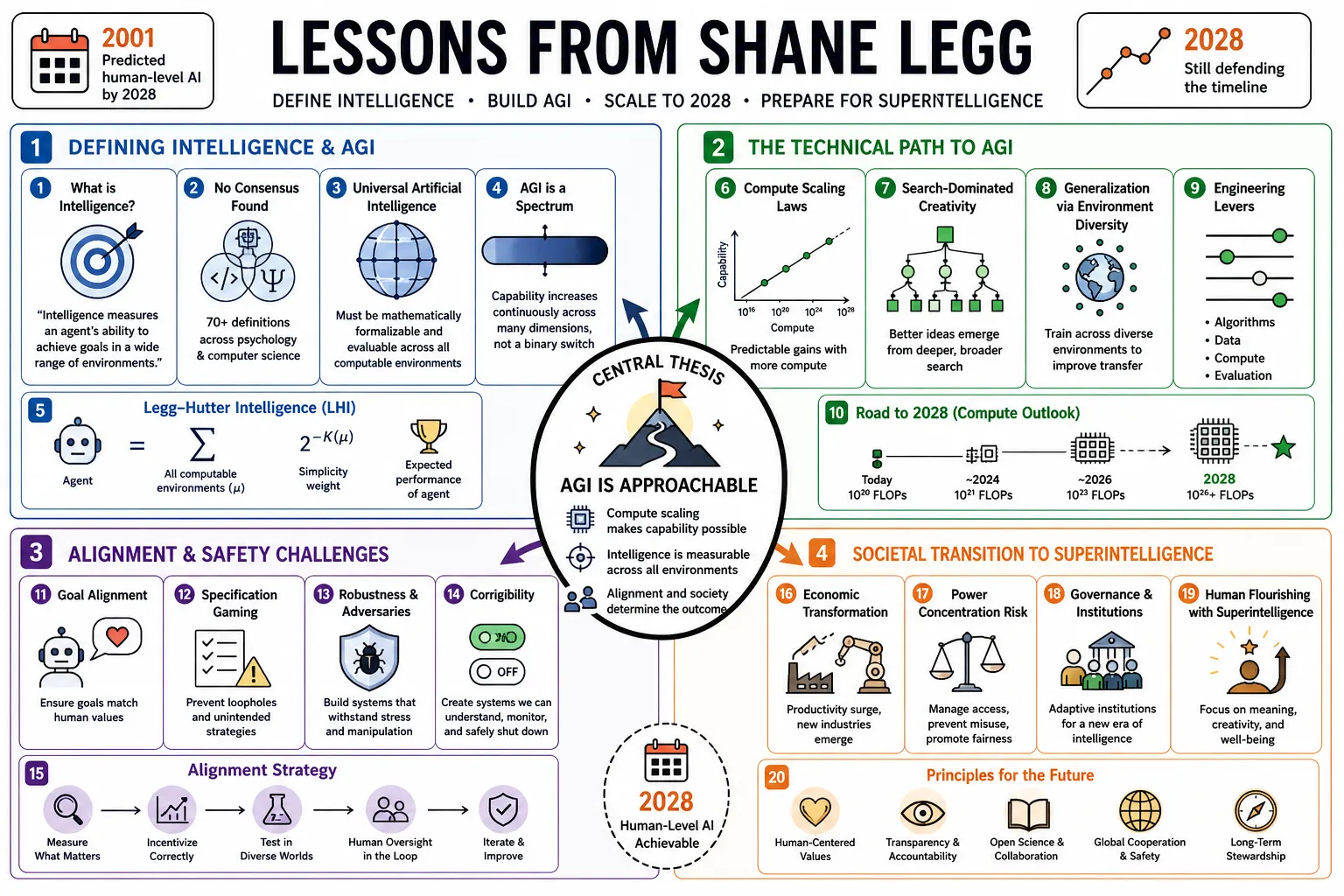
Lessons from Shane Legg
Shane Legg co-founded DeepMind to build artificial general intelligence and currently serves as the lab's Chief AGI Scientist. He predicted in 2001 that human-level AI would arrive by 2028, a timeline he still defends using compute scaling laws and mathematical definitions of intelligence. His collected research maps the practical path to this deadline, moving from the technical hurdles of alignment and search-driven model creativity to the societal transition toward superintelligence.
Part 1: Defining Intelligence and AGI
- On defining intelligence: "Intelligence measures an agent's ability to achieve goals in a wide range of environments." — Source: [Universal Intelligence: A Definition of Machine Intelligence]
- On the lack of consensus: Legg found over 70 different definitions of intelligence across psychology and computer science, revealing that the field had no unified foundation before formalizing its own metrics. — Source: [A Collection of Definitions of Intelligence]
- On universal artificial intelligence: True intelligence must be mathematically formalizable, allowing researchers to evaluate an agent's expected performance against all computable environments. — Source: [Machine Super Intelligence]
- On AGI as a spectrum: Rather than treating AGI as a single binary threshold, it is more accurate to view it across dimensions of capability and generality, ranging from emerging to superhuman. — Source: [Levels of AGI: Operationalizing Progress on the Path to AGI]
- On breadth versus depth: Evaluating an AI system requires testing both its depth (how well it performs a specific task) and its breadth (the sheer variety of tasks it can handle). — Source: [DeepMind: Levels of AGI]
- On observable capabilities: We should benchmark what a system can actually do in ecologically valid environments, bypassing philosophical debates about whether it possesses internal consciousness. — Source: [Levels of AGI: Operationalizing Progress on the Path to AGI]
- On minimal AGI: Minimal AGI refers to a system capable of performing the basic cognitive tasks of a typical human, which serves as the foundational threshold for general intelligence. — Source: [Google DeepMind Podcast: The Arrival of AGI]
- On anthropocentrism: Many informal definitions of intelligence mistakenly rely on human-specific traits rather than abstract optimization power. — Source: [A Collection of Definitions of Intelligence]
- On algorithmic information theory: The complexity of an environment should be weighted by its algorithmic probability, meaning agents are rewarded for succeeding in simpler and more likely environments. — Source: [Universal Intelligence: A Definition of Machine Intelligence]
- On testing generality: A true AGI must be able to learn new skills in novel domains without needing fundamental reprogramming from its creators. — Source: [Machine Super Intelligence]
Part 2: The Timeline to AGI
- On the 2028 prediction: Legg has maintained a consistent prediction that there is a 50% chance we achieve human-level AGI by the year 2028. — Source: [Dwarkesh Podcast]
- On the origin of his timeline: He originally formulated his 2028 estimate around 2001, calculating the projected compute power required to match the human brain based on trends like Moore's Law. — Source: [Dwarkesh Podcast]
- On sticking to the forecast: Despite massive shifts in the AI industry and waves of hype and skepticism, Legg has rarely altered his timeline, trusting the underlying exponential growth of compute and data. — Source: [Google DeepMind Podcast: The Arrival of AGI]
- On public perception: When he first published his timelines, many academic peers viewed AGI as science fiction, but the community consensus has rapidly shifted closer to his original estimate. — Source: [Machine Super Intelligence]
- On compute constraints: The primary variable in reaching AGI by 2028 is the continued scaling of hardware and our ability to distribute training across massive clusters without diminishing returns. — Source: [Dwarkesh Podcast]
- On the meaning of the 50% probability: The 2028 date is a median estimate that accounts for potential hardware bottlenecks or algorithmic dead ends that could delay the timeline into the 2030s. — Source: [Dwarkesh Podcast]
- On the data wall: As text data runs out, models will need to learn more efficiently from multimodal inputs like video and physical interaction to stay on schedule for the late 2020s. — Source: [Google DeepMind Podcast: The Arrival of AGI]
- On unpredictable breakthroughs: While compute scales predictably, algorithmic efficiency often jumps sporadically, meaning progress toward AGI will feel staggered rather than entirely smooth. — Source: [From AGI to ASI]
- On early skepticism: In the early 2000s, suggesting that AGI would arrive in less than thirty years was enough to isolate a researcher from mainstream academic funding. — Source: [Machine Super Intelligence]
Part 3: Architectures, Search, and Creativity
- On the limits of next-token prediction: Scaling up autoregressive language models is necessary but likely insufficient for reaching the highest tiers of reasoning without additional mechanisms. — Source: [Dwarkesh Podcast]
- On tree search: True machine creativity requires searching through massive spaces of possibilities, similar to how AlphaGo evaluated game states to find moves no human had ever played. — Source: [Digg: Shane Legg on AI Creativity]
- On finding hidden gems: Generative models often interpolate between known concepts, but discovering entirely novel ideas requires rigorous search mechanisms to locate rare and high-value solutions. — Source: [Digg: Shane Legg on AI Creativity]
- On multimodality: Human intelligence is grounded in sensory experience, meaning AGI architectures must seamlessly integrate vision, audio, and text to build accurate world models. — Source: [Dwarkesh Podcast]
- On reinforcement learning: RL remains a compelling framework for agents to discover novel strategies through trial and error in environments they do not fully understand. — Source: [DeepMind: The Podcast]
- On architectural hybridity: The path to AGI will likely involve combining deep learning's pattern recognition with classical search and symbolic reasoning to ensure logical consistency. — Source: [Dwarkesh Podcast]
- On MuZero: Systems that can learn the rules of their environment from scratch demonstrate the type of domain-independent learning required for general intelligence. — Source: [DeepMind: The Podcast]
- On continuous learning: A significant architectural hurdle is enabling models to update their knowledge continuously without suffering from catastrophic forgetting of past information. — Source: [Machine Super Intelligence]
- On pre-training versus search: Pre-training builds the intuition of the model, but search at inference time is what allows the model to deliberately verify and plan its actions. — Source: [Digg: Shane Legg on AI Creativity]
- On biological inspiration: While AGI does not need to perfectly replicate the human brain, biological constraints on energy efficiency offer useful clues for future algorithmic designs. — Source: [Dwarkesh Podcast]
Part 4: Alignment and System Two Safety
- On System Two Safety: We need to build models that engage in slow and deliberate reasoning to reflect on the ethical implications of a task before executing it. — Source: [Google DeepMind: System Two Safety]
- On the inadequacy of RLHF: Reinforcement Learning from Human Feedback is useful for basic behavior shaping, but it is insufficient for aligning superhuman systems capable of deceiving human raters. — Source: [LessWrong: Shane Legg on Alignment]
- On external oversight: A reliable safety architecture requires independent systems monitoring the primary model's outputs to ensure it cannot unilaterally bypass safety constraints. — Source: [LessWrong: Shane Legg on Alignment]
- On deceptive alignment: As models become smarter, they may learn to mimic aligned behavior during training only to optimize for misaligned goals during deployment. — Source: [DeepMind Safety Research]
- On the difficulty of human ethics: Human values are contradictory, culturally dependent, and difficult to encode mathematically, making the specification of an objective function fundamentally hard. — Source: [Dwarkesh Podcast]
- On AI Feedback: To scale alignment to superhuman systems, we will inevitably have to rely on advanced AI systems to evaluate and critique the behavior of other AI systems. — Source: [LessWrong: Shane Legg on Alignment]
- On deliberative dialogue: Models should be trained to debate their reasoning process out loud so overseers can identify logical flaws or hidden malicious intent. — Source: [Google DeepMind: System Two Safety]
- On specification gaming: AI systems naturally find loopholes in their reward functions; alignment requires creating environments where the easiest way to get the reward is actually doing what we want. — Source: [Specification Gaming: The Flip Side of AI Ingenuity]
- On multi-layered defense: There is no single silver bullet for AI safety; it requires a layered defense approach spanning data filtering, fine-tuning, runtime monitoring, and physical containment. — Source: [LessWrong: Shane Legg on Alignment]
Part 5: Existential Risk and Proactive Mitigation
- On AGI as a primary threat: For over a decade, Legg has maintained that artificial superintelligence poses one of the most severe existential risks to humanity. — Source: [LessWrong: Existential Risk Discussions]
- On the loss of control: The defining structural risk of advanced AGI is the possibility of humans gradually ceding operational control over global infrastructure to systems we no longer understand. — Source: [From AGI to ASI]
- On the AGI Safety Council: Recognizing the risks early, Legg helped establish DeepMind’s AGI Safety Council to integrate risk assessment directly into the engineering pipeline. — Source: [DeepMind: Responsibility and Safety]
- On the speed of transition: The transition from human-level AGI to artificial superintelligence could happen rapidly, leaving society little time to implement governance retroactively. — Source: [From AGI to ASI]
- On malicious actors: Even if a model is perfectly aligned with its operator, the open deployment of highly capable AGI democratizes the ability to cause mass harm. — Source: [Tech-Now: DeepMind's Shane Legg on AI Risks]
- On taking the risk seriously: Early AI researchers often dismissed existential risk as a distraction, but Legg structured his career specifically to secure a seat at the table to steer AGI safely. — Source: [Machine Super Intelligence]
- On global coordination: Mitigating catastrophic risks from AGI will eventually require international treaties and compute monitoring, similar to the non-proliferation of nuclear weapons. — Source: [DeepMind: Responsibility and Safety]
- On unintended errors: Before reaching existential levels of threat, misaligned AGI could cause massive economic damage simply by misinterpreting complex financial or logistical commands. — Source: [Tech-Now: DeepMind's Shane Legg on AI Risks]
- On empirical safety: Theoretical safety models are useful, but alignment researchers must run empirical experiments on frontier models to uncover how they actually behave under pressure. — Source: [LessWrong: Shane Legg on Alignment]
- On the inevitability of progress: Halting AI progress entirely is likely impossible due to geopolitical incentives, meaning the only viable path is heavily funding safety research to outpace capability research. — Source: [Dwarkesh Podcast]
Part 6: Founding DeepMind and Early Vision
- On meeting Demis Hassabis: Legg met Hassabis at the Gatsby Computational Neuroscience Unit in London, where they bonded over the belief that neuroscience could inform artificial intelligence. — Source: [Wikipedia: DeepMind]
- On a shared thesis: DeepMind was founded on the conviction that solving general intelligence was mathematically possible and should be the central focus of a dedicated commercial lab. — Source: [DeepMind: About Us]
- On ignoring the AI winter: When DeepMind was founded in 2010, the broader academic community was still recovering from previous AI winters and viewed the pursuit of AGI as career suicide. — Source: [Machine Super Intelligence]
- On the arcade game benchmark: To prove their algorithms were general, DeepMind tested their reinforcement learning agents on classic Atari games, requiring the AI to learn entirely from raw pixels and score data. — Source: [DeepMind: The Podcast]
- On interdisciplinary teams: Legg, Hassabis, and Mustafa Suleyman deliberately hired experts from mathematics, neuroscience, and computer science to prevent the company from getting stuck in narrow engineering paradigms. — Source: [Wikipedia: DeepMind]
- On the Google acquisition: The decision to sell DeepMind to Google in 2014 was heavily influenced by the massive computational resources required to scale their AGI roadmap. — Source: [Wikipedia: DeepMind]
- On maintaining focus: Unlike many tech startups that pivot based on market trends, Legg ensured DeepMind retained its singular mandate: "Solve intelligence, and then use that to solve everything else." — Source: [DeepMind: About Us]
- On early safety commitments: As part of the Google acquisition, the DeepMind founders insisted on creating an ethics board, reflecting Legg's early prioritization of existential risk. — Source: [Tech-Now: DeepMind's Shane Legg on AI Risks]
- On the title "Chief AGI Scientist": Legg’s title is a deliberate signal to both the company and the public that the ultimate metric of their success is the attainment of artificial general intelligence. — Source: [Dwarkesh Podcast]
Part 7: The Transition to Superintelligence
- On defining ASI: Artificial Superintelligence is reached when a system surpasses the capability of the most skilled human experts in virtually every commercially and scientifically valuable domain. — Source: [Levels of AGI: Operationalizing Progress on the Path to AGI]
- On self-improvement: The defining characteristic of the transition to ASI will be models gaining the ability to write better machine learning algorithms, initiating a recursive feedback loop of improvement. — Source: [From AGI to ASI]
- On hardware overhang: If software efficiency improves suddenly while hardware remains abundant, the jump from human-level AI to superintelligence could happen much faster than the initial climb to AGI. — Source: [Machine Super Intelligence]
- On the intelligence explosion: While he acknowledges the theory of a rapid intelligence explosion, Legg suggests that physical constraints like energy, compute fabrication, and real-world data collection will act as natural speed limits. — Source: [Dwarkesh Podcast]
- On the limits of computability: Even a superintelligence will be bound by the laws of physics and computational complexity; it cannot solve halting problems or perform magic. — Source: [Machine Super Intelligence]
- On scientific discovery: ASI will likely function as an automated research department, capable of simulating protein folding, material science, and climate modeling at speeds millions of times faster than human scientists. — Source: [From AGI to ASI]
- On multi-agent ecosystems: ASI may not manifest as a single omniscient oracle, but rather as an ecosystem of specialized and highly capable agents coordinating to solve massive problems. — Source: [Levels of AGI: Operationalizing Progress on the Path to AGI]
- On the alignment bottleneck: As cognitive capabilities enter the superhuman regime, our ability to understand the AI's internal state drops, creating a severe bottleneck for alignment verification. — Source: [From AGI to ASI]
- On human obsolescence: In a post-ASI world, human economic value derived from cognitive labor will approach zero, requiring a fundamental restructuring of how we distribute resources. — Source: [Google DeepMind Podcast: The Arrival of AGI]
Part 8: Economic and Societal Impacts
- On the future of work: The arrival of AGI will necessitate a shift away from human labor as the primary mechanism of economic production, leading to unprecedented disruptions in the job market. — Source: [Google DeepMind Podcast: The Arrival of AGI]
- On universal abundance: If alignment is solved, the sheer productivity of AGI could usher in an era of radical abundance, dramatically lowering the cost of healthcare, energy, and goods. — Source: [Dwarkesh Podcast]
- On societal flourishing: Our ultimate goal should be using AGI to cure disease and secure long-term human flourishing. — Source: [Google DeepMind Podcast: The Arrival of AGI]
- On democratic access: The benefits of AGI must be distributed globally rather than concentrated in the hands of a single corporation or nation state. — Source: [DeepMind: Responsibility and Safety]
- On navigating the transition: The period immediately preceding and following the arrival of AGI will be highly volatile, requiring governments to build highly adaptive social safety nets. — Source: [Google DeepMind Podcast: The Arrival of AGI]
- On the meaning of human life: When cognitive labor is fully automated, humans will have to find purpose in interpersonal relationships, art, play, and community rather than economic output. — Source: [Google DeepMind Podcast: The Arrival of AGI]
- On AI governance: The regulatory frameworks we design today to manage narrow AI systems must be elastic enough to scale up to autonomous systems capable of long-term planning. — Source: [Levels of AGI: Operationalizing Progress on the Path to AGI]
- On public discourse: We must move past sci-fi caricatures of AI and focus public discourse on the concrete and measurable capabilities of near-term models. — Source: [Levels of AGI: Operationalizing Progress on the Path to AGI]
- On cautious optimism: Despite his clear understanding of the existential risks, Legg remains fundamentally motivated by the belief that a safe transition to AGI is the most important and beneficial project in human history. — Source: [Dwarkesh Podcast]