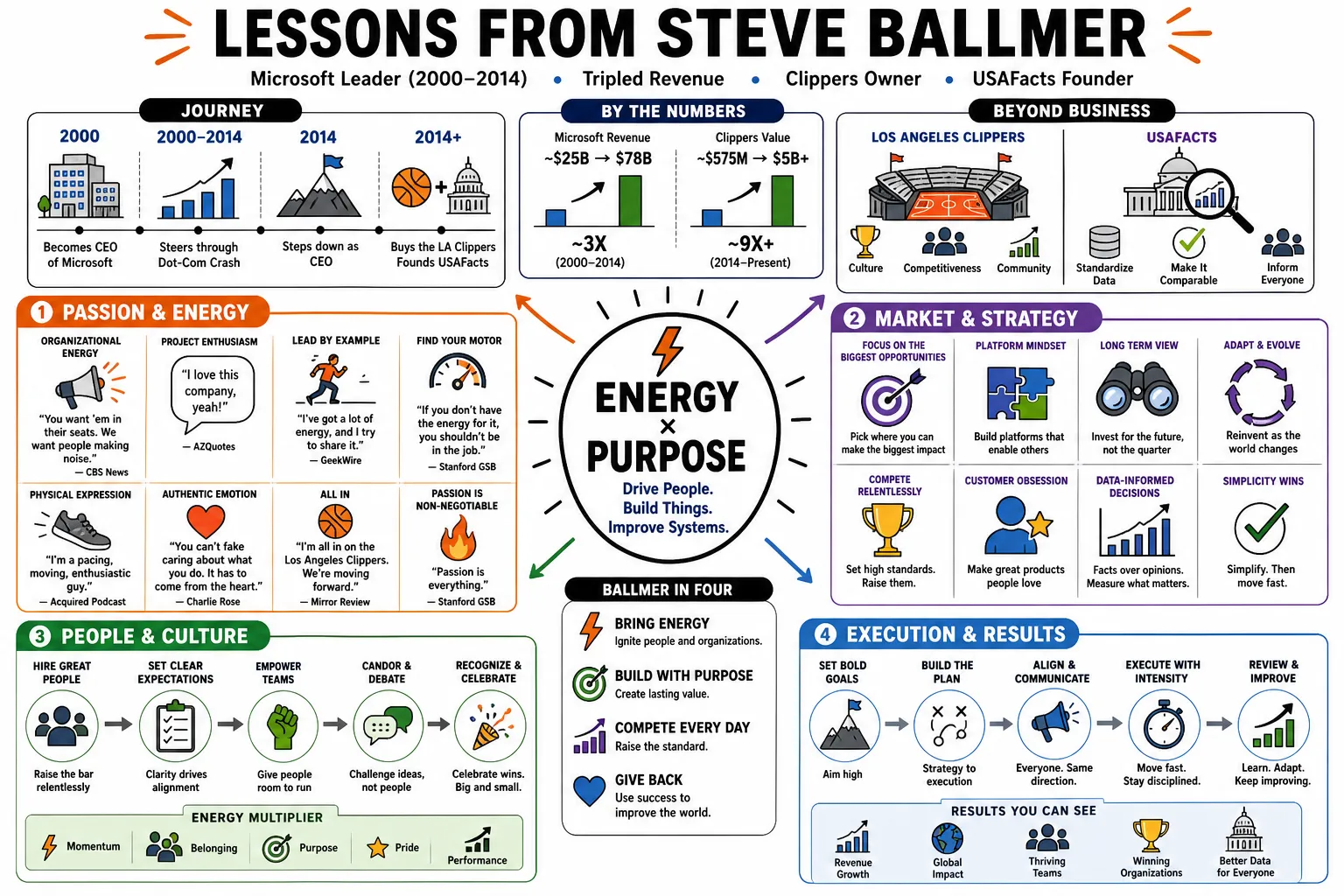
Lessons from Steve Ballmer
Steve Ballmer ran Microsoft from 2000 to 2014, steering the company through the dot-com crash and tripling its revenue. After leaving tech, he bought the Los Angeles Clippers and founded USAFacts, a non-profit built to standardize government data. This profile gathers his best insights on leadership, market strategy, and organizational energy.
Part 1: Passion and Energy
- On organizational energy: "You want 'em in their seats. We want people making noise. We want it to... give the team energy." — Source: CBS News
- On projecting enthusiasm: "I have four words for you: I love this company, yeah!" — Source: AZQuotes
- On leading by example: "I've got a lot of energy, and I try to share it." — Source: GeekWire
- On finding your motor: "If you don't have the energy for it, you shouldn't be in the job." — Source: Stanford GSB
- On physical expression: "I'm a pacing, moving, enthusiastic guy." — Source: Acquired Podcast
- On authentic emotion: "You can't fake caring about what you do. It has to come from the heart." — Source: Charlie Rose
- On intensity: "I'm all in on the Los Angeles Clippers. We're moving forward." — Source: Mirror Review
- On the necessity of passion: "Passion is what drives you through the hard times." — Source: CNBC
- On staying motivated: "I don't think about legacy; I think about what I'm doing today." — Source: Podcast P with Paul George
- On infectious enthusiasm: "If the leader isn't excited, nobody else is going to be." — Source: Stanford GSB
Part 2: Leadership and Management
- On decision making: "You've got to be bold, but you've got to be right. It turns out that being bold and being wrong may be the worst place to be." — Source: Business Insider
- On pointing the way: "The most important thing in leadership is actually pointing people the right direction." — Source: Business Insider
- On defining greatness: "Great companies with the way they work, first start with great leaders." — Source: AZQuotes
- On resilience: "You get some success. You run into some walls... it's how tenacious you are, how irrepressible... that will determine your success." — Source: AZQuotes
- On admitting mistakes: "We didn't get mobile right. I regret that." — Source: The Verge
- On managing smart people: "You have to give them the room to do their best work, but hold them accountable to the business goals." — Source: Acquired Podcast
- On setting culture: "Cultures don't change totally. And the notion of being hardcore and pushing forward and driving — I know that's part of Microsoft." — Source: GeekWire
- On succession: "You need someone who can see what you missed." — Source: Bloomberg
- On accountability: "At the end of the day, the buck stops with the CEO." — Source: Stanford GSB
- On taking feedback: "Listen to the people who tell you you're wrong, because they might just be right." — Source: WSJ
Part 3: Business Strategy and Growth
- On execution and vision: "I like to tell people that all of our products and business will go through three phases. There's vision, patience, and execution." — Source: Gracious Quotes
- On bold bets: "A bold bet doesn't assure you of winning, but if you make no bold bets you can't continue to succeed." — Source: Computerworld
- On persistence: "We make bold bets. We're persistent about them, but we make them." — Source: Computerworld
- On market transitions: "You can't sit still. The market is always moving." — Source: CNBC
- On revenue growth: "Growth covers a multitude of sins." — Source: Forbes
- On core competencies: "Stick to what you're great at, and acquire what you need." — Source: Acquired Podcast
- On business models: "The software business model is the best business model in the history of the world." — Source: Acquired Podcast
- On pacing: "Sometimes you are too early, which is exactly the same as being wrong." — Source: TechCrunch
- On customer feedback: "The customer doesn't always know what they want until you show it to them." — Source: Wired
- On adapting: "Our strategy has to adapt to what the internet is becoming." — Source: NY Times
Part 4: The Microsoft Legacy
- On Bill Gates: "He was the smartest guy I've ever known." — Source: GeekWire
- On Paul Allen: "Without Paul's genius, without Paul's push, without Paul's insight, there's no Microsoft. Just not a chance." — Source: GeekWire
- On loving the company: "Do I love the company? Do I even know the company? And the answer is, only sort of. But I love what the company does." — Source: GeekWire
- On enterprise software: "We built a company that powers the businesses of the world." — Source: Acquired Podcast
- On developer ecosystems: "Developers, developers, developers, developers!" — Source: Acquired Podcast
- On transitioning out: "It was time. The company needed a new set of eyes." — Source: Bloomberg
- On the early days: "We were just kids who thought we could change the world with software." — Source: GeekWire
- On missing search: "Google did a great job. We were late." — Source: Charlie Rose
- On Microsoft's durability: "The core franchises we built—Windows, Office, Server—are the foundation of modern computing." — Source: Acquired Podcast
Part 5: Competition and Markets
- On Apple's iPhone (2007): "There's no chance that the iPhone is going to get any significant market share. No chance. It's a $500 subsidized item." — Source: AZQuotes
- On underestimating rivals: "We didn't see the hardware integration piece being as critical as it turned out to be." — Source: The Verge
- On open source: "Linux is a cancer that attaches itself in an intellectual property sense to everything it touches." — Source: CNET
- On changing his mind: "I loved Windows, but Satya did the right thing by opening Microsoft up to Linux." — Source: TechCrunch
- On market saturation: "When everyone has a PC, you have to find the next screen." — Source: WSJ
- On cloud computing: "We bet the company on the cloud, and it paid off." — Source: CNBC
- On Google's dominance: "They have a monopoly in search, and monopolies are hard to break." — Source: Bloomberg
- On hardware vs software: "We were a software company. Learning hardware was a painful, expensive lesson." — Source: Acquired Podcast
- On consumer vs enterprise: "Consumer markets are fickle. Enterprise markets are about trust and reliability." — Source: Forbes
Part 6: Innovation and Technology
- On computer science: "Computer science is the operating system for all innovation." — Source: QuoteFancy
- On empowerment: "The number one benefit of information technology is that it empowers people to do what they want to do. It lets people be creative. It lets people be productive." — Source: Gracious Quotes
- On accessible tech: "Technology should be invisible. You should just do your work." — Source: Wired
- On the future of AI: "Machine learning will change how we interact with all software." — Source: GeekWire
- On platforms: "A platform is only successful if the developers building on it make more money than the platform creator." — Source: Acquired Podcast
- On disruption: "You either disrupt yourself, or someone else will do it for you." — Source: Fast Company
- On the internet: "The internet was the biggest shift we ever navigated." — Source: NY Times
- On engineering talent: "The company with the best engineers wins. Period." — Source: Stanford GSB
- On continuous improvement: "Version 1 is rarely perfect. Version 3 is where the magic happens." — Source: Acquired Podcast
Part 7: The LA Clippers and Sports Ownership
- On temporary stewardship: "Somebody once told me that you never really own a basketball team. You just take care of it for the fans until the next person comes along." — Source: Reddit NBA
- On community assets: "Hopefully we have an asset that the community can value for decades to come." — Source: Reddit NBA
- On the Intuit Dome: "I want this to be the most intense, hardcore basketball environment in the league." — Source: Podcast P with Paul George
- On winning a championship: "I'm not patient. We are here to win." — Source: ESPN
- On investing in the team: "If we need to spend money to get better, we will spend the money." — Source: Bleacher Report
- On fan experience: "The fan has to feel like they are part of the game." — Source: CBS News
- On rebranding: "We need an identity that separates us in this city." — Source: LA Times
- On player relationships: "I want the players to know I have their backs, unconditionally." — Source: Podcast P with Paul George
- On transitioning from tech to sports: "In business, you measure success quarterly. In sports, you measure it every single night." — Source: Acquired Podcast
Part 8: Data, Truth, and USAFacts
- On founding USAFacts: "I wanted to look at the government like a business. Where does the money come from, and where does it go?" — Source: USAFacts
- On objective truth: "We need a common set of facts to have a productive debate." — Source: Numbers Geek Podcast
- On data literacy: "Citizens need to be able to read the numbers to hold their representatives accountable." — Source: GeekWire
- On partisanship: "Numbers aren't Republican or Democrat. They are just the numbers." — Source: WSJ
- On the 10-K format: "We modeled USAFacts after a corporate 10-K because it forces transparency." — Source: USAFacts
- On government outcomes: "It's not enough to know what we spent. We have to know what outcomes we achieved." — Source: Numbers Geek Podcast
- On the complexity of government: "The federal government is the most complex organization on earth." — Source: Bloomberg
- On civic duty: "Providing this data is my way of giving back to the country that gave me so much opportunity." — Source: USAFacts
- On the future of democracy: "A functioning democracy requires an informed public, and you can't be informed without the data." — Source: Numbers Geek Podcast