Lessons from Steve Schwarzman
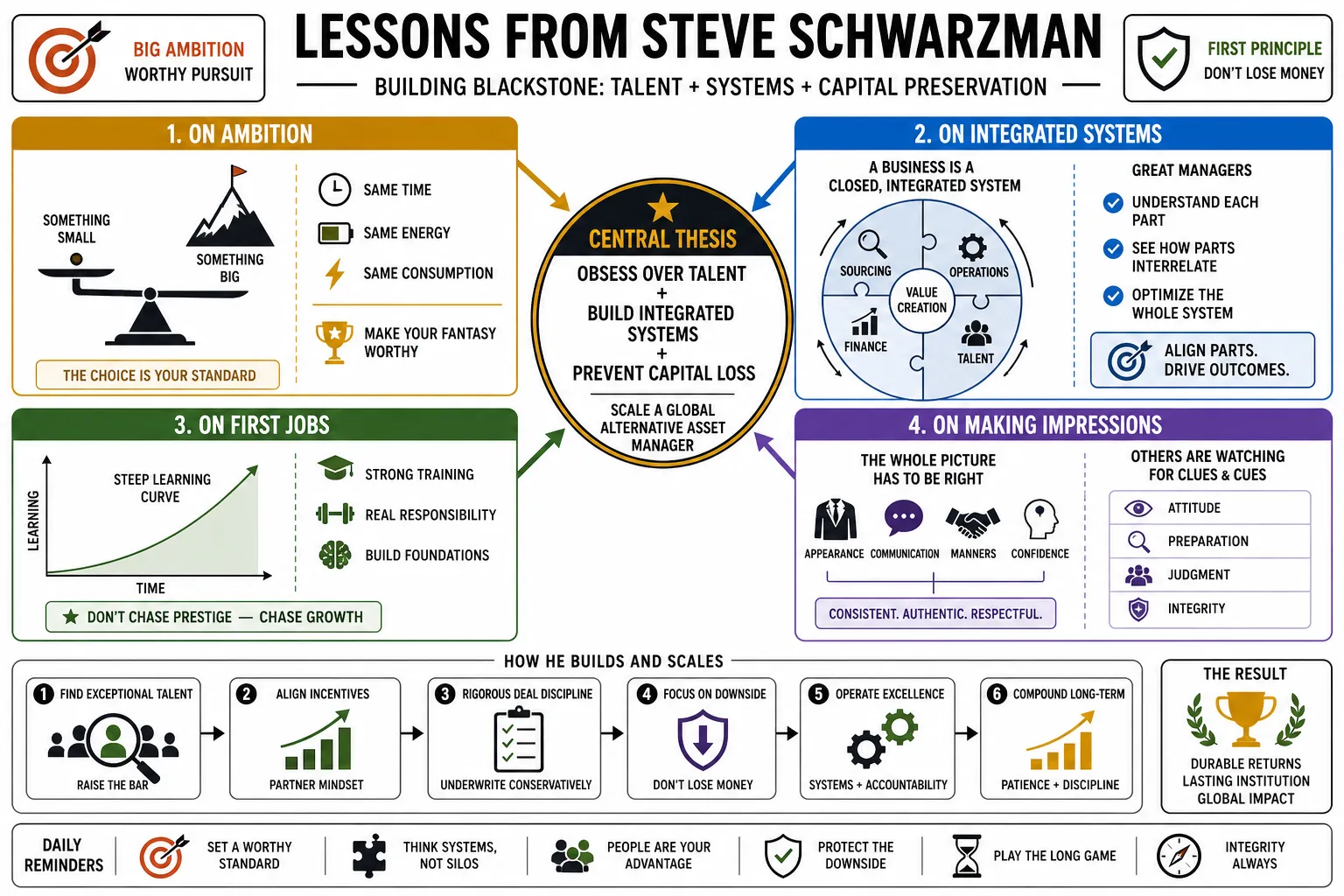
Steve Schwarzman co-founded Blackstone and built it into the world's largest alternative asset manager by obsessing over talent and establishing strict systems to prevent capital loss. These principles outline his mechanics for scaling a global business, showing exactly how he aligns incentives and negotiates deals.
Part 1: The Foundations of Work and Life
- On Ambition: "It’s as easy to do something big as it is to do something small. Both will consume your time and energy, so make sure your fantasy is worthy of your pursuit." — Source: [What It Takes]
- On Integrated Systems: "Every business is a closed, integrated system with a set of distinct but interrelated parts. Great managers understand how each part works on its own and in relation to all the others." — Source: [Goodreads]
- On First Jobs: "When you’re young, only take a job that provides you with a steep learning curve and strong training. First jobs are foundational. Don’t take a job just because it seems prestigious." — Source: [Robert Chen Blog]
- On Making Impressions: "When presenting yourself, remember that impressions matter. The whole picture has to be right. Others will be watching for all sorts of clues and cues that tell who you are." — Source: [Reddit Book Summaries]
- On Authenticity: "Be authentic. Interviews are a mutual assessment, a bit like speed dating; everyone is looking for the right fit." — Source: [Thrive Global]
- On Being Bold: "Successful entrepreneurs, managers, and individuals have the confidence and courage to act when the moment seems right." — Source: [Goodreads]
- On Integrity: "Never deviate from your sense of right and wrong. Your integrity must be unquestionable." — Source: [Economic Motivation]
- On Hard Choices: "It is easy to do what’s right when you don’t have to write a check or suffer any consequences. It’s harder when you have to give something up." — Source: [Goodreads]
- On Meaningful Assistance: "A random act of kindness in someone’s time of need can change the course of a life and create an unexpected friendship or loyalty." — Source: [Reddit Book Summaries]
Part 2: The Art of Dealmaking
- On Deal Velocity: "Time wounds all deals, sometimes even fatally." — Source: [Medium]
- On Deal Delays: "Often the longer you wait, the more surprises await you." — Source: [Goodreads]
- On Keeping People Engaged: "In tough negotiations especially, keep everyone at the table long enough to reach an agreement." — Source: [Goodreads]
- On Framing Negotiations: "I’ve always felt negotiation is pretty easy. You have to look at any situation from the perspective of all sides, and find a zone of fairness in between." — Source: [HKUST]
- On Value Creation: "The returns to successful ownership will often be much higher than the returns on winning a one-off battle over price." — Source: [Goodreads]
- On Listening First: "I didn't just try selling whatever it was I had to sell. I listened. I waited to hear what people wanted, what was on their mind, then set about making it happen." — Source: [What It Takes]
- On Selling the Vision: "You’ve got to sell your vision over and over again. Most people don’t like change, and you have to overwhelm them with your argument, and some charm." — Source: [HKUST]
- On Handling Rejection: "If you believe in what you’re selling and they say no, you have to presume that they don’t fully understand, so you give them another opportunity." — Source: [HKUST]
- On Assessing Counterparties: "My biggest job really is to figure other people out. I need to understand what makes a person tick." — Source: [HKUST]
- On Structuring Deals: "I saw the intricate ways in which deals can be structured, the subtleties that must be negotiated. Mastery like that takes experience, endurance, and tolerance for pain." — Source: [HKUST]
Part 3: Hiring and Building Culture
- On Hiring the Best: "Hire 10s whenever you can. You can always build something around a 10." — Source: [Forbes]
- On Assessing Grades of Talent: "Eights just do the stuff you tell them. Nines are great at executing. But 10s sense problems, design solutions, and take the business in new directions without being told." — Source: [Forbes]
- On Magnetism: "Tens always make it rain. They also attract and hire other 10s." — Source: [Forbes]
- On the Airport Test: "Would I want to be stuck waiting at the airport with you if our flight were delayed? If the answer is no, I don't want to work with you." — Source: [Inc. Magazine]
- On Character: "I will never hire anyone who isn't nice, regardless of his or her talent." — Source: [Global Advisors]
- On Punctuality: "Punctuality is the first indicator of how much thought and preparation you have put into an interview." — Source: [Thrive Global]
- On Adaptability in Interviews: "If a candidate doesn't demonstrate the ability to connect, engage, pivot, and change course within the bounds of a conversation, chances are that person won't fare well at Blackstone." — Source: [Thrive Global]
- On Office Environment: "I wanted the same for everyone at Blackstone: warmth, elegance, simplicity, balance, and natural light pouring in from huge windows." — Source: [Thrive Global]
- On Interactive Assessment: "The best interviews are interactive. Ask questions, ask for advice... Find a way to engage interviewers, and always make sure the conversation goes both ways." — Source: [Thrive Global]
Part 4: Risk, Failure, and Capital Preservation
- On Capital Preservation: "Don’t lose money! Objectively assess the risks of every opportunity." — Source: [Economic Motivation]
- On Financial Assumptions: "Finance is not about math... To figure out what the right assumptions are is the whole game." — Source: [Inc. Magazine]
- On Avoiding Pressure: "Be patient. Don’t force an investment decision—only invest when you have enormous confidence that something will work." — Source: [Inc. Magazine]
- On the Value of Worrying: "Worrying is an active, liberating activity. If channeled appropriately, it allows you to articulate the downside in any situation and drives you to take action to avoid it." — Source: [Goodreads]
- On Discussing Mistakes: "You must not bury your failures but talk about them openly and analyze what went wrong so you can learn new rules for decision making." — Source: [Robert Chen Blog]
- On Institutionalizing Failure: "Failure is the best teacher in an organization... If evaluated well, failures have the potential to change the course of any organization and make it more successful in the future." — Source: [Robert Chen Blog]
- On Preventing Ego: Creating a rigorous, collective decision-making process ensures that no single person's ego or excitement can lead the firm into a bad investment. — Source: [What It Takes]
- On Bidding Wars: "If you waste all your energy and goodwill in pursuit of the lowest possible purchase price and end up losing the asset to a higher bidder, all that future value goes away." — Source: [Goodreads]
- On Price vs Implementation: "Sometimes it’s best to pay what you have to pay and focus on what you can then do as an owner." — Source: [Goodreads]
- On Acting Smartly: Accept risk when others are cautious and take action when everyone else is frozen, but always ensure you do so smartly. — Source: [Reddit Book Summaries]
Part 5: Identifying and Scaling Opportunities
- On Solving Others' Problems: "There is nothing more interesting to people than their own problems. If you can find out what they are and come up with solutions, they will want to talk to you no matter their rank or status." — Source: [Robert Chen Blog]
- On Recognizing Patterns: "Information is the most important asset in business. The more you know, the more perspective you have, and the more likely you are to spot patterns and anomalies before your competition." — Source: [Peak Life Brandon]
- On Difficult Problems: "The harder the problem is, the more limited the competition, and the greater the reward for whomever can solve it." — Source: [Inc. Magazine]
- On Transforming Messes: "Find a real mess, and no one will be around. If you can clean it up, you will find yourself in rare company." — Source: [HKUST]
- On Ignoring the Herd: "If you see a huge, transformative opportunity, don’t worry that no one else is pursuing it. You might be seeing something others don’t." — Source: [Goodreads]
- On Rare Openings: "Success comes down to rare moments of opportunity. Be open, alert, and ready to seize them." — Source: [Peak Life Brandon]
- On Full Commitment: "Gather the right people and resources; then commit. If you’re not prepared to apply that kind of effort, either the opportunity isn’t as compelling as you think or you are not the right person to pursue it." — Source: [Goodreads]
- On Directing Focus: "People in a tough spot often focus on their own problems, when the answer usually lies in fixing someone else’s." — Source: [Reddit Book Summaries]
- On Making Sales: "Sales rarely get made on the first pitch. Just because you believe in something doesn’t mean everyone else will. Don’t be afraid to ask for what you want." — Source: [Goodreads]
Part 6: Leadership and Decisiveness
- On Developing Executives: "The best executives are made, not born. They never stop learning." — Source: [What It Takes]
- On Asking for Advice: "Write or call the people you admire, and ask for advice or a meeting. You never know who will be willing to meet with you." — Source: [Robert Chen Blog]
- On Collective Intelligence: "No one person, however smart, can solve every problem. But an army of smart people talking openly with one another will." — Source: [Reddit Book Summaries]
- On Avoiding Hubris: "Never get complacent. Nothing is forever. Whether it’s an individual or a business, if you assume you’re on top and the best, it’s only a matter of time before someone finds your weakness and exploits it." — Source: [Peak Life Brandon]
- On Buying Time: "Make decisions when you are ready, not under pressure. Others will always push you to make a decision for their own purposes." — Source: [Goodreads]
- On Diffusing Tension: You can almost always say, "I need a little more time to think about this. I’ll get back to you," to effectively handle difficult and uncomfortable situations. — Source: [Goodreads]
- On Higher Beliefs: "Believe in something greater than yourself and your personal needs. It can be your company, your country, or a duty for service." — Source: [Reddit Book Summaries]
- On Standing By Others: "Be there for the people you know to be good, even when everyone else is walking away. Anyone can end up in a tough situation." — Source: [Reddit Book Summaries]
- On Words of Leaders: "You have to be very gentle around people. If you're in a leadership position, people hear your words amplified. You have to be very careful what you say and how you say it." — Source: [Global Advisors]
- On Team Sports: "Business is usually a team sport. There isn't one great person sitting there directing things. You can't run an effective business like that." — Source: [Global Advisors]
Part 7: Philanthropy and Societal Impact
- On the Habit of Giving: "Helping others is supposed to be part of life. It should be a habit, not something reserved for 'philanthropy' in the traditional sense." — Source: [Forbes]
- On Purposeful Philanthropy: "My philanthropy has brought a tremendous sense of joy and meaning to my life and I anticipate I will find more ways to give back during my lifetime." — Source: [Giving Pledge]
- On Setting an Example: "I am joining [the Giving Pledge] because I think it's an important signal to encourage others to step up philanthropically as well." — Source: [Giving Pledge]
- On Transformative Ideas: "I've always been motivated seeing the opportunity in something that doesn't yet exist, seeing it as something big and a powerful idea that's going to make a change and be remarkable." — Source: [Thought Economics]
- On Education as a Passport: "Education is the passport to a better life." — Source: [Forbes]
- On Societal Equality: "To get out of this economic inequality and be equitable we're going to have to find a way to make sure everybody in society is educated... they have to change for the goodness and the cohesion of the society." — Source: [Forbes]
- On Mentorship: "Being in the hands of somebody who's truly amazing makes all the difference... training people, teaching them, and making sure they're ready is really part of our role as managers and entrepreneurs." — Source: [Forbes]
- On Complex Giving: "In philanthropy, as in business, I enjoy tackling complex challenges that require thoughtful, innovative solutions." — Source: [University of Miami]
- On Fulfilling Dreams: "Everyone has dreams. Do what you can to help others achieve theirs." — Source: [Peak Life Brandon]
Part 8: Lifelong Learning and Adaptability
- On the Goal of Education: "I believe that education is a discipline. The object of this discipline is to learn how to think." — Source: [Goodreads]
- On Applying Discipline: "Once we have mastered this discipline we can use it to learn a vocation, appreciate art, or read a book." — Source: [Goodreads]
- On Learning Beyond School: "Education continues when we leave the classroom. Our associations with friends, our participation in clubs all increase our store of knowledge." — Source: [Goodreads]
- On Continuous Growth: "In fact, we never stop learning until we die." — Source: [Goodreads]
- On Studying Success: "Study the people and organizations in your life that have had enormous success. They offer a free course from the real world to help you improve." — Source: [Robert Chen Blog]
- On Building Connections: Seeking out people you admire may help you learn something important or form a connection you can leverage for the rest of your life. — Source: [Robert Chen Blog]
- On Welcoming New Inputs: "Always be open to new inputs, whether they are people, experiences, or knowledge." — Source: [Reddit Book Summaries]
- On Navigating Conversations: True mastery in a professional environment involves the ability to connect, engage, pivot, and change course dynamically. — Source: [Thrive Global]
- On Core Values: Any challenge you tackle that is inspired by your beliefs and core values will be worth it, regardless of whether you succeed or fail. — Source: [Reddit Book Summaries]