Stevana "Stevie" Case (commonly known as Stevie Case) is a pioneering technology executive and the world’s first female professional gamer. Currently the Chief Revenue Officer at Vanta, her career spans from the high-stakes arenas of competitive Quake to scaling revenue at Twilio and leading the charge in automated compliance.
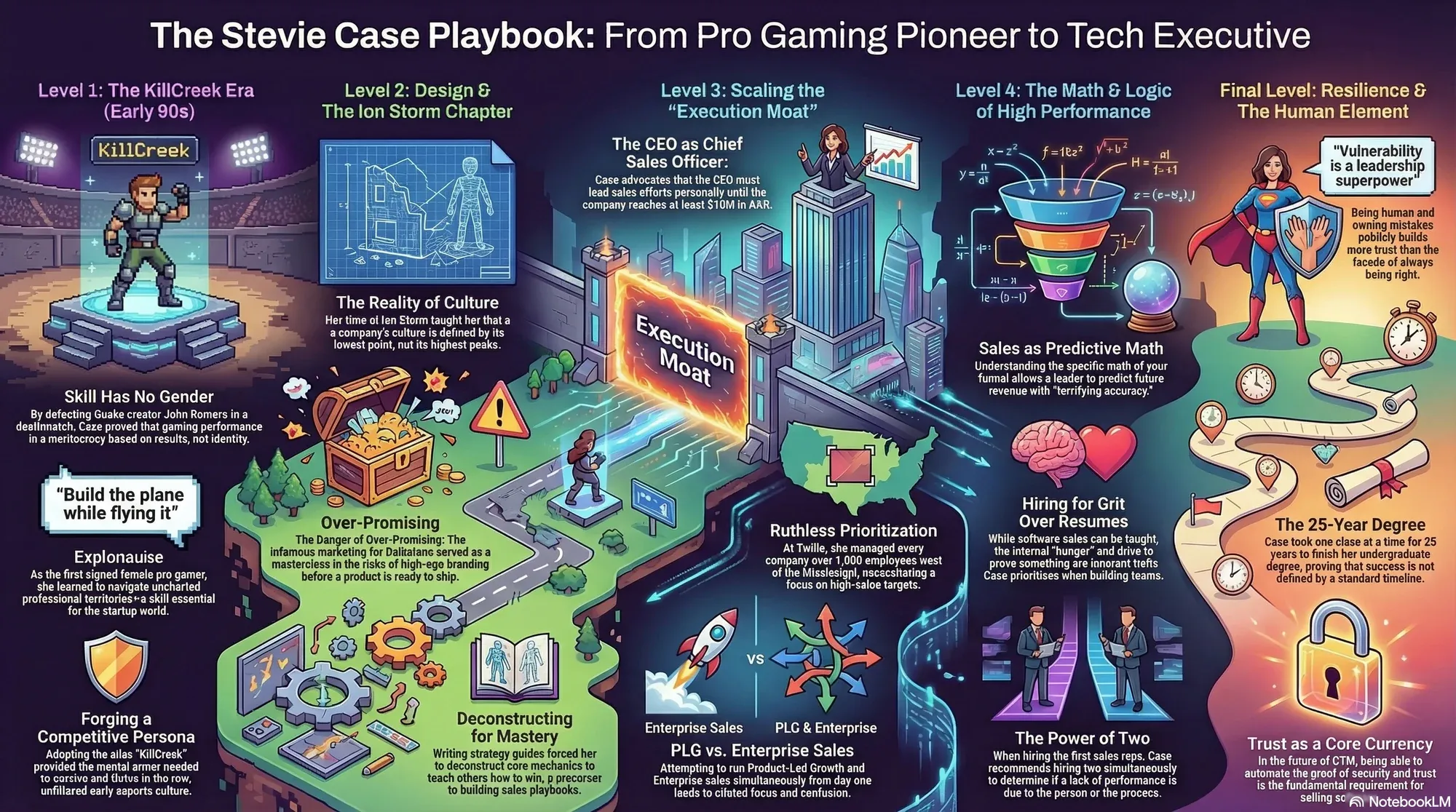
Part 1: The First Female Professional Gamer (KillCreek Era)
- On the Alias "KillCreek": The real, more modest story, per Wikipedia: the alias was taken from the Lawrence, Kansas band Kill Creek, who had a member Case was friends with -- not a deliberate statement about blending her roots with a competitive persona. [1]
- On Defeating John Romero: "Beating the creator of Quake in a deathmatch wasn't just a win; it was a statement that skill in gaming has no gender." — [Source: Alchetron]
- On the Early Esports Culture: "The early competitive scene was raw and unfiltered, teaching me that if you want to be respected, you have to be undeniable in your performance." — [Source: Techies Project]
- On Professional Gaming as a Career: The real, verifiable fact, per Wikipedia: she was the first professional gamer signed to the Cyberathlete Professional League. [5]
- On Identity and Gender in Tech: "Nothing feels better than meeting someone who has low expectations because you’re a woman and then completely proving them wrong through sheer results." — [Source: Medium]
- On Handling Public Scrutiny: The real, harsher story, per her own words on Wikipedia: there was a ton of harassment and hate and sexism and abuse -- people would send me hate email all the time -- not a character-building exercise, but a driving reason she eventually left the industry. [3]
- On the Transition to Game Design: Her real, more specific reason, per Wikipedia: I love games, and I love competition, but having no choice but to play the same game day-in and day-out with all sorts of pressure attached just didn't suit my nature. [6]
- On Competitive Advantage: "My competitive nature didn't start in a boardroom; it was forged in the 3:00 AM practice sessions where every millisecond counted." — [Source: 20VC Podcast]
- On Gaming as Resource Management: "Every game is just a series of resource management decisions; sales leadership is the exact same game with different variables." — [Source: Path to Growth]
Part 2: Lessons from Game Design and Ion Storm
- On the Scope of Daikatana: "We were trying to give the player a sense of scale that dwarfed them, moving through time from ancient Greece to futuristic San Francisco." — [Source: IGN Interview]
- On Working at Ion Storm: "It was an educational experience—even when it wasn't enjoyable, it was a masterclass in the complexities of managing high-talent, high-ego teams." — [Source: Shacknews]
- On Level Design: "Mapping a game is about creating a flow that feels organic while maintaining the tension required to keep the player engaged." — [Source: GameSpot]
- On Creative Ambition: "The 'John Romero is about to make you his b**h' ad was a lesson in the dangers of over-promising before the product is ready to ship." — [Source: PC Gamer]*
- On Leaving the Industry: Her real, more specific words, per Wikipedia: there was a ton of harassment and hate and sexism and abuse -- people would send me hate email all the time -- the benefit of connecting with people was so drowned out by how bad it felt to be in the spotlight. [2]
- On Strategy Guides: The real, verifiable fact, per Wikipedia: Case authored strategy guide books for Prima Games, including for Daikatana and Buck Bumble, and also contributed to their Quake sequel strategy guide. [4]
- On Iterative Development: "The Greek episode of Daikatana became my favorite because it was the most refined through constant, painful iteration." — [Source: YouTube]
- On the Importance of Shipping: "Vision is great, but until you ship, you haven't actually delivered value to the user." — [Source: LinkedIn]
- On Company Culture: "Growing up at Ion Storm taught me that a company's culture is defined by its lowest point, not its highest." — [Source: Shacknews]
Part 3: Scaling Revenue and the "Execution Moat"
- On the Only Moat: "Execution is the only moat in modern software; your competitors can copy your features, but they can't copy your speed of execution." — [Source: The Revenue Leadership Podcast]
- On Product-Led Growth (PLG): "You shouldn't try to do PLG and enterprise sales simultaneously from day one; it’s a recipe for confusion and diluted focus." — [Source: 20VC Podcast]
- On the Sales Playbook: "There is no magic playbook that works for every company; you have to build your own based on the math of your unique market." — [Source: GTMNow]
- On Founding Sales: "Founders shouldn't step back from sales too early; they need to stay in the foxhole until the sales team can speak their language fluently." — [Source: AirTree]
- On Enterprise Selling: "Buyers often can't tell the difference between two products until they are actually using them; therefore, the sales experience is the product." — [Source: The Revenue Leadership Podcast]
- On Speed as a Feature: Her actual claim about response speed is more specific than a general first-to-respond rule: with inboxes now flooded by AI-written slop, she says the ROI on cold calling is unbelievable, calling it so strong that it has become Vanta's primary pipeline-generation channel again. [10]
- On Scaling from Zero to One: "Scaling isn't just about adding more people; it's about adding more predictable systems." — [Source: Girl Geek]
- On Individual Contribution: "I chose to go back to an IC role at Twilio because I wanted to prove I could crush a quota before I asked anyone else to do it." — [Source: Master Move Podcast]
- On Market Dynamics: Her own account of Twilio's core flaw was more specific than a general law-of-physics claim: the team got addicted to growth and told itself a story about eventually fixing the margin problem, a story that was not actually based on truth, and the margin math never caught up. [7]
Part 4: The Math and Strategy of Sales
- On Sales as Math: "If you understand the math of your funnel, you can predict your future with terrifying accuracy." — [Source: 20VC Podcast]
- On Underpricing: "Founders often underprice their enterprise products because they are afraid of the 'no,' but low prices actually raise red flags for enterprise buyers." — [Source: YouTube]
- On the Role of the CEO in Sales: Her actual view of the top sales leadership seat is about evolving skill sets rather than a fixed ARR trigger: there will always be a place for the classic closer, she argues, but she does not think that place will be in the CRO seat, since the role is becoming analytical and systems-driven. [8]
- On Competitive Intelligence: "Winning isn't just about knowing your strengths; it's about knowing your competitor's weaknesses better than they do." — [Source: The Revenue Leadership Podcast]
- On Customer-Centricity: "The best sales strategy is to solve the customer's problem so effectively that they feel foolish for not buying." — [Source: Vanta Blog]
- On Territory Management: "When I joined Twilio, my territory was 'every company over 1,000 employees west of the Mississippi'—it taught me how to prioritize ruthlessly." — [Source: YouTube]
- On Incentives: Her own quota-design rule is a specific numeric floor rather than a general reward-behavior claim: for a healthy quota-to-OTE ratio, if you're below that, you're in trouble, referring to a four-to-one ratio that most enterprise teams run at. [9]
- On the Sales Funnel: "A leaky funnel is just an expensive way to learn that your product-market fit isn't quite there yet." — [Source: Pocus]
- On Decision Makers: "Stop selling to the person who can say 'yes' and start solving the problems of the person who can say 'no'." — [Source: LinkedIn]
Part 5: Leadership: Transparency and Authenticity
- On Vulnerability: "The best way to open people up is to give them comfort with your own vulnerability; being human is a leadership superpower." — [Source: 20VC Podcast]
- On Owning Mistakes: "If you make a bad decision, own it immediately and publicly; it builds more trust than being right ever could." — [Source: Path to Growth]
- On Being Kind in Sales: "You don't have to be a jerk or aggressive to be successful; you can be a kind person and still be a stone-cold killer in the market." — [Source: YouTube]
- On Mentorship: "A great mentor doesn't tell you what to do; they give you the psychological safety to figure out what you need to do." — [Source: COO Alliance]
- On Leadership Cadence: "Leadership is about the rhythm of the business; if the cadence is off, the whole organization feels the friction." — [Source: The Revenue Leadership Podcast]
- On Transparency: "Transparency isn't about sharing everything; it's about sharing the truth when it matters most." — [Source: Twilio Blog]
- On Leading Through Change: "Change is the only constant in a scaling startup; your job as a leader is to be the shock absorber for your team." — [Source: Vanta Blog]
- On Authentic Connections: "People buy from people; never let the 'corporate persona' drown out the human being who is actually doing the work." — [Source: YouTube]
- On Empowerment: "Empowerment isn't giving people permission; it's giving them the resources and then getting out of their way." — [Source: Path to Growth]
- On Strategic Influence: "The higher you go in leadership, the more your job becomes about influence rather than direct command." — [Source: COO Alliance]
Part 6: Building High-Performance Teams and Hiring
- On Hiring for Grit: "I care a lot less about the resume and a lot more about the drive; you can't teach grit, but you can teach software sales." — [Source: YouTube]
- On Curiosity in Candidates: "The best salespeople are the most curious people; they ask better questions because they actually care about the answer." — [Source: 20VC Podcast]
- On the "Learning Machine": "My goal is to build a team that is a learning machine, where every loss is a data point for a future win." — [Source: The Revenue Leadership Podcast]
- On the Power of Two: "When hiring your first sales reps, always hire two; you need a point of comparison to know if the problem is the person or the process." — [Source: AirTree]
- On High Expectations: "High-performance teams thrive on high expectations; people want to be part of something that is difficult and meaningful." — [Source: Path to Growth]
- On Balanced Scorecards: "Measure the behaviors that lead to the revenue, not just the revenue itself; if you only look at the quota, you’re looking at a lagging indicator." — [Source: GTMNow]
- On Sales Enablement: "Enablement isn't a one-time training; it's a continuous process of sharpening the saw." — [Source: Girl Geek]
- On Team Alignment: "If the sales team and the product team aren't talking every day, you're building a product for a market that doesn't exist." — [Source: Vanta Blog]
- On Internal Drive: "I look for the 'hunger'—the person who has something to prove and the work ethic to back it up." — [Source: 20VC Podcast]
- On Firing Fast: "Keeping a low performer on a high-performing team is an insult to the people who are doing the work." — [Source: LinkedIn]
Part 7: Resilience, Motherhood, and Personal Drive
- On Being a Single Mother: "Being a single mom made me hungrier; I wasn't just working for myself anymore, I was working to provide a future for my daughter." — [Source: YouTube]
- On the Road Under Your Feet: "Don't get overwhelmed by the mountain in the distance; just focus on the road right under your feet today." — [Source: Path to Growth]
- On Concealing Motherhood: "Early in my career, I hid the fact that I was a single mom because I didn't want people to think I was less committed to the job." — [Source: YouTube]
- On Breaking Barriers: "Being a pioneer in gaming prepared me for being a pioneer in tech sales; the barriers are different, but the strategy to break them is the same." — [Source: Techies Project]
- On Staying in the Moment: "When you're at work, be 100% at work. When you're with your family, be 100% with your family." — [Source: Path to Growth]
- On Overcoming Abuse: "The hate mail I received in the 90s taught me that other people's opinions of you are none of your business." — [Source: Techies Project]
- On Personal Growth: "It took me 25 years to finish my undergraduate degree, taking one class at a time; never let a timeline define your success." — [Source: 20VC Podcast]
- On Vulnerability as Strength: "Giving yourself permission to be human in front of your team is the ultimate form of strength." — [Source: YouTube]
- On Ambition: "My daughter is my 'why'; she is the reason I push for scale and the reason I never settle for 'good enough'." — [Source: YouTube]
- On Resilience: "Resilience is just the ability to get back up one more time than you were knocked down." — [Source: LinkedIn]
Part 8: The Future of Trust, Compliance, and AI
- On Automated Compliance: "Vanta’s mission is to make the internet more trustworthy by automating the proof of security." — [Source: Vanta Blog]
- On AI in Sales: "AI is here to augment our teams, not replace them; it’s about removing the drudgery so humans can do the high-value work." — [Source: GTMNow]
- On Trust as a Product: "Trust is the core currency of the modern economy; if you can't prove you're trustworthy, you can't sell software." — [Source: YouTube]
- On the Future of GTM: "The future of go-to-market is data-driven, automated, and deeply human all at the same time." — [Source: The Revenue Leadership Podcast]
- On Trust Management: "We are moving beyond compliance to 'trust management'—managing risk across the entire vendor and partner ecosystem." — [Source: YouTube]
- On the Speed of AI: "AI allows us to move at the speed of the market; those who don't adopt it will be left behind by the 'laws of math'." — [Source: GTMNow]
- On Data Security: "Security is no longer a 'check the box' exercise; it’s a fundamental requirement for doing business in a global market." — [Source: Vanta Blog]
- On Building for Scale: "When you're at $100M ARR, your problems are no longer about product; they are about organizational design and trust." — [Source: YouTube]
- On the Long Game: "Success isn't a destination; it's a series of levels you have to beat. Keep playing." — [Source: Path to Growth]
Learn more:
- Stevie Case (Wikipedia)
- Stevie Case (Wikipedia)
- Stevie Case (Wikipedia)
- Stevie Case (Wikipedia)
- Stevie Case (Wikipedia)
- Stevie Case (Wikipedia)
- The Crew Podcast, "Inside the GTM Playbooks at Twilio & Vanta w/ Stevie Case, CRO @ Vanta"
- The Crew Podcast, "Inside the GTM Playbooks at Twilio & Vanta w/ Stevie Case, CRO @ Vanta"
- The Crew Podcast, "Inside the GTM Playbooks at Twilio & Vanta w/ Stevie Case, CRO @ Vanta"
- The Crew Podcast, "Inside the GTM Playbooks at Twilio & Vanta w/ Stevie Case, CRO @ Vanta"