Lessons from Susan Cain
Susan Cain spent years as a corporate lawyer before writing Quiet and Bittersweet, books that examine how society routinely undervalues introversion and sorrow. This profile gathers her practical advice on surviving loud workplaces and raising thoughtful children, as well as her arguments for finding value in melancholy.
Part 1: Introversion and the Extrovert Ideal
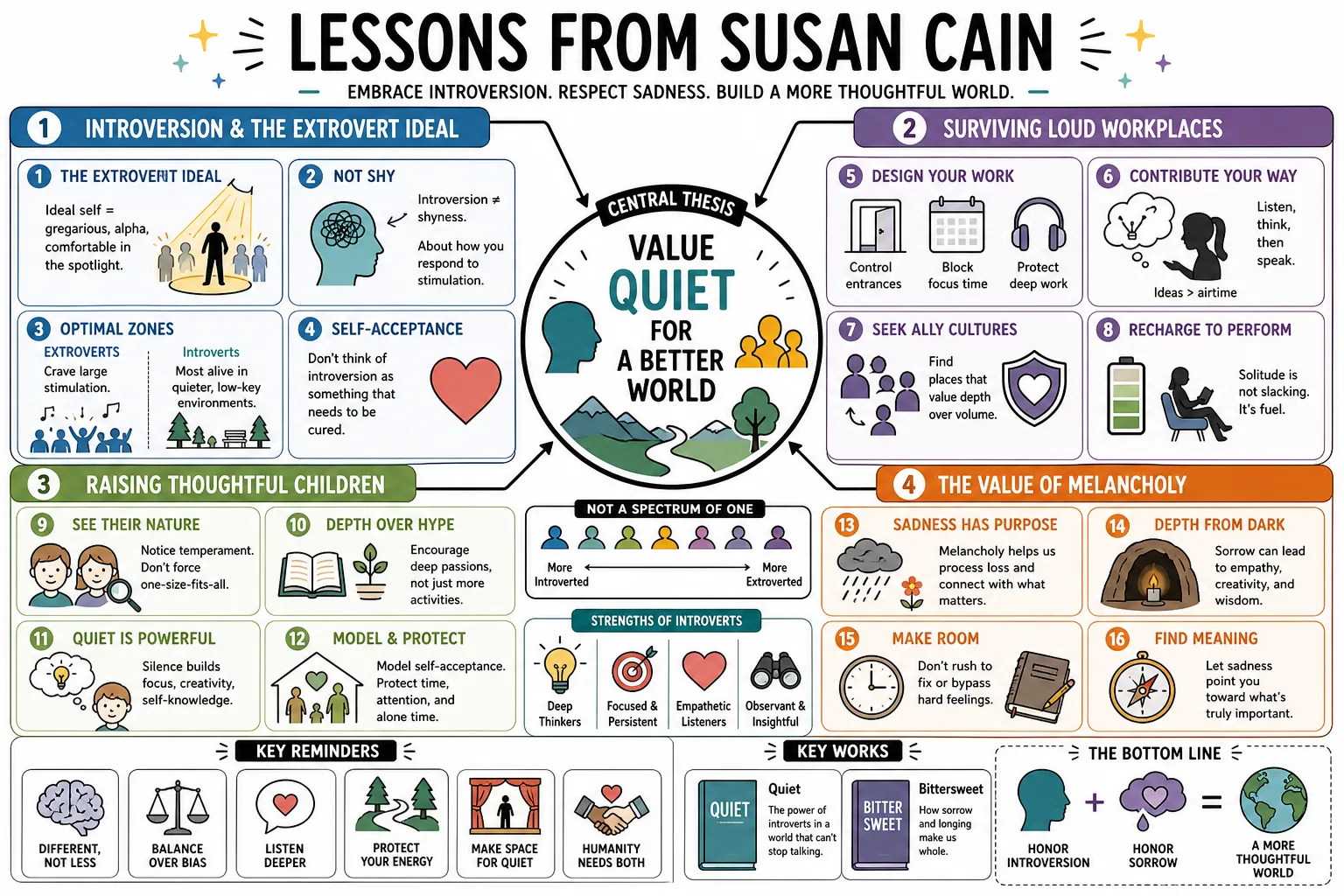
- On the Extrovert Ideal: "We live with a value system that I call the Extrovert Ideal, the omnipresent belief that the ideal self is gregarious, alpha, and comfortable in the spotlight." — Source: Quiet
- On defining introversion: "Introversion is not about shyness. Shyness is about fear of social judgment. Introversion is more about how do you respond to stimulation, including social stimulation." — Source: TED: The power of introverts
- On optimal zones: "Extroverts really crave large amounts of stimulation, whereas introverts are at their most alive and their most switched-on and their most capable when they're in quieter, more low-key environments." — Source: TED: The power of introverts
- On self-acceptance: "Don't think of introversion as something that needs to be cured." — Source: Quiet
- On the spectrum of temperament: "There is no such thing as a pure introvert or extrovert. Such a person would be in the lunatic asylum." — Source: Quiet
- On cultural biases: "Our culture made a virtue of living only as extroverts. We discouraged the inner journey, the quest for a center. So we lost our center and have to find it again." — Source: Quiet
- On the cost of faking it: "Introverts who fake it for too long can suffer from burnout, stress, and physical illness." — Source: The Tim Ferriss Show
- On biological roots: "Introverts have more sensitive nervous systems, which means they react more strongly to sensory input like noise, bright lights, and crowded rooms." — Source: Quiet
- On restorative niches: "The secret to life is to put yourself in the right lighting. For some, it's a Broadway spotlight; for others, a lamplit desk. Use your natural powers of persistence, concentration, and insight to do work you love." — Source: Quiet
- On quiet confidence: "There's zero correlation between being the best talker and having the best ideas." — Source: TED: The power of introverts
Part 2: Leadership and the Workplace
- On rethinking leadership: "We don't need giant personalities to transform companies. We need leaders who build not their own egos but the institutions they run." — Source: Quiet
- On empowering proactive employees: "Introverted leaders often deliver better outcomes than extroverts do, because when they are managing proactive employees, they're much more likely to let those employees run with their ideas." — Source: TED: The power of introverts
- On extroverted leadership risks: "Extroverted leaders can get so excited about things that they're putting their own stamp on things, and other people's ideas might not as easily bubble up to the surface." — Source: TED: The power of introverts
- On office design: "We have constructed most of our institutions like our schools and workplaces for extroverts. We need offices that allow for deep, independent work as well as collaborative sharing." — Source: The Atlantic Interview
- On groupthink: "When people are in groups, they tend to sit back and let the most dominant person do the talking, and then they all just agree with whatever that person says." — Source: Quiet
- On brainstorming: "The evidence from science suggests that business people must be insane to use brainstorming groups. If you have talented and motivated people, they should be encouraged to work alone when creativity or efficiency is the highest priority." — Source: Quiet
- On networking: "One genuine new relationship is worth a fistful of business cards." — Source: Quiet
- On soft power: "In a gentle way, you can shake the world." — Source: Quiet
- On speaking up: "If you want to be heard, don't raise your voice. Improve your argument." — Source: Quiet Power
- On complementary partnerships: "The most effective teams require a mix of both introverts and extroverts. We need to respect each other's different working styles." — Source: HBR IdeaCast
Part 3: Creativity, Solitude, and Innovation
- On the necessity of solitude: "Solitude is an essential ingredient to creativity. In some ways, it is the air that creativity breathes." — Source: Quiet
- On historical breakthroughs: "Many of the world’s most significant breakthroughs have come from people who favored quiet reflection over constant collaboration. Think of Eleanor Roosevelt, Rosa Parks, and Gandhi." — Source: TED: The power of introverts
- On deliberate practice: "To achieve mastery in a field, you must engage in deliberate practice. And deliberate practice is almost always a solitary activity." — Source: Quiet
- On the madness of group work: "We need to stop the madness for constant group work in our schools and workplaces. Creativity doesn't always come from a committee." — Source: TED: The power of introverts
- On independent thought: "It is only when you're alone that you can engage in deliberate practice, and it's only when you're alone that you can think deeply without being subject to group pressure." — Source: Quiet
- On reading as an act of connection: "Reading is a deeply social act. It is a way of communing with the author and the characters, but you get to do it while sitting alone in a quiet room." — Source: The Tim Ferriss Show
- On original thinking: "If you want to have original ideas, you have to spend time alone. You can't absorb the consensus of the crowd." — Source: NPR Interview
- On the New Groupthink: "The New Groupthink elevates teamwork above all else. But it insists that creativity and intellectual achievement come from a gregarious place, which ignores how many great ideas are born in solitude." — Source: Quiet
- On wandering minds: "Let your mind wander. The most creative ideas often come to us when we stop trying to force them and just give our brains the quiet space to process." — Source: Quiet
Part 4: Education and Parenting Introverted Kids
- On school environments: "Most teachers believe that the ideal student is an extrovert. We are asking introverted children to learn in environments that are fundamentally hostile to their nervous systems." — Source: TED: The power of introverts
- On honoring quiet children: "If you have a quiet child, don't push them to be outgoing. Honor their temperament. Their quietness is a strength, not a deficit." — Source: Quiet Power
- On the pressure to participate: "Grading on class participation often rewards those who speak the fastest, rather than those who have thought the most deeply about the subject." — Source: Quiet
- On deep interests: "Introverted kids often have one or two deep passions rather than a wide array of superficial interests. Encourage them to dive deep into what they love." — Source: Quiet Power
- On recharging: "After a long day of school, introverted children need time to decompress in solitude. Don't immediately force them into extracurricular group activities." — Source: Quiet Power
- On listening: "We teach kids how to present and speak, but we rarely teach them how to listen. Introverted kids are naturally gifted listeners; we should value that skill." — Source: Quiet
- On gentle nudging: "You can stretch an introverted child's comfort zone, but you have to do it gently and on their terms. Don't throw them into the deep end." — Source: Quiet Power
- On role models: "Introverted kids need introverted role models. They need to see that you can be quiet, thoughtful, and highly successful in this world." — Source: Quiet Power
- On early socialization: "The message we send to introverted children at summer camp or in school is often that their natural way of being is wrong. We must change the message, not the child." — Source: TED: The power of introverts
Part 5: Bittersweetness and the Value of Sorrow
- On defining bittersweetness: "Bittersweetness is a tendency to states of longing, poignancy, and sorrow; an acute awareness of passing time; and a curiously piercing joy at the beauty of the world." — Source: Bittersweet
- On toxic positivity: "We have a culture of toxic positivity that tells us we must always be cheerful and winning. But suppressing our sorrow only cuts us off from our full humanity." — Source: Bittersweet
- On the root of compassion: "It is the recognition of our shared vulnerability and suffering that connects us to one another. Sorrow is the bridge to compassion." — Source: Bittersweet
- On longing: "Longing is not a sign of illness. It's a sign of health. It is the core of our humanity and our creative impulse." — Source: Brené Brown Unlocking Us Podcast
- On music and emotion: "Sad music doesn't make us sad; it elevates us. It reminds us that we are not alone in our sorrow and connects us to the sublime." — Source: Bittersweet
- On transforming pain: "Whatever pain you can't get rid of, make it your creative offering. That is the ultimate act of alchemy." — Source: Bittersweet
- On the light and the dark: "You can't experience true joy without acknowledging the reality of sorrow. The light and the dark are eternally paired." — Source: Bittersweet
- On grief: "Grief is a ghost that visits everyone. When we try to ignore it, it haunts us. When we invite it in, it can teach us." — Source: Bittersweet
- On the illusion of perfection: "The pursuit of a flawless, constantly happy life is a modern delusion. A meaningful life includes acknowledging failure, loss, and imperfection." — Source: The Tim Ferriss Show
- On sensitivity as strength: "Those who feel the sadness of the world most acutely are also the ones most equipped to heal it." — Source: Bittersweet
Part 6: Love, Relationships, and Connection
- On conflicting social needs: "In relationships between an introvert and an extrovert, the biggest challenge is navigating the conflict between one person's need for connection and the other's need for space." — Source: Quiet
- On quiet intimacy: "For introverts, true connection often happens in quiet, one-on-one conversations rather than at loud parties or group gatherings." — Source: Quiet
- On vulnerability: "We connect with others through our shared struggles and vulnerabilities, rather than our strengths and victories." — Source: Bittersweet
- On the energy of socializing: "Introverts tire easily of small talk. They prefer deep, meaningful conversations that actually matter." — Source: Quiet
- On boundaries: "It is essential to communicate your need to recharge without making your partner or friends feel rejected. Say, 'I love you, but I need some quiet time.'" — Source: Quiet
- On conflict resolution: "Introverts often shy away from conflict because of their sensitive nervous systems. But avoiding conflict can damage relationships. We must learn to disagree gently but firmly." — Source: Quiet
- On shared silence: "One of the profoundest markers of a strong relationship is the ability to sit comfortably in silence together." — Source: Quiet
- On authentic friendships: "Introverts may have fewer friends, but the friendships they do cultivate are often fiercely loyal and deeply enduring." — Source: Quiet
- On emotional attunement: "Because they spend so much time observing, introverts are often highly attuned to the subtle emotional shifts in their partners." — Source: Quiet
Part 7: Overcoming Fear and Public Speaking
- On confronting fear: "I was terrified of public speaking. But I realized that if I wanted my message to be heard, I had to step out of my comfort zone and face the fear directly." — Source: TED Interview
- On purpose overriding anxiety: "When you care deeply enough about your subject, your passion can override your fear. You speak not because you want the attention, but because you have something vital to share." — Source: Quiet
- On preparation: "For an introvert, rigorous preparation is the antidote to performance anxiety. You can't wing it; you have to know your material cold." — Source: Quiet
- On acting out of character: "We can act out of character for the sake of work we consider important, people we love, or a high-level project." — Source: Quiet
- On the power of quiet speaking: "You don't have to be loud or theatrical to be a powerful speaker. Speaking softly and deliberately forces the audience to lean in and listen." — Source: TED: The power of introverts
- On desensitization: "The way to overcome a phobia of public speaking is through gradual exposure. Start small, speak to a few people, and slowly increase the size of the audience." — Source: Quiet
- On authenticity on stage: "Audiences connect with authenticity. If you are naturally soft-spoken, own it. Don't try to mimic a booming extroverted speaker." — Source: The Tim Ferriss Show
- On post-performance recovery: "After you push yourself to perform in a high-stimulation environment, you must allow yourself a restorative niche or time alone to recover your energy." — Source: Quiet
- On the physical signs of anxiety: "Accept that your heart will race and your hands might shake. Frame it as your body preparing you for a challenge, rather than a signal of impending disaster." — Source: Quiet
Part 8: Culture, Society, and Human Nature
- On the Culture of Personality: "In the 20th century, we moved from a Culture of Character, where people were valued for their inner virtue, to a Culture of Personality, where we value charm and charisma." — Source: Quiet
- On the influence of self-help: "Early self-help manuals focused on hard work and integrity. Modern ones focus on how to win friends, influence people, and project confidence, regardless of competence." — Source: Quiet
- On religious communities: "Even in our spiritual lives, the Extrovert Ideal has taken over. Many contemporary religious services emphasize loud worship and socializing over quiet contemplation." — Source: Quiet
- On Eastern vs. Western ideals: "Western culture celebrates the bold and vocal individual. Many Eastern cultures place a higher value on quietness, humility, and harmony." — Source: Quiet
- On the value of slow thinking: "We have built a society that rewards rapid responses. But the most complex problems require slow, deliberate, and sustained thinking." — Source: Quiet
- On technology and connection: "Social media can be a haven for introverts because it allows for asynchronous communication, but it can also exacerbate our cultural obsession with curating a perfect, relentlessly upbeat image." — Source: Bittersweet
- On the necessity of sadness in art: "Look at our enduring love for tragic plays, sad songs, and heartbreaking novels. Our culture tries to banish sadness, yet our art proves that we fundamentally crave its resonance." — Source: Bittersweet
- On redefining success: "Success should not be measured solely by how many people you manage or how much money you make. It should also be measured by the depth of your thought and the quality of your quiet contributions." — Source: Quiet
- On a balanced world: "The world needs introverts and extroverts alike. A healthy society is an ecosystem that makes room for both the people who leap and the people who look." — Source: Quiet