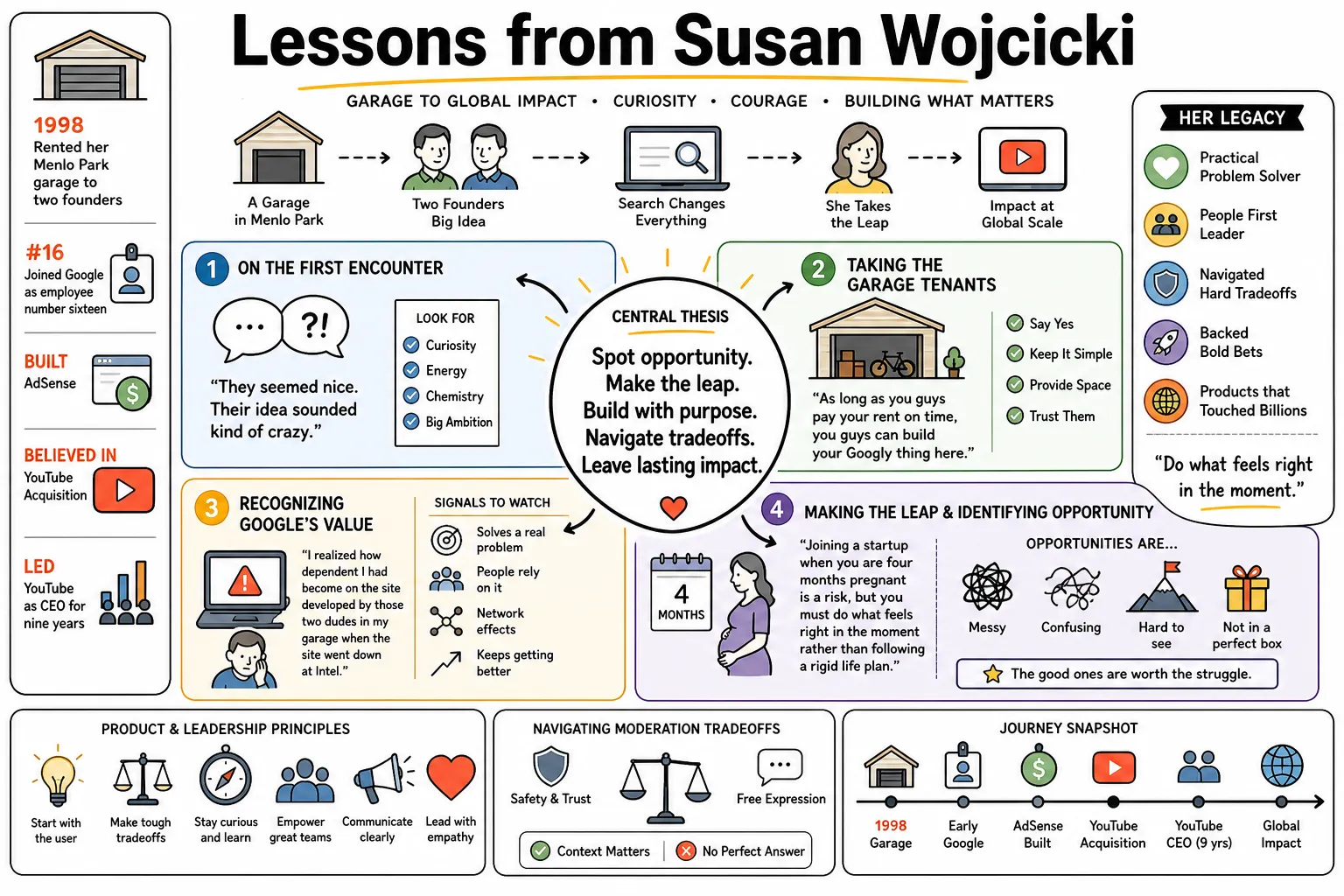
Lessons from Susan Wojcicki
Susan Wojcicki rented her Menlo Park garage to Google’s founders in 1998 before joining as employee number sixteen. She later built AdSense, pushed through the YouTube acquisition, and ran the video platform as CEO for nine years. These notes cover her practical approach to evaluating products, navigating moderation tradeoffs, and surviving decades in the tech industry.
Part 1: The Early Days of Google
- On the First Encounter: "They seemed nice. Their idea sounded kind of crazy." — YouTube: Stanford GSB View From The Top.
- On Taking the Garage Tenants: "As long as you guys pay your rent on time, you guys can build your Googly thing here." — YouTube: Stanford GSB View From The Top.
- On Recognizing Google's Value: "I realized how dependent I had become on the site developed by those two dudes in my garage when the site went down at Intel." — Source: [Forbes]
- On Making the Leap: "Joining a startup when you are four months pregnant is a risk, but you must do what feels right in the moment rather than following a rigid life plan." — Forbes: Susan Wojcicki Profile.
- On Identifying Opportunity: "Rarely are opportunities presented to you in a perfect way. In a nice little box with a yellow bow on top. Opportunities—the good ones—are messy, confusing, and hard to recognize. They're risky." — YouTube: Stanford GSB View From The Top.
- On Unplanned Careers: "Many of my most significant career steps were completely unplanned. You have to be open to the unexpected detour." — Official Blog: A Personal Update from Susan.
- On Building From Scratch: "I love taking an idea… to a prototype and then to a product that millions of people use." — YouTube: Stanford GSB View From The Top.
- On Early Scrambling: "When you are a small company, you are just scrambling to survive and build something people actually want." — YouTube: Stanford GSB View From The Top.
- On Nostalgia: "Wow, it's amazing to see it looks the same. It's like going back in time." — Official Blog: A Personal Update from Susan.
Part 2: Building the Advertising Business
- On The Basics of Advertising: "Advertising is very simple in a lot of ways. Advertisers go where the users go, and users are choosing to spend a lot more time online." — YouTube: Code Media 2018 Full Interview.
- On Ad Logistics: "People don't understand the logistics of advertising. To have the ads purchased and run, you need to have a series of products that work together." — YouTube: Code Media 2018 Full Interview.
- On Creating AdSense: "We realized there was a whole web of content outside of search, and those publishers needed a way to monetize just as much as we did." — YouTube: Stanford GSB View From The Top.
- On The DoubleClick Acquisition: "Acquiring DoubleClick was about building the infrastructure that allowed publishers and advertisers to connect seamlessly across the entire internet." — YouTube: Stanford GSB View From The Top.
- On Wearing Many Hats: "Over the years, I've worn many hats... managed marketing, co-created Google Image Search, led Google's first Video and Book search, as well as early parts of AdSense's creation." — YouTube: Stanford GSB View From The Top.
- On Funding the Free Web: "Advertising is the economic engine that funds the free internet, allowing everyone to access information regardless of their ability to pay." — YouTube: Code Media 2018 Full Interview.
- On Scaling Revenue: "You have to build a system that works for the smallest business and the largest enterprise simultaneously." — YouTube: Code Media 2018 Full Interview.
- On Data and Creativity: "Advertising isn't just about targeting; it's about matching the right creative message with the right audience at the right time." — YouTube: Code Media 2018 Full Interview.
- On Speed in Tech: "I don't really care how we get there as long as we get there... anything that helps us move faster is going to be considered." — YouTube: Code Media 2018 Full Interview.
Part 3: The Video Revolution and YouTube Acquisition
- On Predicting the Future: "Video was the next TV." — YouTube: Code 2019 Full Interview with Kara Swisher.
- On Embracing Failure: "When you realize that you need to make a change in strategy or that something’s not working, a lot of times a reaction is to fight it. What you need to do is embrace it." — YouTube: Stanford GSB View From The Top.
- On Changing Course: "The sooner you accept a failure like Google Video, the sooner you can actually get on the right path and make the right acquisition." — YouTube: Stanford GSB View From The Top.
- On Generational Shifts: "If you look at the next generation, they are completely changing the way that they watch TV... they don't watch the TV as we knew it." — YouTube: Code Media 2018 Full Interview.
- On Recognizing YouTube's Magic: "YouTube wasn't just a video player; it was a community where anyone could upload a video and instantly reach the world." — YouTube: Code 2019 Full Interview with Kara Swisher.
- On Pitching the Acquisition: "You have to be direct and confident when stating your opinion, even when others are skeptical of buying a startup with no revenue." — YouTube: Stanford GSB View From The Top.
- On The Early Vision: "I saw that opportunity with YouTube and I think we're still at the beginning of it." — YouTube: Code 2019 Full Interview with Kara Swisher.
- On The Power of Video: "Video is a uniquely powerful medium for empathy because it allows you to step into someone else's shoes anywhere in the world." — YouTube: Stanford GSB View From The Top.
- On Making Bold Bets: "Sometimes the best strategic move is realizing someone else built a better mousetrap and bringing them into your ecosystem." — YouTube: Stanford GSB View From The Top.
Part 4: Scaling YouTube and the Creator Economy
- On The Platform's Core Engine: "Our success is entirely dependent on the success of our creators. If they don't succeed, we don't succeed." — YouTube: Stanford GSB View From The Top.
- On Creators as Small Businesses: "We view our creators as small businesses. We are providing the infrastructure for them to grow and thrive globally." — YouTube: Stanford GSB View From The Top.
- On Education: "One of the things about YouTube that makes me proudest is the role we play in enabling people to learn new skills." — YouTube: Stanford GSB View From The Top.
- On Setting Goals: "We're setting a new goal: to double the number of users who engage with educational content on YouTube." — YouTube: Stanford GSB View From The Top.
- On Creativity and Innovation: "Creativity and innovation are the foundation of progress." — YouTube: Stanford GSB View From The Top.
- On Community over Technology: "Our success didn't just come from proprietary tech; it came from the deep, authentic community relationships built on the platform." — YouTube: Stanford GSB View From The Top.
- On Expanding Access: "We want to give everyone a voice and show them the world." — YouTube: Stanford GSB View From The Top.
- On The Democratization of Media: "You no longer need a studio backing you to find an audience. You just need a camera, a connection, and a good idea." — YouTube: Stanford GSB View From The Top.
- On Monetizing Creativity: "We built a system where passion could become a profession. That is the essence of the creator economy." — YouTube: VidCon Industry Keynote.
- On Long-Term Platform Health: "Sustainable infrastructure is more important than chasing short-term viral wins." — Official Blog: A Personal Update from Susan.
Part 5: Strategic Foresight and Navigating Change
- On Assessing Talent: "If people can’t name a single thing about how to make a product better that they use a lot, then that’s probably not a good indication that they’ll be a good product manager." — YouTube: Stanford GSB View From The Top.
- On Organizational Habits: "I often ask candidates how they manage their email to understand if they work in bursts or maintain a constant flow." — YouTube: Stanford GSB View From The Top.
- On Acting Like an Owner: "If you’re an owner of the company and you see something that’s not working, fix it, change it—because it’s all of our company." — YouTube: Stanford GSB View From The Top.
- On Scaling Teams: "As the company grows, you need to keep finding the small team and big goals, to keep finding those opportunities to stretch." — YouTube: Stanford GSB View From The Top.
- On Embracing Feedback: "Especially as you get more senior in the organization… you really need to step back and not make it personal and be willing to hear the feedback." — YouTube: Stanford GSB View From The Top.
- On The Purpose of Senior Leadership: "As you get more senior, your job is to hear what's not working so you can make it better, not to be told everything is fine." — YouTube: Stanford GSB View From The Top.
- On Defensiveness: "I was defensive early in my career, but I learned that fighting reality only delays the necessary course correction." — YouTube: Stanford GSB View From The Top.
- On Work Ethic: "Work smart. Get things done." — YouTube: Stanford GSB View From The Top.
- On Persistence: "One of the things when I look at my career... certainly being persistent... it’s been really important just to be persistent and to not give up." — YouTube: Stanford GSB View From The Top.
- On Staying Grounded: "A humanities background reminds you that behind every data point is a human experience." — YouTube: Stanford GSB View From The Top.
Part 6: Motherhood, Flexibility, and Work-Life Integration
- On The Myth of Balance: "I think the hardest part is that work-life balance is a lie. It’s a journey, and it’s something that you’re constantly trying to work through." — YouTube: Fortune on Working Mothers and Boundaries.
- On The Necessity of Rest: "If you are working 24/7, you’re not going to have any interesting ideas." — YouTube: How I Work with Susan Wojcicki.
- On Motherhood as an Asset: "Mothers return to the workforce with a broader sense of purpose, more compassion, and a better ability to prioritize and get things done efficiently." — YouTube: How I Work with Susan Wojcicki.
- On Prioritization: "Having limited hours forces you to be ruthless about your schedule and focus only on the things that drive the most results." — YouTube: How I Work with Susan Wojcicki.
- On Early Career Pressures: "The intersection of early-career pressure and early-parenthood is the hardest phase, where many are tempted to drop out. You just have to muddle through." — YouTube: How I Work with Susan Wojcicki.
- On Setting Boundaries: "I made it a point to be home for dinner with my kids at 6:00 PM because you need to unplug to maintain perspective." — YouTube: Fortune on Working Mothers and Boundaries.
- On Asking for What You Need: "Whether it's flexibility or better maternity leave, ask for what you need. If you need it, others likely do too." — YouTube: Maternity Leave Keeps Women at Work.
- On Paid Leave as a Business Imperative: "Paid family leave isn't just a women’s issue; it is a fundamental business necessity to retain your best talent." — YouTube: Maternity Leave Keeps Women at Work.
- On Setting the Tone: "I have tried in my role of being one of the first women at Google, let alone the first woman to have a baby, to really try to set the tone that this is a great place to work." — YouTube: How I Work with Susan Wojcicki.
- On The Value of Disconnecting: "Weekends are for family. Disconnecting gives your brain the space it needs to solve hard problems on Monday." — YouTube: How I Work with Susan Wojcicki.
Part 7: Diversity and Women in Tech
- On The Tech Gender Gap: "Tech is an incredible force that will change our world in ways we can't anticipate. If that force is only 20 to 30% women, that is a problem." — YouTube: The Internet Needs More Women in Tech.
- On Non-Technical Paths: "I always like to remind women that you don't need to have science or technology degrees to build a career in tech." — YouTube: Stanford GSB View From The Top.
- On Computer Science's Reputation: "I think Computer Science has a reputation that's not completely accurate and it's scared away a lot of women. This is a field that's very creative." — YouTube: The Internet Needs More Women in Tech.
- On Top-Down Accountability: "Diversity has to come from the top, where the leaders of the company say, 'We believe in diversity,' and go to the recruiters and say, 'We need to do better.'" — YouTube: Stanford GSB View From The Top.
- On Self-Advocacy: "Whether it's salary or a promotion or a job, I think it's important for women to ask for what they think they deserve." — YouTube: Fortune on Working Mothers and Boundaries.
- On Designing for Everyone: "If you don't have diverse teams building the products, you won't build products that serve a diverse global population." — YouTube: Stanford GSB View From The Top.
- On Closing the Gap: "We need to expose girls to coding early, before societal stereotypes tell them it's not a field for them." — YouTube: The Internet Needs More Women in Tech.
- On Inclusive Workplaces: "It's not just about hiring diverse talent; it's about building an environment where they actually want to stay." — YouTube: Fortune on Working Mothers and Boundaries.
- On Mentorship: "Finding mentors who can guide you through the muddy waters of the tech industry is critical for retaining female talent." — YouTube: Fortune on Working Mothers and Boundaries.
Part 8: Responsibility and The Future of Platforms
- On Openness vs. Responsibility: "YouTube is built on the premise of openness... But we also have a responsibility to protect our community. Striking the right balance is one of the most important things we do." — YouTube: Code 2019 Full Interview with Kara Swisher.
- On The Four Rs: "We’ve actually come up with what we call the four R’s of responsibility, and pretty much everything we do is captured in one of these four R’s." — YouTube: Code 2019 Full Interview with Kara Swisher.
- On Removing Content: "Our first priority is removing content that violates our policies as quickly as possible." — YouTube: 2021 Priorities and Community Letter.
- On Raising Authoritative Voices: "We must raise up authoritative voices when people are looking for breaking news and information." — YouTube: World Economic Forum Davos Conversation.
- On Reducing Borderline Content: "We have a duty to reduce the spread of content that brushes right up against policy lines or pushes harmful misinformation." — YouTube: Code 2019 Full Interview with Kara Swisher.
- On Rewarding Good Actors: "It is crucial that we are rewarding trusted, eligible creators and artists who meet a higher bar for our platform." — YouTube: 2021 Priorities and Community Letter.
- On the 99/1 Rule: "While one percent of content might be problematic and require intense focus, the other 99 percent is incredibly valuable, educational, and transformative." — YouTube: 2021 Priorities and Community Letter.
- On Earning Trust: "Our success is directly linked to our users trusting us." — YouTube: 2021 Priorities and Community Letter.
- On The Ultimate Goal: "Living up to our responsibilities is our number one priority, because without trust, the ecosystem falls apart." — YouTube: 2021 Priorities and Community Letter.