Lessons from Tamara Mellon
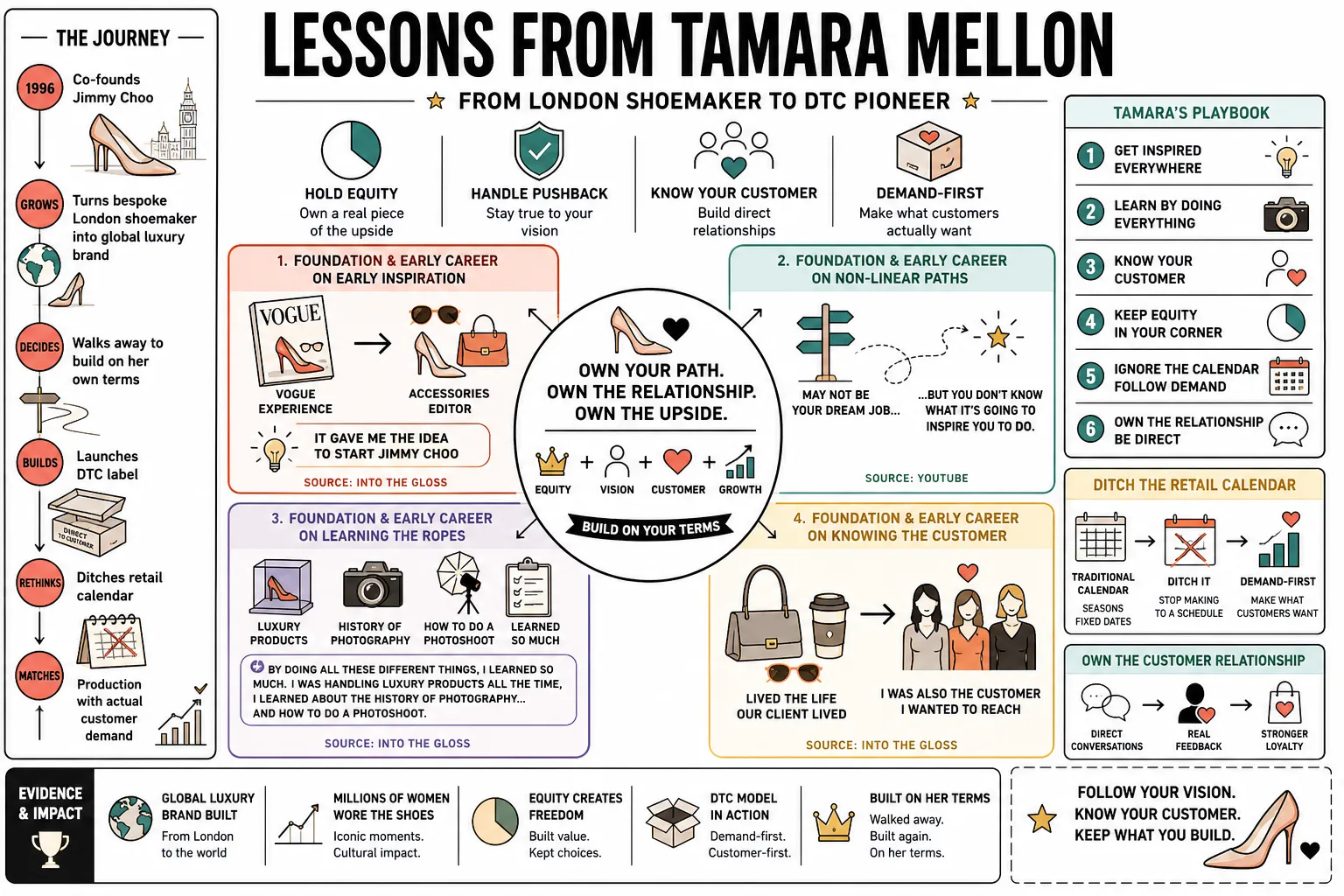
Tamara Mellon co-founded Jimmy Choo in 1996, turning a bespoke London shoemaker into a global luxury brand. She eventually walked away to start her own direct-to-consumer label, ditching the traditional retail calendar to match production with actual customer demand. This profile covers her advice on holding onto equity, handling industry pushback, and managing direct customer relationships.
Part 1: The Foundation and Early Career
- On early inspiration: "Working at Vogue was an incredible experience. I was there for five years and I ended up being the accessories editor. It gave me the idea to start Jimmy Choo." — Source: Into The Gloss
- On non-linear paths: "Whenever I'm talking to young people, I say something may not be your dream job, but you don't know what it's going to inspire you to do." — Reference: Fashion Week Daily interview on British Vogue and Jimmy Choo
- On learning the ropes: "By doing all these different things, I learned so much. I was handling luxury products all the time, I learned about the history of photography... and how to do a photoshoot." — Source: Into The Gloss
- On knowing the customer: "I was also the customer I wanted to reach. I lived the life our prospective client lived." — Source: Then and In
- On emotional connection: "I had an emotional connection to her tastes and dreams because I shared her tastes and dreams." — Source: Then and In
- On identifying a gap: "I caught the wave of accessories exploding, because back then it was only Manolo Blahnik, there weren’t all the shoes and bags we have today." — Source: Into The Gloss
- On past struggles: "I had the idea to start Jimmy Choo when I was an assistant at British Vogue in the early '90s. I got fired for taking too many drugs... So I went to rehab and after that started Jimmy Choo." — Source: Into The Gloss
- On starting at the bottom: "When someone asks about a career in fashion, I say start at the bottom." — Source: AZ Quotes
- On continuous activity: Mellon tells young people to stay active even when a role is not the dream job, because the next idea can come from unexpected work and exposure. — Reference: Fashion Week Daily interview on unexpected career inspiration
- On needing an outlet: "After all those years of being told that I was useless, a dunce, and a thoroughly worthless human being, I had a desperate need to express myself. That’s when the penny dropped: Jimmy Choo." — Source: Then and In
Part 2: Navigating the Luxury Industry and Design
- On design flow: "I love designing shoes; it's what gets me into a state of flow." — Source: Create & Cultivate
- On personal aesthetic: "My favorite decade is the '70s and it's reflected in the brand. Our aesthetic is both masculine and feminine, and classic with an edge." — Source: Create & Cultivate
- On translating concepts: "The concept came from an Eames Soft Pad chair that I have in my home and sitting on that one day and thinking to myself how beautifully constructed the chair is. And so, I wanted to translate that into a shoe." — Source: Forbes
- On responding to feedback: "We're always looking for new ways to serve our customers and part of that is listening to feedback, especially when it comes to fit. We kept hearing, 'I really want to buy your boots, but my calf doesn't fit', and decided to solve for that problem." — Source: Forbes
- On the power of accessories: "It doesn’t matter what you are wearing, if you have good shoes and a good bag, you’ll look right." — Source: 20/20 Mag
- On collaborative creation: "I also love reading comments and feedback from our followers and customers, negative or positive, to better offer exactly what women want. I read every single one!" — Source: Inc.
- On breaking the rules: "I'm still obsessed with shoes, but not the traditional way of doing things. So I'm starting over. This is my reboot... I'm redefining luxury and doing what I do best: designing shoes and breaking rules." — Source: Tamara Mellon
- On the state of traditional luxury: "We were designing huge collections that we'd take to market four times a year, and bringing them out months before they ever wanted to wear them... It wasn't really in-step with where the customer was at." — Source: Glossy
- On intimidation in retail: "We don't ever want anyone to be intimidated to walk in one of my stores." — Source: Shopify
Part 3: The Reality of Building a Global Brand
- On hands-on experience: "The reality is that I spent years in the factories in Italy when I first set up Jimmy Choo. Today, everyone who has a job at Jimmy Choo, I’ve done their job, right down to the cleaner." — Source: QuoteFancy
- On foundational knowledge: "If you want to start a business, you have to know it from the ground up." — Source: AZ Quotes
- On scaling priorities: "I'm really hoping just to keep building on what we're doing. You have to build your core business first which is really important." — Reference: ELLE interview on building the core shoe business first
- On ambition: "I always said I was determined to own a truly global brand. I didn’t buy Jimmy Choo just to have a couple of shoe shops in London, did I?" — Source: QuoteFancy
- On growth and exit: "So we started Jimmy Choo and business grew and 15 years later it sold for $800 million." — Source: Into The Gloss
- On intuition over intellect: "Everything I do is just really my intuition, and every time I go against my intuition, it’s a mistake. Even though I may sit down and analyze and intellectualize something on paper, if I go against my gut feeling, it's wrong." — Source: AZ Quotes
- On shared values with consumers: "We really think that people want to buy from a brand that they have shared values with, much more than buying just for status." — Source: Shopify
- On sustainability: "You can't have sustainable growth and real innovation when no one cares about what they're actually producing or about the people who produce it." — Source: Successful Women of Israel
- On ignoring distractions: "I don't really care about gossip. I care about building great businesses." — Source: QuoteFancy
- On long-term vision: "A brand cannot scale globally without recognizing that even highly skilled artisans may not inherently share the strategic drive required for international expansion." — Source: Startup Fashion
Part 4: Partnerships, Investors, and Control
- On retaining control: "If you love what you do, never give up control; retention of total control is paramount." — Source: Podcast Notes
- On equity ownership: "Founders should maintain at least 51% control; bringing in private equity can lead to a loss of influence over the company's direction." — Source: Founders Podcast
- On investor dynamics: "These are people who should never be in a creative industry because they don't understand the creative process. A start-up needs investors who are going to nurture it, and support you if things go wrong." — Source: Fashion United
- On the role of accountants: Mellon traces one Jimmy Choo lesson to her father's seed-money warning that she should not let accountants run the business. — Reference: Founders episode description on In My Shoes
- On private equity debt: "Private equity firms often trade shares among themselves rather than injecting new capital, leaving the business burdened by the debt used to finance those transactions." — Source: Founders Podcast
- On alternative financing: "Instead of taking on private equity partners who extract value, founders should explore borrowing directly to buy out partners and keep their autonomy intact." — Source: Founders Podcast
- On differing visions: "It’s steering not rowing." — Source: Startup Fashion
- On early alignment: "Picking a business partner is akin to a marriage; clear expectations and roles must be established from the very beginning to avoid acrimonious splits." — Source: Startup Fashion
- On resisting regression: "I had three investors who wanted me to just go back to fashion's old calendar and build Tamara Mellon the same way I'd built Jimmy Choo." — Source: Entrepreneur
Part 5: Navigating Failure and the Pivot
- On facing resistance: "People are afraid of change. They want things to stay the same, the way they've always done it." — Source: Glossy
- On wholesale rejection: "I tried to put direct to consumer through a wholesale channel, the industry was just not ready to adapt and change." — Source: AZ Quotes
- On conviction amidst failure: "And that is how I ended up in Chapter 11. But it would be worth it." — Source: Entrepreneur
- On viewing failure as data: "Filing for Chapter 11 bankruptcy was not an end, but an incredible learning experience that clarified the necessary shift away from wholesale." — Source: Entrepreneur
- On executing the pivot: "We look forward to implementing this revitalised approach, shortening the design and manufacturing process, and further enhancing our mission to provide customers with the fashion they want to wear, now." — Source: The Industry Fashion
- On the illusion of safety: "The risky way is the safe way, and the safe way is the risky way." — Reference: Unlocking Creativity episode on risk and reward
- On tactical retreating: "Know when to throw the punches and when to roll with them." — Source: Sophie C. Barnett
- On resilience: "It may seem that now and then I need a rescuer. But over time, I learned to rescue myself." — Source: Podcast Notes
- On overcoming obstacles: "When the going gets tough, the tough get going." — Source: Cathy Heller
Part 6: Rebuilding: The Direct-to-Consumer Revolution
- On the necessity of digital: "As Marc Andreessen said, 'Every business will eventually be eaten by digital.' And that's what was happening in the fashion industry, but they were very slow to move." — Source: Glossy
- On changing the conversation: "I felt like the business model needed to change, and the way people talked and spoke to their customers needed to change. So that's how we came up with doing direct-to-consumer." — Source: Glossy
- On fair pricing: "We're direct-to-consumer, which means that I pay the same factory prices as all the luxury brands... but we don't mark them up six times anymore because we don't do any wholesale." — Source: Shopify
- On passing value to the customer: "So what used to be my wholesale price is now my retail price. We pass that on to the customer." — Source: Shopify
- On the drop model: "We also put new shoes up every week. We don't produce big collections and then have those come out four times a year... We just have continuous product coming out." — Source: Shopify
- On ultimate independence: "Direct to consumer really gives you control of your business completely." — Source: PictureQuotes
- On bypassing intermediaries: "By cutting out the middleman, luxury brands can align production with actual consumer demand rather than relying on inaccurate forecasting months in advance." — Source: Glossy
- On challenging tradition: "If your business model disrupts industry standards, you may find that traditional partners are unable or unwilling to accommodate you." — Source: Forbes
- On data integration: "Direct-to-consumer success relies heavily on utilizing data and mobile-first experiences to intimately understand consumer preferences." — Source: Forbes
Part 7: Feminism, Equality, and Advocacy
- On the true meaning of feminism: "The definition of a feminist is someone who wants equality. That's all it is, it's equal. And there's nothing wrong in asking for equal." — Source: Startup Fashion
- On reclaiming the label: "Am I a feminist? Absolutely. The problem is the media men of the 60s set the definition of feminist as someone who hates men... And that's just not true." — Source: The Guardian
- On the double standard of negotiation: "If a woman gets tough in negotiations, she's difficult, whereas a man would be considered a brilliant businessman." — Source: AZ Quotes
- On women speaking up: "What a woman does is work herself to death and hope someone notices. Rather than speak up." — Source: IMAGE
- On experiencing the pay gap: "It meant that my work as a woman was not valued the same as the men who were working for me in a company I founded." — Source: Forbes
- On the unspoken reality: "The gender pay gap is the elephant in the room of feminism, work as hard and accomplish as much as any man, but don't ask for something that someone doesn't want to give you." — Source: Forbes
- On stepping up: "There have been moments in my career when I've had to be tough and I've had to step up to the plate, but usually that's because a man has underestimated me." — Source: The Real Quotes
- On female independence: "It's important for women to work. They need to keep their independence, to keep earning and being challenged." — Source: AZ Quotes
- On building a female-first culture: "Modern companies must actively prioritize hiring and partnering with businesses that feature women on their boards to dismantle systemic inequality." — Source: Entrepreneur
Part 8: Personal Resilience and Leadership Philosophy
- On owning your space: "You don't get taken seriously by asking someone to take you seriously. You've got to show up and own it. If this is a man's world, who cares? I'm still really glad to be a girl in it." — Source: Sophie C. Barnett
- On facing fear: "My motto is: feel the fear and do it anyway." — Source: QuoteFancy
- On personal agency: "You can turn your life around. You can do anything that you want to do, and you can be self-educated." — Source: Who What Wear
- On surviving adversity: "The basic Danielle Steel conceit is to take a plucky heroine, set her on a quest, and then subject her to every villain and viper and obstacle imaginable. Which, I suppose, is not an entirely bad summary of my life so far." — Source: Joujou de la Mode
- On parental influence: "What do you owe your parents? Being independent. My father always encouraged me to do my own thing." — Source: The Guardian
- On early adversity: "I fought my way through the rites of passage." — Source: DrugRehab
- On true motivation: "There were two things that motivated me then: independence, and passion about what I was doing. And those are still the things that motivate me now." — Reference: Interview Magazine interview on independence and motivation
- On the limits of intellect: "While IQ may help open doors, sustained entrepreneurial success is ultimately driven by high emotional intelligence and the ability to manage complex relationships." — Source: The Guardian
- On emotional intelligence: "Founders possess a unique emotional connection to their product and audience that operators driven purely by profit often lack." — Source: The Guardian
- On dealing with toxic family dynamics: "My mother and I never got along, not even when I was a child... She wanted to be me, I think, which seems sad." — Source: Gulf News