Lessons from Tanner Greer
Tanner Greer is an essayist and researcher who analyzes Chinese strategic texts, U.S. foreign policy, and American institutional history. He is best known for his blog, The Scholar's Stage, and for articulating concepts like the "My Friend from Beida" bias and the cultural shift from building to managing. This collection maps his distinct views on how states function, why institutions decay, and what drives great power competition in the 21st century.
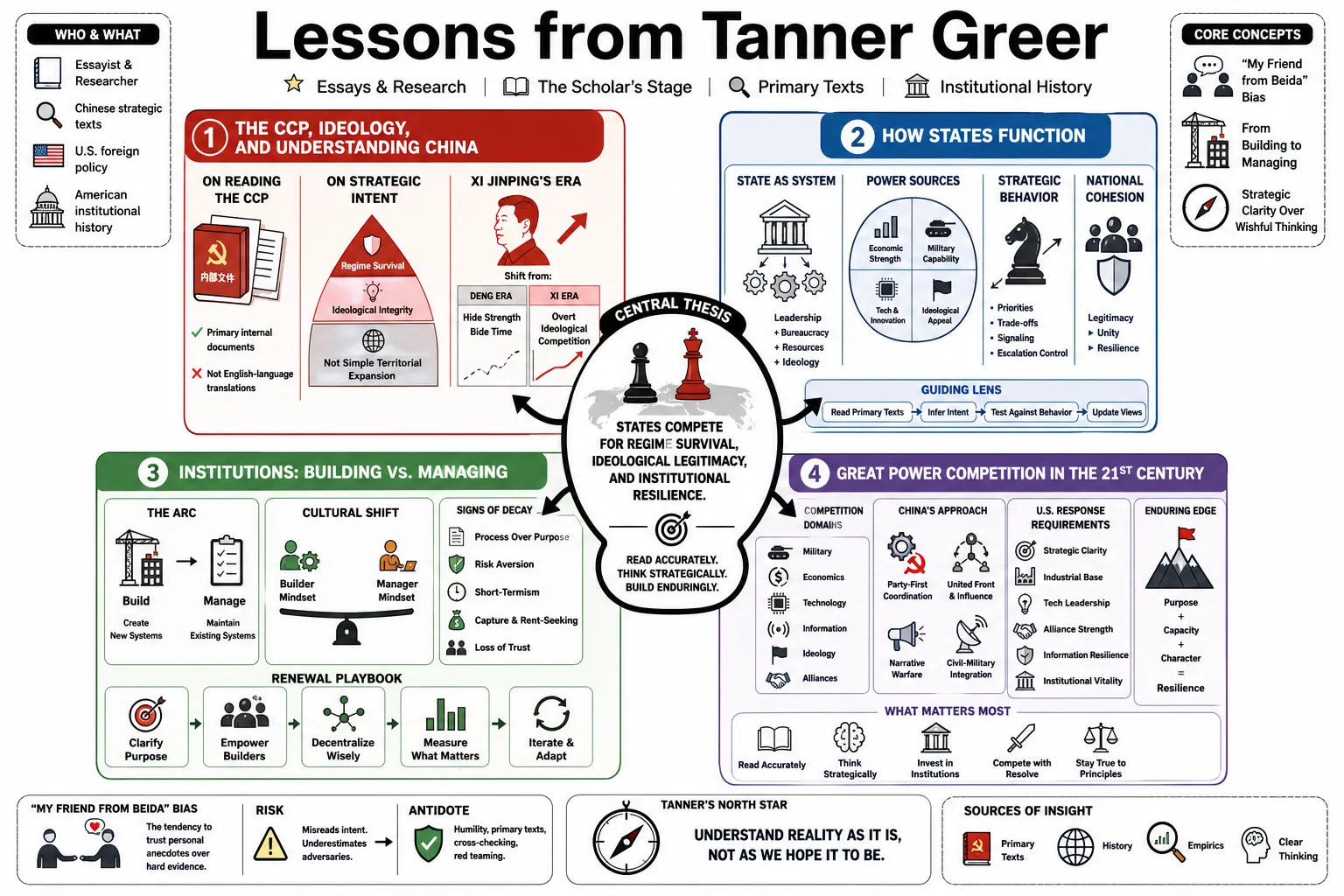
Part 1: The CCP, Ideology, and Understanding China
- On Reading the CCP: "If you want to understand what the Chinese Communist Party intends to do, you must read the primary documents they write for their internal consumption, not what they translate into English for foreign audiences." — Source: Center for Strategic Translation
- On Strategic Intent: "Regime survival and internal ideological integrity, rather than simple geographic expansion, are the primary drivers of Chinese state behavior." — Source: The Scholar's Stage
- On Xi Jinping's Era: "The current leadership has fundamentally abandoned Deng Xiaoping's paradigm of hiding strength and biding time, moving instead toward a phase of overt ideological competition." — Source: Foreign Policy Research Institute
- On Translation as Analysis: "The difficulty of understanding Chinese politics in the New Era is fundamentally an access problem—policymakers lack direct engagement with the strategic and historical texts that shape Beijing's worldview." — Source: City Journal
- On the Nature of the Rivalry: "The conflict between the United States and China is a fundamental clash over how human societies should be organized and governed." — Source: The Scholar's Stage
- On Maoist Imagery: "The re-embrace of Maoist rhetoric and imagery under Xi is not mere window dressing; it signals a return to a specific theory of history and party discipline." — Source: Palladium Magazine
- On the Belt and Road Initiative: "Many of the chosen quotations in Xi's internal speeches are direct acknowledgements of his awareness of the BRI's failings. Each of these statements is an attempt to steady the Initiative's course." — Source: The Scholar's Stage
- On Generational Turnover: "Changes in Chinese policy are often downstream of generational turnover within the party ranks, replacing pragmatic technocrats with ideological loyalists." — Source: The Scholar's Stage
- On Analyzing Authoritarian Systems: "The internal logic of a Leninist system forces its leaders to prioritize political control over economic efficiency whenever the two come into conflict." — Source: Foreign Affairs
Part 2: The "My Friend from Beida" Bias
- On Elite Bubbles: "Western observers frequently assume that the liberal, cosmopolitan views of the university students they befriend in Beijing represent the standard Chinese view, completely missing the actual beliefs of the ruling party." — Source: ChinaTalk
- On the Origin of the Bias: "The 'My Friend from Beida' problem occurs because foreign visitors to China naturally gravitate toward English-speaking, intellectually curious elites at institutions like Peking University." — Source: ChinaTalk
- On Projecting Values: "Because these students are often eager to share their skepticism of the party, a foreign visitor mistakenly concludes that the general Chinese public shares these same anti-authoritarian sentiments." — Source: The Scholar's Stage
- On False Optimism: "This exposure to a highly unrepresentative slice of Chinese society generated decades of false optimism in the West regarding China's inevitable democratic transition." — Source: The Scholar's Stage
- On the Language Barrier: "Relying on English-speaking Chinese interlocutors filters out the voices of the nationalist base and the hardline party cadres who actually steer state policy." — Source: ChinaTalk
- On Dissonance: "When the Chinese state acts in ways that contradict the assurances of these liberal friends, Western analysts often dismiss the state's actions as temporary aberrations rather than core policy." — Source: The Scholar's Stage
- On Representative Sampling: "To understand China, an analyst must actively seek out the media, literature, and speeches consumed by the rural and working-class party members, not just the urban elite." — Source: ChinaTalk
- On Empathy vs. Analysis: "Personal connections with Chinese liberals are valuable on a human level, but they become an analytic liability when used as a proxy for forecasting the behavior of the CCP." — Source: The Scholar's Stage
- On Correcting the Bias: "Overcoming this blindspot requires reading what the party writes to itself, stripped of the comforting translations designed to placate foreign sensibilities." — Source: Center for Strategic Translation
Part 3: Taiwan's Defense and National Resolve
- On Asymmetric Warfare: "It is much cheaper to build a ship-killing missile than it is to build a ship. But if this means that the Chinese army can counter U.S. force projection at a fraction of America's costs, it also means that the democracies straddling the East Asian rim can deter Chinese aggression at a fraction of the PLA's costs." — Source: Foreign Policy
- On the Cost of Defense: "In an era that favors defense, small nations like Taiwan do not need a PLA-sized military budget to keep the Chinese at bay." — Source: Foreign Policy
- On National Resolve: "Taiwan's greatest weakness is resolve. The Taiwanese people have little confidence in their military, and the Chinese invasion strategy is designed to take advantage of this." — Source: The Scholar's Stage
- On the Limits of American Support: "I cannot advocate sending American servicemen to die for the sake of a country that is not serious about defending itself." — Source: The Scholar's Stage
- On Conditional Guarantees: "Unless American diplomats deliver an ultimatum requiring serious military reform to the Taiwanese, I am not sure they ever will take their own defense as the existential crisis it truly is." — Source: The Scholar's Stage
- On Military Training: "The operational reality of Taiwan's military includes severe problems with training, culture, and readiness that undermine any theoretical asymmetric advantages." — Source: ChinaTalk
- On Public Denial: "A significant portion of the Taiwanese electorate remains in denial about the imminence of the threat, preferring to believe that the U.S. will handle the problem for them." — Source: The Scholar's Stage
- On Conscription: "A society facing an existential threat from a massive neighbor cannot rely on a hollowed-out conscription system; it requires a population prepared for mobilization." — Source: New Bloom Magazine
- On the Shift in Perspective: "Between 2018 and 2020, close observation of Taiwan's domestic politics forced a reassessment: hardware and geography mean nothing if the societal will to fight is absent." — Source: Substack
- On the Center of Gravity: "The success of the Chinese invasion strategy ultimately turns on the morale of the Taiwanese citizenry." — Source: The Scholar's Stage
Part 4: Strategy, Warfare, and Geopolitics
- On Defense Analysis: "Strategy must move beyond 'RANDspeak'—the technical, jargon-heavy analysis of weapons systems—to understand conflicts through a grounded, narrative lens." — Source: The Scholar's Stage
- On Strategic Ambiguity: "Maintaining strategic ambiguity regarding Taiwan forces both Beijing to calculate the risk of American intervention and Taipei to take responsibility for its own deterrence." — Source: The Scholar's Stage
- On the Cold War Analogy: "While the Cold War offers useful lessons in long-term ideological competition, applying it directly to modern China ignores the deep economic integration that defines the current era." — Source: Palladium Magazine
- On Assessing Intent: "Strategic intentions cannot be deduced solely from capabilities; they must be traced through the historical grievances and ideological texts that motivate state actors." — Source: Foreign Policy Research Institute
- On Military Procurement: "The obsession with prestigious, big-ticket military platforms often leaves frontline forces without the basic munitions and logistical support required for actual combat." — Source: The Scholar's Stage
- On the Logic of Authoritarianism: "Authoritarian regimes frequently make suboptimal economic and foreign policy decisions because their internal incentive structures punish delivering bad news to the center." — Source: The Scholar's Stage
- On Alliance Systems: "The U.S. alliance network in the Pacific is less a unified bloc and more a series of bilateral agreements with states that hold vastly different tolerances for confronting Beijing." — Source: Foreign Affairs
- On Geography: "The fundamental geography of the First Island Chain remains the defining constraint on Chinese maritime expansion, dictating the shape of any future conflict." — Source: Foreign Policy
- On the Role of History in Strategy: "Statesmen who ignore the historical narratives their adversaries teach in their schools will routinely be surprised by their adversaries' geopolitical risk-taking." — Source: Center for Strategic Translation
Part 5: "Cultures That Build" and Institutional Decay
- On the Managerial Shift: "In the 21st century, the main question in American social life is not 'how do we make that happen?' but 'how do we get management to take our side?'" — Source: The Scholar's Stage
- On the Consequences of Management: "This is a learned response, and a culture which has internalized it will not be a culture that 'builds.'" — Source: The Scholar's Stage
- On Civic Infrastructure: "America once possessed a dense network of fraternal societies and local associations that acted as training grounds for agency and self-organization." — Source: The Scholar's Stage
- On Institutional Impotence: "At every level of society, individuals have lost the authority to act on their own judgment due to an accumulation of real or feared bureaucratic constraints." — Source: The Aaron Renn Show
- On the Loss of Practical Skills: "A society that outsources all mechanical and logistical problem-solving to distant specialists gradually loses the localized competence required to maintain its own infrastructure." — Source: The Scholar's Stage
- On the Vetocracy: "Modern institutional design prioritizes the ability to halt action over the ability to execute it, leading to systemic paralysis." — Source: The Aaron Renn Show
- On State Capacity: "The decline in American state capacity is fundamentally a cultural issue, rooted in a loss of trust in ground-level execution." — Source: Palladium Magazine
- On High-Agency Organizations: "Groups like the U.S. Marine Corps or the LDS Church maintain a culture of execution by isolating themselves from the broader societal trend toward managerialism." — Source: The Aaron Renn Show
- On the Progressive Era: "The reformers of the early 20th century succeeded because they possessed a culture of tinkering and grassroots institution-building that modern activists lack." — Source: The Scholar's Stage
- On Rebuilding Trust: "Restoring institutional capacity requires decentralizing authority and accepting that empowering individuals to build means accepting the friction of occasional failure." — Source: The Scholar's Stage
Part 6: American Conservatism and The New Right
- On the New Right: "The American New Right represents a fundamental break from Cold War-era conservatism, prioritizing state capacity and industrial policy over free-market orthodoxies." — Source: Unsupervised Learning
- On Elite Circulation: "Political realignments occur when a rising counter-elite successfully captures or builds parallel institutions to challenge an entrenched managerial class." — Source: The Scholar's Stage
- On Conservative Intellectuals: "The failure of legacy conservative institutions was their inability to recognize that the culture they were trying to conserve had already been dismantled." — Source: The Scholar's Stage
- On Populism: "Populist movements act as an alarm system indicating that elite institutions have insulated themselves too thoroughly from the consequences of their own policies." — Source: The Scholar's Stage
- On the Tech Right: "The emerging alliance between certain Silicon Valley factions and the political right is driven by a shared frustration with institutional sclerosis and bureaucratic friction." — Source: The Aaron Renn Show
- On the Failure of Fusionism: "The old fusionist consensus held together only as long as the Soviet threat existed; without an external enemy, its internal contradictions became unmanageable." — Source: Unsupervised Learning
- On the Role of Institutions: "Conservatives often write essays complaining about cultural decline, while their opponents build the HR departments and legal frameworks that actually dictate cultural norms." — Source: The Scholar's Stage
- On Cultural Transmission: "A political movement cannot survive if it fails to build the educational and social pipelines necessary to transmit its worldview to the next generation." — Source: The Scholar's Stage
- On Foreign Policy: "The intellectual underpinnings of the populist approach to foreign policy emphasize a transactional skepticism of international institutions and a focus on hard power." — Source: ChinaTalk
Part 7: History, Generational Cycles, and the Gilded Age
- On Historical Memory: "A society that forgets its own history loses the vocabulary necessary to understand its present crises." — Source: The Scholar's Stage
- On the Silicon Valley Canon: "Modern tech elites study the biographies of great men to understand leadership, trying to reverse-engineer the agency that produced historical greatness." — Source: The Scholar's Stage
- On the Gilded Age: "Comparing modern tech billionaires to Gilded Age industrialists reveals a shift: the industrialists built physical infrastructure, while today's elite build digital frameworks that abstract away physical reality." — Source: The Aaron Renn Show
- On the Myth of the Rugged Individual: "Historical American masculinity was not defined by isolated, rugged individualism, but by public usefulness and service to a localized community." — Source: Palladium Magazine
- On Reading Great Books: "The decline in reading historical and classical texts limits the horizon of what modern leaders believe is politically and socially possible." — Source: The Scholar's Stage
- On Spenglerian Decline: "The feeling of living in a stagnant era stems from the observation that our culture is increasingly recycling past forms rather than generating new world-historical ideas." — Source: The Scholar's Stage
- On Generational Cycles: "Societal resilience fluctuates as generations that lived through existential crises are replaced by those who inherit institutions they do not fully understand how to operate." — Source: The Scholar's Stage
- On Applying History: "History does not provide exact blueprints for the future, but it does expose the recurring failure modes of complex societies." — Source: The Scholar's Stage
- On Public Usefulness: "The metric for a successful life in earlier American eras was the tangible improvement of one's immediate physical and civic environment." — Source: Palladium Magazine
Part 8: Agency, Culture, and the Over-Managed Society
- On Young Adult Fiction: "The massive popularity of dystopian YA fiction is a symptom of a society where 21st-century Americans feel stripped of agency." — Source: The Scholar's Stage
- On the Myths of the Over-Managed: "These stories act as the myths of the over-managed, providing a fictional outlet for the desire to dismantle the bureaucratic systems that constrain daily life." — Source: The Scholar's Stage
- On the Modern Workplace: "The modern corporate environment trains individuals to seek permission rather than to take initiative, fundamentally altering how they behave in their civic lives." — Source: The Scholar's Stage
- On the Education System: "Schools increasingly function to socialize children into compliance with managerial authority rather than preparing them for autonomous action." — Source: The Scholar's Stage
- On the Internet as an Outlet: "Because physical space is heavily regulated and monitored, the internet has become the only remaining frontier where young people can exercise raw agency." — Source: The Scholar's Stage
- On Stripped Agency: "When the built environment and the legal code make it impossible to host a neighborhood event without a permit, the civic muscle of the community atrophies." — Source: The Aaron Renn Show
- On Fraternal Societies: "The collapse of local lodges and associations removed the primary mechanism by which average citizens learned how to run a meeting, manage a budget, and execute a project." — Source: The Scholar's Stage
- On Self-Organization: "The antidote to a managerial culture is the deliberate practice of self-organization outside the purview of formal institutions." — Source: The Scholar's Stage
- On Reclaiming Agency: "Reclaiming agency requires a willingness to bypass established administrative pathways and assume the risk of acting independently." — Source: The Aaron Renn Show
- On the Future of Civic Life: "If America is to recover its ability to build, it must first deliberately dismantle the cultural and legal norms that penalize independent action." — Source: The Scholar's Stage