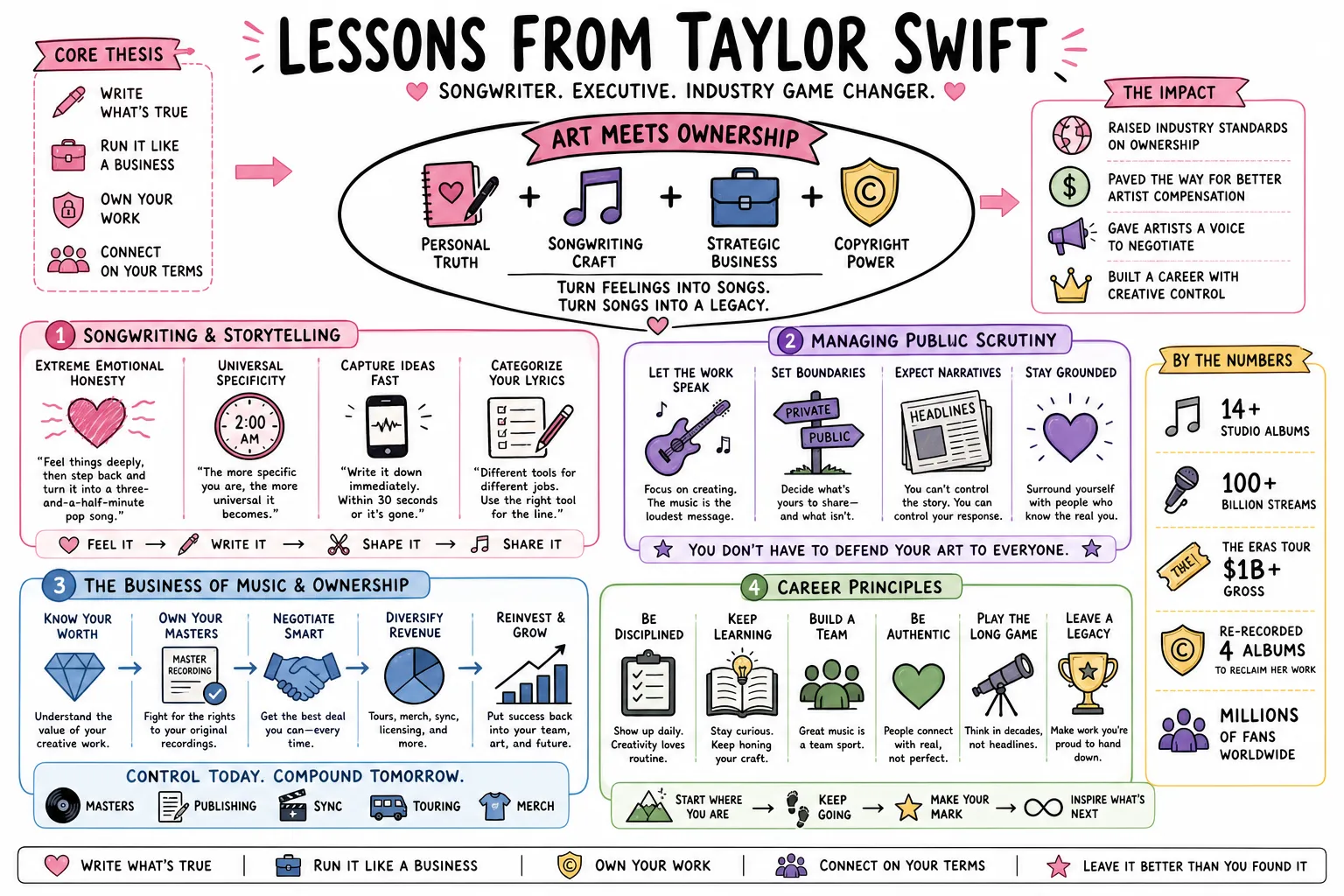
Lessons from Taylor Swift
Taylor Swift is a songwriter and executive who changed modern industry standards around copyright ownership and artist compensation. She built her career by treating her lyrics as specific personal records while running her tours and releases as a structured enterprise. This profile collects her documented advice on writing music, managing public scrutiny, and operating an entertainment business.
Part 1: Songwriting and Storytelling
- On extreme emotional honesty: "I've always felt like there's this weird balancing act of feeling things really deeply, to the point of near delusion, and then stepping back and turning it into a three-and-a-half-minute pop song." — Source: [Apple Music]
- On universal specificity: "The more specific you are, the more universal it becomes. If you write about a very specific feeling you had at 2 AM, someone else in the world felt that exact same thing." — Source: [Time Magazine]
- On capturing ideas: "I have to write it down immediately. If I have an idea for a lyric or a melody and I don't record it into my phone within 30 seconds, it's gone forever." — Source: [GQ]
- On categorizing lyrics: "I came up with these categories of lyrics based on what tool I imagine I was holding when I wrote them: Quill Pen, Fountain Pen, and Glitter Gel Pen." — Source: [NSAI Awards]
- On musical storytelling: "I love writing songs because I love telling stories. A song is just a story set to a melody, and the melody is supposed to dictate how the story makes you feel." — Source: [Billboard]
- On vulnerability: "My favorite kind of writing is when it's just so painfully honest that it makes you uncomfortable to read it." — Source: [Vogue]
- On trusting instincts: "You have to prioritize what you love down to your very core, because the internet will change its mind about what's cool every 15 seconds." — Source: [NYU Commencement]
- On writer's block: "Writer's block is usually just a fear of writing something bad. You just have to let yourself write bad songs until the good ones start coming back." — Source: [Rolling Stone]
- On collaboration: "When I cowrite, I like to bring a finished chorus or a very strong concept. I never want to walk into a room empty-handed." — Source: [Grammy Pro]
- On fictionalizing life: "With Folklore, I realized I didn't just have to write about my own life. I could create characters and storylines, and it was the most freeing experience." — Source: [Disney+]
Part 2: The Business of Music
- On owning your labor: "Artists should own their own work for so many reasons, but the most screamingly obvious one is that the artist is the only one who really knows that body of work." — Source: [Billboard]
- On the value of art: "Music is art, and art is important and rare. Important, rare things are valuable. Valuable things should be paid for." — Source: [Wall Street Journal]
- On strategic thinking: "Women in music are often not allowed to say they are strategic. It's supposed to be a happy, talented accident. But when you realize the rules of the game you're playing, you have to look at the board and make your strategy." — Source: [Time Magazine]
- On negotiating with streaming services: "I felt like I was the only one saying that the terms didn't feel right. When Apple changed their policy, it showed me that standing up for other creators can actually move the needle." — Source: [Vanity Fair]
- On direct distribution: "We decided to bypass the studio system and put the Eras Tour film directly in AMC theaters because we wanted the fans to have it faster, and we wanted to control the terms." — Source: [Variety]
- On betting on yourself: "Every time I've had to make a massive, terrifying business decision, it has come down to betting on myself when institutions told me to play it safe." — Source: [Forbes]
- On knowing your audience: "Nobody knows my fans like I do. The label can run analytics, but I actually talk to them online every single day." — Source: [Entertainment Weekly]
- On contractual leverage: "When I signed my new record deal, I made it a condition that if they ever sell their Spotify shares, the money must be distributed to the artists, non-recoupable." — Source: [Rolling Stone]
- On touring economics: "A tour isn't just a string of shows; it's a massive traveling company, and as the boss, you have to ensure the crew is treated and paid extraordinarily well." — Source: [Pollstar]
- On long-term brand equity: "I never make a decision based on what will make the most money tomorrow. I think about what will protect the trust I have with my audience ten years from now." — Source: [Fast Company]
Part 3: Managing Criticism and Public Perception
- On internet backlash: "When millions of people hate you very loudly, it is a very physically isolating experience. You either let it break you, or you use it to build a new foundation." — Source: [Vogue]
- On controlling the narrative: "If you are lucky enough to have people care about what you do, they will invent a version of you. Your only job is to make sure your actual work outshines their fiction." — Source: [Time Magazine]
- On shedding good-girl complex: "I spent my whole life trying to be the good girl who does the right thing. It is incredibly liberating to finally let go of the need to be universally liked." — Source: [Netflix]
- On processing failure: "My mistakes have been my most important lessons. The moments I've been publicly humiliated were the exact catalysts for the best work of my life." — Source: [NYU Commencement]
- On gendered criticism: "A man is allowed to react. A woman can only overreact. A man does something, it's strategic. A woman does the same thing, it's calculated." — Source: [CBS Sunday Morning]
- On ignoring noise: "I had to learn to mute the noise. I literally turned off comments on my social media because I needed to train my brain to stop seeking external validation." — Source: [Elle]
- On responding through art: "I don't need to do an interview to defend myself against a rumor. I can just write a song about it, and the song will last much longer than the rumor." — Source: [Rolling Stone]
- On outgrowing shame: "You will cringe at things you did five years ago. Let yourself cringe. Cringe is unavoidable over a lifetime. Just don't let it stop you from trying." — Source: [NYU Commencement]
- On public apologies: "If I make a real mistake, I will apologize and try to fix it. But I will no longer apologize for existing, taking up space, or being successful." — Source: [Guardian]
- On living with scrutiny: "You can't live your life reacting to what strangers think of you. You have to live your life for the people who actually know you." — Source: [BBC]
Part 4: Fan Connection and Community
- On treating fans like friends: "I've never looked at my fans as consumers. I look at them as friends I just haven't met yet, and I talk to them the exact same way I talk to my best friends." — Source: [Tumblr]
- On inside jokes: "Leaving Easter eggs and clues in my music videos and lyrics is just a way to have a secret language with the people who care the most." — Source: [Entertainment Weekly]
- On active listening: "I lurk online. I read what they are saying, what they care about, what they are struggling with, and it heavily influences what I write about next." — Source: [BBC Radio 1]
- On loyalty: "They have had my back when no one else did. My job is to consistently give them music that makes them feel understood in return." — Source: [Billboard]
- On meet-and-greets: "I do free meet-and-greets before or after shows because I want to meet the people who lined up for hours, not just the people who could afford a VIP ticket." — Source: [Time Magazine]
- On shared experiences: "When we are in a stadium of 70,000 people screaming the bridge to a song, it stops being my song and becomes our song." — Source: [Variety]
- On growing up together: "The most beautiful part of my career is that I've been writing the soundtrack to my life, and somehow it became the soundtrack to theirs. We are growing up side by side." — Source: [Vogue]
- On community building: "I wanted my shows to feel like a massive, glittering support group where everyone is allowed to feel their feelings loudly without judgment." — Source: [Rolling Stone]
- On rewarding attention: "If a fan is going to take the time to analyze a music video frame by frame, I have a responsibility to make sure there is actually something hidden there for them to find." — Source: [The Tonight Show]
Part 5: Reinvention and Era-Building
- On necessary evolution: "Female artists have to reinvent themselves 20 times more than male artists. You have to find a new facet of yourself that people find shiny, or you are out of a job." — Source: [Netflix]
- On visual storytelling: "An era isn't just about changing clothes. It's an entire visual and sonic architecture that communicates the exact emotional tone of the album." — Source: [Apple Music]
- On genre shifting: "Going from country to pop wasn't an abandonment of my roots; it was a realization that I had hit the ceiling of what I could creatively achieve in that specific room." — Source: [Billboard]
- On taking risks: "If you do the same thing twice, people will complain it's boring. If you do something entirely different, they will say they miss the old you. So you just have to do what interests you." — Source: [NPR]
- On committing to a bit: "When I did the Reputation era, I knew I had to commit completely to the dark, snake-heavy aesthetic. Half-measures don't work when you're trying to shift public perception." — Source: [Time Magazine]
- On the concept of time: "The Eras Tour was my way of looking back at all these different versions of myself and realizing they all still exist in me at the same time." — Source: [Variety]
- On surprising the audience: "Just when they think they have me figured out, I like to drop a surprise folk album in the woods. You have to keep them on their toes." — Source: [Disney+]
- On discarding old rules: "Every time I start a new album, I write down a list of rules I followed on the last one, and then I systematically try to break them." — Source: [Rolling Stone]
- On aesthetic cohesion: "Everything from the font on the album cover to the color of the confetti at the tour has to tell the exact same story." — Source: [Entertainment Weekly]
Part 6: Work Ethic and Ambition
- On outworking talent: "I've never considered myself the best singer or the most naturally gifted musician, but I know I can outwork almost anyone in the room." — Source: [GQ]
- On relentless focus: "I treat my career like a marathon. You don't win a marathon by sprinting the first mile; you win by training every day and pacing yourself." — Source: [Time Magazine]
- On physical preparation: "To prepare for the Eras Tour, I spent six months running on a treadmill every day while singing the entire setlist out loud to make sure my stamina was unbreakable." — Source: [Time Magazine]
- On ambition as a dirty word: "We teach women to shrink themselves. I decided a long time ago that I was going to be unapologetically ambitious, and I wasn't going to hide it anymore." — Source: [Netflix]
- On output volume: "The only way to guarantee a few great songs is to write hundreds of terrible ones. Volume is the only path to quality." — Source: [Apple Music]
- On taking nothing for granted: "The moment you think you deserve to be at the top is the moment you start sliding down. I wake up every day terrified I might lose it, which is why I work so hard." — Source: [Vogue]
- On the value of effort: "There is no such thing as trying too hard. The people who tell you not to care are just afraid of failing." — Source: [NYU Commencement]
- On directing her own work: "I started directing my own music videos because I realized I was the only one who had the exact picture in my head of what it needed to look like." — Source: [Tribeca Film Festival]
- On pushing boundaries: "I always want to see if I can run faster, jump higher, and write a better bridge than I did last time." — Source: [Billboard]
Part 7: Independence and Ownership
- On the Taylor's Version project: "Re-recording my first six albums wasn't just a financial decision; it was a psychological exercise in reclaiming my own life's work from people who tried to hold it hostage." — Source: [Time Magazine]
- On legal boundaries: "You have to read your own contracts. Don't let a lawyer just summarize it for you. You need to know exactly what you are signing your life away to." — Source: [Forbes]
- On self-advocacy: "No one is going to fight for your art as hard as you will. If you don't speak up for yourself in the boardroom, the room will decide your fate for you." — Source: [Wall Street Journal]
- On leaving Big Machine: "Walking away from the label I started with was the hardest thing I've ever done, but staying would have meant giving up my future." — Source: [Rolling Stone]
- On setting industry precedents: "If I can use my leverage to negotiate better terms with streaming platforms, then it's my responsibility to do that for the indie artists who don't have that leverage." — Source: [Vanity Fair]
- On ignoring naysayers: "When I decided to re-record, industry experts told me it was a massive waste of time. They didn't understand that for me, ownership is the only currency that matters." — Source: [CBS Sunday Morning]
- On building a team: "I try to surround myself with people who aren't afraid to tell me my ideas are bad. You cannot survive in this industry in an echo chamber." — Source: [GQ]
- On financial independence: "Being fiercely independent financially means I never have to make a creative decision based out of panic or desperation." — Source: [Time Magazine]
- On legacy: "I want to leave behind a catalog that is entirely mine, and a blueprint for other young artists to demand the same." — Source: [Billboard]
Part 8: Navigating Fame and Adulthood
- On losing anonymity: "I haven't walked down a street completely unnoticed since I was a teenager. You mourn that loss of normalcy, but you also accept it as the cost of admission for this life." — Source: [Rolling Stone]
- On female friendships: "In an industry that constantly tries to pit women against each other, maintaining fiercely loyal female friendships is an act of rebellion." — Source: [Vogue]
- On aging in pop music: "Society has a weird habit of discarding women as they age. I've decided I'm just going to keep making art and force them to deal with me getting older." — Source: [Netflix]
- On protecting private life: "I've learned the hard way that you have to keep certain things entirely to yourself. Not everything belongs to the public." — Source: [Guardian]
- On setting boundaries: "Saying no is a complete sentence. I spent years saying yes to everything because I wanted to be agreeable, and it nearly exhausted me to death." — Source: [Elle]
- On finding happiness: "Happiness isn't a permanent state. It's a fleeting moment you have to actively catch and hold onto when you can." — Source: [Apple Music]
- On forgiveness: "You don't have to forgive everyone who hurts you. Sometimes moving on is just accepting that they did it and choosing not to carry it anymore." — Source: [NYU Commencement]
- On trusting the journey: "You are going to mess up, and it's going to hurt, but you are also going to survive it and write a great song about it later." — Source: [Time Magazine]
- On defining success: "At the end of the day, success isn't about the awards or the record sales. It's about knowing I told the truth in my work." — Source: [Billboard]