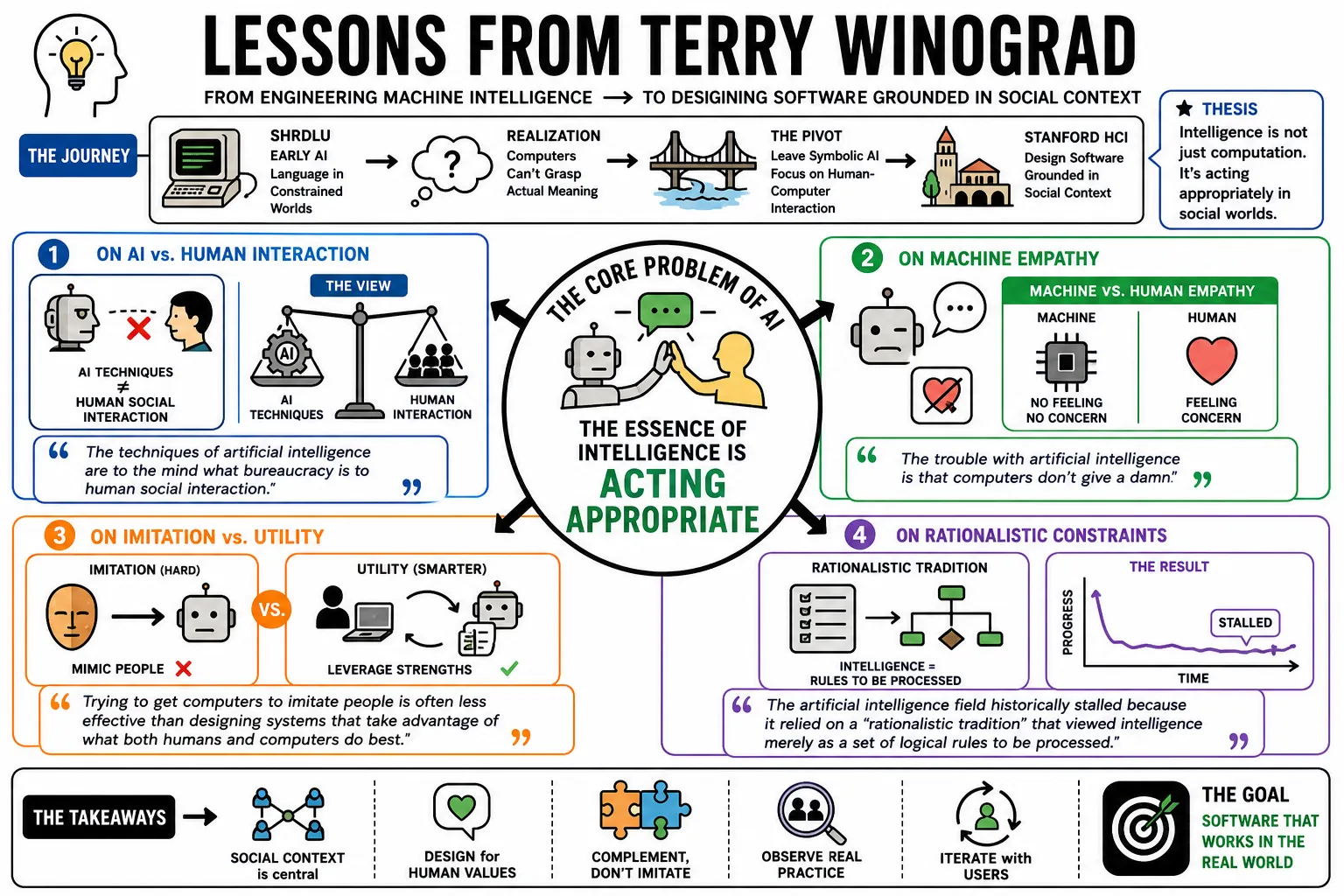
Terry Winograd began his career building SHRDLU, an early AI program that parsed language in strictly constrained environments. When he realized computers couldn't grasp actual meaning, he abandoned symbolic AI to focus on human-computer interaction at Stanford. The lessons below track his shift from engineering machine intelligence to designing software grounded in social context.
Part 1: The Limits of Artificial Intelligence
- On AI vs. Human Interaction: "The techniques of artificial intelligence are to the mind what bureaucracy is to human social interaction." — Source: [QuoteFancy]
- On Machine Empathy: "The trouble with artificial intelligence is that computers don't give a damn." — Source: [Boston Review]
- On Imitation vs. Utility: Trying to get computers to imitate people is often less effective than designing systems that take advantage of what both humans and computers do best. — Source: [Interaction Design Foundation]
- On Rationalistic Constraints: The artificial intelligence field historically stalled because it relied on a "rationalistic tradition" that viewed intelligence merely as a set of logical rules to be processed. — Source: [Understanding Computers and Cognition]
- On the Core Problem of AI: The essence of intelligence is acting appropriately when there is no simple pre-definition of the problem or the space of states in which to search for a solution. — Source: [Understanding Computers and Cognition]
- On True Intelligence: True intelligence requires "being-in-the-world" and operating within a cultural background that cannot be fully formalized into code. — Source: [Understanding Computers and Cognition]
- On Formalization's Blindness: Every computational formalization, like a software program, is necessarily blind to the human context it intentionally leaves out. — Source: [Understanding Computers and Cognition]
- On the Limitations of Micro-worlds: SHRDLU succeeded in a "blocks world" precisely because every word had a clear, unambiguous physical referent, which is fundamentally not how human reality works. — Source: [Charles Babbage Institute]
- On LLMs and Grounding: Large language models are grounded only in statistical patterns of text, which remains entirely different from being grounded in a physical and social world. — Source: [The Gradient]
- On Finding Meaning: Progress in computing is not made by finding the right answers, but by asking meaningful questions about what it means to be human. — Source: [QuoteFancy]
Part 2: The Fallacy of the Machine Brain
- On the Computer Metaphor: "The most important thing to learn is that the computer is not a brain, but a tool for human communication and action." — Source: [Understanding Computers and Cognition]
- On Anthropomorphizing Machines: Ascribing human traits to machines is a dangerous mistake because it obscures the human responsibility behind the software. — Source: [Understanding Computers and Cognition]
- On Biological vs. Computational Processing: Human thought operates on a background of existence and thrownness, an entirely different reality from the presence-at-hand processing of a machine. — Source: [Understanding Computers and Cognition]
- On Machine Intelligence as Illusion: What we perceive as machine intelligence is merely the playback of human intelligence that the programmer embedded into the system's design. — Source: [Understanding Computers and Cognition]
- On Concealing Responsibility: "In the absence of this perspective it becomes all too easy to make the dangerous mistake of interpreting the machine as making commitments, thereby concealing the source of responsibility." — Source: [Understanding Computers and Cognition]
- On Problem Solving: "A 'problem' always arises for human beings in situations where they live—in other words, it arises in relation to a background." — Source: [Understanding Computers and Cognition]
- On the Machine as Intermediary: "Once we recognize the machine as an intermediary, it becomes clear that the commitment inherent in the use of language is made by those who produce the system." — Source: [Understanding Computers and Cognition]
- On the Myth of Objective Data: "Objects and properties are not 'out there' in the world, but are artifacts of our own ways of breaking down the world into manageable pieces." — Source: [Understanding Computers and Cognition]
- On Context-Free Facts: Machines operate on context-free data, but human meaning relies entirely on the specific situations and histories in which facts arise. — Source: [Understanding Computers and Cognition]
Part 3: Language and Social Commitment
- On Linguistic Action: "Linguistic action is... the essential human activity." — Source: [Understanding Computers and Cognition]
- On Language as Commitment: "Sentences are to be treated not as 'statements of fact about an objective world,' but as 'actions in a space of commitments.'" — Source: [Understanding Computers and Cognition]
- On the Capacity of Computers: "Computers will remain incapable of using language in the way human beings do, both in interpretation and in the generation of commitment that is central to language." — Source: [Understanding Computers and Cognition]
- On Responsible Beings: "We treat other people not as merely 'rational beings' but as 'responsible beings.' An essential part of being human is the ability to enter into commitments." — Source: [Understanding Computers and Cognition]
- On Language Disclosing Worlds: "Language is not a tool used within a world. It is the medium through which a world is disclosed." — Source: [Understanding Computers and Cognition]
- On the Function of Dialog: A proper software system must have a dialog with the person, accommodating the back-and-forth flow of human interaction rather than just parsing grammar. — Source: [Bringing Design to Software]
- On the Illusion of Machine Talk: When a machine generates text, it is simply producing symbols without the existential weight of a promise, a threat, or a lie. — Source: [Understanding Computers and Cognition]
- On Hermeneutics: Interpretation is always grounded in the prejudices and background of the interpreter, meaning language cannot be decoupled from the human listener. — Source: [Understanding Computers and Cognition]
- On Social Action: Moving from seeing language as a representation of reality to seeing it as a coordination of social action transforms how we design interfaces. — Source: [Understanding Computers and Cognition]
Part 4: Interaction Design Over Software Engineering
- On Interaction Design: "Interaction design is about designing a space for people, where that space has to have a temporal flow." — Source: [Bringing Design to Software]
- On the Designer's Eye: "To design software that really works, we need to move from a constructor's-eye view to a designer's-eye view, taking the system, the users, and the context all together as a starting point." — Source: [Bringing Design to Software]
- On Software as a Medium: "Software is a medium for the creation of virtualities—the world in which a user of the software perceives, acts, and responds." — Source: [Bringing Design to Software]
- On Engineering vs. Design: "One of the main reasons most computer software is so abysmal is that it's not designed at all, but merely engineered." — Source: [Bringing Design to Software]
- On the Activity of Programming: "The main activity of programming is not the origination of new independent programs, but in the integration, modification, and explanation of existing ones." — Source: [QuoteFancy]
- On the Openness of Software: Software design is a user-oriented field that demands the human openness of disciplines like architecture, rather than the hard-edged formulaic certainty of engineering. — Source: [Bringing Design to Software]
- On Adapting Ideas: "The secret of great design is to know what to steal and to know when some element or some way of doing things that worked before will be appropriate to your setting and then adapt it." — Source: [Bringing Design to Software]
- On What "Works" Means: When software engineers say a program works, they mean it meets specifications; when designers say it works, they mean it successfully serves people in a context of values and needs. — Source: [Bringing Design to Software]
- On the User's Conceptual Model: The most important thing to design properly in a software system is the user's conceptual model of how the entire environment operates. — Source: [Stanford HCI Group]
- On Beyond the Interface: "The look and feel of a product is but one part of its design." The deeper design lies in the virtual world and the workflows it creates. — Source: [Bringing Design to Software]
Part 5: Designing Ways of Being
- On Ontological Design: "We encounter deep questions of design when we recognize that in designing tools we are designing ways of being." — Source: [Understanding Computers and Cognition]
- On Technology and Human Nature: "All new technologies develop within the background of a tacit understanding of human nature and human work." — Source: [Understanding Computers and Cognition]
- On Technology Altering Us: "The use of technology in turn leads to fundamental changes in what we do, and ultimately in what it is to be human." — Source: [Understanding Computers and Cognition]
- On Breakdown and the Hammer: "The hammer is not an object with properties for the person who is using it... it is 'ready-to-hand.' It becomes 'present-at-hand' only when there is a breakdown." — Source: [Understanding Computers and Cognition]
- On Transparency: Good design makes a tool transparent, allowing the user to focus entirely on their goal rather than fighting with the interface. — Source: [Understanding Computers and Cognition]
- On the Network of Practices: "The significance of a new invention lies in how it fits into and changes [the] network [of institutions, equipment, practices, and conventions]." — Source: [Understanding Computers and Cognition]
- On Bridging Two Worlds: The role of the designer is to stand with one foot in the world of technology and the other in the world of human purposes, bringing the two together. — Source: [Bringing Design to Software]
- On the Background of Action: Every tool is built against a background of unarticulated cultural assumptions that dictate how it will actually be utilized in reality. — Source: [Understanding Computers and Cognition]
- On Designing Work: Introducing a new piece of software into an office is not merely automating a task; it is an active redesign of the social structure of the workplace. — Source: [Understanding Computers and Cognition]
Part 6: Technology and Responsibility
- On the Technologist's Moral Obligation: "Technology is driving the future… it is up to us to do the steering." — Source: [Computer Professionals for Social Responsibility]
- On the Loss of Control: "Once I've built it, if I don't own it, I cannot control who's going to use it for what," highlighting the inherent risk in creating powerful systems. — Source: [Computer Professionals for Social Responsibility]
- On Corporate Profit Motives: "I have always been painfully aware of the way that the profit motives of big corporations lead them to trample on the rights and needs of the people." — Source: [CPSR Archives]
- On the Illusion of Harmlessness: "It's very easy to say 'oh, I would never do anything bad... but I would never let it.' And to realize that's not your ability." — Source: [Computer Professionals for Social Responsibility]
- On Shaping the Future: The technologist's true role is not merely building capability, but asking how to shape the space of possibilities in a direction that is more humane. — Source: [ACM Ubiquity]
- On the Distraction of Tech in Education: "There is a tendency to throw computers at third world problems, which I think is often a distraction. Putting computers in the schools is great, but it may be more important to put teachers in the schools." — Source: [QuoteFancy]
- On AI as a Societal Threat: Designing machines to make autonomous decisions threatens the fabric of human accountability, as only humans can bear the weight of moral choices. — Source: [Computer Professionals for Social Responsibility]
- On Protecting the Public Interest: Computer scientists must actively organize and advocate for the public interest, as technological momentum will not self-correct toward ethical outcomes. — Source: [Computer Professionals for Social Responsibility]
- On Designing for the Full Human Experience: "Designing for the full range of human experience may well be the theme for the next generation of discourse about software design." — Source: [Bringing Design to Software]
Part 7: The Stanford Era and Google's Genesis
- On the Role of Academic Mentorship: As Larry Page’s PhD advisor, Winograd's guidance proved that sometimes the most valuable role a professor plays is redirecting a student toward a more foundational problem. — Source: [Stanford University History]
- On the Mathematical Web: Winograd encouraged Larry Page to focus on the mathematical properties of the World Wide Web's link structure, which Page later called "the best advice I ever got." — Source: [Wikipedia: Larry Page]
- On PageRank's Origins: The development of the PageRank algorithm, introduced in the seminal 1998 paper co-authored by Winograd, demonstrated how organizing information can be a profound act of design. — Source: [Stanford InfoLab]
- On Moving from AI to HCI: Winograd’s transition from building symbolic AI systems at MIT to founding the HCI Group at Stanford marked a historic shift in how computer science departments valued the user experience. — Source: [Stanford d.school History]
- On the Multi-Disciplinary Approach: By bringing together computer scientists, psychologists, and designers at Stanford, Winograd proved that software creation requires a synthesis of the humanities and engineering. — Source: [Stanford HCI Group]
- On the Impact of "Demo" Culture: Reflecting on the MIT AI lab, Winograd recognized that "demo" culture often rewarded fragile, heavily constrained systems over robust, real-world utility. — Source: [Charles Babbage Institute]
- On Student Empowerment: The Stanford environment cultivated by Winograd prioritized giving students the freedom to tackle massive, unstructured problems like organizing the entire internet. — Source: [Stanford Computer Science]
- On Academic vs. Commercial Computing: The shift from academic computing to commercial applications required a fundamental change in how software interacts with human social structures. — Source: [ACM Ubiquity]
- On Integrating Design Thinking: Winograd's involvement in the founding of the Stanford d.school cemented the idea that "design thinking" is an essential methodology for addressing complex systemic challenges. — Source: [Stanford d.school]
- On Evaluating Impact: The true measure of a research project's success is not its theoretical purity, but the degree to which it meaningfully organizes or improves human activity. — Source: [Bringing Design to Software]
Part 8: The Future of Human-Computer Interaction
- On the Next 50 Years: "In the next 50 years, the increasing importance of designing spaces for human communication and interaction will lead to expansion in those aspects of computing that are focused on people, rather than machinery." — Source: [QuoteFancy]
- On Seeking Humanity: "In asking what computers can do, we are drawn into asking what people do with them, and in the end into addressing the fundamental question of what it means to be human." — Source: [Understanding Computers and Cognition]
- On Moving Past Machinery: The era of treating the computer as an end in itself is over; the future belongs to disciplines that treat the computer purely as a substrate for human connection. — Source: [Bringing Design to Software]
- On Evolving the Paradigm: The evolution of HCI requires moving beyond graphical interfaces into designing the very structure of how organizations and communities collaborate. — Source: [Stanford HCI Group]
- On Continuous Adaptation: Because human needs and cultural backgrounds are always in flux, the design of interaction spaces must be an ongoing, temporal dialogue rather than a static artifact. — Source: [Bringing Design to Software]
- On Beyond Imitation: The future of technology lies not in machines that successfully masquerade as humans, but in tools that transparently amplify human capabilities. — Source: [Interaction Design Foundation]
- On the Ultimate Goal: The highest achievement of a software system is to become so deeply integrated into a community's practices that its technical nature disappears completely. — Source: [Understanding Computers and Cognition]
- On Shifting from Rules to Context: The future of system design must abandon rigid, rule-based logic in favor of architectures that gracefully handle ambiguity and shifting contexts. — Source: [Understanding Computers and Cognition]
- On the Heart of the Quest: "Ultimately, we are seeking a better understanding of what it means to be human." — Source: [QuoteFancy]