Tim Hwang is a researcher and lawyer who studies technology policy and the economics of science. His best-known book, Subprime Attention Crisis, makes the case that the digital advertising market is fundamentally broken and overvalued. This collection gathers his work on programmatic ads, AI governance, internet culture, and how scientific research actually gets funded.
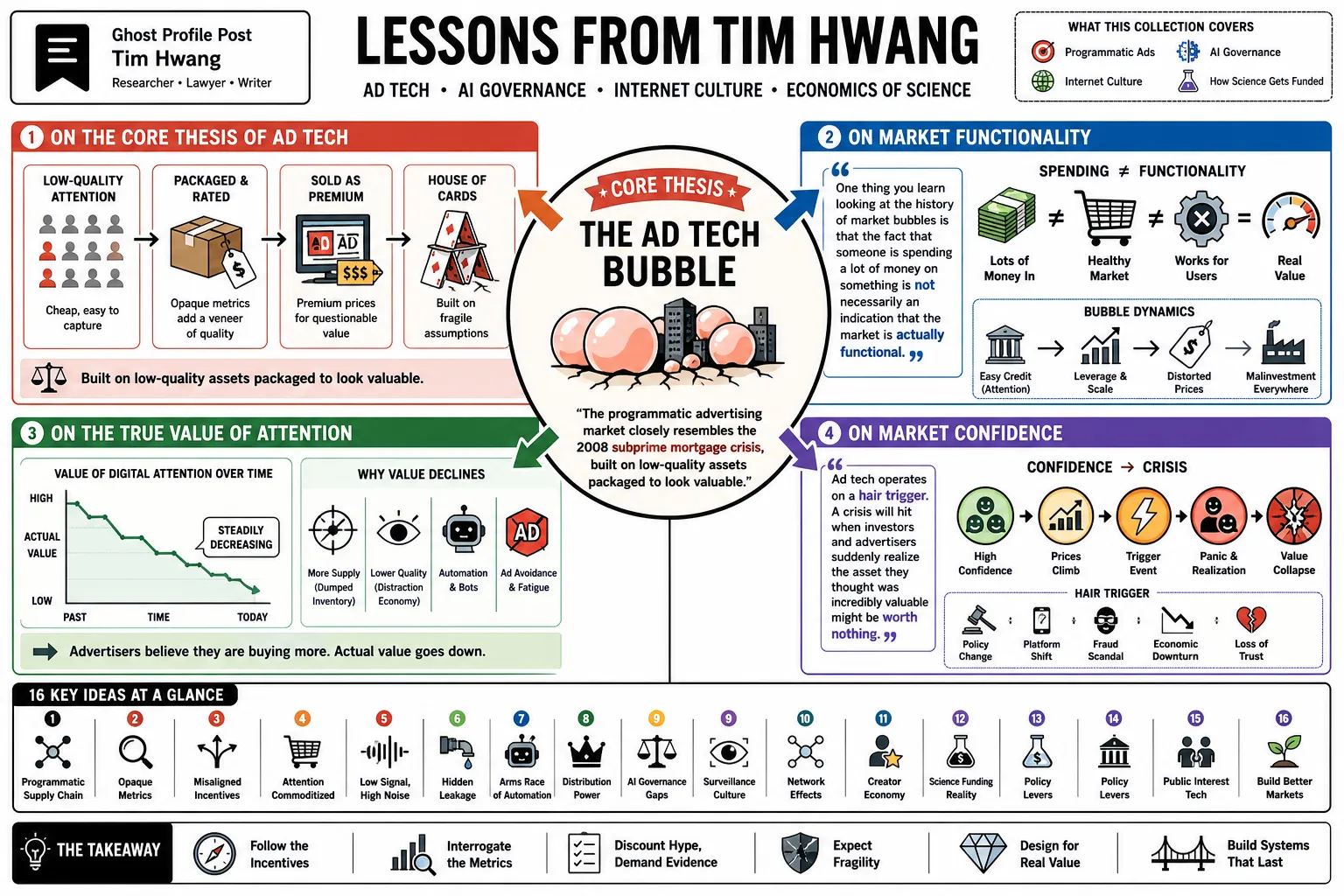
Part 1: The Ad Tech Bubble
- On the Core Thesis of Ad Tech: "The programmatic advertising market closely resembles the 2008 subprime mortgage crisis, built on low-quality assets packaged to look valuable." — Source: [Reading.Supply]
- On Market Functionality: "One thing you learn looking at the history of market bubbles is that the fact that someone is spending a lot of money on something is not necessarily an indication that the market is actually functional." — Source: [Public Infrastructure]
- On the True Value of Attention: "The specific kind of digital attention that advertisers believe they are buying is steadily decreasing in actual value over time." — Source: [Analytics Hour]
- On Market Confidence: "Ad tech operates on a hair trigger. A crisis will hit when investors and advertisers suddenly realize the asset they thought was incredibly valuable might be worth nothing." — Source: [Analytics Hour]
- On Ad Tech Returns: "Digital advertising has functioned like corporate jet fuel, offering historically unprecedented returns in an incredibly short period of time." — Source: [Public Infrastructure]
- On Controlled Demolitions: "Rather than trying to fix a fundamentally broken programmatic market, regulators should pursue a controlled demolition to safely reduce its economic influence." — Source: [Reading.Supply]
- On Writing Strategy: "Subprime Attention Crisis was deliberately designed to be polemical, with a success metric partly tied to making as many ad industry insiders angry as possible." — Source: [Public Infrastructure]
- On the Wannamaker Problem: "Tech companies sold their advertising as mathematically distinct from older eras, yet the old adage that half of all ad spending is wasted remains completely true today." — Source: [YouTube]
- On Economic Precedents: "Like previous financial crashes, the digital ad market relies on the illusion of stability masking an underlying foundation of junk assets." — Source: [Reading.Supply]
Part 2: Opacity and Advertising Fraud
- On the Plumbing of Programmatic Ads: "Similar to how Wall Street traded complex mortgage packages without knowing what was inside, advertisers buy digital inventory with almost no idea what lurks underneath." — Source: [YouTube]
- On Garbage Data: "The targeting data that powers the modern internet economy is largely garbage, leading to algorithmic delivery systems built entirely on bunk logic." — Source: [Goodreads]
- On the Function of Opacity: "A lack of transparency in programmatic supply chains allows the underlying degradation of ad effectiveness to continue without buyers noticing." — Source: [Analytics Hour]
- On Fraud Volume: "When you consider that a massive chunk of annual ad spend goes directly to bots and fraudulent click farms, the premise of the entire industry starts to look unstable." — Source: [Public Infrastructure]
- On Information Asymmetry: "Platforms have near-total control over the metrics used to grade their own ad performance, leaving buyers in the dark about actual conversion reality." — Source: [International Journal of Communication]
- On Micro-Targeting Realities: "Despite claims of laser-precise audience targeting, programmatic systems regularly serve ads to non-human traffic or entirely irrelevant demographic profiles." — Source: [Goodreads]
- On Value Extraction: "The complex layers of intermediaries in ad tech mostly exist to extract a toll, further separating the advertiser dollar from actual human attention." — Source: [Analytics Hour]
- On Ad Blocker Impact: "The rising consumer adoption of ad-blocking software actively shrinks the pool of high-quality human attention, concentrating remaining ad buys onto lower-tier inventory." — Source: [Reading.Supply]
- On the Attention Economy: "The market treats human attention as a limitless commodity, but it is actually a finite resource that is being strip-mined to exhaustion." — Source: [Goodreads]
- On Metric Manipulation: "The metrics used to sell ads, such as viewability or engagement rates, are frequently gamified or redefined by platforms to maintain the illusion of growth." — Source: [International Journal of Communication]
Part 3: The Myth of Mind Control
- On Perfect Manipulation: "The biggest error tech critics make is buying into the marketing claims of the tech industry, specifically the idea that platforms possess a flawless mind control ray." — Source: [YouTube]
- On Critiquing the Critique: "Should our tech critique really be built on the marketing claims of the tech industry? We should resist these companies for reasons other than the claimed power that they have." — Source: [YouTube]
- On Cambridge Analytica: "The panic over data firms brainwashing voters often obscured a more mundane truth. Micro-targeted political ads are highly ineffective most of the time." — Source: [Public Infrastructure]
- On Platform Omnipotence: "Assuming that tech giants can perfectly manipulate human behavior gives those companies unearned credit and distracts from their actual structural weaknesses." — Source: [YouTube]
- On Behavioral Advertising: "The prevailing belief that platforms can predictably hack human psychology relies heavily on self-reported, proprietary data that independent researchers cannot verify." — Source: [International Journal of Communication]
- On Surveillance Capitalism Limitations: "Extensive data collection does not automatically translate to the ability to force people to buy products or change deeply held political beliefs." — Source: [Goodreads]
- On the Tech Industry Bluff: "Calling the tech industry bluff means recognizing that their primary product is far less potent than their pitch decks suggest." — Source: [Reading.Supply]
- On the Danger of Hyperbole: "Framing social media as an unstoppable hypnosis machine leads to poorly designed policy interventions that fail to address basic market failures." — Source: [Analytics Hour]
- On Mark Zuckerberg's True Power: "Rather than fearing Mark Zuckerberg as a master manipulator of human psychology, society should fear the extreme fragility of the advertising infrastructure his company relies upon." — Source: [YouTube]
Part 4: The Fragility of the Internet Ecosystem
- On Monoculture: "Advertising's complete dominance as a business model has smothered out the structural experimentation that a healthy internet desperately needs." — Source: [YouTube]
- On Systemic Risk: "The ad market has made the broader internet economy brittle, meaning a relatively small market failure could create a massive, cascading collapse." — Source: [YouTube]
- On the Future of Journalism: "If the programmatic ad market collapses, it will take the remaining funding structures for digital journalism down with it unless alternative models are built first." — Source: [Reading.Supply]
- On Alternative Business Models: "We should aim for an internet ecosystem that relies on a diverse set of revenue strategies like subscriptions, micro-payments, and public funding rather than a single point of failure." — Source: [Public Infrastructure]
- On Platform Decay: "As platforms desperately try to squeeze more revenue out of shrinking human attention, user experiences inevitably degrade into hostile environments." — Source: [Analytics Hour]
- On Post-Ad Tech Infrastructure: "Society needs to actively build public, non-commercial digital infrastructure so that the web remains functional when the private ad market corrects." — Source: [Reading.Supply]
- On the Illusion of Free Services: "The concept of a free internet was always a loan taken out against human attention, and the bill for that loan is coming due as ads become less effective." — Source: [Goodreads]
- On Institutional Capture: "So many cultural and political institutions rely on platforms for distribution that an ad-revenue collapse would severely shock civic communication." — Source: [International Journal of Communication]
- On the Definition of a Crisis: "A tech crisis will not look like servers shutting down, but rather a sudden, severe contraction of the capital that currently subsidizes free digital services." — Source: [Public Infrastructure]
- On Preventive Regulation: "Regulators should act now to separate essential web services from ad tech dependencies before a market panic forces their hand." — Source: [YouTube]
Part 5: Internet Culture and Web Ecology
- On the Reality of Online Life: "Wow, this is a culture in a real sense. It is a genuine community, far beyond people fooling around online." — Source: [The Guardian]
- On Memes as Cultural Hallmarks: "Just as sitcoms or radio soap operas defined earlier generations, the internet meme is the defining format for how modern cohorts understand entertainment." — Source: [The Guardian]
- On Micro-Celebrities: "The internet fundamentally altered fame, making it entirely possible for someone to be a recognized celebrity to exactly fifteen specific people." — Source: [The Guardian]
- On Viral Experiences: "Early meme creators shared the incredibly odd, unprecedented experience of waking up to find themselves famous to a massive audience of strangers." — Source: [WNYC Studios]
- On Community Earnestness: "Below the layers of irony in early meme culture, there was a deep, earnest desire to connect with other people over shared digital artifacts." — Source: [WNYC Studios]
- On Selling Out: "As internet culture grew, the inevitable push toward professionalization led to valid anxieties about who owned these communal spaces and whether making money ruined the joke." — Source: [LiveJournal]
- On the End of an Era: "The moment viral stars required professional agents, the chaotic, grassroots fun of early internet culture effectively ended." — Source: [LiveJournal]
- On Computational Sociology: "Studying the internet requires treating web communities as living ecosystems where ideas flow and compete under specific environmental conditions." — Source: [JoinReboot]
- On Analyzing Power Through Imagery: "Applying serious academic scrutiny to a tech founder PR photo reveals the uncanny nature of modern corporate power." — Source: [JoinReboot]
Part 6: AI Governance and Ethics
- On AI Reality vs. Hype: "I think that a lot of the people who work on machine learning on a day-to-day basis are pretty humble about the technology because they are largely confronted with how frequently it just breaks." — Source: [Texas TIPI]
- On the Real Threat of AI: "AI is not the Terminator. It is not going to climb out of your computer and destroy you. Negligence and incompetence around the use of AI are the real threats." — Source: [UT Austin]
- On Corporate Influence: "Because machine learning was heavily developed within private tech companies, there is an urgent need to bolster independent voices to hold these tools accountable." — Source: [UT Austin]
- On Historical Context: "The current AI boom follows a long AI Winter where the field was considered a dead end, proving that trajectories in tech are rarely linear." — Source: [Texas TIPI]
- On Social Alignment: "We have to continuously evaluate how technical AI capabilities conflict with or complement existing social structures to keep them aligned with public interests." — Source: [UT Austin]
- On Black Box Algorithms: "When algorithms make decisions regarding justice, media, or labor without transparency, they undermine basic democratic oversight." — Source: [Just Security]
- On Bridging the Gap: "Effective AI governance requires closing the knowledge gap between the engineers building the models and the public experiencing their effects." — Source: [Georgetown University]
- On Ethics as a Process: "Treating AI ethics as a checklist is a mistake. It must be an ongoing, active negotiation between developers, policymakers, and affected communities." — Source: [TimHwang.org]
- On Philanthropic Interventions: "Large-scale philanthropic funds are necessary to build a public-interest technology sector that can act as a counterweight to Silicon Valley capital." — Source: [TimHwang.org]
- On Engineering Culture: "True accountability in technology requires changing the incentive structures and norms within engineering culture itself, rather than solely imposing laws from the outside." — Source: [Texas TIPI]
Part 7: Deepfakes, Disinformation, and Hype
- On the Distraction of Deepfakes: "I do not think deepfakes will have as big an impact as many people believe and may be a distraction to the real issues facing AI technology." — Source: [UT Austin]
- On the Disinformation Epidemic: "The panic over sophisticated AI-generated fake news often ignores the reality that cheap, low-tech misinformation is already highly effective." — Source: [UT Austin]
- On Science Fiction Framing: "Framing AI policy around Hollywood doomsday scenarios wastes regulatory resources that should be spent on mundane issues like algorithmic bias and data privacy." — Source: [UT Austin]
- On Trust in Media: "Deepfakes are less likely to trick people into believing something false than they are to give people an excuse to dismiss true evidence they dislike." — Source: [Just Security]
- On the Liar's Dividend: "The mere existence of synthetic media technology degrades the overall information ecosystem by allowing bad actors to claim any real video is fake." — Source: [Just Security]
- On Misplaced Panic: "Policymakers often rush to regulate the most visually alarming technologies while ignoring the invisible recommendation algorithms that quietly dictate information flow." — Source: [Texas TIPI]
- On Technical Solutions to Social Problems: "Developing algorithms to detect deepfakes is a game of cat-and-mouse that fails to address the underlying social reasons people want to share fake content." — Source: [UT Austin]
- On the Speed of Adoption: "While AI generation tools scale rapidly, human cognitive habits and institutional verification methods adapt much slower, creating a dangerous friction point." — Source: [Just Security]
- On Policy Priorities: "Effective tech policy should ignore hypothetical future superintelligences and focus strictly on the immediate harms caused by automation in policing, hiring, and lending." — Source: [TimHwang.org]
Part 8: Macroscience and Research Funding
- On the Lack of Macro-Level Tools: "We have macroeconomics, which helps us manage the money supply. We do not have anything like macroscience to help us organize science on a large scale." — Source: [Macroscience]
- On the Epistemic Fog of War: "Failures in scientific reform are a badge of honor, but public and private funders rarely have the patience to survive long stretches without clear returns." — Source: [Macroscience]
- On Countercyclical Funding: "Science funding institutions should deploy their resources to encourage a final burst of effort precisely as expert consensus is turning negative on an approach to a problem." — Source: [Macroscience]
- On Second Chances for Ideas: "A healthy scientific ecosystem requires institutions dedicated to funding replications of negative results, systematically giving apparently failed ideas a second look." — Source: [Macroscience]
- On the Necessity of the State: "We require courageous public institutions equipped with strong policy tools to build a functioning economy of science. Private capital alone is insufficient." — Source: [Macroscience]
- On the Role of Private Funders: "Nimble private funders freed from bureaucratic constraints play a vital role in rapidly launching experiments that government agencies cannot touch." — Source: [Macroscience]
- On the Reality of Metascience: "Discussions about metascience are frequently not about science, but about money." — Source: [FORRT]
- On Reforming Grantmaking: "The core agenda of science reform is ultimately about redesigning evaluation frameworks so that dollars can flow to the best ideas faster." — Source: [FORRT]
- On Defying Consensus During Crises: "The rapid development of mRNA vaccines proved that in a genuine emergency, standard rules of governance should be suspended, making it entirely rational to fund approaches that experts deem unpromising." — Source: [Macroscience]