Lessons from Tom Gaglardi
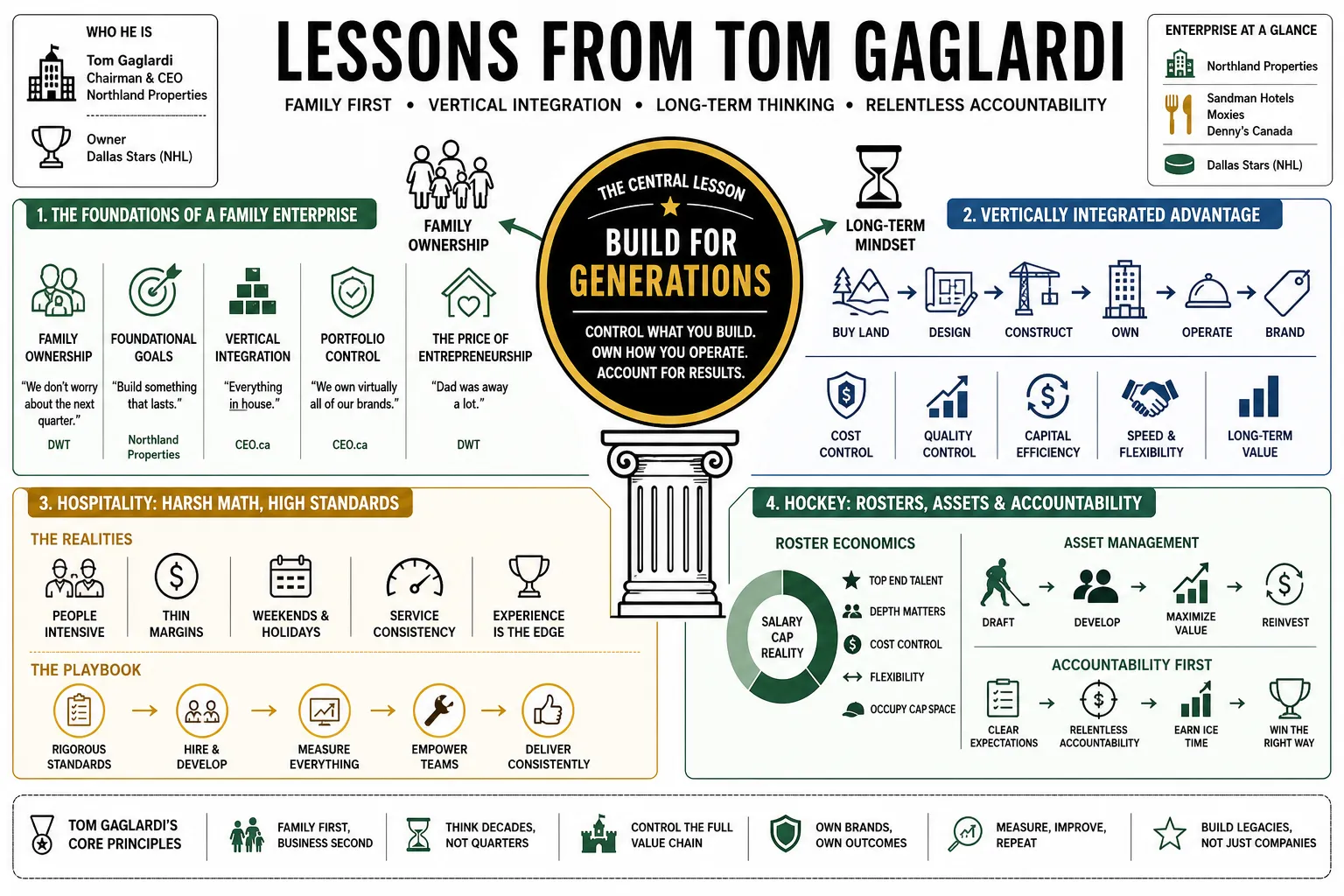
Tom Gaglardi runs Northland Properties, overseeing brands like Sandman Hotels, Moxies, and Denny's Canada, and owns the NHL's Dallas Stars. He applies a strict, vertically integrated approach to both real estate and sports, demanding direct accountability and high liquidity. This profile explores his unvarnished take on running a multi-generational family enterprise and the harsh economics of both hospitality markets and hockey rosters.
Part 1: The Foundations of a Family Enterprise
- On Family Ownership: "We’re a family business. We don’t have to worry about the next quarter. We worry about the next decade and the next generation." — Source: DWT
- On Foundational Goals: "Our goal has always been to build something that lasts, not just something that scales for the sake of scaling." — Source: Northland Properties
- On Vertical Integration: "We are a unique company because we are vertically integrated. Everything in house from buying land, designing what we build, constructing it, owning it, operating it, branding it." — Source: CEO.ca
- On Portfolio Control: "We own virtually all of our brands." — Source: CEO.ca
- On the Price of Entrepreneurship: "Dad was away a lot. That's the price you pay for being an entrepreneur and building what he was able to get built." — Source: CRE Library
- On Early Growth: "My father started with one hotel in 1967." — Source: DWT
- On Taking Responsibility: Discussing his grandfather Phil Gaglardi's political scandal, he noted that leaders take the blame for their teams. "I don't think Grandpa was even on the plane. The pilot made the decision. Grandpa took responsibility for it." — Source: BC Business
- On Cost Advantages: "Being vertically integrated we can accomplish things for cheaper than the general market can. Look for an edge at every level along the way." — Source: CEO.ca
- On Modesty: Despite his wealth, he claims to allow himself only "one indulgence," which he refers to as his Bentley convertible. — Source: BC Business
Part 2: Real Estate and Hospitality Economics
- On Real Estate Risk: "Hotels and restaurants are the riskiest class of real estate." — Source: CEO.ca
- On the Reward of Hospitality: "With the risk comes the reward. Our returns on equity are higher in this class than any other asset class." — Source: CEO.ca
- On Real Estate Liquidity: "The key to being successful in real estate is liquidity. Making sure you have enough of it." — Source: CEO.ca
- On Surviving Downturns: Operators fail because they "couldn’t hold on through a down period. Staying power will come out successful." — Source: CEO.ca
- On Core Focus: "Sticking to your core business and staying focused on execution of your strategy is really the key." — Source: NHL.com
- On the Three Keys of Hospitality: "Location, product and management are the three keys and it's tough to survive without all three of them." — Source: CEO.ca
- On Missing Market Opportunities: "I wish I would have understood the Dallas real estate market sooner because I should have bought a lot more land when I first got here and I didn't. So I made that mistake." — Source: NHL.com
- On the Premium Casual Niche: "We just do a better job than most at high-quality food and high-quality service in a high-quality room. We call it premium casual." — Source: BC Business
- On Corporate Acquisitions: Acquiring the Moxies chain in 1998 "was the turnaround point for our company." — Source: BIV
Part 3: Crisis Management and Market Realities
- On Asymmetric Recoveries: "We’re in what economists call a K-shaped recovery. The tourism hospitality events sectors are at the bottom of that K and have been among the hardest hit sectors." — Source: Hospitality Net
- On Industry Devastation: "You’ve seen large hotels closed, occupancies in big city centers in the single digits. Totally unheard of." — Source: Hospitality Net
- On Frictionless Operations: "We have as a company been focused for a while on reducing touch points. Technology trying to become frictionless." — Source: Hospitality Net
- On Accelerating Technology: "Certainly since the pandemic has hit we’ve sped up our focus on frictionless technology." — Source: Hospitality Net
- On Consumer Returns: "We see leisure coming back first, business travel coming back second. The convention market is going to be the distant one." — Source: Hospitality Net
- On Rising Operating Costs: "The only choice we have as operators is to pass on those expenses to try to stay in business." — Source: Hospitality Net
- On the Danger of Price Increases: "We become more expensive and as we become more expensive we’re less successful." — Source: Hospitality Net
- On the Business of Junior Hockey: "Hockey doesn't work without paying spectators, let's call a spade a spade. A lot of WHL clubs have suffered a lot of pain." — Source: The Hockey News
- On Simple Formulas: "You build a nice asset, you maintain it, you provide great customer service, and you provide value. And you’re going to have success." — Source: Coastal Front
Part 4: Core Principles of Leadership
- On Evolving as a Leader: "I used to know pretty much everything that was going on. But then you realize as you grow and if you want to be successful, you have to hire amazing people and you have to delegate." — Source: NHL.com
- On Hiring Up: "You can't grow the business without amazing people and hiring people with better skill sets than yourself." — Source: NHL.com
- On Work Environment: After hiring great people, the primary job of leadership is "making sure the environment is such that they can thrive." — Source: NHL.com
- On Internal Development: "I think some fresh people from the outside is healthy, but my preference is always to develop internally and hire that way." — Source: NHL.com
- On Early Career Advice: "Young people ask me what to do to be successful? Find a mentor, that's the best advice I could give you." — Source: Grokipedia
- On the Purpose of Degrees: "When we interview people, having a degree is very important. I don't really care what subject it's in. It shows learning and communication skills." — Source: Grokipedia
- On Universal Management: "It’s the processes that matter. It’s leadership, it’s culture, it’s empowerment. It’s hiring the best talent and retaining the best talent. Those core principles are the same across all businesses." — Source: Coastal Front
- On Sports Exceptions: "Those core principles are the same across all businesses, and hockey doesn’t get a pass on that." — Source: Coastal Front
- On Self-Description: When asked for a single word to describe his leadership style, he chose "determined." — Source: Coastal Front
Part 5: Bridging Business and Professional Sports
- On Stewardship in Sports: "I grew up in a family business where you learn that you’re a steward of the assets you own. Whether it’s a hotel or a hockey team, you have a responsibility to the people who support it." — Source: DWT
- On Division of Labor: "I’m there to ask hard questions and to worry about the business side of it, but when it comes down to it, the hockey decisions are made by the hockey people." — Source: NHL.com
- On Trusting Operations: "I’ve got a really strong management team. I’m a hands-off owner when it comes to the decision-making." — Source: Cam and Strick
- On Healthy Friction: "It’s not kumbaya every day. You need a little friction and a little tension sometimes." — Source: Coastal Front
- On Debate in Management: "I think you get the best decisions when you’re challenged and you have to really make your case." — Source: Coastal Front
- On Learning Patience: "I’m not naturally as patient as Jim Nill is, and it’s a skill I’ve had to learn. I suspect he would say, 'Tom’s more patient now than he was.'" — Source: Coastal Front
- On Competition Variability: "The thing that’s different about hockey is there’s 32 teams trying to make the playoffs. Unfortunately, every night when you go to play a game, the team on the other side of the ice is trying to win too." — Source: Coastal Front
- On Emotional Bandwidth: "I just don’t know that I have the bandwidth to do any more in sports than the teams that I have. They occupy a tremendous amount of bandwidth." — Source: NHL.com
- On Business Accountability in Sports: "I just think you have to run it as a business and you have to have accountability." — Source: Coastal Front
- On Deal Failures: Discussing his initial attempt to buy the Canucks with Francesco Aquilini, he stated he felt "shafted and screwed" when Aquilini ultimately bought the team independently. — Source: The Hockey News
Part 6: Roster Construction and RFA Economics
- On Building from Within: "I learned in the Western Hockey League that the only way to win is that you build from within." — Source: Defending Big D
- On the Fallacy of Buying Championships: "I think there's been enough cases around the NHL to show that you cannot buy a winner." — Source: Defending Big D
- On Talent vs. Culture: "Culture and a great locker room and great camaraderie is necessary to win, but you don't win without skill." — Source: Coastal Front
- On the Necessity of Skill: "And you don't win without talent at the end of the day." — Source: Coastal Front
- On Roster Filters: "If you're an asshole, you're not going to play for our team. Jim Nill has a filter." — Source: Coastal Front
- On Total Commitment: "You need to have 23 players plus all your guys. All in, no blinking, behind each other 100%. No issues, no selfishness." — Source: Coastal Front
- On the Changing Economics of Youth: "A kid in the third year of his entry-level deal puts up 40 goals and now he wants to make $7 million." — Source: The Score
- On Middle-Class Squeeze: "The stars are taking all the money, and the guys in the middle are getting squeezed." — Source: The Score
- On Free Market Realities: "I don't like it, but that's the market, and that's the way it works." — Source: The Score
- On Leverage Limitations: "You’re an RFA, there’s really no deadline, there’s no hurry, and that’s kind of how the cookie crumbles." — Source: WordPress
Part 7: Accountability and Performance Standards
- On Star Player Burdens: "Our best players have to be our best players." — Source: Russian Machine Never Breaks
- On Focusing the Narrative: "This is not about trading anyone. This is not about firing anyone. This team is built to win and contend now." — Source: Fox Sports
- On Cap Efficiency: "A quarter of the cap being devoted to two stars was inefficient based on the amount of production that the team was getting from them." — Source: Cam and Strick
- On Acknowledging Decline: "The reality is that Jamie and Tyler are not the players they were when they signed those contracts." — Source: Cam and Strick
- On Deliberate Provocation: "I wanted to stir up some Stars conversation." — Source: Cam and Strick
- On Systemic Factors: He admitted that a stark drop in his stars' offensive output could be "directly tied to the defensive approach" of previous coaching regimes. — Source: Cam and Strick
- On Cultural Impact: Praising veterans like Joe Pavelski, he noted that "The residue of his leadership is continuing to persist even without him there." — Source: Coastal Front
- On Captains: "We have a really strong room and we have for a long, long time, and that’s really a testament to Jamie Benn, our captain." — Source: Coastal Front
- On Market Frustration: "I know there’s a passionate group of people that follow the Dallas Stars and we’ve alienated a bunch of those people over the years." — Source: Defending Big D
- On Junior Standards: Speaking to his junior team, the Blazers: "We're not going to accept three years in a row not being there in the playoffs. They need to get that done." — Source: The Hockey News
Part 8: Geographic Expansion and Long-Term Vision
- On Relocation Rumors: "The team’s not moving. It will never move. Dallas is one of the best markets in America." — Source: Defending Big D
- On the Texas Economy: "Texas is one of the world’s great economies and it’s gotten better and better. We’re long-term people and we believe in Texas." — Source: NHL.com
- On Strategic Geography: "The team brought me there and allowed me to focus on Texas. Now Texas is our U.S. beachhead." — Source: NHL.com
- On Rapid Scaling: "I think within five years, half of our projects might be in Texas." — Source: NHL.com
- On Exporting Concepts: "It gives us a chance to do what we do in Canada in Dallas. It was a thought we had at the very beginning." — Source: BC Business
- On Familiarity with Markets: Expanding Moxies to Dallas made sense because "I’d be spending large amounts of time in Dallas, and I’d be able to become very familiar with the marketplace." — Source: BC Business
- On Global Ambition: "Sandman started from very humble beginnings, and over the last 50 years, our family has grown to include more than 50 hotels across Canada, the UK, and many more on the horizon." — Source: CEO.ca
- On Rebuilding Brand Trust: "I just think the market is responding well to the story here." — Source: Defending Big D
- On the Next Era of Growth: His brother Mitch framed their recent UK property expansions as "legacy properties" that serve the family's broader international strategy. — Source: Hospitality Net