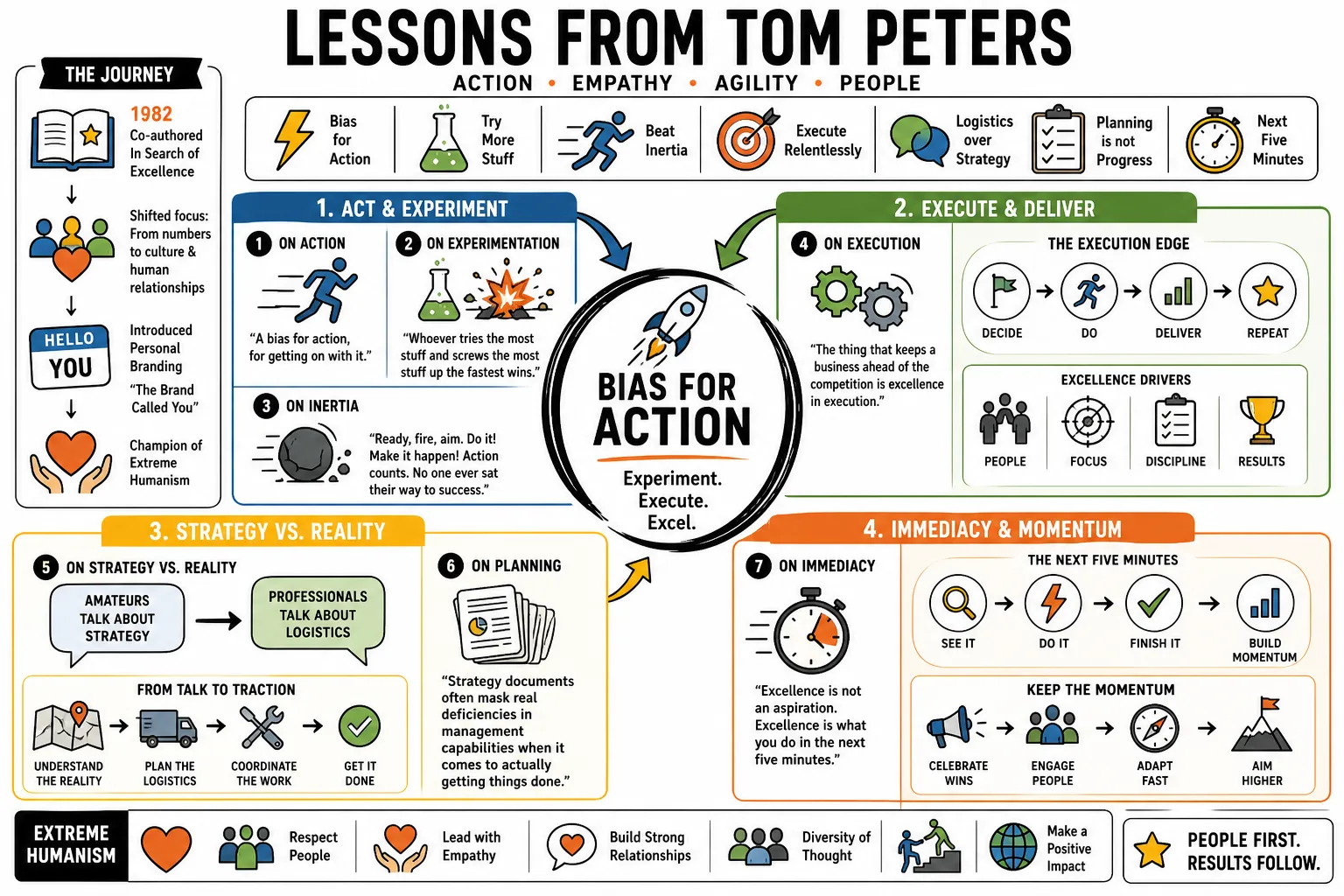
Lessons from Tom Peters
Tom Peters co-authored In Search of Excellence in 1982, helping shift management focus from pure financial metrics to corporate culture and human relationships. He later introduced the idea of personal branding with "The Brand Called You" and championed the concept of "Extreme Humanism." This profile gathers his advice on how businesses and individuals can work with more empathy and practical agility.
Part 1: The Bias for Action
- On Action: "A bias for action, for getting on with it." — Source: [In Search of Excellence]
- On Experimentation: "Whoever tries the most stuff and screws the most stuff up the fastest wins." — Source: [TomPeters.com]
- On Inertia: "Ready, fire, aim. Do it! Make it happen! Action counts. No one ever sat their way to success." — Source: [QuoteFancy]
- On Execution: "The thing that keeps a business ahead of the competition is excellence in execution." — Source: [Forbes]
- On Strategy vs. Reality: "Amateurs talk about strategy. Professionals talk about logistics." — Source: [TomPeters.com]
- On Planning: "Strategy documents often mask real deficiencies in management capabilities when it comes to actually getting things done." — Source: [Goodreads]
- On Immediacy: "Excellence is not an aspiration. Excellence is what you do in the next five minutes." — Source: [QuoteFancy]
- On Agility: "Test fast, fail fast, adjust fast." — Source: [AllAuthor]
- On Projectizing Work: "Routine assignments should be turned into distinct, actionable chunks with clear goals to transform abstract strategies into tangible results." — Source: [Tom Peters Company]
- On Momentum: "If a window of opportunity appears, don't pull down the shade." — Source: [AZQuotes]
Part 2: Extreme Humanism
- On Human Value: "A business is its people. They are not 'important' to the business for someone's sake. They are the business." — Source: [TomPeters.com]
- On Soft Skills: "Hard is soft. Soft is hard. Hard (Numbers/Plans/Org charts) is soft. Soft (People/Relationships/Culture) is hard." — Source: [TomPeters.com]
- On Caring: "Extreme Humanism means caring. It means love. It is as clear an idea in the workplace as it is at home." — Source: [TomPeters.com]
- On Financialization: "We put finance and data manipulation first, while the basic human element rarely makes it to the top of the priority pile." — Source: [Forbes]
- On Basic Decency: "The simple act of paying positive attention to people has a great deal to do with productivity." — Source: [Michael Hartzell]
- On Dignity: "Productivity through people requires treating employees with respect and dignity as the primary source of operational gains." — Source: [In Search of Excellence]
- On Empathy: "Be kind, for everyone you meet is fighting a great battle." — Source: [TomPeters.com]
- On Small Gestures: "Trivial courtesies like thank-you notes and greeting employees by name make a profound, lasting impact on organizational culture." — Source: [TomPeters.com]
- On Joy: "Workplaces should be breathing communities that help employees realize their dreams, not just units of productivity." — Source: [Next Big Idea Club]
- On Community: "Business is about people. It's about passion." — Source: [ToolsHero]
Part 3: Leadership and Management
- On the Role of Management: "Management is about arranging and telling. Leadership is about nurturing and enhancing." — Source: [Gary Fox]
- On Legacy: "Leaders don't create followers, they create more leaders." — Source: [QuoteFancy]
- On the Core Vocabulary: "Arguably the eight most important words a leader can utter are: 'Thank you,' 'I'm sorry,' and 'What do you think?'" — Source: [In Search of Excellence]
- On Spectrum of Focus: "An effective leader must be the master of two ends of the spectrum: ideas at the highest level of abstraction and actions at the most mundane level of detail." — Source: [Goodreads]
- On Success Metrics: "Your record as a leader is based on the number of successes that the people who worked for you had." — Source: [Forbes]
- On Communication: "The best leaders… almost without exception and at every level, are master users of stories and symbols." — Source: [ToolsHero]
- On Engagement: "Leadership is about tapping the wellsprings of human motivation and focusing on fundamental relations with one's fellows." — Source: [QuoteFancy]
- On Middle Management: "Vision is dandy, but sustainable company excellence comes from a huge stable of able managers." — Source: [AllAuthor]
- On Visible Leadership: "Hands-on, value-driven management ensures that leadership is visible and committed to core organizational values." — Source: [In Search of Excellence]
- On Recognition: "Celebrate what you want to see more of." — Source: [AZQuotes]
Part 4: The Brand Called You
- On Personal Accountability: "All of us need to understand the importance of branding. We are CEOs of our own companies: Me Inc." — Source: [Fast Company]
- On Self-Marketing: "To be in business today, our most important job is to be head marketer for the brand called You." — Source: [Forbes]
- On Agency: "It's this simple: You are a brand. You are in charge of your brand." — Source: [QuoteFancy]
- On Differentiation: "Your personal brand is what differentiates you from everyone else." — Source: [Phable]
- On Value Promises: "A brand is a promise of the value you'll receive." — Source: [StudyCorgi]
- On Urgency: "There is no single path to success, but you must start managing your own brand today, or else you will be left behind." — Source: [AZQuotes]
- On Internal Branding: "Brand inside is more important than brand outside for sustained success." — Source: [AZQuotes]
- On Marketplace Identity: "A personal brand is your promise to the marketplace and the world." — Source: [TomPeters.com]
- On Deliverables: "Personal branding is not about vanity, but about delivering consistent value and taking ownership of your career trajectory." — Source: [TomPeters.com]
Part 5: Innovation and Change
- On Disruption: "If you're not confused, you're not paying attention." — Source: [AZQuotes]
- On Constant Evolution: "Excellent firms don't believe in excellence—only in constant improvement and constant change." — Source: [ToolsHero]
- On Making Mistakes: "Don't 'tolerate' mistakes. Embrace them!" — Source: [AZQuotes]
- On Defining Innovation: "Creativity is thinking up new things. Innovation is doing new things." — Source: [Goodreads]
- On Application: "Ideas are useless unless used." — Source: [Goodreads]
- On Embracing the Future: "Winners must learn to relish change with the same enthusiasm and energy that we have resisted it in the past." — Source: [AZQuotes]
- On Autonomy: "Foster innovation by breaking the organization into smaller, manageable units and encouraging entrepreneurship and risk-taking." — Source: [In Search of Excellence]
- On Cultural Failure: "The trick, and it's a tough one, is a common cultural understanding of what kind of failure is okay and what kind leads to disaster." — Source: [In Search of Excellence]
- On Restrictive Norms: "The dominant culture in most big companies demands punishment for a mistake, no matter how small, which actively stifles necessary innovation." — Source: [TomPeters.com]
Part 6: Design and Simplicity
- On Centrality: "Design is so critical it should be on the agenda of every meeting in every single department." — Source: [QuoteFancy]
- On Sensory Experience: "Design is… an understanding that all the senses were created equal." — Source: [TomPeters.com]
- On Process Improvement: "Almost all quality improvement comes via simplification of design, manufacturing, layouts, processes, and procedures." — Source: [ToolsHero]
- On Relevance: "Design is not about making things look cool; it is about making things relevant to the user and creating a genuine connection." — Source: [TomPeters.com]
- On Lean Structures: "Maintain lean headquarters and simple organizational forms to avoid unnecessary bureaucracy and operational bloat." — Source: [In Search of Excellence]
- On Focus: "Stick to the knitting by staying focused on the core business rather than diversifying into unfamiliar, overly complex areas." — Source: [In Search of Excellence]
- On Quality Control: "It doesn't matter what product or service you're offering; there is an unlimited ability to improve the quality of anything through thoughtful design." — Source: [In Search of Excellence]
- On Aesthetics: "Innovation and design are no longer optional for businesses, as they function as the core differentiator of a company's value proposition." — Source: [WordPress]
- On Loose-Tight Properties: "Excellent organizations balance centralized control over core values with decentralized autonomy in day-to-day operations." — Source: [In Search of Excellence]
Part 7: Customer Excellence
- On Relationships: "The magic formula that successful businesses have discovered is to treat customers like guests and employees like people." — Source: [AZQuotes]
- On Listening: "Many innovative companies get their best product ideas directly from customers by listening intently and regularly." — Source: [In Search of Excellence]
- On Proximity: "The best companies stay close to the customer, learning from the people they serve to provide unparalleled service and reliability." — Source: [In Search of Excellence]
- On the Point of Sale: "All business success rests on something labeled a sale, which at least momentarily weds company and customer." — Source: [AllAuthor]
- On Wasted Time: "Every meeting that does not stir the imagination and curiosity of its attendees is what I like to call a PLO: a Permanently Lost Opportunity." — Source: [In Search of Excellence]
- On Value Delivery: "True organizational excellence comes from providing a service that makes the customer's life tangibly better, not just maximizing quarterly profits." — Source: [In Search of Excellence]
- On Perception: "How a company treats its front-line workers inevitably defines how it is perceived by the customers those workers interact with." — Source: [TomPeters.com]
- On Service: "Treat the customer not as a transaction, but as an ongoing relationship that requires continuous nurturing and attention." — Source: [TomPeters.com]
- On Feedback: "The most valuable data a company can collect is qualitative feedback from a frustrated customer." — Source: [TomPeters.com]
Part 8: Culture and Values
- On Humanity in Systems: "Excellence is human." — Source: [TomPeters.com]
- On Corporate Reputation: "Culture is your brand." — Source: [TomPeters.com]
- On Lasting Impact: "The art of creative leadership is the art of institution building, the reworking of human and technological materials to fashion an organism that embodies new and enduring values." — Source: [TomPeters.com]
- On Joy at Work: "Building a culture of joy goes beyond basic job satisfaction; it is a primary driver for employee engagement and loyalty." — Source: [Next Big Idea Club]
- On Organizational Energy: "Excellence is characterized by an insatiable appetite for change and a collective energy directed toward a great cause." — Source: [TomPeters.com]
- On Shared Adventure: "True company cultures are defined by shared adventures, bizarre failures, and a collective determination to make a difference." — Source: [TomPeters.com]
- On Treating People: "Despite the modern obsession with technology and systems, the core of an excellent organization remains how its people interact with each other." — Source: [TomPeters.com]
- On Authenticity: "True cultural shifts cannot be engineered by HR departments; they must be lived and modeled daily by the executives in charge." — Source: [TomPeters.com]
- On The Ultimate Goal: "The purpose of business is to improve the human condition, making communities stronger and individuals more capable." — Source: [TomPeters.com]