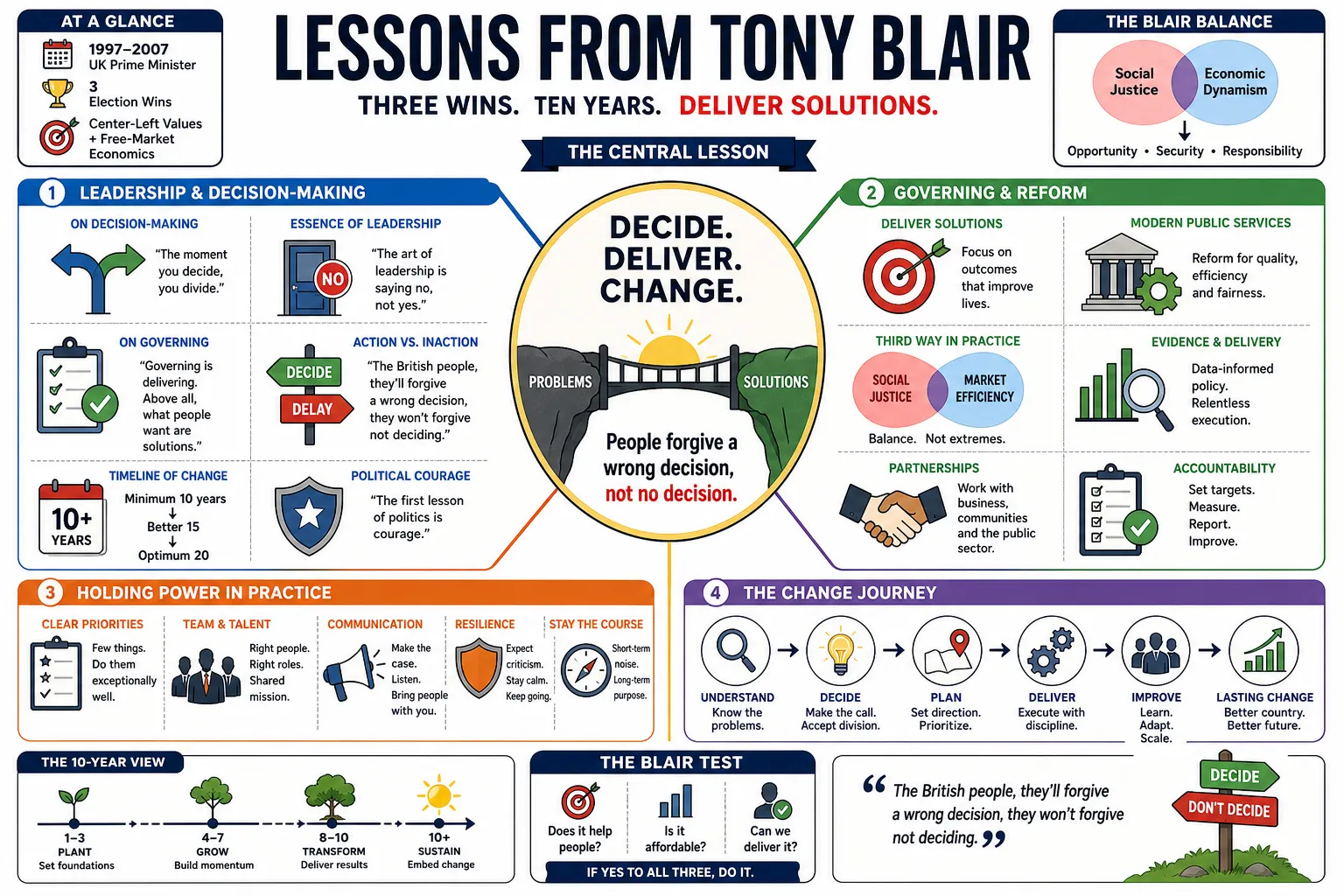
Lessons from Tony Blair
As UK Prime Minister from 1997 to 2007, Tony Blair led the Labour Party to three consecutive election wins by pairing center-left social policies with free-market economics. This profile collects his direct thoughts on running a government, reforming the public sector, and the practical realities of holding power.
Part 1: Leadership & Decision-Making
- On Decision-Making: "The moment you decide, you divide." — Source: A Journey: My Political Life
- On the Essence of Leadership: "The art of leadership is saying no, not yes. It is very easy to say yes." — Source: A Journey: My Political Life
- On Governing: "Governing is delivering. Above all, what people want are solutions." — Source: On Leadership: Lessons for the 21st Century
- On Action vs. Inaction: "The British people, they'll forgive a wrong decision, they won't forgive not deciding." — Source: 2006 Resignation Speech
- On the Timeline of Change: "I reckon it takes ten years to change a country. And that is ten years of focused change-making. At a minimum. Fifteen is better and twenty optimum." — Source: On Leadership: Lessons for the 21st Century
- On Political Courage: "I had discovered long ago the first lesson of political courage: to think anew. I had then learned the second: to be prepared to lead and to decide. I was now studying the third: how to take the calculated risk." — Source: A Journey: My Political Life
- On Preventing Crises: "That's the art of leadership. To make sure that what shouldn't happen, doesn't happen." — Source: On Leadership: Lessons for the 21st Century
- On the Transition to Power: "The transition you have to make in government is from great persuader to great chief executive." — Source: McKinsey Interview
- On Holding Grudges: "You can be ruthless, but you shouldn't be mean. There's no point in bearing grudges." — Source: The Guardian
Part 2: New Labour & The Third Way
- On the Third Way: "The Third Way is the route to renewal and success for modern social democracy. It is not simply a compromise between left and right." — Source: Third Way Speech
- On Modern Socialism: "My kind of socialism is a set of values based around notions of social justice... Socialism as a rigid form of economic determinism has ended." — Source: New Labour Doctrine
- On Party Traditions: "They say I hate the party, and its traditions. I don't. I love this party. There's only one tradition I hated: losing." — Source: 2006 Labour Party Conference
- On Welfare Reform: "We should provide a hand-up, not a hand-out." — Source: New Labour Welfare Policy
- On Ideological Flexibility: "The Third Way seeks to take the essential values of the centre-left and apply them to a world of fundamental social and economic change, free from outdated ideology." — Source: New Politics for a New Century
- On Transcending Old Divides: "It moves decisively beyond an old left preoccupied by state control, and a new right treating public investment as an evil to be undone." — Source: The Third Way Pamphlet
- On Momentum: "I can only go one way, I've not got a reverse gear." — Source: 2003 Labour Party Conference
- On Political Rules: "The first rule in politics is that there are no rules, at least not in the sense of inevitable defeats or inevitable victories. If you have the right policy and the right strategy, you always have a chance of winning." — Source: A Journey: My Political Life
- On the Electorate: "The single hardest thing for a practicing politician to understand is that most people, most of the time, don't give politics a first thought." — Source: A Journey: My Political Life
- On Modernization: "The third way stands for a modernised social democracy, passionate in its commitment to social justice, but flexible, innovative and forward-looking in the means to achieve them." — Source: New Politics for a New Century
Part 3: Foreign Policy & Global Intervention
- On Global Interdependence: "The defining characteristic of today's world is its interdependence." — Source: Doctrine of the International Community
- On Active Engagement: "The consequence of this interdependence is a policy of engagement not isolation; and one that is active not reactive." — Source: Doctrine of the International Community
- On Peace: "Mine is the first generation able to contemplate the possibility that we may live our entire lives without going to war or sending our children to war." — Source: 1997 Paris Speech
- On the War on Terror: "This is not a battle between the United States of America and terrorism but between the free and democratic world and terrorism." — Source: September 11 Statement
- On the Iraq War: "If we have to do this in Iraq, the people in Iraq will be the main beneficiaries." — Source: 2003 Remarks
- On Terrorism and Technology: "The virus is terrorism, whose intent to inflict destruction is unconstrained by human feeling; and whose capacity to inflict it is enlarged by technology." — Source: 2003 Speech to US Congress
- On Shared Values: "Unless we articulate a common global policy based on common values, we risk chaos threatening our stability." — Source: 2006 Foreign Policy Centre Speech
- On the Nature of Globalization: "Globalisation is an economic, political, and security phenomenon." — Source: Chicago Speech 1999
- On International Alliances: "We therefore here in Britain stand shoulder to shoulder with our American friends in this hour of tragedy." — Source: September 11 Statement
Part 4: The Northern Ireland Peace Process
- On the Weight of the Moment: "A day like today is not a day for soundbites, really. But I feel the hand of history upon our shoulders. I really do." — Source: 1998 Good Friday Agreement Speech
- On the Necessity of the Deal: "The Good Friday Agreement is the one chance Northern Ireland has got, I know it. You know it. Those opposed to it have never had an alternative." — Source: 1999 Remarks
- On the Scale of the Achievement: "Enemies would become partners in progress and sit together in government." — Source: 2002 Speech in Belfast
- On Sectarian Bitterness: "After 30 years of troubles, we agreed to shape a new future to heal a daily life scarred in innumerable ways by sectarian bitterness." — Source: 2002 Speech in Belfast
- On the Negotiation Process: "The negotiations were an extraordinary rollercoaster." — Source: 2023 Retrospective
- On Political Paradox: "It was an irony that my opening line explicitly stated that this was not a day for soundbites, before I immediately gave one." — Source: A Journey: My Political Life
- On Persistence: "You have to be prepared to endure failures and setbacks without abandoning the ultimate framework." — Source: A Journey: My Political Life
- On Compromise: "Finding peace means swallowing your pride and negotiating with people who have done terrible things." — Source: The Rest Is Politics
- On Historical Burdens: "To escape history, you have to be willing to take immense personal and political risks." — Source: A Journey: My Political Life
Part 5: Public Services & Reform
- On Government Priorities: "Ask me my three main priorities for Government, and I tell you: education, education, and education." — Source: 1996 Labour Party Conference
- On Criminal Justice: "Tough on crime and tough on the causes of crime." — Source: 1993 Labour Conference
- On Investment vs. Reform: "Investment must be matched by reform or it is wasted." — Source: 2002 New Year's Message
- On Defending Public Services: "If we fail to reform public services then one day the Right will come back and demolish the very ethos on which they are built." — Source: 2003 Fabian Society Speech
- On Citizen-Centric Reform: "The understanding which has driven New Labour's reform is to put the individual citizen, the patient, the parent, the pupil, at the centre of each public service." — Source: New Labour Reform Agenda
- On the Political Cost of Reform: "I have the scars on my back from trying to reform public services." — Source: 2003 Reflections
- On Continuous Improvement: "Our duty, and the duty of any government, is to leave public services in better shape than we found it." — Source: 2004 Civil Service Speech
- On False Dichotomies: "The government should not pretend that public services are all perfect; and our opponents should not pretend they're all rubbish. Let's celebrate the good and tackle the bad." — Source: 2002 Public Services Speech
- On the Thatcherite Legacy: "Do we believe the problem is years of underinvestment and the solution is investment matched with reform? Or do we believe the Thatcherite revolution was never completed and the solution is cuts?" — Source: 2002 Labour Conference
- On State Capability: "In this day and age if you've got the technology then it's vital to use that technology to track people down and deliver services." — Source: 2006 Remarks on DNA Database
Part 6: Globalisation & The Economy
- On the Inevitability of Globalization: "I hear people say we have to stop and debate globalisation. You might as well debate whether autumn should follow summer." — Source: 2005 Labour Party Conference
- On Economic Reality: "Globalisation is a force of nature, not a policy: it is a fact." — Source: Cato Institute Policy Forum
- On Competitiveness: "In the era of rapid globalisation, there is no mystery about what works, an open, liberal economy, prepared constantly to change to remain competitive." — Source: 2005 Labour Party Conference
- On Managing Change: "The issue is not how to stop globalisation. The issue is how we use the power of community to combine it with justice." — Source: 2001 Labour Party Conference
- On Public Anxiety: "I realise why people protest against globalisation. We feel powerless, as if we were now pushed to and fro by forces far beyond our control... But globalisation is a fact." — Source: 2001 Speech on Trade
- On Global Trade: "The problem with the global economy is that there is too little trade and integration, not too much." — Source: 2001 Speech on Trade
- On Macro-Economic Stability: "You cannot build social justice on a foundation of economic instability." — Source: The Third Way Pamphlet
- On Adapting to Global Forces: "We cannot switch off globalisation; our task as leaders is to manage its consequences." — Source: The Globalist
- On the Limits of State Control: "Heavy state control and isolationism simply cannot survive the realities of a modern, interconnected economy." — Source: New Labour Economics
Part 7: Technology & The Future of Governance
- On Technological Anxiety: "If there's a lesson to be learnt from history, it's that technological advances, once invented by human ingenuity, are never disinvented by human anxiety." — Source: On Leadership: Lessons for the 21st Century
- On the Leader's Role in Tech: "The answer is not to resist or deny the AI revolution, but to understand it fully, to access its opportunities and mitigate its risks." — Source: On Leadership: Lessons for the 21st Century
- On the Era of AI: "AI means there has never been a better time to govern." — Source: Tony Blair Institute for Global Change
- On the Information Age: "Don't forget: communication is fifty per cent of the battle in the information age. Say it once, say it twice and keep on saying it, and when you've finished, you'll know you've still not said it enough." — Source: A Journey: My Political Life
- On State Efficiency: "Technology gives us the tools to reorganize the entire architecture of the state around the needs of the individual citizen." — Source: Tony Blair Institute for Global Change
- On the Tech Revolution: "The pace of change today requires a proactive state, which is very different from the reactive state of the 20th century." — Source: On Leadership: Lessons for the 21st Century
- On Global Tech Competition: "Britain and Europe must embrace the technology race or accept a future of strategic irrelevance." — Source: Tony Blair Institute for Global Change
- On Biometrics and Identity: "We have to use digital identity and data to modernize how we manage borders and deliver services." — Source: Policy Debates
- On Public Sector Productivity: "Artificial intelligence is the only viable path to unlocking productivity gains in a public sector that has become too expensive." — Source: 2024 Institute Interviews
- On Policy and Technologists: "Policy must now be co-created with technologists and engineers, rather than handed down by traditional bureaucrats." — Source: Tony Blair Institute for Global Change
Part 8: Political Strategy & Relationships
- On Public Perception: "I think most people who have dealt with me, think I'm a pretty straight sort of guy, and I am." — Source: 1997 BBC Interview
- On Diana, Princess of Wales: "She was the people's princess, and that is how she will stay, how she will remain in our hearts and our memories forever." — Source: 1997 Tribute
- On His Partnership with Gordon Brown: "We were as close as two people ever are in politics. It was not simply a professional relationship, it was a friendship." — Source: A Journey: My Political Life
- On Political Breakups: "The wrench of our relationship deteriorating was all the harder because the intimacy had been so real." — Source: A Journey: My Political Life
- On Brown's Traits: "He had analytical intelligence, absolutely, but emotional intelligence, zero." — Source: A Journey: My Political Life
- On Political Marriages: "The personal bond is like a marriage which is founded on shared values and common belief, even when you occasionally disagree." — Source: 2005 Press Conference
- On the Contribution of Rivals: "He is somebody of enormous talent, ability, commitment. And in the end, his contribution was enormous as a huge, solid figure for the government." — Source: Post-Memoir Interviews
- On Winning Elections: "The centre-left only wins when it builds a broad coalition that reaches far beyond its traditional base." — Source: New Labour Strategy
- On the Ultimate Goal of Politics: "Political strategy must always serve the end of making a tangible difference in people's lives, rather than merely winning an ideological argument." — Source: A Journey: My Political Life