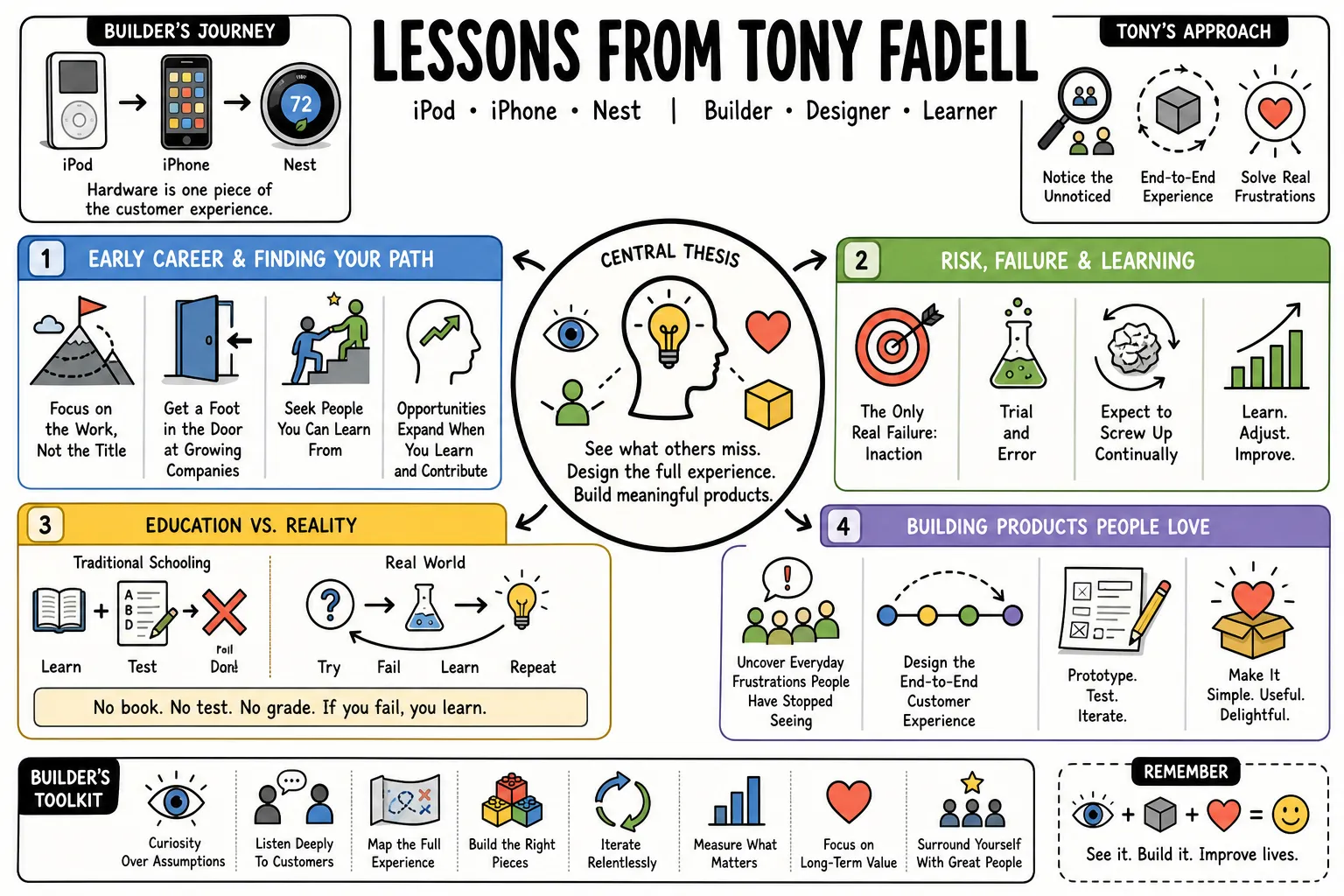
Lessons from Tony Fadell
Tony Fadell led the teams that built the iPod and iPhone before founding Nest. He focuses on noticing the everyday frustrations people have stopped seeing, treating the physical hardware as just one piece of the customer's experience. This collection outlines his methods for designing products and running the companies behind them.
Part 1: Early Career and Finding Your Path
- On the only real failure: "The only failure in your twenties is inaction. The rest is trial and error." — Source: [Build: An Unorthodox Guide to Making Things Worth Making]
- On taking risks early: "Don’t worry too much about the title—focus on the work. If you get a foot in the door at a growing company, you’ll find opportunities to grow, too." — Source: [Tony Fadell Substack]
- On continuous learning: "Expect to screw up continually until you learn how to screw up a little bit less." — Source: [Build: An Unorthodox Guide to Making Things Worth Making]
- On traditional education vs. reality: "Traditional schooling trains people to think incorrectly about failure. You’re taught a subject, you take a test, and if you fail, that’s it. You’re done. But once you’re out of school, there is no book, no test, no grade. And if you fail, you learn." — Source: [Build: An Unorthodox Guide to Making Things Worth Making]
- On choosing where to work: "Go to a place where you can learn from people who are doing it right, or doing it so wrong that you learn what not to do." — Source: [The Tim Ferriss Show #591]
- On mission-driven work: "If you’re not solving a real problem, you can’t start a revolution." — Source: [15 Minute Business Books]
- On putting in the time: "You should never kill yourself for your job. But if you want to prove yourself, to learn as much as you can and do as much as you can, you need to put in the time." — Source: [Dave Martin on Build]
- On the value of mentors: "Mentors don't give you answers. They give you the framing to make the right choice when you're paralyzed by options." — Source: [Lex Fridman Podcast #294]
- On early-career entitlements: "Titles and compensation are byproducts of doing hard things well over time. Optimize for the slope of your learning, never the starting y-intercept of your salary." — Source: [The Tim Ferriss Show #403]
- On shared journeys: "The most wonderful part of building something together with a team is that you’re walking side by side with other people. The work is reaching your destination together." — Source: [Build: An Unorthodox Guide to Making Things Worth Making]
Part 2: Product Strategy and Solving Real Problems
- On painkillers vs. vitamins: "Create painkillers, never vitamins. Ensure it’s something your customers can’t live without." — Source: [Medium: Product Management Insights]
- On the timing of ideas: "General Magic had the right idea, a decade too early. You cannot merely be right about what the future looks like; you have to be right about what people are ready for today." — Source: [Lex Fridman Podcast #294]
- On the 'why' before the 'what': "Before you write a line of code or draw a CAD model, you must understand the 'why.' If you cannot articulate why this needs to exist, the 'what' will inevitably fail." — Source: [Lex Fridman Podcast 294]
- On recognizing the problem: "A great product starts with a problem that is a daily nuisance, something people have resigned themselves to, but actually despise." — Source: [TED Talk: The First Secret of Design]
- On feature creep: "If you build something for everyone, you build it for no one. Start with a specific customer and solve their specific pain." — Source: [Build: An Unorthodox Guide to Making Things Worth Making]
- On over-innovating: "Excessive innovation can lead to failure if people cannot understand it. A disruptive technology still needs to fit into a user's existing mental model." — Source: [Medium: Design Principles]
- On the burden of first-movers: "Being first means you have to educate the market. Sometimes it is better to let someone else bleed on the cutting edge, and then you come in and do it right." — Source: [The Tim Ferriss Show #591]
- On hardware vs. software: "In software, you can ship a beta and fix it next week. In hardware, if you ship a flaw, you've shipped a brick. The discipline required is an order of magnitude higher." — Source: [Lex Fridman Podcast #294]
- On true disruption: "Disruption does not mean changing everything. It means taking the one thing that is incredibly painful and making it completely disappear." — Source: [Build: An Unorthodox Guide to Making Things Worth Making]
- On killing projects: "Killing a bad project early is a success, never a failure. It frees up your best people to work on the things that actually matter." — Source: [The Tim Ferriss Show #403]
Part 3: Design and The User Journey
- On habituation: "Human beings are incredibly quick to get used to everyday frustrations. As a designer, your job is to look at the world and see the invisible problems everyone else has learned to ignore." — Source: [TED Talk: The First Secret of Design]
- On the scope of a product: "Your product isn’t only your product. It’s the whole user experience. The actual thing you're building is only one tiny part of a vast, intangible, overlooked user journey." — Source: [Build: An Unorthodox Guide to Making Things Worth Making]
- On thinking younger: "To fight habituation, ask 'why' like a child who hasn't yet accepted that 'that's just how it is.' Children haven't been conditioned to tolerate bad design." — Source: [TED Talk: The First Secret of Design]
- On looking broader: "Look at the entire customer journey. How they hear about it, how they buy it, how they unbox it, how they return it. Every touchpoint is the product." — Source: [Wise Words Blog]
- On prototyping the experience: "We prototyped the thermostat at Nest alongside the packaging, the screwdriver included in the box, and the instruction manual. The out-of-box experience is your first handshake with the customer." — Source: [Lex Fridman Podcast #294]
- On looking closer: "Focus on the tiny details that others ignore. The weight of the dial, the resistance of the click. Those micro-interactions are where trust is built." — Source: [Medium: Design Principles]
- On removing friction: "Every extra step you force a customer to take halves your conversion rate. Simplify until it feels like magic." — Source: [Build: An Unorthodox Guide to Making Things Worth Making]
- On the aesthetic-usability effect: "Things that look better are perceived to work better. But if the underlying functionality is broken, beautiful hardware becomes a beautiful paperweight." — Source: [The Tim Ferriss Show #403]
- On constraints: "The best design never comes from unlimited resources. It comes from brutal constraints that force you to make hard choices about what actually matters." — Source: [Lex Fridman Podcast #294]
- On emotional connection: "You do not want people to merely use your product; you want them to love it. Love comes from anticipating their needs before they even know they have them." — Source: [Build: An Unorthodox Guide to Making Things Worth Making]
Part 4: Storytelling and Product Marketing
- On the ultimate goal of a story: "You should always be striving to tell a story so good that it stops being yours—so your customer learns it, loves it, internalizes it, owns it. And tells it to everyone they know." — Source: [Build: An Unorthodox Guide to Making Things Worth Making]
- On the fusion of roles: "Product Management and Product Marketing should be the same job. The person defining what the product is must also define how it is explained. Separation dilutes the vision." — Source: [Tony Fadell Substack]
- On analogies: "People do not understand new technology; they understand analogies. When we launched the iPod, we didn't say it was a 5GB hard drive. We said it was '1,000 songs in your pocket.'" — Source: [Lex Fridman Podcast #294]
- On internal narrative: "The story isn't exclusively for the customer. It's for your engineering team, your sales team, your investors. It aligns the entire company behind a single north star." — Source: [The Tim Ferriss Show #591]
- On the virus of doubt: "If you cannot tell the story of your product in three sentences or fewer, your product is too complicated." — Source: [Build: An Unorthodox Guide to Making Things Worth Making]
- On positioning: "Positioning is rarely about what you are; it is about what you are replacing. You have to clearly define the enemy." — Source: [Lex Fridman Podcast 294]
- On the packaging as narrative: "The box is the first chapter of the story. If the box is cheap and confusing, the customer immediately expects the device to be cheap and confusing." — Source: [Lex Fridman Podcast #294]
- On authenticity: "Marketing shouldn't feel like marketing. It should feel like an enthusiastic friend explaining why they found a solution to a problem you both share." — Source: [Build: An Unorthodox Guide to Making Things Worth Making]
- On the product as its own marketer: "The best marketing campaign in the world cannot save a product that fails to deliver on the promise. The product has to be the proof." — Source: [The Tim Ferriss Show #403]
Part 5: Leadership, Management, and Culture
- On the burden of the CEO: "Your job as CEO is to care. Because you’re it. You’re the top of the pyramid. Your focus, your passion, trickles down. If you don’t give a shit about marketing you’ll get shitty marketing." — Source: [Medium: Management Lessons]
- On helping others succeed: "Helping people to succeed is your job as a manager. It’s your responsibility to make sure they can become the best versions of themselves. You need to create a setting where they can surprise you. And surpass you." — Source: [Medium: Management Lessons]
- On micromanagement: "Examining the product in great detail and caring deeply about the quality of what your team is producing is never micromanagement. That is exactly what you should be doing." — Source: [Dave Martin on Build]
- On the role of a product manager: "A Product Manager is like a music producer. They might not play an instrument, but they ensure every musician is playing the same song in harmony." — Source: [Medium: Product Management Insights]
- On hiring A+ players: "Top talent doesn't mind joining small teams, but they hate wearing too many hats that misalign with their expertise. You must give them the specific responsibilities they deserve." — Source: [Medium: Product Management Insights]
- On assessing candidates: "I ignore how you work on paper. In an interview, I want to pick a problem and try to solve it together to see how your brain actually operates." — Source: [Build: An Unorthodox Guide to Making Things Worth Making]
- On past jobs: "I always ask why someone left their last job. I am looking for a clear story and how they handled frustration. Did they run away from a problem, or run toward an opportunity?" — Source: [Build: An Unorthodox Guide to Making Things Worth Making]
- On curiosity: "The most important trait in a hire is curiosity. I always ask: 'What are you curious about? What do you want to learn?'" — Source: [Build: An Unorthodox Guide to Making Things Worth Making]
- On protecting the team: "A manager's job is to act as a heat shield. You take the pressure from above so your team can focus on the work without distraction." — Source: [The Tim Ferriss Show #591]
Part 6: Decision Making: Data vs. Opinion
- On the duality of decisions: "Every decision has elements of data and opinion, but they are ultimately driven by one or the other. Sometimes you have to double down on the data; other times you have to look at all the data and then trust your gut." — Source: [Build: An Unorthodox Guide to Making Things Worth Making]
- On trusting your gut: "Trusting your gut is incredibly scary. Many people don’t have either a good gut instinct to follow or the faith in themselves to follow it. It takes time to develop that trust." — Source: [Dave Martin on Build]
- On the fear of deciding: "Fear of making the wrong decision, rather than the decisions themselves, is what kills your product. The most important thing is to keep moving." — Source: [Tony Fadell Substack]
- On vision-driven choices: "Use data for optimizing—like A/B testing a website. But use your opinion for creating a new category. Never let data kill a bold new idea before it has a chance to breathe." — Source: [Lex Fridman Podcast #294]
- On the limitation of data: "Data is historical. It can tell you what has happened in the past. It cannot tell you what people will want in a future that does not exist yet." — Source: [The Tim Ferriss Show #591]
- On making the call: "When there is no clear right answer, the leader simply has to make a call. Consensus is the enemy of innovation." — Source: [Build: An Unorthodox Guide to Making Things Worth Making]
- On changing your mind: "Strong opinions, loosely held. If new data completely contradicts your gut, you have to swallow your pride and pivot." — Source: [The Tim Ferriss Show #403]
- On the illusion of certainty: "You will never have 100 percent of the information you want. If you wait until you are completely certain, you are too late." — Source: [Lex Fridman Podcast #294]
- On heart decisions: "Heart decisions are the ones that define the soul of the company. You cannot put a spreadsheet behind why a product should make someone smile." — Source: [The Tim Ferriss Show #591]
Part 7: Handling Failure, Crisis, and "Assholes"
- On mission-driven intensity: "There is a difference between a mission-driven person who is intensely demanding, and someone who is a jerk for their own ego. Learn to tolerate the former and fire the latter." — Source: [Build: An Unorthodox Guide to Making Things Worth Making]
- On crisis management: "When things go wrong, focus on the problem first; blame comes later. Accept responsibility, apologize immediately, and communicate constantly." — Source: [24 Letters]
- On facing the music: "You cannot hide from a failure. The longer you wait to tell the truth about a mistake, the more it compounds in severity." — Source: [Build: An Unorthodox Guide to Making Things Worth Making]
- On constructive conflict: "If there is no friction in the room, you aren't pushing the boundaries hard enough. Good ideas are forged in the fire of debate." — Source: [Lex Fridman Podcast #294]
- On political operators: "Beware of people who manage up brilliantly but step on everyone below them. They will eventually destroy the trust within your team." — Source: [Build: An Unorthodox Guide to Making Things Worth Making]
- On surviving a disaster: "A crisis is when you find out who your real leaders are. The best people rarely panic; they get incredibly calm and focus on the next right step." — Source: [The Tim Ferriss Show #403]
- On quitting: "Knowing when to walk away from a toxic environment is a skill. Loyalty matters, but never at the cost of your sanity or your integrity." — Source: [The Tim Ferriss Show #591]
- On post-mortems: "Never waste a good failure. You must dissect it ruthlessly to ensure the systemic issue that caused it is permanently eradicated." — Source: [Build: An Unorthodox Guide to Making Things Worth Making]
- On apologies: "A real apology has three parts: acknowledging what you did wrong, explaining how you will fix it, and actually fixing it. Anything less is merely PR." — Source: [Build: An Unorthodox Guide to Making Things Worth Making]
Part 8: The Board, Investing, and Building for the Future
- On managing the board: "The board is not there to run the company. They are there to make sure you are running the company. You must manage them, rather than the other way around." — Source: [Build: An Unorthodox Guide to Making Things Worth Making]
- On choosing investors: "Money is a commodity; advice is not. Take money from people who have the scars of building businesses, rather than purely financial engineers." — Source: [Lex Fridman Podcast #294]
- On climate technology: "We spent the last decade building apps to distract ourselves. The next decade must be spent building hard tech to save our planet." — Source: [The Tim Ferriss Show #591]
- On the responsibility of founders: "If you bring a piece of hardware into the world, you are responsible for its lifecycle. You have to think about where it goes when it dies." — Source: [Lex Fridman Podcast #294]
- On deep tech investments: "True venture capital is about funding science experiments that can change the world, rather than simply B2B SaaS platforms with predictable recurring revenue." — Source: [Future Shape Studio]
- On generational shifts: "Every generation gets a defining technological wave. We had the PC, then mobile. The current generation must tackle sustainability." — Source: [The Tim Ferriss Show #591]
- On getting bored: "You have to allow yourself to get bored. Boredom is the space where the brain resets and actually starts to synthesize new ideas." — Source: [The Tim Ferriss Show #403]
- On quitting caffeine and alcohol: "To maintain the stamina needed for the long haul, you have to manage your biology. Removing crutches forces you to generate your own sustainable energy." — Source: [The Tim Ferriss Show #403]
- On the ultimate legacy: "What you build matters, but who you build it with and who you become in the process is what you actually keep when it's over." — Source: [Build: An Unorthodox Guide to Making Things Worth Making]